
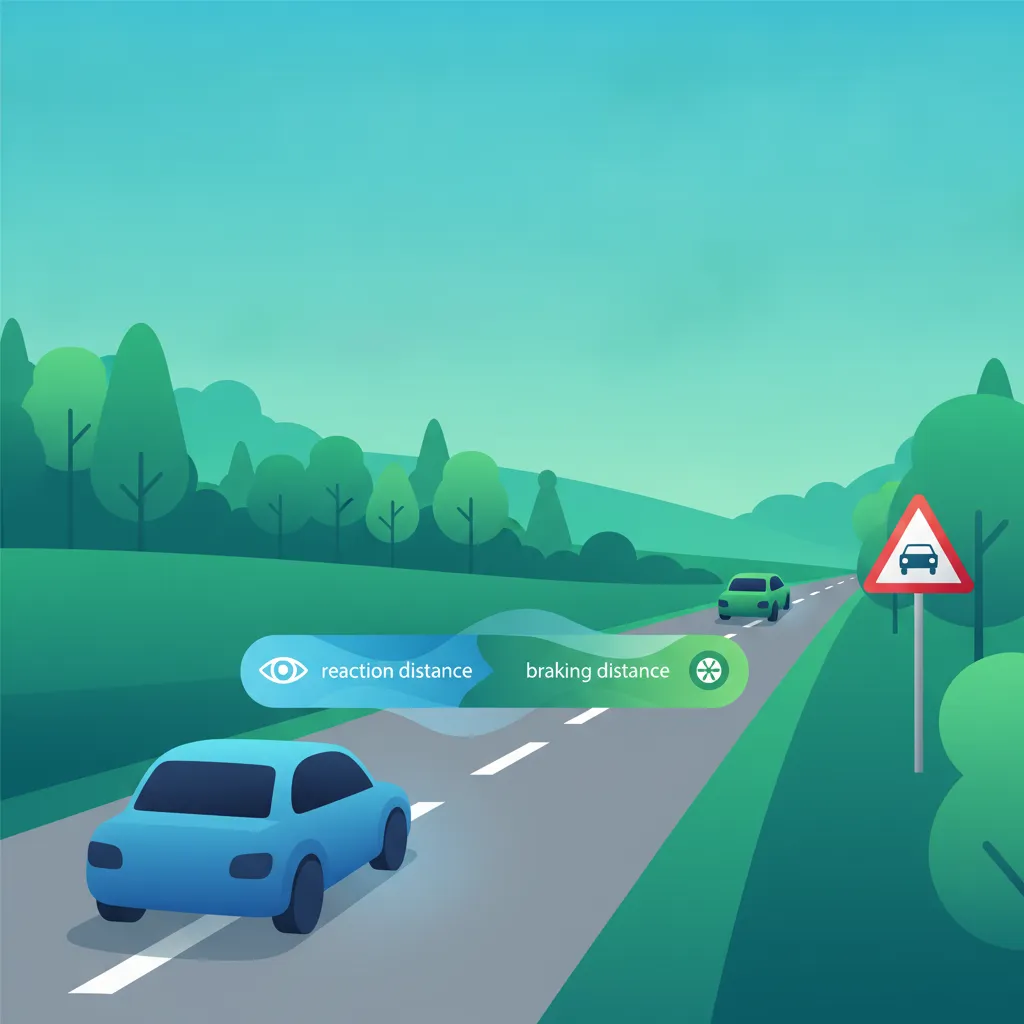
Stopping distance is the total distance your vehicle travels from the moment you detect a hazard until it comes to a complete stop. This includes both your reaction distance and the subsequent braking distance. In Belgium, understanding these components is fundamental for safe driving, adapting to varying road conditions, and successfully passing your theory exam, as even slight increases in speed dramatically extend the distance needed to stop.
Theory topic content overview
Read the full theory topic guide for Stopping Distance & Safety with structured, easy-to-scan content built for learners in Belgium. This detailed section explains the exact rule, meaning, traffic context, comparison points, and exam logic behind this Belgian driving theory topic so you can study faster, understand the concept more clearly, and avoid common interpretation mistakes on the theory test.
Stopping distance is one of the most fundamental concepts in driving theory, particularly in Belgium, where dense traffic and varying road conditions demand keen awareness. It represents the total distance your vehicle travels from the precise moment you recognise a hazard until it comes to a complete, standstill stop. Understanding this critical safety measure means grasping its two distinct, yet interconnected, components: reaction distance and braking distance.
In Belgian driving theory, the total stopping distance, known as distance d'arrêt, is the sum of two phases:
distance de réaction): The distance your vehicle covers while you perceive a hazard, process the information, decide to act, and move your foot from the accelerator to firmly press the brake pedal. During this time, your vehicle is still travelling at its original speed.distance de freinage): The distance your vehicle covers from the moment you apply the brakes until it comes to a full stop. This is where the physical forces of friction and momentum are at play to slow and halt your vehicle.Therefore: Stopping Distance = Reaction Distance + Braking Distance.
Understanding stopping distance isn't just about passing your Belgian theory exam; it's paramount for everyday road safety.
N-wegen and cobbled urban streets, combined with often unpredictable weather, means drivers must constantly adjust their perception of stopping distance.Your reaction distance is entirely dependent on your reaction time and your speed.
Crucially, reaction distance increases proportionally with speed. Double your speed, and you double the distance you travel during your reaction time.
Once you've applied the brakes, your braking distance is the next critical phase. This distance is influenced by a combination of factors, with speed being the most dominant.
The most critical takeaway for Belgian drivers is the disproportionate impact of speed on stopping distance. While your reaction distance increases linearly with speed, your braking distance increases exponentially. This means that:
champ visuel). This tunnel vision means you perceive hazards later, directly increasing your reaction time and thus reaction distance. This compounding effect drastically reduces your margin for error.Learners often confuse these terms, which is a common pitfall in the Belgian theory exam.
distance de sécurité): The recommended minimum space you should maintain behind the vehicle in front of you. This distance is designed to give you enough time and space to react, brake, and stop even if the vehicle in front suddenly stops.In Belgium, the common rule for safe following distance is the 2 secondes rule (or "2 crocodiles" technique mentioned by AWSR). You should leave a gap that allows you to count "one crocodile, two crocodiles" between the vehicle in front passing a fixed point and your own vehicle reaching that same point. This two-second buffer accounts for your typical reaction time and provides a margin for braking and unforeseen circumstances. In adverse conditions (rain, ice, heavy loads), this should be increased to 3 or 4 seconds.
2 secondes rule consistently, especially on Belgian motorways or busy urban routes, leading to dangerous tailgating.N-weg): Driving at 70 km/h on a wet, often unlit, N-weg after a rainfall. A deer suddenly steps onto the road. Your reaction time remains about 1 second (around 19.5 meters travelled), but the wet surface drastically extends your braking distance. The combined distance to stop could be more than double what it would be on a dry road, making an impact unavoidable without adequate space and reduced speed.Mastering stopping distance is about adopting a proactive driving mindset, essential for your driving test and for safety on Belgian roads. Always remember:
voir le danger (see the danger), the more time you have.vitesse) not just to the legal limit, but to the prevailing conditions of the road, weather, traffic, and your own physical state. A slower speed gives you disproportionately more time and distance to react and stop.By deeply understanding stopping distance and its components, you empower yourself to make safer, more informed decisions on every Belgian journey.
Stopping distance is the total distance travelled from hazard perception to a complete stop, combining reaction distance (perception to brake application) and braking distance (brake application to full stop). While reaction distance increases linearly with speed, braking distance increases with the square of speed, making small speed increases disproportionately dangerous. Belgian drivers must distinguish between stopping distance (the physical minimum needed for their vehicle) and safe following distance (the recommended gap, typically the 2-second rule). Road conditions in Belgium — including wet cobblestones, variable N-wegen surfaces, and unpredictable weather — demand constant adjustment of both speed and following distance, not just adherence to posted limits.
A short set of high-value points that capture the most important ideas from this theory explanation.
Stopping distance is always the sum of reaction distance and braking distance — never one or the other alone.
Braking distance grows with the square of your speed, meaning doubling your speed quadruples braking distance, not just doubles it.
Reaction distance grows linearly with speed — at 50 km/h you travel over 13 metres in just one second of reaction time before brakes engage.
The 2-second rule gives you a safe following distance, not your total stopping distance — always leave more space than the minimum in poor conditions.
Road conditions like wet asphalt, ice, and Belgian cobblestones drastically extend braking distance beyond what most drivers expect.
Reaction time averages about one second for an alert driver — during this time your vehicle continues at full speed.
Wet road surfaces at 70 km/h require approximately 25 extra metres to stop compared to dry conditions.
The legal speed limit is the maximum permitted speed, not necessarily the safe speed for current conditions.
Always increase following distance to 3–4 seconds in rain, fog, ice, or when carrying heavy loads.
Vehicle condition matters — worn tyres, faulty brakes, or incorrect tyre pressure all increase your braking distance.
Assuming braking distance increases only proportionally with speed, when in fact it increases exponentially.
Confusing safe following distance with stopping distance — the 2-second rule is a minimum gap, not the total space needed to stop.
Believing that staying just below the speed limit automatically guarantees safe stopping ability.
Not adjusting speed for Belgian conditions such as wet cobblestones in old towns or unlit N-wegen.
Underestimating how much reaction time is lost through minor distractions like adjusting the radio or talking on the phone.
Start with a short, direct summary of Stopping Distance & Safety before reading the full explanation below.
Stopping distance is the total ground covered from recognizing a hazard to a full stop, comprising reaction distance (perception to brake application) and braking distance (brake application to full stop). In Belgium, as elsewhere, it's significantly affected by speed, road conditions, and driver alertness. Always maintain sufficient following distance to account for this total distance.
Review the most important terms, rule signals, and traffic concepts linked to Stopping Distance & Safety.
Explore related theory topic pages connected to Stopping Distance & Safety and continue with the next useful rule explanation.
See the common search queries learners use when trying to understand Stopping Distance & Safety in Belgium.

Start your comprehensive preparation for the Belgian driving licence theory exam. Dive into our expertly curated topics, master the road rules and concepts, and build the confidence you need to pass your test and drive safely on Belgian roads. Begin mastering theory today.
Explore Belgian Theory TopicsTheory topic content overview
A short set of high-value points that capture the most important ideas from this theory explanation.
Stopping distance is always the sum of reaction distance and braking distance — never one or the other alone.
Braking distance grows with the square of your speed, meaning doubling your speed quadruples braking distance, not just doubles it.
Reaction distance grows linearly with speed — at 50 km/h you travel over 13 metres in just one second of reaction time before brakes engage.
The 2-second rule gives you a safe following distance, not your total stopping distance — always leave more space than the minimum in poor conditions.
Road conditions like wet asphalt, ice, and Belgian cobblestones drastically extend braking distance beyond what most drivers expect.
Reaction time averages about one second for an alert driver — during this time your vehicle continues at full speed.
Wet road surfaces at 70 km/h require approximately 25 extra metres to stop compared to dry conditions.
The legal speed limit is the maximum permitted speed, not necessarily the safe speed for current conditions.
Always increase following distance to 3–4 seconds in rain, fog, ice, or when carrying heavy loads.
Vehicle condition matters — worn tyres, faulty brakes, or incorrect tyre pressure all increase your braking distance.
Assuming braking distance increases only proportionally with speed, when in fact it increases exponentially.
Confusing safe following distance with stopping distance — the 2-second rule is a minimum gap, not the total space needed to stop.
Believing that staying just below the speed limit automatically guarantees safe stopping ability.
Not adjusting speed for Belgian conditions such as wet cobblestones in old towns or unlit N-wegen.
Underestimating how much reaction time is lost through minor distractions like adjusting the radio or talking on the phone.
Start with a short, direct summary of Stopping Distance & Safety before reading the full explanation below.
Stopping distance is the total ground covered from recognizing a hazard to a full stop, comprising reaction distance (perception to brake application) and braking distance (brake application to full stop). In Belgium, as elsewhere, it's significantly affected by speed, road conditions, and driver alertness. Always maintain sufficient following distance to account for this total distance.
Review the most important terms, rule signals, and traffic concepts linked to Stopping Distance & Safety.
Explore related theory topic pages connected to Stopping Distance & Safety and continue with the next useful rule explanation.
See the common search queries learners use when trying to understand Stopping Distance & Safety in Belgium.
Start your comprehensive preparation for the Belgian driving licence theory exam. Dive into our expertly curated topics, master the road rules and concepts, and build the confidence you need to pass your test and drive safely on Belgian roads. Begin mastering theory today.
Explore Belgian Theory TopicsUse this exam-focused revision tip to understand how Stopping Distance & Safety is likely to appear in theory questions for learners in Belgium. This section helps you identify the most testable part of the rule, avoid common traps, and remember the concept more effectively during Belgian driving theory exam preparation.
In the Belgian theory exam, pay close attention to questions distinguishing between reaction distance and braking distance, and how speed impacts each. Remember that stopping distance is always the combined total. Don't confuse it with safe following distance, which is the minimum space you should leave to react and stop safely.
Read direct answers to the most common learner questions about Stopping Distance & Safety in Belgium. This FAQ focuses on rule confusion, practical meaning, comparison with similar concepts, and the exact uncertainties that appear most often in Belgian driving theory revision and exam preparation.
Stopping distance is the total distance your vehicle travels from the moment you first perceive a danger or hazard until your vehicle is completely stationary.
Reaction distance is the distance covered from the moment you see a hazard until you actually apply the brakes. Braking distance is the distance covered from the moment the brakes are applied until the vehicle comes to a full stop. Stopping distance is the sum of these two.
In Belgium, as with all driving, stopping distance increases disproportionately with speed. While reaction distance increases linearly, braking distance increases roughly with the square of your speed, meaning a small increase in speed can lead to a much larger increase in total stopping distance.
Key factors include higher speed, poor road conditions (wet, icy, gravel), worn tires, vehicle load, and driver factors like fatigue, distraction, alcohol, or medication, all of which can extend reaction time.
Yes, 'distance d'arrêt' is the French term used in Belgian driving theory to refer to the total stopping distance. It encompasses both the 'distance de réaction' (reaction distance) and 'distance de freinage' (braking distance).
Understanding stopping distance helps you maintain a safe following distance, anticipate hazards, and adapt your speed to conditions, significantly reducing the risk of rear-end collisions and other accidents in Belgian traffic.
Ready to focus your Belgian driving theory revision? Utilize our powerful search tool to pinpoint exact topics, road signs, or difficulty levels. Engage with practice questions that directly address your learning needs and solidify your understanding of Belgian traffic laws for your upcoming exam.