
Understanding road markings is a foundational requirement for any driver in Denmark. This article explains the core functions of various surface lines, including the legal significance of solid versus broken lines, the yield requirements of hajtænder, and the specific behavior expected at cyklistboks or box junctions. By learning these rules, you will be well-prepared to identify road regulations and demonstrate correct conduct during your practical and theory assessments.
Article content overview
Mastering Danish road markings is a critical component of passing your theory exam and becoming a safe driver. In Denmark, road surface markings (vejafmærkning) serve as the primary language of the road, dictating lane discipline, yield obligations, and safe interactions with vulnerable road users. These markings, governed by national traffic legislation, are designed to organize complex urban environments and ensure predictable flow on motorways and rural roads alike.
The difference between a broken and a solid white line is a fundamental concept in the Danish theory test. A standard vognbanelinje is a narrow, broken line used to separate traffic lanes. You are generally permitted to cross these lines when you can safely do so without causing danger or inconvenience to other road users.
In contrast, a solid white line, or ubrudt linje, functions as a strict boundary. It is often used to prevent overtaking in high-risk areas, such as hills, tight curves, or narrow sections of road. Under Danish law, you are prohibited from driving to the left of a solid white line, except when it is necessary to pass a road obstruction or enter a property, provided you do so without endangering oncoming traffic.
Road markings (surface markings) on the carriage way, cycle paths, or verges that provide instructions or warnings to traffic, sometimes acting as the primary regulation in the absence of vertical signs.
Perhaps the most iconic marking in the Danish driving landscape is the hajtænder, or "shark's teeth." This row of white triangles painted across the lane indicates that you have a yield obligation. When approaching an intersection marked with these triangles, you must be prepared to stop if there is traffic on the intersecting road.
It is essential to understand that the shark's teeth do not necessarily require a full stop if the road is clear. However, they are legally binding instructions that prioritize the flow of the crossing traffic. Failing to yield at these markings is a common reason for failure in practical driving assessments, as it demonstrates an inability to interpret priority rules correctly.
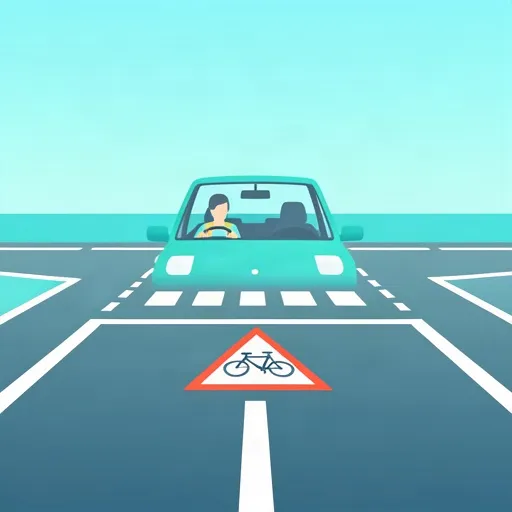
Danish urban traffic, especially in cities like Copenhagen, relies on specific markings to manage high volumes of cyclists and heavy traffic. The cyklistboks (cycle advance box) is a rectangular area painted ahead of the vehicle stop line at signal-controlled intersections. Cyclists use this space to position themselves at the front of the queue, increasing their visibility. Motorists must stop before the first line, leaving the box clear for cyclists to move into.
Never enter a cyklistboks when the traffic light is red. You must stop behind the line that precedes the cycle box, even if the road appears empty, as doing otherwise is a violation of the Danish Road Traffic Act.
Similarly, yellow box junctions—often marked with a large yellow X—are used to prevent gridlock. You must not enter this box unless your exit is clear. If you find yourself in a situation where traffic has backed up, you must wait behind the line even if you have a green light, ensuring that you do not block the intersection for cross-traffic.
In areas near schools, you may encounter the "Skolevej" text painted directly onto the road surface. This serves as a warning that you are entering an area with a high density of children who may not always act predictably.
When you see these markings, the expectation is that you will exercise extreme caution, reduce your speed, and maintain an increased distance from the curb. These zones are frequently monitored, and traffic laws in Denmark are strictly enforced to protect vulnerable road users in these specific environments.
The Danish theory exam often tests your ability to interpret complex road markings in simulated scenarios. You may be shown an image of an intersection with various lane arrows and asked to select the only legal path for a vehicle in a specific lane. Always remember that road markings on the ground take precedence over general road rules if a conflict arises.
This guide covers the essential road markings every Danish driver must understand for both the theory exam and practical driving. The distinction between broken and solid white lines defines when lane changes and overtaking are permitted, while hajtænder establishes clear yield obligations at intersections without mandating unnecessary stops. Urban markings like cyklistboks and yellow box junctions manage interactions between motor vehicles, cyclists, and traffic flow in complex city environments. School zone markings reinforce the need for reduced speed and extreme caution around children. For exam preparation, remember that visible road markings on the ground take legal precedence over general traffic rules when interpreting priority situations.
A short set of high-value points that capture the most important ideas from this article.
Broken white lines (vognbanelinje) allow lane changes when safe; solid white lines (ubrudt linje) strictly prohibit overtaking
Hajtænder (shark's teeth) are legally binding yield markings requiring you to give way to crossing traffic
Never enter a cyklistboks or yellow box junction unless your exit is clearly visible
School zone markings (Skolevej) demand reduced speed and heightened vigilance around children
Road markings take legal precedence over general road rules in exam and real-world scenarios
You may only cross a solid white line to pass a road obstruction or enter a property, never for overtaking
Hajtænder requires yielding, not necessarily stopping—only stop if traffic is actually present
Motorists must stop behind the line before a cyklistboks, even if the box appears empty at a red light
Yellow X markings define a box junction where you must not enter unless your exit is clear
Pilmærkning (painted arrows) indicate mandatory driving directions that override general lane preferences
Believing hajtænder always requires a full stop—in most cases, yielding is sufficient if the road is clear
Entering a cyklistboks on a red light because the box looks empty, which violates the Danish Road Traffic Act
Blocking a yellow box junction by entering when exit traffic is backed up, causing gridlock
Attempting to overtake by crossing a solid white line, especially on hills, curves, or narrow sections
Failing to recognize that ground markings override verbal descriptions of general priority rules in exam questions
Article content overview
A short set of high-value points that capture the most important ideas from this article.
Broken white lines (vognbanelinje) allow lane changes when safe; solid white lines (ubrudt linje) strictly prohibit overtaking
Hajtænder (shark's teeth) are legally binding yield markings requiring you to give way to crossing traffic
Never enter a cyklistboks or yellow box junction unless your exit is clearly visible
School zone markings (Skolevej) demand reduced speed and heightened vigilance around children
Road markings take legal precedence over general road rules in exam and real-world scenarios
You may only cross a solid white line to pass a road obstruction or enter a property, never for overtaking
Hajtænder requires yielding, not necessarily stopping—only stop if traffic is actually present
Motorists must stop behind the line before a cyklistboks, even if the box appears empty at a red light
Yellow X markings define a box junction where you must not enter unless your exit is clear
Pilmærkning (painted arrows) indicate mandatory driving directions that override general lane preferences
Believing hajtænder always requires a full stop—in most cases, yielding is sufficient if the road is clear
Entering a cyklistboks on a red light because the box looks empty, which violates the Danish Road Traffic Act
Blocking a yellow box junction by entering when exit traffic is backed up, causing gridlock
Attempting to overtake by crossing a solid white line, especially on hills, curves, or narrow sections
Failing to recognize that ground markings override verbal descriptions of general priority rules in exam questions
Explore related topics, search based questions, and concepts that learners often look up when studying Guide to Danish Road Markings. These themes reflect real search intent and help you understand how this topic connects to wider driving theory knowledge in Denmark.
Find clear and practical answers to common questions learners often have about Guide to Danish Road Markings. This section helps explain difficult points, remove confusion, and reinforce the key driving theory concepts that matter for learners in Denmark.
Hajtænder, or shark's teeth, are a series of white triangles pointing toward approaching traffic. They indicate that you must yield to crossing traffic.
A cyklistboks is a designated area at an intersection for cyclists to wait at traffic lights. Motor vehicles must stop before the line preceding the cyklistboks to allow cyclists to clear the intersection safely.
A broken centre line allows you to overtake when safe, whereas a solid line prohibits crossing or driving on the left side of the line, meaning overtaking is forbidden.
The yellow box junction marking indicates an area that must remain clear. You should not enter this area unless your exit is free, helping to prevent gridlock in busy urban intersections.
Continue your learning journey by searching for additional articles or browsing our comprehensive topic categories. Deepen your knowledge of Danish road law, vehicle mechanics, and hazard perception to ensure complete preparation for your official theory exam.