
As a driver in Denmark, you are legally responsible for ensuring that all passengers, especially those under 15, are properly secured before the vehicle moves. This guide covers the specific requirements for child seats, the 135 cm rule, and the penalties, including fines and potential penalty points (klip) that can impact your license. Gaining a clear grasp of these regulations is vital for navigating real-world traffic safely and answering safety-related questions correctly in your theory test.
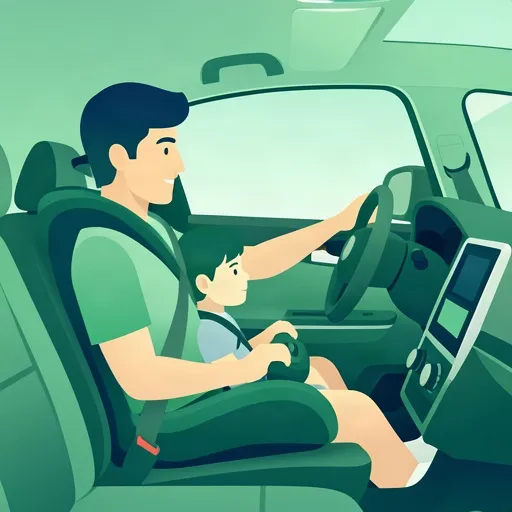
Article content overview
In Denmark, the rules regarding the use of seat belts are not merely guidelines; they are fundamental requirements embedded in the Traffic Act (Færdselsloven). Whether you are preparing for your theory exam or getting behind the wheel for the first time, understanding these regulations is essential. The law is designed to ensure the safety of all occupants, and as a driver, you hold a significant legal responsibility for the passengers inside your vehicle.
According to Færdselsloven § 80, it is mandatory to use a seat belt if the seat you occupy is equipped with one. This rule applies to all vehicle types, including passenger cars, vans, and lorries, and extends to every seat in the vehicle, whether in the front or the back. When a vehicle is fitted with seat belts, every occupant must be securely fastened while the vehicle is in motion.
Tucking the shoulder portion of the belt behind your back or under your arm is a clear violation of safety protocols and the law, as it renders the restraint system ineffective during a collision. Furthermore, the number of passengers in a vehicle must never exceed the number of available seat belts. Driving with more people than there are seats with belts is illegal and puts lives at risk.
One of the most critical aspects of the Danish driving theory exam is your role as a driver regarding the safety of minors. You are legally responsible for ensuring that all passengers under the age of 15 are correctly secured. This means that if you are stopped by the police and a child under 15 is not buckled up or is in an improper seat, you—the driver—will face the legal consequences.
The penalties for failing to secure a child under 15 are significant and are designed to emphasize the severity of this responsibility. As a driver, you risk receiving a fine of 2,000 DKK, a contribution of 1,000 DKK to the Offerfond, and, importantly, a klip (penalty point) on your driving license. Accumulating these points can eventually lead to a suspension of your driving privileges, making this a frequent topic in theory test scenarios.
The law requires that children under 135 cm in height must be secured using an approved child restraint system, such as a car seat or booster seat, that is appropriate for their specific height and weight. These systems must be approved according to international standards (ECE R129/i-Size, or the older 44-03/44-04 standards).
Children must use an approved child restraint system (autostol or selepude) until they reach a height of at least 135 cm. The equipment must be specifically fitted to the child's physical dimensions to be considered legally compliant.
It is important to remember that you must never place a rear-facing child seat in a seat equipped with an active front airbag. The force of an airbag deployment can cause fatal injuries to a child in such a position. Always ensure the airbag is deactivated if you must place a child in the front seat, although placing children in the back seat is widely considered the safest practice.
The theory exam often tests your knowledge of who is responsible for a fine in different situations. For an adult passenger who fails to wear a seat belt, the fine is typically 1,500 DKK, and the penalty is applied to the individual passenger rather than the driver. However, the distinction is clear: if the individual is under 15, the responsibility shifts entirely to the driver.
Regarding taxi services, while taxis in Denmark are equipped with seat belts, passengers are technically exempted from the mandatory use while the taxi is engaged. Despite this legal nuance, most taxi and ride-sharing companies enforce their own strict safety policies requiring belt use. For your theory exam, always prioritize the standard requirement for all occupants to be belted.
Do not confuse the penalties. An unbelted adult passenger pays their own fine, but an unbelted passenger under 15 years old results in a fine, a contribution to the Victim Fund (Offerfond), and a klip on the driver's license.
Danish seat belt laws under Færdselsloven mandate belt use for all occupants wherever seats are fitted, and tucking the shoulder belt behind the back is illegal. Drivers carry full responsibility for passengers under 15, facing a 2,000 DKK fine, a 1,000 DKK Offerfond contribution, and a klip (penalty point) if minors are unsecured. Children must use approved child restraint systems until reaching 135 cm in height, and rear-facing car seats must never be placed on seats with active front airbags. The key exam distinction is that unbelted adult passengers pay their own 1,500 DKK fine, while unbelted passengers under 15 trigger driver penalties including the klip system.
A short set of high-value points that capture the most important ideas from this article.
Seat belts are mandatory for all vehicle occupants in every seat that is equipped with one, according to Færdselsloven § 80
Drivers bear full legal responsibility for securing all passengers under 15 years old, not the passengers themselves
Children under 135 cm must use an approved child restraint system appropriate for their height and weight
Never place a rear-facing child seat in a vehicle seat equipped with an active front airbag
Penalties differ based on passenger age: unbelted adults pay their own fine, but unbelted minors under 15 result in driver penalties
Færdselsloven § 80: all occupants must wear seat belts where fitted, including rear seats
The 135 cm rule is height-based, not weight-based; use i-Size (ECE R129) or older 44-03/44-04 approved restraints
Driver responsibility for minors includes children under 15, not just under 12 or other ages
Three klip (penalty points) within three years can lead to conditional license suspension
Tucking the shoulder belt behind the back or under the arm is a legal violation, not an acceptable alternative
Believing passengers of any age are responsible for buckling themselves up—only adults bear personal responsibility
Confusing the 135 cm child restraint rule with weight-based requirements from older standards
Placing a rear-facing child seat in the front passenger seat without deactivating the airbag
Thinking the fine for an unbelted child is the same as for an unbelted adult (2,000 DKK + 1,000 Offerfond + klip vs. 1,500 DKK)
Assuming taxis exempt passengers from seat belt use entirely, when the exemption only applies during the taxi journey itself
Article content overview
A short set of high-value points that capture the most important ideas from this article.
Seat belts are mandatory for all vehicle occupants in every seat that is equipped with one, according to Færdselsloven § 80
Drivers bear full legal responsibility for securing all passengers under 15 years old, not the passengers themselves
Children under 135 cm must use an approved child restraint system appropriate for their height and weight
Never place a rear-facing child seat in a vehicle seat equipped with an active front airbag
Penalties differ based on passenger age: unbelted adults pay their own fine, but unbelted minors under 15 result in driver penalties
Færdselsloven § 80: all occupants must wear seat belts where fitted, including rear seats
The 135 cm rule is height-based, not weight-based; use i-Size (ECE R129) or older 44-03/44-04 approved restraints
Driver responsibility for minors includes children under 15, not just under 12 or other ages
Three klip (penalty points) within three years can lead to conditional license suspension
Tucking the shoulder belt behind the back or under the arm is a legal violation, not an acceptable alternative
Believing passengers of any age are responsible for buckling themselves up—only adults bear personal responsibility
Confusing the 135 cm child restraint rule with weight-based requirements from older standards
Placing a rear-facing child seat in the front passenger seat without deactivating the airbag
Thinking the fine for an unbelted child is the same as for an unbelted adult (2,000 DKK + 1,000 Offerfond + klip vs. 1,500 DKK)
Assuming taxis exempt passengers from seat belt use entirely, when the exemption only applies during the taxi journey itself
Explore related topics, search based questions, and concepts that learners often look up when studying Danish Seat Belt Rules and Penalties. These themes reflect real search intent and help you understand how this topic connects to wider driving theory knowledge in Denmark.
Find clear and practical answers to common questions learners often have about Danish Seat Belt Rules and Penalties. This section helps explain difficult points, remove confusion, and reinforce the key driving theory concepts that matter for learners in Denmark.
The driver is legally responsible for ensuring all passengers under 15 years old are properly secured using a seat belt or an approved child restraint system. Failure to do so can result in a fine, a penalty point (klip), and a mandatory contribution to the Victim Fund.
Children must use an approved child restraint system (such as a car seat or booster) until they are at least 135 cm tall. The equipment must be approved according to ECE R129 (i-Size) or older standards like 44-04 or 44-03.
While taxis in Denmark are equipped with seat belts, passengers in a taxi using a taxameter are technically exempted from the mandatory belt requirement by law. However, most taxi companies enforce belt use as part of their standard passenger policy.
Adults who fail to wear a seat belt face a fine. If the unbelted person is a passenger under 15, the driver receives a fine, a mandatory contribution to the Victim Fund, and a penalty point (klip) on their driving license.
No, you must never place a rear-facing child seat on a passenger seat equipped with an active front airbag. The airbag must be permanently deactivated if such a seat is used.
Continue your learning journey by searching for additional articles or browsing our comprehensive topic categories. Deepen your knowledge of Danish road law, vehicle mechanics, and hazard perception to ensure complete preparation for your official theory exam.