Navigating Bornholm requires a solid grasp of Danish traffic law, especially when traversing rural landscapes without motorways. This guide explains how to manage island-specific hazards, including narrow coastal roads and high volumes of bicycle traffic, while clarifying essential urban parking rules in Rønne to help you prepare for the practical realities of the road.
Article content overview
Driving on Bornholm offers a unique experience compared to the rest of Denmark, defined by its rugged coastal landscape and a distinct absence of motorways. As an island municipality, navigating Bornholm requires a solid grasp of Danish traffic law, particularly regarding rural road behavior, speed enforcement, and the dense cycle infrastructure that defines the island's travel culture. Whether you are a local learner or a visitor, understanding how these rules apply in a non-urban, granite-lined environment is critical for both safety and exam preparation.
Traveling to Bornholm by vehicle requires careful planning, as the island is only accessible via the Bornholmerlinjen ferry service. Most drivers will utilize the route between Rønne and Ystad in Sweden. When planning this journey, keep in mind that passing through Sweden requires adherence to international transit regulations, including having all necessary identification and valid vehicle documentation readily available.
For those traveling from Copenhagen, there are direct overnight sailings to Rønne. Regardless of the route, booking in advance is mandatory, especially during the summer months when tourist traffic spikes. Once you arrive in Rønne, the primary hub of the island, you are transitioning into a specific traffic environment where local parking rules and narrow coastal roads dominate.
Bornholm is unique in that it lacks the high-speed motorway network found on the Danish mainland. Instead, the island is connected by a series of landeveje (rural roads) and kommuneveje (municipal roads) that wind through forests, along rocky cliffs, and through charming coastal villages.
Public roads outside of built-up areas (byzone). In Denmark, the general speed limit on these roads is 80 km/h, unless otherwise posted, which is a common setting for Bornholm's coastal routes.
While 80 km/h is the legal maximum, you must constantly adjust your speed based on conditions. The granite-heavy landscape near Hammershus and along the northern coast features narrow, winding sections where sightlines are significantly reduced. In these areas, the theory test expects you to choose a "safe speed" rather than simply following the "legal maximum." Always scan for potential hazards, such as agricultural machinery, unexpected wildlife, or tight bends that require a reduced approach speed.
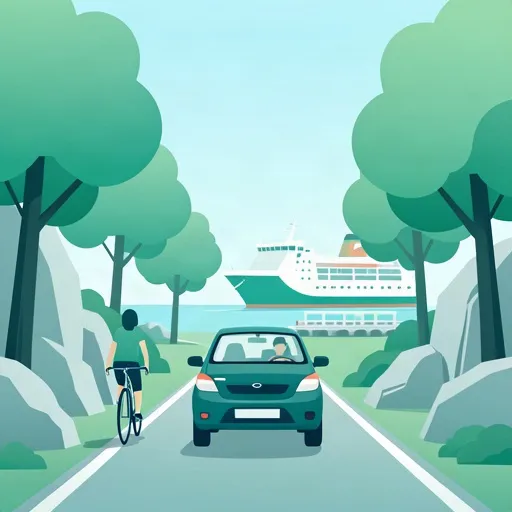
Bornholm is famous for its extensive cycle network, and you will frequently encounter cyclists on the same roads as motorized traffic. Under Danish law, the responsibility for safe overtaking lies heavily with the driver. When passing cyclists, you must maintain a safe distance to ensure their stability, especially when wind conditions or uneven road surfaces are present.
The 1.5-meter clearance rule is not just a guideline; it is a fundamental aspect of defensive driving. When overtaking cyclists on narrow Bornholm roads, wait until the oncoming lane is completely clear before initiating the pass. Never attempt to squeeze past a cyclist if the road width is insufficient to maintain the required safety buffer.
Rønne is the island's main urban center, and it operates under standard Danish municipal parking regulations. You will often encounter zones where a P-disc is mandatory to indicate your time of arrival. Failure to set your P-disc correctly or exceeding the displayed time limit in a regulated zone will lead to a parking fine, which is a common point of contention for both visitors and new drivers.
Always look for signs indicating the parking duration and whether a P-disc is required. In the theory exam, questions regarding urban parking often focus on your ability to identify these zones and correctly set the clock to the nearest quarter-hour following your arrival time.
| Feature | Regulation / Practice |
|---|---|
| Max Speed (Rural) | 80 km/h (unless otherwise signed) |
| Max Speed (Urban) | 50 km/h (standard byzone) |
| Cycling Safety | Mandatory 1.5m passing clearance |
| Parking (Rønne) | P-disc required in marked zones |
| Motorways | None present on Bornholm |
Driving on Bornholm requires adapting to a rural road environment without motorways, where 80 km/h is the maximum on landeveje but safe speeds on winding coastal sections are often much lower due to reduced sightlines. The mandatory 1.5-meter passing clearance when overtaking cyclists reflects Danish defensive driving principles and places responsibility on drivers to wait for safe overtaking conditions. Parking in Rønne follows standard Danish municipal rules requiring P-discs with clocks set to the nearest quarter-hour in regulated zones. Ferry access via Bornholmerlinjen involves international transit considerations when traveling through Sweden, and advance booking is essential during peak tourist season.
A short set of high-value points that capture the most important ideas from this article.
Bornholm has no motorways; all roads are landeveje (rural) or kommuneveje (municipal), requiring constant adaptation to road conditions
On winding coastal roads near Hammershus and northern Bornholm, choose a safe speed rather than automatically driving the legal 80 km/h maximum
The 1.5-meter lateral clearance when overtaking cyclists is a legal requirement, not just a guideline, enforced under Danish Road Traffic Act
P-disc zones in Rønne require the clock to be set to the nearest quarter-hour after arrival to avoid fines
International transit through Sweden when using the Bornholmerlinjen ferry requires valid vehicle documentation and identification
Landeveje: rural roads outside byzone with a standard 80 km/h limit unless otherwise posted
Byzone: built-up areas with a standard 50 km/h speed limit, including Rønne town center
P-disc: a parking disc displaying arrival time; mandatory in regulated parking zones to avoid fines
1.5-meter rule: mandatory clearance when passing cyclists; wait for clear oncoming lane on narrow roads before overtaking
Bornholmerlinjen: the ferry service connecting Rønne to Ystad (Sweden) and Copenhagen with mandatory advance booking in summer
Confusing the legal maximum speed (80 km/h) with the appropriate safe speed on narrow, winding Bornholm coastal roads
Attempting to squeeze past cyclists when the road width is insufficient to maintain the required 1.5-meter safety buffer
Setting the P-disc clock to the exact arrival minute instead of rounding to the nearest quarter-hour
Assuming motorway driving habits apply on Bornholm; there are no high-speed motorways on the island
Overlooking supplementary parking signs that indicate P-disc requirements or time limits in Rønne
Article content overview
A short set of high-value points that capture the most important ideas from this article.
Bornholm has no motorways; all roads are landeveje (rural) or kommuneveje (municipal), requiring constant adaptation to road conditions
On winding coastal roads near Hammershus and northern Bornholm, choose a safe speed rather than automatically driving the legal 80 km/h maximum
The 1.5-meter lateral clearance when overtaking cyclists is a legal requirement, not just a guideline, enforced under Danish Road Traffic Act
P-disc zones in Rønne require the clock to be set to the nearest quarter-hour after arrival to avoid fines
International transit through Sweden when using the Bornholmerlinjen ferry requires valid vehicle documentation and identification
Landeveje: rural roads outside byzone with a standard 80 km/h limit unless otherwise posted
Byzone: built-up areas with a standard 50 km/h speed limit, including Rønne town center
P-disc: a parking disc displaying arrival time; mandatory in regulated parking zones to avoid fines
1.5-meter rule: mandatory clearance when passing cyclists; wait for clear oncoming lane on narrow roads before overtaking
Bornholmerlinjen: the ferry service connecting Rønne to Ystad (Sweden) and Copenhagen with mandatory advance booking in summer
Confusing the legal maximum speed (80 km/h) with the appropriate safe speed on narrow, winding Bornholm coastal roads
Attempting to squeeze past cyclists when the road width is insufficient to maintain the required 1.5-meter safety buffer
Setting the P-disc clock to the exact arrival minute instead of rounding to the nearest quarter-hour
Assuming motorway driving habits apply on Bornholm; there are no high-speed motorways on the island
Overlooking supplementary parking signs that indicate P-disc requirements or time limits in Rønne
Explore related topics, search based questions, and concepts that learners often look up when studying Driving on Bornholm Island. These themes reflect real search intent and help you understand how this topic connects to wider driving theory knowledge in Denmark.
Find clear and practical answers to common questions learners often have about Driving on Bornholm Island. This section helps explain difficult points, remove confusion, and reinforce the key driving theory concepts that matter for learners in Denmark.
No, there are no motorways or expressways on Bornholm. The road network consists primarily of Landeveje and Kommuneveje, which often wind through forest areas and along the coast.
Just like on the mainland, you must maintain a safe distance when overtaking cyclists. Danish traffic law strongly emphasizes a 1.5-meter clearance rule to ensure the safety of the many cyclists present on island roads.
Yes, standard Danish parking disc regulations apply in the town center of Rønne. Ensure you have a valid P-disc clearly visible on the windshield if you are parking in a designated time-restricted zone.
The general Danish speed limits apply: 50 km/h in urban areas (byzone) and 80 km/h on rural roads (landeveje), unless specific local signage indicates otherwise.
Continue your learning journey by searching for additional articles or browsing our comprehensive topic categories. Deepen your knowledge of Danish road law, vehicle mechanics, and hazard perception to ensure complete preparation for your official theory exam.