
Understanding how to approach and cross railway tracks is a critical component of safe driving and a frequent topic in the Danish theory test. You will learn the specific legal obligations when encountering an Andreaskors sign, how to interpret different types of crossing protection, and why proceeding too early can lead to severe penalties or accidents. This guide clarifies the correct behavior to help you navigate these high-risk areas with confidence.
Article content overview
Railway crossings, or jernbaneoverskæringer, are among the most critical high-risk areas you will encounter on Danish roads. Because of the extreme danger posed by heavy, fast-moving trains, Danish traffic law imposes the strictest possible requirements on drivers approaching these zones. Understanding these regulations is not just a necessity for passing the Danish driving theory exam; it is a fundamental pillar of becoming a safe and responsible road user.
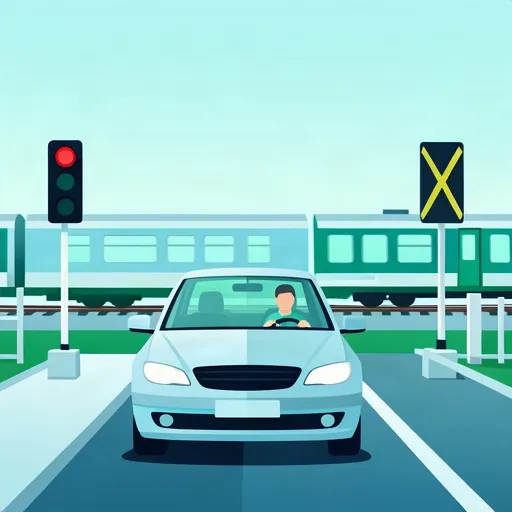
Every railway crossing in Denmark is marked with the Andreaskors sign. This X-shaped warning sign is the universal indicator that you are approaching railway tracks. Whether a crossing is fully equipped with barriers and lights or is a simpler, unprotected track, the presence of the Andreaskors sign is your legal notification to heighten your awareness, reduce your speed, and prepare to stop if necessary.
In the Danish traffic system, railway crossings are categorized by the level of protection they offer. Recognizing these categories is vital for your hazard perception skills during the theory test.
| Type of Crossing | Protection Level | Driver Responsibility |
|---|---|---|
| Fully Protected | Barriers, red lights, sound | Stop immediately when signals activate |
| Half-Barrier | Partial barriers, lights | Do not pass until barriers are fully raised |
| Light-Signal Only | Red flashing lights only | Stop before the line when lights are active |
| Unprotected | Only the Andreaskors sign | Full responsibility to scan and stop if a train approaches |
Danish law is explicit regarding your conduct when approaching a crossing with active signals. When the red lights begin to flash, or if the barrier starts to descend, you are strictly prohibited from entering the crossing. This rule applies even if you believe you have enough time to clear the tracks before the train arrives.
It is important to remember that you must not enter the crossing unless the road on the far side is entirely clear. If traffic is congested and there is no space for your vehicle on the other side of the tracks, you must wait before the stop line. Stopping on the tracks due to a traffic jam is a dangerous mistake that can lead to catastrophic consequences.
A common trap in the Danish theory exam involves the behavior required immediately after a train has passed. Many drivers mistakenly assume they can move as soon as the train clears the crossing or the barriers begin to rise. However, the law requires that you wait until the barriers are fully in the upright position and the flashing lights have completely extinguished.
Furthermore, always observe the area for a few seconds after the signals stop. In some locations, there may be multiple tracks, and a second train could be approaching from the opposite direction. Patient observation is the hallmark of a safe driver in Denmark.
Danish railway crossings are marked by the Andreaskors sign and range from fully protected (barriers and lights) to unprotected, requiring varying levels of driver responsibility. The red flashing lights signal an absolute stop command—proceeding through them is a serious traffic violation that can result in license suspension. Safe crossing requires ensuring the road ahead is clear before entering, and waiting for all barriers to fully raise and lights to completely extinguish after a train passes. Always scan for secondary trains at multi-track crossings, as patience and observation are essential to safe railway crossing behavior.
A short set of high-value points that capture the most important ideas from this article.
The Andreaskors (X-shaped) sign is the universal warning for all railway crossings in Denmark and signals the need to heighten awareness and reduce speed
Danish crossings are categorized into four protection types: fully protected, half-barrier, light-signal only, and unprotected, each requiring different driver responses
Red flashing lights at a railway crossing represent an absolute stop command—never attempt to cross even if a train is not immediately visible
You must verify that the road beyond the tracks is completely clear before crossing; stopping on the rails due to traffic congestion is extremely dangerous
Continue observing for a second train after the first passes, as some crossings have multiple tracks in both directions
Red flashing lights and descending barriers create an absolute legal prohibition on entering the crossing regardless of perceived time
Wait until barriers are fully raised AND lights have completely stopped flashing before proceeding after a train passes
If your vehicle cannot fully clear the crossing due to traffic, you must stop before the tracks—not on them
At unprotected crossings with only the Andreaskors sign, the driver bears full responsibility to visually confirm safe passage
The general duty to yield (vigepligt) is superseded by the strict rail safety laws at railway crossings
Assuming you can cross if you believe you have enough time to 'beat' the train—this is illegal and extremely dangerous
Moving forward as soon as barriers begin to rise or the train clears the tracks, rather than waiting for full signal cessation
Entering the crossing without confirming there is sufficient space on the far side, potentially resulting in stopping on the tracks
Forgetting to scan for a second train after the first has passed, particularly at multi-track crossings
Confusing the level crossing rules with standard yielding procedures, not recognizing that rail safety laws override general vigepligt rules
Article content overview
A short set of high-value points that capture the most important ideas from this article.
The Andreaskors (X-shaped) sign is the universal warning for all railway crossings in Denmark and signals the need to heighten awareness and reduce speed
Danish crossings are categorized into four protection types: fully protected, half-barrier, light-signal only, and unprotected, each requiring different driver responses
Red flashing lights at a railway crossing represent an absolute stop command—never attempt to cross even if a train is not immediately visible
You must verify that the road beyond the tracks is completely clear before crossing; stopping on the rails due to traffic congestion is extremely dangerous
Continue observing for a second train after the first passes, as some crossings have multiple tracks in both directions
Red flashing lights and descending barriers create an absolute legal prohibition on entering the crossing regardless of perceived time
Wait until barriers are fully raised AND lights have completely stopped flashing before proceeding after a train passes
If your vehicle cannot fully clear the crossing due to traffic, you must stop before the tracks—not on them
At unprotected crossings with only the Andreaskors sign, the driver bears full responsibility to visually confirm safe passage
The general duty to yield (vigepligt) is superseded by the strict rail safety laws at railway crossings
Assuming you can cross if you believe you have enough time to 'beat' the train—this is illegal and extremely dangerous
Moving forward as soon as barriers begin to rise or the train clears the tracks, rather than waiting for full signal cessation
Entering the crossing without confirming there is sufficient space on the far side, potentially resulting in stopping on the tracks
Forgetting to scan for a second train after the first has passed, particularly at multi-track crossings
Confusing the level crossing rules with standard yielding procedures, not recognizing that rail safety laws override general vigepligt rules
Explore related topics, search based questions, and concepts that learners often look up when studying Danish Railway Crossing Rules. These themes reflect real search intent and help you understand how this topic connects to wider driving theory knowledge in Denmark.
Find clear and practical answers to common questions learners often have about Danish Railway Crossing Rules. This section helps explain difficult points, remove confusion, and reinforce the key driving theory concepts that matter for learners in Denmark.
You must show extra caution, adjust your speed, and ensure you can stop before the tracks if necessary. You must never enter the crossing if you hear or see a train approaching, or if signals indicate danger.
No, it is strictly prohibited. You must wait until the barriers are fully raised, the lights have stopped flashing, and it is confirmed that no other trains are approaching.
The Andreaskors (Saint Andrew's cross) is a warning sign that indicates the presence of a level crossing with railway tracks. It is present at all railway crossings in Denmark.
No. You must never enter a level crossing unless there is enough space on the other side to clear the tracks immediately. If traffic is backed up, you must wait before the tracks.
Continue your learning journey by searching for additional articles or browsing our comprehensive topic categories. Deepen your knowledge of Danish road law, vehicle mechanics, and hazard perception to ensure complete preparation for your official theory exam.