
Learn the critical difference between the blue square E39 information sign and the regulatory circular C55 speed limit sign to avoid common errors in your theory exam. We explain your legal obligation under the Danish Traffic Act to adjust your speed based on traffic, road, and weather conditions, regardless of whether a sign is advisory or mandatory. Mastering these sign definitions is fundamental to both passing your test and practicing responsible, defensive driving.
Article content overview
For many students preparing for the Danish driving theory test, the distinction between different types of road signs is a common source of confusion. Among these, the difference between the blue square information sign E39 and the regulatory circular speed limit sign C55 is critical. Failing to grasp this nuance can lead to errors in both your final theory exam and your practical driving performance, as these signs serve entirely different purposes within the framework of the Danish Traffic Act.
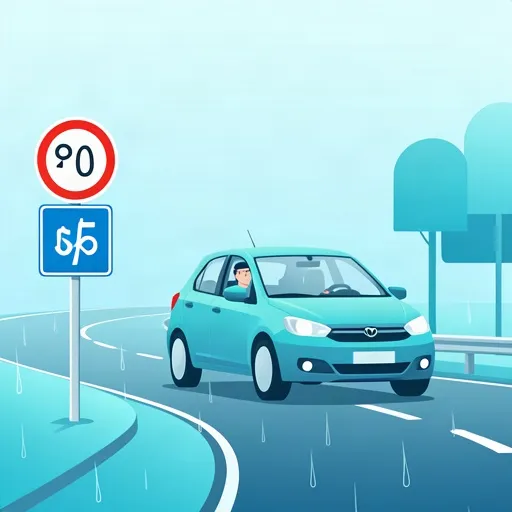
The E39 sign is a blue, square information sign that displays a recommended speed. Unlike regulatory signs, which impose a legal requirement, the E39 sign suggests a speed that is deemed appropriate for the current road section under normal conditions. It serves as guidance for the driver, providing a benchmark that typically enhances traffic flow and safety when visibility, road surface, and traffic density are optimal.
It is a common misconception that the E39 sign functions as a legal speed limit. Research into driver behavior has shown that a significant portion of motorists incorrectly believe this sign is a binding instruction. In the context of your theory exam, it is vital to remember that the E39 sign does not change the general speed limits defined in Færdselsloven. If the sign indicates 60 km/h, but you are in a built-up area where the general limit is 50 km/h, the general limit still takes precedence unless specifically overruled by a circular regulatory sign.
When you encounter the C55 speed limit sign, the legal landscape changes entirely. This circular, red-bordered sign sets a definitive maximum speed that you are legally forbidden to exceed. While the E39 sign is advisory, the C55 sign is regulatory. When you pass a C55 sign, you must adjust your vehicle's speed to ensure that you are at or below the stated limit immediately.
Regardless of whether you are looking at an E39 recommendation or a mandatory C55 limit, the Danish Traffic Act imposes a primary duty on the driver to adapt their speed at all times. Under Færdselsloven § 41, you are always required to adjust your speed according to the conditions of the road, weather, visibility, and traffic. This means that even if a sign permits a certain speed, you may be in violation of the law if you drive at that speed when conditions are unsafe, such as during heavy rain, snowfall, or high-density traffic.
| Feature | E39 Recommended Speed | C55 Speed Limit |
|---|---|---|
| Sign Shape | Square | Circular |
| Primary Color | Blue | White with Red Border |
| Nature | Advisory / Information | Mandatory / Regulatory |
| Legal Status | Non-binding, but useful | Legally binding maximum |
In the Danish theory exam, examiners often use scenarios involving E39 signs to test whether students truly understand the concept of "driving according to conditions." A common trick question might present a situation where the E39 sign suggests a speed, but the road is covered in slush or ice. In such a case, the correct answer is never to maintain the "recommended" speed, but to drive significantly slower, even if that speed is well below the recommendation.
Do not confuse the E39 sign with a mandatory speed limit. While an E39 sign provides a helpful target for traffic flow, your primary legal obligation is to assess the road conditions yourself under the provisions of Færdselsloven § 41.
Mastering the distinction between recommended and mandatory signs is more than just a requirement for passing your theory test. It represents the transition from a learner to a responsible, defensive driver. By internalizing that the E39 sign is a tool for smooth traffic flow and that your safety responsibilities under § 41 are constant, you will be better prepared for both the challenges of the final exam and the varied demands of the Danish road network. Always look for the circular red-bordered signs to know your legal limits, but keep your eyes on the road conditions to know your safe speed.
The E39 recommended speed sign is a blue square information sign that provides advisory guidance for smooth traffic flow under normal conditions, but it does not impose a legal obligation like the mandatory C55 speed limit sign. Under Færdselsloven § 41, drivers must continuously adapt their speed to match road, weather, and traffic conditions regardless of what any sign indicates. The E39 sign does not override existing general speed limits, and in hazardous conditions (such as ice or heavy rain), driving at the recommended speed could constitute a legal violation. Always look for circular red-bordered signs to identify your legal maximum limits, while keeping situational awareness of actual driving conditions to fulfill your constant duty of speed adaptation.
A short set of high-value points that capture the most important ideas from this article.
The E39 sign is advisory (blue square) and does not override general speed limits or legal obligations
The C55 sign is mandatory (circular with red border) and sets a legally binding maximum speed you cannot exceed
Færdselsloven § 41 requires you to always adapt your speed to actual road, weather, and traffic conditions
A recommended speed on E39 becomes irrelevant when conditions are hazardous, regardless of what the sign displays
When E40 appears, the previous recommended speed no longer applies but legal limits remain in force
E39 = blue square = advisory information sign; C55 = white circle with red border = regulatory mandatory sign
General speed limits (e.g., 50 km/h in built-up areas) always apply unless a C55 specifically overrides them
Driving at an E39-recommended speed during unsafe conditions (rain, ice, poor visibility) can violate § 41
The E39 sign enhances traffic flow under normal conditions but never creates a legal obligation
Legal responsibility under § 41 supersedes any sign recommendation when conditions require slower speeds
Believing the E39 sign creates a legal speed limit that must be followed exactly
Maintaining E39 recommended speed when road conditions (slush, ice, heavy rain) require significant reduction
Confusing the blue square E39 with the circular red-bordered C55 sign under exam pressure
Assuming that because no mandatory sign is visible, no speed restrictions apply (general limits always exist)
Forgetting that § 41 creates an independent legal duty to assess conditions, separate from any sign recommendation
Article content overview
A short set of high-value points that capture the most important ideas from this article.
The E39 sign is advisory (blue square) and does not override general speed limits or legal obligations
The C55 sign is mandatory (circular with red border) and sets a legally binding maximum speed you cannot exceed
Færdselsloven § 41 requires you to always adapt your speed to actual road, weather, and traffic conditions
A recommended speed on E39 becomes irrelevant when conditions are hazardous, regardless of what the sign displays
When E40 appears, the previous recommended speed no longer applies but legal limits remain in force
E39 = blue square = advisory information sign; C55 = white circle with red border = regulatory mandatory sign
General speed limits (e.g., 50 km/h in built-up areas) always apply unless a C55 specifically overrides them
Driving at an E39-recommended speed during unsafe conditions (rain, ice, poor visibility) can violate § 41
The E39 sign enhances traffic flow under normal conditions but never creates a legal obligation
Legal responsibility under § 41 supersedes any sign recommendation when conditions require slower speeds
Believing the E39 sign creates a legal speed limit that must be followed exactly
Maintaining E39 recommended speed when road conditions (slush, ice, heavy rain) require significant reduction
Confusing the blue square E39 with the circular red-bordered C55 sign under exam pressure
Assuming that because no mandatory sign is visible, no speed restrictions apply (general limits always exist)
Forgetting that § 41 creates an independent legal duty to assess conditions, separate from any sign recommendation
Explore related topics, search based questions, and concepts that learners often look up when studying Understanding Danish E39 Speed Signs. These themes reflect real search intent and help you understand how this topic connects to wider driving theory knowledge in Denmark.
Find clear and practical answers to common questions learners often have about Understanding Danish E39 Speed Signs. This section helps explain difficult points, remove confusion, and reinforce the key driving theory concepts that matter for learners in Denmark.
No, the E39 sign is an information sign and not a mandatory speed limit. However, under Færdselsloven § 41, you are still required to adjust your speed to ensure safety based on road, weather, and traffic conditions.
The E39 is a blue square information sign suggesting a safe speed, while the C55 is a circular regulatory sign that sets a strict, mandatory speed limit.
While you are not technically speeding if you exceed the recommended E39 speed, you could still be penalized if your speed is deemed unsafe or inappropriate for the specific traffic conditions under the Danish Traffic Act.
The recommendation concludes at the E40 sign, which marks the end of the recommended speed, or when other traffic regulations or speed limits take precedence.
Continue your learning journey by searching for additional articles or browsing our comprehensive topic categories. Deepen your knowledge of Danish road law, vehicle mechanics, and hazard perception to ensure complete preparation for your official theory exam.