Navigating narrow, high-altitude roads requires a deep understanding of unique legal obligations and safe driving practices. This article explains the mandatory priority rules, how to interpret mountain-specific signage, and the theoretical approach to managing long, steep descents. Learning these concepts will help you navigate mountain road questions on your French theory test with confidence.
Article content overview
Navigating mountainous terrain in France presents a unique set of challenges that every driver must master to pass their ETG theory exam. The Code de la route establishes specific regulations for these environments, designed to manage the limitations of narrow roads, steep gradients, and restricted visibility. Understanding the interaction between uphill and downhill traffic is a fundamental skill that often appears in exam questions, acting as a critical litmus test for your hazard perception and knowledge of legal priority rules.
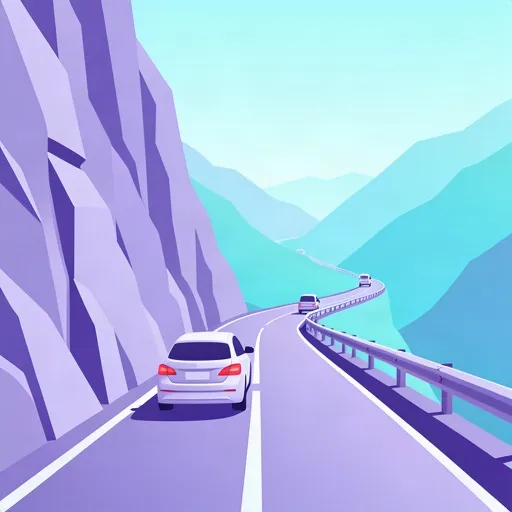
One of the most common points of confusion for learners involves determining who should yield when two vehicles meet on a narrow mountain path. The general rule of thumb in France is that vehicles moving uphill have priority over those moving downhill. This is because a vehicle traveling uphill is under greater mechanical strain; stopping on an incline requires significant effort to resume movement, potentially causing the vehicle to roll backward.
Conversely, a vehicle traveling downhill has the benefit of gravity, making it easier to maneuver, slow down, or reverse into a passing bay if necessary. However, if the uphill vehicle has a passing bay on its own side, it is expected to use it to facilitate the flow of traffic.
In the context of the ETG exam, you will encounter specific warning signs designed to alert you to the geometry and potential dangers of mountain roads. These signs are not merely advisory; they provide legal context for how you must approach the road ahead.
The Code de la route emphasizes that maintaining vehicle control during long descents is a matter of safety and mechanical preservation. A common exam trap involves asking about the correct use of gears when navigating a steep slope. Relying solely on the brake pedal can lead to brake fade, where the brakes become dangerously hot and lose effectiveness. Instead, theory dictates that drivers should use "engine braking" by selecting a lower gear, which uses the engine's resistance to slow the vehicle down naturally.
On steep descents, the rule is to select the same gear you would use to climb the same slope. This ensures your speed is effectively managed by the drivetrain rather than just the friction brakes.
Mountain roads in France, particularly in regions like the Alps, Pyrenees, or the Massif Central, are subject to rapidly changing weather. Even in summer, temperatures at high altitudes can drop significantly, and fog or sudden storms can reduce visibility to mere meters. When driving in these conditions, your speed must be adapted to the visibility distance, not just the legal speed limit. If you cannot see far enough ahead to stop within the distance you can see, you are moving too fast.
Driving on mountain roads in France requires understanding that uphill vehicles have priority over downhill vehicles, with the downhill driver expected to use passing bays or reverse if necessary. The Code de la route mandates engine braking on steep descents to prevent brake fade, using the same gear you would need to climb the slope. Specific signs like A17 (steep descent), B29 (narrow road), and A18 (falling rocks) provide legal context for driver obligations. Speed must always be adjusted to visibility conditions, particularly in high-altitude regions subject to sudden weather changes, making mountain driving a common ETG exam topic testing both priority knowledge and hazard awareness.
A short set of high-value points that capture the most important ideas from this article.
Uphill vehicles have priority over downhill vehicles on mountain roads because stopping on an incline makes it harder to restart.
Downhill vehicles must be prepared to reverse or use passing bays since gravity makes maneuverability easier for them.
Engine braking should be used on descents to avoid brake fade, which occurs when brakes overheat and lose effectiveness.
Mountain warning signs like A17 (Steep Descent), B29 (Narrow Road), and A18 (Falling Rocks) carry legal weight and dictate required driver behavior.
Speed on mountain roads must be adapted to visibility distance, not just the posted speed limit.
The Code de la route grants priority to uphill traffic when two vehicles meet on a narrow mountain road.
Select the same gear on a descent that you would use to climb the same slope to manage speed safely.
If descending and you see a passing bay on your right, you are expected to use it to let uphill traffic pass.
Relying solely on brakes for long descents can cause brake fade and dangerous loss of braking power.
Weather conditions in high-altitude regions like the Alps and Pyrenees can change rapidly, requiring constant speed adjustment.
Assuming downhill vehicles always have priority; the rule is the opposite for uphill traffic.
Using only the brake pedal to control speed on steep descents instead of engine braking.
Overlooking passing bay obligations when descending toward uphill traffic.
Failing to recognize that mountain warning signs impose legal obligations, not just advisory information.
Setting speed based solely on posted limits without considering reduced visibility from fog, rain, or sharp bends.
Article content overview
A short set of high-value points that capture the most important ideas from this article.
Uphill vehicles have priority over downhill vehicles on mountain roads because stopping on an incline makes it harder to restart.
Downhill vehicles must be prepared to reverse or use passing bays since gravity makes maneuverability easier for them.
Engine braking should be used on descents to avoid brake fade, which occurs when brakes overheat and lose effectiveness.
Mountain warning signs like A17 (Steep Descent), B29 (Narrow Road), and A18 (Falling Rocks) carry legal weight and dictate required driver behavior.
Speed on mountain roads must be adapted to visibility distance, not just the posted speed limit.
The Code de la route grants priority to uphill traffic when two vehicles meet on a narrow mountain road.
Select the same gear on a descent that you would use to climb the same slope to manage speed safely.
If descending and you see a passing bay on your right, you are expected to use it to let uphill traffic pass.
Relying solely on brakes for long descents can cause brake fade and dangerous loss of braking power.
Weather conditions in high-altitude regions like the Alps and Pyrenees can change rapidly, requiring constant speed adjustment.
Assuming downhill vehicles always have priority; the rule is the opposite for uphill traffic.
Using only the brake pedal to control speed on steep descents instead of engine braking.
Overlooking passing bay obligations when descending toward uphill traffic.
Failing to recognize that mountain warning signs impose legal obligations, not just advisory information.
Setting speed based solely on posted limits without considering reduced visibility from fog, rain, or sharp bends.
Explore related topics, search based questions, and concepts that learners often look up when studying French Mountain Driving Rules. These themes reflect real search intent and help you understand how this topic connects to wider driving theory knowledge in France.
Find clear and practical answers to common questions learners often have about French Mountain Driving Rules. This section helps explain difficult points, remove confusion, and reinforce the key driving theory concepts that matter for learners in France.
Yes. Under the French Code de la route, vehicles moving uphill generally have priority over those moving downhill, as it is much harder to restart an uphill ascent than to manage a descent.
If you are the vehicle moving downhill and you encounter an uphill vehicle, you must pull over or reverse if necessary to allow the ascending vehicle to pass, provided you can do so safely.
On long, steep descents, using engine braking (selecting a lower gear) is a recommended safety practice to prevent your main service brakes from overheating, which can lead to brake failure.
Continue your preparation for the French permis de conduire exam. Dive deeper into specific Code de la route sections, practice scenarios, or review official procedures. Use our comprehensive article collection to master every aspect of driving theory.