Navigating parking regulations is a fundamental skill for every driver in France, as misinterpreting signs often leads to fines for 'stationnement gênant'. This guide breaks down the legal definitions and conditions applied to delivery bays and other reserved zones under the Code de la route. You will learn to correctly identify time-based restrictions and distinguish between a temporary stop and a longer parking period.
Article content overview
Navigating urban parking in France requires more than just finding an empty space; it demands a precise understanding of the Code de la route. For learners preparing for the Examen Théorique Général (ETG), the distinction between permitted, restricted, and prohibited parking is a frequent source of exam errors. Misinterpreting signage often leads to fines for stationnement gênant (obstructive parking), which can range from 35€ to more severe penalties depending on the nature of the infraction.
In French law, an 'arrêt' (stop) is a momentary immobilization of the vehicle on the road, with the driver remaining at the controls or nearby, allowing for the quick dropping off or picking up of passengers. 'Stationnement' (parking) occurs when the driver leaves the vehicle or remains inside for an extended period, effectively abandoning the driving task.
The primary challenge for students is identifying the limitations imposed by supplementary panels found beneath standard regulatory signs. A circular sign with a blue background and a red border crossed by two lines signifies a prohibition on both parking and stopping. However, the presence of specific text or icons below this sign can modulate these rules.
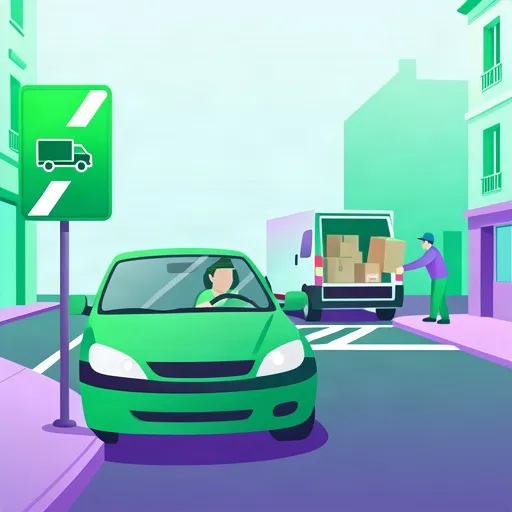
When you encounter signs indicating reserved spaces, such as those for deliveries or emergency vehicles, the rules become absolute. Parking or even stopping in a space reserved for delivery vehicles—often marked with the label 'Livraison'—is strictly prohibited unless you are actively operating a vehicle engaged in delivery activities during the allowed hours.
Delivery bays are a common feature of French urban planning, designed to facilitate the logistics of city centers. If a sign indicates that an area is for 'Livraison', it is reserved exclusively for the loading and unloading of goods. Even a momentary 'arrêt' to answer a phone call or wait for a passenger in these bays constitutes a traffic violation.
Do not assume that a delivery bay becomes a normal parking space outside of business hours. Unless a supplementary sign explicitly states a time window (e.g., "7h-11h"), the restriction is considered permanent, and the space remains off-limits to private passenger vehicles at all times.
In many areas, you will encounter the "Zone Bleue" (Blue Zone), which allows for short-term free parking. These zones are regulated by the use of a standard European parking disc, which must be clearly displayed on the dashboard. Failure to display the disc, or exceeding the permitted time, is treated similarly to unauthorized parking.
The Code de la route categorizes improper parking into several levels, including gênant (obstructive), très gênant (highly obstructive), and dangereux (dangerous). An obstructive parking fine is typically 35€, but if the vehicle is deemed to be in a très gênant position—such as blocking a reserved lane for buses or an entrance to a property—the authorities may order the vehicle to be towed to the fourrière (vehicle pound).
| Infraction Category | Penalty Class | Typical Fine |
|---|---|---|
| Obstructive (Gênant) | 2nd Class | 35€ |
| Abusive (Abusif) | 2nd Class | 35€ |
| Highly Obstructive (Très gênant) | 4th Class | 135€ |
| Dangerous (Dangereux) | 4th Class | 135€ |
The exam often presents scenarios featuring a combination of a main sign and a supplementary panel. A common trap is to focus only on the main sign while ignoring the text beneath it. For instance, a question might show a parking sign with a panel reading "sauf livraisons" (except deliveries). If the question asks if you can park your personal vehicle there, the correct answer is always "no."
Always look for the "début" (start) and "fin" (end) arrows on panels, as they define the exact physical boundaries of the restricted area. Recognizing these subtle markers is essential for correctly answering questions about where your parking obligation begins and ends.
This article clarifies the fundamental French legal distinction between arrêt (a momentary stop with the driver present) and stationnement (leaving the vehicle or stopping for an extended period), which is tested frequently on the ETG exam. Delivery bays marked 'Livraison' are permanently reserved and cannot be used for any stopping or parking, unless supplementary signs specify permitted hours. The critical exam skill is reading supplementary panels carefully, as they define time limits, exceptions, and physical boundaries of restrictions. Fines escalate from 35€ for obstructive parking to 135€ for dangerous parking or blocking reserved lanes, with towing to the fourrière possible for serious infractions.
A short set of high-value points that capture the most important ideas from this article.
The law distinguishes arrêt (brief stop with driver present) from stationnement (leaving vehicle or extended period), and both have different rules under the Code de la route
Delivery bays marked 'Livraison' are permanently reserved unless a supplementary sign explicitly states a time window
Supplementary panels beneath main signs always take precedence—never answer a parking question based only on the primary sign
Zone Bleue allows free short-term parking but requires a displayed European parking disc, not payment
Obstructive parking fines start at 35€, while highly obstructive or dangerous parking reaches 135€ and may result in towing
A circular sign with a blue background and red border crossed by two lines (B6d) means no stopping and no parking anywhere
Look for arrows indicating 'début' and 'fin' boundaries on supplementary panels to know exact restricted zones
Even answering your phone or waiting briefly in a delivery bay constitutes a traffic violation
Time restrictions on delivery bays must be explicitly stated—absence of business hours does not make them public parking
Abusive parking (exceeding permitted time in Zone Bleue) carries the same 35€ fine as obstructive parking
Assuming delivery bays become normal parking outside delivery hours unless a sign explicitly says so
Focusing only on the main regulatory sign and ignoring the text or icons on supplementary panels
Confusing arrêt with stationnement when answering exam questions about brief stops
Forgetting to display a parking disc in Zone Bleue, which is treated as unauthorized parking
Interpreting a parking-authorized sign (B6a) as unconditional without checking for time limits or payment requirements
Article content overview
A short set of high-value points that capture the most important ideas from this article.
The law distinguishes arrêt (brief stop with driver present) from stationnement (leaving vehicle or extended period), and both have different rules under the Code de la route
Delivery bays marked 'Livraison' are permanently reserved unless a supplementary sign explicitly states a time window
Supplementary panels beneath main signs always take precedence—never answer a parking question based only on the primary sign
Zone Bleue allows free short-term parking but requires a displayed European parking disc, not payment
Obstructive parking fines start at 35€, while highly obstructive or dangerous parking reaches 135€ and may result in towing
A circular sign with a blue background and red border crossed by two lines (B6d) means no stopping and no parking anywhere
Look for arrows indicating 'début' and 'fin' boundaries on supplementary panels to know exact restricted zones
Even answering your phone or waiting briefly in a delivery bay constitutes a traffic violation
Time restrictions on delivery bays must be explicitly stated—absence of business hours does not make them public parking
Abusive parking (exceeding permitted time in Zone Bleue) carries the same 35€ fine as obstructive parking
Assuming delivery bays become normal parking outside delivery hours unless a sign explicitly says so
Focusing only on the main regulatory sign and ignoring the text or icons on supplementary panels
Confusing arrêt with stationnement when answering exam questions about brief stops
Forgetting to display a parking disc in Zone Bleue, which is treated as unauthorized parking
Interpreting a parking-authorized sign (B6a) as unconditional without checking for time limits or payment requirements
Explore related topics, search based questions, and concepts that learners often look up when studying French Urban Parking Rules. These themes reflect real search intent and help you understand how this topic connects to wider driving theory knowledge in France.
Find clear and practical answers to common questions learners often have about French Urban Parking Rules. This section helps explain difficult points, remove confusion, and reinforce the key driving theory concepts that matter for learners in France.
An 'arrêt' (stop) is a temporary immobilization of the vehicle while the driver remains on board or nearby, typically for loading or unloading passengers. 'Stationnement' (parking) occurs when the driver leaves the vehicle or remains inside for a longer period, exceeding a simple stop.
Usually, no. Delivery bays are reserved for vehicles performing deliveries during authorized hours indicated by a supplementary plate. Parking there outside of permitted times or without being a delivery vehicle can result in a 35 euro fine for 'stationnement gênant'.
Reserved spaces are often indicated by road markings and supplementary signs that specify the category of vehicle allowed, such as residents, taxis, or disabled drivers. Always check the panels underneath the primary parking sign for time, date, or permit restrictions.
Parking in a restricted or reserved zone is considered 'stationnement gênant' and carries a standard 35 euro fine. If you are absent or refuse to move your vehicle, it may be immobilized or towed to the municipal impound lot.
Continue your preparation for the French permis de conduire exam. Dive deeper into specific Code de la route sections, practice scenarios, or review official procedures. Use our comprehensive article collection to master every aspect of driving theory.