Driving in the French mountains requires a clear understanding of specific traffic regulations that differ from urban environments. This guide clarifies the priority hierarchy on narrow, steep roads and explains how to distinguish between essential mountain road signs. Mastering these concepts is vital for passing the ETG and ensuring safety when traveling through mountainous regions.
Article content overview
Mountain driving in France presents a unique set of challenges that are frequently tested in the Code de la route theory exam. Whether you are navigating the winding roads of the Alps or the steep passes of the Pyrenees, the theoretical rules governing these environments are designed to ensure safety where visibility and maneuverability are naturally restricted. For your ETG exam preparation, understanding these specific regulations—particularly the nuances of priority rules on narrow lanes—is essential to avoiding common pitfalls.
One of the most critical concepts for the French driving theory exam is the priority hierarchy on narrow, steep mountain roads. Unlike standard urban priority rules, which often rely on "priority to the right," mountain roads follow a principle based on the physical difficulty of the vehicles involved.
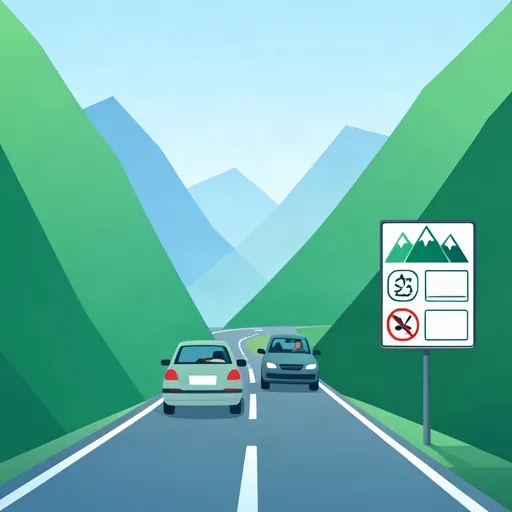
On narrow mountain roads where two vehicles cannot pass each other simultaneously, the vehicle going downhill must stop or pull over to allow the vehicle climbing uphill to pass. This is because it is significantly more difficult to restart a vehicle on a steep incline than it is to hold a vehicle on a descent.
In the context of the theory test, you may be presented with a scenario where two vehicles meet on a narrow road. Remember that if a vehicle is pulling a trailer, it is considered a single unit that usually has priority over smaller, more maneuverable vehicles when climbing. If both vehicles are the same type, the one that has the most space or the safest area to pull over must yield, regardless of direction, though the uphill rule remains the default legal expectation.
Recognition of specific traffic signs is a staple of the French theory exam. In mountainous areas, signs often indicate hazards such as steep gradients, falling rocks, or restricted widths. Understanding the distinction between warning signs (triangular with a red border) and mandatory signs (circular with a blue background) is vital.
Learners often mistake standard traffic conventions for those applied in the mountains. While priority to the right is the default rule in many French urban intersections, it is superseded in mountain scenarios by the practical limitations of the terrain. The theory exam will often test your ability to differentiate between these environments.
| Situation | Standard Rule | Mountain Rule |
|---|---|---|
| Narrow Road Passing | Yield to the right | Yield to the climbing vehicle |
| Steep Grades | Normal gear use | Use low gears to manage speed |
| Stopping | Parking permitted (with lights) | Avoid stopping on sharp bends |
A common mistake in the theory exam is assuming that priority is absolute. Even if you are climbing uphill, you must always be prepared for the possibility that the other driver may not see you or may not be able to pull over safely. Examiners look for candidates who demonstrate "defensive driving" (conduite apaisée). If the descending vehicle has already engaged in a narrow passage, forcing them to reverse up a steep hill could be dangerous or impossible.
Never rely solely on your legal right of way in the mountains. If a large vehicle—such as a bus or a heavy truck—is descending, they may struggle to stop on an incline. Always look for passing zones (refuges) and be prepared to yield if it ensures the safety of all road users.
French mountain driving follows a specific priority hierarchy where uphill vehicles have the right of way on narrow roads, as restarting on a steep incline is more difficult than stopping on a descent. The ETG exam tests knowledge of essential mountain road signs including A17 (steep descent), A18 (steep ascent), and B9c (width restriction), as well as the distinction between these rules and standard urban traffic conventions. Defensive driving is emphasized—learners must recognize that legal priority does not override safety considerations, and yielding may be necessary if another vehicle has already engaged a narrow passage. Key terms like ETG, Code de la route, refuge, and frein moteur are foundational vocabulary for both the exam and practical mountain driving.
A short set of high-value points that capture the most important ideas from this article.
On narrow mountain roads where two vehicles cannot pass, the vehicle going downhill must yield to the vehicle climbing uphill
Vehicles pulling trailers are treated as single units and generally have priority when climbing steep inclines
Warning signs (triangular with red border) indicate hazards like steep gradients, while mandatory signs (circular with blue background) impose specific obligations
Always practice defensive driving in mountain zones—never assume other drivers will respect your legal right of way
Using engine braking (frein moteur) on steep descents helps prevent brake overheating
The uphill vehicle always has priority on narrow mountain roads unless a large vehicle has already engaged the narrow passage
A17 warns of steep descent, A18 warns of steep ascent, and B9c indicates width restrictions that may block your vehicle
Urban 'priority to the right' rules do not apply on narrow mountain roads with steep gradients
Know your vehicle's gabarit (dimensions) before entering narrow mountain passes
Look for refuges—designated wide areas—to pull over and allow others to pass safely
Assuming uphill priority is absolute and refusing to yield even when it creates a dangerous situation
Confusing urban intersection rules with mountain priority rules on narrow roads
Using brakes exclusively on long descents instead of engine braking, risking brake failure
Ignoring B9c width restriction signs and proceeding when the vehicle exceeds the indicated dimensions
Failing to check if a large vehicle has already committed to the narrowest section before asserting priority
Article content overview
A short set of high-value points that capture the most important ideas from this article.
On narrow mountain roads where two vehicles cannot pass, the vehicle going downhill must yield to the vehicle climbing uphill
Vehicles pulling trailers are treated as single units and generally have priority when climbing steep inclines
Warning signs (triangular with red border) indicate hazards like steep gradients, while mandatory signs (circular with blue background) impose specific obligations
Always practice defensive driving in mountain zones—never assume other drivers will respect your legal right of way
Using engine braking (frein moteur) on steep descents helps prevent brake overheating
The uphill vehicle always has priority on narrow mountain roads unless a large vehicle has already engaged the narrow passage
A17 warns of steep descent, A18 warns of steep ascent, and B9c indicates width restrictions that may block your vehicle
Urban 'priority to the right' rules do not apply on narrow mountain roads with steep gradients
Know your vehicle's gabarit (dimensions) before entering narrow mountain passes
Look for refuges—designated wide areas—to pull over and allow others to pass safely
Assuming uphill priority is absolute and refusing to yield even when it creates a dangerous situation
Confusing urban intersection rules with mountain priority rules on narrow roads
Using brakes exclusively on long descents instead of engine braking, risking brake failure
Ignoring B9c width restriction signs and proceeding when the vehicle exceeds the indicated dimensions
Failing to check if a large vehicle has already committed to the narrowest section before asserting priority
Explore related topics, search based questions, and concepts that learners often look up when studying Mountain Road Driving Rules. These themes reflect real search intent and help you understand how this topic connects to wider driving theory knowledge in France.
Find clear and practical answers to common questions learners often have about Mountain Road Driving Rules. This section helps explain difficult points, remove confusion, and reinforce the key driving theory concepts that matter for learners in France.
Generally, the vehicle going uphill has priority over the vehicle going downhill, as it is easier for a descending vehicle to stop or reverse. However, if a passing bay or wider area is available, the driver closer to it should prioritize safety and clear the path.
Look for specific danger warning signs such as the 'steep descent' sign, signs indicating a series of dangerous bends, or signs specifying the gradient percentage of a hill. These often indicate that special mountain driving precautions are required.
Not necessarily. While the general rural speed limits often apply, mountain roads frequently feature specific speed restrictions due to the danger of hairpin bends and narrow lanes. Always prioritize the speed indicated by temporary or permanent regulatory road signs.
Continue your preparation for the French permis de conduire exam. Dive deeper into specific Code de la route sections, practice scenarios, or review official procedures. Use our comprehensive article collection to master every aspect of driving theory.