
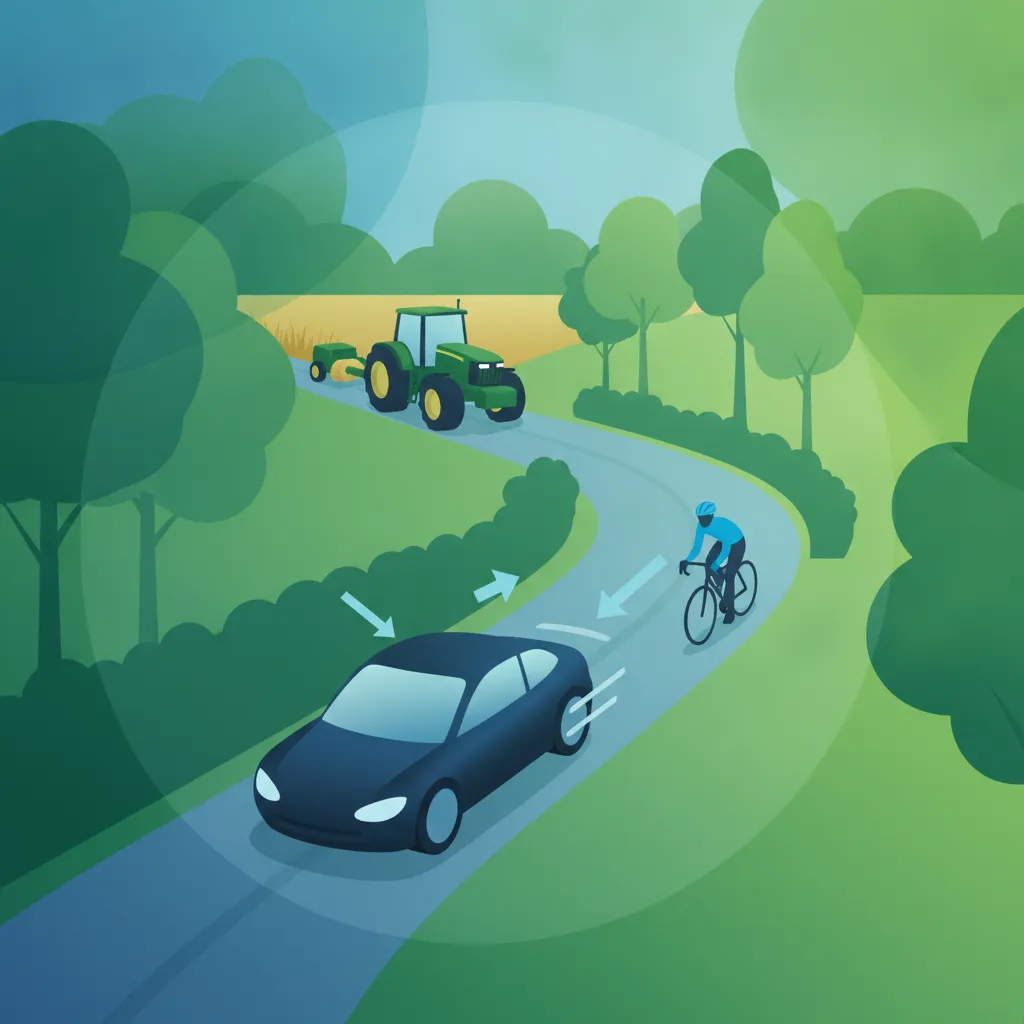
This lesson explores the specific challenges of navigating secondary and rural roads in France while operating large passenger vehicles. You will learn essential techniques for maintaining control on steep gradients, managing blind spots on narrow paths, and anticipating rural-specific hazards. These skills are vital for your professional driving theory exam and for safely transporting passengers through varied terrain.
Lesson content overview
The rural road network in France, primarily consisting of routes départementales (departmental roads), presents some of the most demanding driving environments for passenger transport professionals. Unlike motorways (autoroutes) which feature wide, clear lanes and standardized safety barriers, rural routes are characterized by variable road widths, unpredictable geometry, agricultural activity, and unique legal priorities.
For drivers operating category D1, D, D1E, or DE passenger vehicles, mastering these routes is critical. The larger dimensions, higher center of gravity, and significant passenger load of a coach or bus magnify the physics of vehicle dynamics. This lesson covers the advanced vehicle control techniques, legal regulations, and hazard anticipation strategies required to safely navigate the French secondary road network.
Rural roads in France are highly diverse. They range from relatively wide, well-marked links to narrow, single-lane tracks with poor visibility and unpaved shoulders. Understanding the legal speed limits and how they adapt to vehicle classifications is the first step in safe rural transit.
Under the French Code de la route, default speed limits on non-urban roads depend heavily on the vehicle's total weight (GVWR/PTAC) and the category of passenger transport:
Drivers must remain highly vigilant of physical infrastructure limitations. Departmental roads frequently feature:
One of the greatest physical risks when driving a heavy passenger vehicle on rural or mountainous routes is the thermal overload of the braking system. Gravity accelerates a heavy vehicle downward, converting potential energy into kinetic energy that must be controlled.
Engine braking (frein moteur) utilizes the internal compression resistance of the engine to slow the vehicle's drive wheels. Instead of converting kinetic energy into heat through friction (as service brakes do), engine retarding transfers this energy back through the drivetrain, utilizing the air compression in the cylinders to resist movement.
On modern passenger coaches, engine braking is supplemented by dedicated retarding systems (ralentisseurs):
The partial or total loss of braking power that occurs when the service brakes (pads, shoes, discs, or drums) overheat due to friction. The high heat reduces the friction coefficient of the brake lining, rendering the pedal spongy and highly ineffective.
Continuous application of the service brakes on a long descent will inevitably cause brake fade. To prevent this hazardous condition, professional drivers must use a combination of engine retarding and strategic, intermittent service brake applications.
Select the Correct Gear Before the Descent: Shift to a lower gear before the vehicle begins descending. As a general rule of thumb, use the same gear to descend the hill that would be required to climb it.
Engage the Retarder System: Activate the electromagnetic or hydraulic retarder to its appropriate stage to maintain a stable, legal speed.
Monitor Engine RPM: Ensure the engine remains within the high-RPM operating band (often indicated by a blue or green "retarder" zone on the tachometer) to maximize retarding efficiency, but do not allow it to over-rev into the red zone.
Use 'Snub' Braking Intermittently: If the vehicle's speed continues to rise, apply the service brakes firmly for 3 to 5 seconds to reduce speed well below the target, then release them completely to allow them to cool. Never ride or lightly drag the brakes continuously.
Relying solely on the retarder on extremely slippery, icy, or wet rural roads can cause the drive wheels to lock or lose traction, leading to a jackknife (for articulated buses or vehicles towing trailers) or a lateral slide. Always adapt retarder usage to the road surface.
French rural economies rely heavily on agriculture. During planting and harvesting seasons, departmental roads are frequented by slow-moving agricultural machinery, including tractors, combine harvesters, and trailers loaded with hay or crops.
Under the Code de la route, agricultural vehicles traveling at slow speeds (typically under 30 km/h) have specific rights and obligations:
Overtaking a slow-moving tractor on a narrow departmental road requires extreme patience and planning.
In rural departments, encountering animals on the roadway is a common hazard. These situations require swift, calm reactions to protect both the passengers inside the coach and the animals outside.
In France, livestock herds (such as sheep, cattle, or goats) being moved between pastures have the right of way when crossing public rural roads under the supervision of a herder.
A major danger of nighttime driving on departmental roads is the presence of unlit intersections (intersections sans dispositif lumineux). These junctions often lack streetlights, active warning lights, or even painted road markings.
In the absence of priority signs, such as a "Priority Road" sign or a "Yield" sign, the default rule of French traffic law applies: priorité à droite (priority to the right).
Many historic routes in rural France feature bridges, stone arch overpasses, and tunnels designed long before modern coaches were engineered.
Before routing a passenger vehicle onto any minor rural road, drivers must confirm that the vehicle's physical dimensions and weight comply with local restriction signs:
The physical behavior of a passenger vehicle shifts dramatically depending on its load state and environmental factors. Rural roads amplify these dynamic changes due to their tighter curves and uneven surfaces.
A fully loaded 50-passenger coach can weigh up to 18 or 19 tonnes. This added mass affects driving dynamics in three critical ways:
When weather conditions deteriorate, the margin for error on narrow rural roads drops to zero.
To consolidate this knowledge, let us analyze real-world scenarios that professional drivers encounter on French rural networks.
This lesson covers the technical and regulatory challenges of operating heavy passenger vehicles on French routes départementales. Key topics include the 70 km/h speed limit for heavy vehicles, proper use of engine braking and retarder systems to prevent brake fade on steep gradients, and specific procedures for navigating agricultural machinery, livestock crossings, and unlit intersections where priorité à droite applies. The lesson also addresses dynamic factors such as how passenger load affects braking distances and rollover risk, and practical scenarios demonstrating correct versus incorrect responses to hazards like long descents and narrow bridges. Understanding these rural-specific skills is essential for both the professional licence theory exam and safe real-world driving on France's demanding secondary road network.
A short set of high-value points that capture the most important learning from this lesson.
Heavy passenger vehicles (PTAC > 3.5 tonnes) are legally limited to 70 km/h on bidirectional departmental roads, lower than standard 80-90 km/h limits for cars.
Engine braking systems (exhaust brakes, hydraulic retarders like Voith, electromagnetic retarders like Telma) use engine compression or fluid resistance rather than friction to slow the vehicle, preventing brake fade on descents.
On steep descents, select the same gear needed to climb the hill, engage the retarder, and use intermittent 'snub braking' (3-5 seconds firm application, then full release) rather than continuous foot braking.
Agricultural convoys exceeding 3.5 metres width may have escort vehicles with yellow flashing lights and must be yielded to; never attempt to overtake a tractor making a left turn.
When livestock is crossing under herder supervision, stop completely, use low beams only, and pass at walking speed with wide lateral clearance.
Explore all units and lessons included in this driving theory course.
Use engine retarding before the descent begins; once brake fade sets in, braking power may not return even after cooling.
Snub braking technique: apply brakes firmly to reduce speed by 10-15 km/h, then release completely to allow cooling—never ride or drag the brakes continuously.
Priorité à droite applies at unlit rural intersections without signage; scan for gaps in trees, telephone poles, or dust clouds as indicators of intersecting paths.
Narrow rural bridges often have width, height, and weight restrictions (PTAC) that may prohibit standard coaches; always verify before routing.
In fog with visibility below 50 metres, the absolute maximum speed limit on all French roads drops to 50 km/h regardless of other posted limits.
Riding the foot brake continuously down a long descent, which causes brake fade and potentially catastrophic loss of braking ability.
Attempting to overtake a tractor that has begun turning left, even if the driver has not activated an indicator—watch the front wheels.
Failing to reduce speed before blind or unlit rural intersections, leaving insufficient space to stop for vehicles emerging from the right.
Assuming retarders are safe on icy or wet surfaces—retarder-induced wheel lock can cause jackknifing or lateral slides on slippery rural roads.
Not checking vehicle dimensions against bridge weight limits and width restrictions before entering narrow rural infrastructure.
Lesson content overview
A short set of high-value points that capture the most important learning from this lesson.
Heavy passenger vehicles (PTAC > 3.5 tonnes) are legally limited to 70 km/h on bidirectional departmental roads, lower than standard 80-90 km/h limits for cars.
Engine braking systems (exhaust brakes, hydraulic retarders like Voith, electromagnetic retarders like Telma) use engine compression or fluid resistance rather than friction to slow the vehicle, preventing brake fade on descents.
On steep descents, select the same gear needed to climb the hill, engage the retarder, and use intermittent 'snub braking' (3-5 seconds firm application, then full release) rather than continuous foot braking.
Agricultural convoys exceeding 3.5 metres width may have escort vehicles with yellow flashing lights and must be yielded to; never attempt to overtake a tractor making a left turn.
When livestock is crossing under herder supervision, stop completely, use low beams only, and pass at walking speed with wide lateral clearance.
Explore all units and lessons included in this driving theory course.
Use engine retarding before the descent begins; once brake fade sets in, braking power may not return even after cooling.
Snub braking technique: apply brakes firmly to reduce speed by 10-15 km/h, then release completely to allow cooling—never ride or drag the brakes continuously.
Priorité à droite applies at unlit rural intersections without signage; scan for gaps in trees, telephone poles, or dust clouds as indicators of intersecting paths.
Narrow rural bridges often have width, height, and weight restrictions (PTAC) that may prohibit standard coaches; always verify before routing.
In fog with visibility below 50 metres, the absolute maximum speed limit on all French roads drops to 50 km/h regardless of other posted limits.
Riding the foot brake continuously down a long descent, which causes brake fade and potentially catastrophic loss of braking ability.
Attempting to overtake a tractor that has begun turning left, even if the driver has not activated an indicator—watch the front wheels.
Failing to reduce speed before blind or unlit rural intersections, leaving insufficient space to stop for vehicles emerging from the right.
Assuming retarders are safe on icy or wet surfaces—retarder-induced wheel lock can cause jackknifing or lateral slides on slippery rural roads.
Not checking vehicle dimensions against bridge weight limits and width restrictions before entering narrow rural infrastructure.
Explore search topics learners often look for when studying Rural Road Challenges and Strategies. These topics reflect common questions about road rules, driving situations, safety guidance, and lesson level theory preparation for learners in France.
Browse additional driving theory lessons that cover connected traffic rules, road signs, and common driving situations related to this topic. Improve your understanding of how different rules interact across everyday traffic scenarios.
Learn the mechanics of service brakes, engine retarding, and hydraulic retarders in heavy vehicles. Understand how weight, passenger load, and gradients influence braking distance and stability to prevent thermal overload and brake fade in professional driving scenarios.

This lesson teaches advanced braking strategies, highlighting the correct application of progressive friction braking and auxiliary retardation systems like electric or hydraulic retarders. Drivers will learn to avoid abrupt braking inputs that could compromise passenger balance, particularly for standing passengers. It also covers emergency stop procedures, showing how to balance maximum deceleration with vehicle stability.
This lesson focuses on the various braking systems used in goods vehicles, including air brakes, hydraulic brakes, and advanced safety systems such as ABS and ESP. Learners will understand how these systems function, their impact on braking performance, and the importance of regular brake inspection and maintenance. The content also addresses brake wear, brake fade, and how these factors affect stopping distances, especially under heavy load conditions.

This lesson focuses on passenger comfort and safety by teaching drivers how to control load transfers during acceleration and gear shifts. Smooth throttle control and progressive gear engagement reduce sudden cabin shifts, preventing standing passengers from falling. Candidates will also explore eco-driving techniques that reduce fuel consumption and wear on mechanical parts without compromising route timetables.
In this lesson, learners will explore the functions and benefits of ABS and ESP systems in goods vehicles, including how they enhance braking stability and prevent skids. The content explains the technology behind these systems, their activation conditions, and their role in emergency braking scenarios. Learners will also be introduced to the maintenance requirements and limitations of ABS and ESP in heavy vehicle operation.
This lesson emphasizes the critical importance of maintaining a safe following distance when carrying dozens of passengers. Learners will study how vehicle weight and passenger load dynamically extend braking and total stopping distances compared to standard passenger cars. The lesson provides concrete spacing rules, such as adjusted safety gaps for highway driving and increased distances on slippery roads.
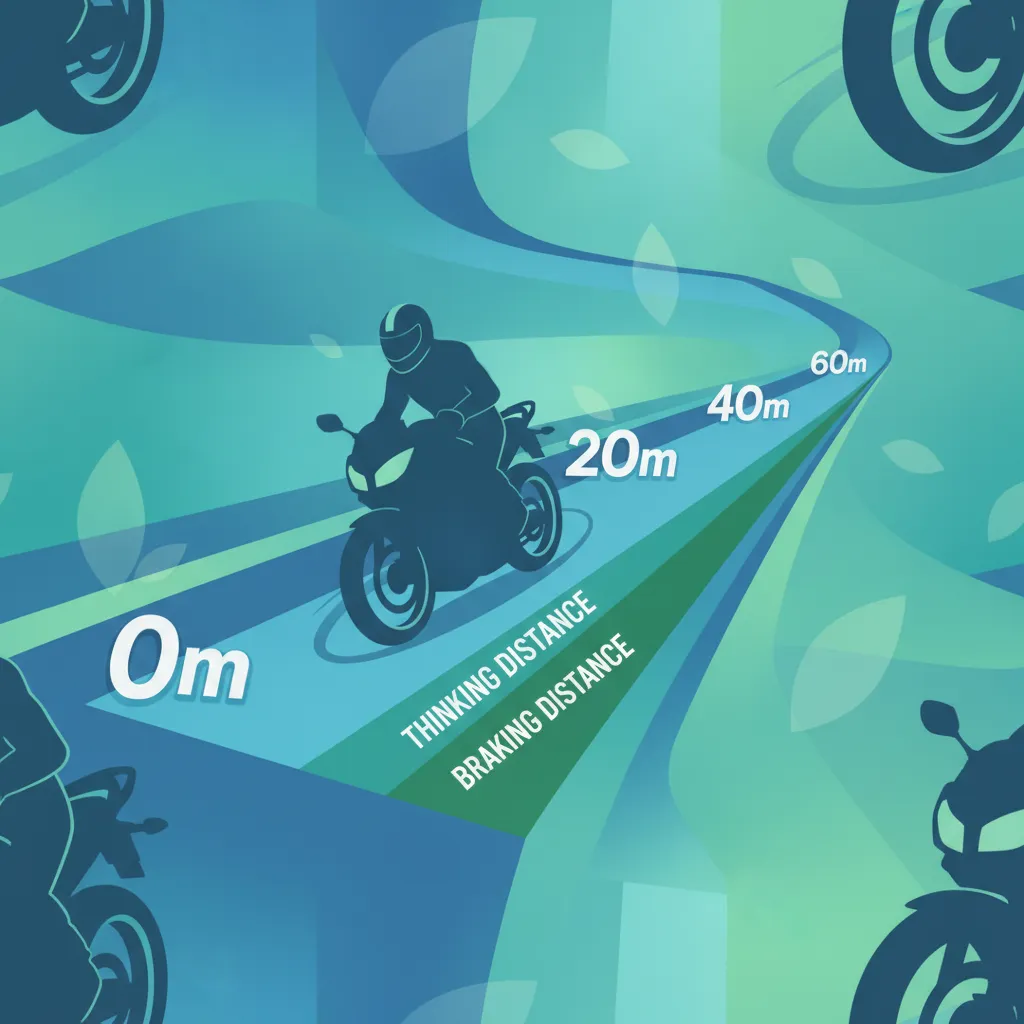
This lesson breaks down the physics of stopping a motorcycle, exploring how kinetic energy varies with the square of your speed. You will learn the mathematical components of total stopping distance, which includes both perception-reaction distance and physical braking distance. The lesson also explains how forward weight transfer during heavy braking increases traction on the front tire while reducing rear-wheel load.

Learners will be introduced to effective braking techniques tailored for AM vehicles, emphasizing progressive pressure application and the importance of maintaining grip. The lesson covers how to estimate stopping distances, execute emergency stops safely, and understand the limitations of light vehicle braking systems in France. Mastery of these techniques ensures riders can stop promptly and maintain control in various traffic scenarios.
Understand the specific traffic rules and safety protocols for managing interactions with vulnerable road users, agricultural machinery, and unlit intersections. This guide covers the operational requirements for category D drivers navigating both narrow rural routes and busy urban infrastructure in France.

This lesson details how to manage high-risk interactions with pedestrians who may step off curbs or cross the road near bus stops. Learners will study French Code de la route laws regarding pedestrian priority at crosswalks and near stopping transit vehicles. Developing heightened spatial awareness around blind zones near the front of the bus is emphasized to prevent tragic pedestrian collisions.

This lesson details the legal restrictions and appropriate use of acoustic horns and visual turn signals under the French Code de la route. Drivers will understand that in urban zones, the horn may only be used to warn of immediate, unavoidable danger to prevent accidents. It covers the correct timing of indicators and hazard lights to communicate intent clearly to surrounding traffic and pedestrians.

This lesson analyzes the various traffic challenges unique to operating large passenger vehicles in historic and modern French urban areas. Drivers will learn to manage narrow street layouts, double-parked delivery trucks, and high-density multi-lane roundabouts safely. The lesson emphasizes defensive driving strategies, route adjustments, and maintaining mental focus under severe schedule and time pressures.

Public transit vehicles like city buses and streetcars (trams) have clear legal priorities and dedicated infrastructure in urban areas. This lesson teaches you to recognize reserved transit lanes and your legal obligation to yield to buses exiting their designated stops. You will also learn safe driving strategies near tram tracks, ensuring you never block public transit lines or risk passenger boarding areas.
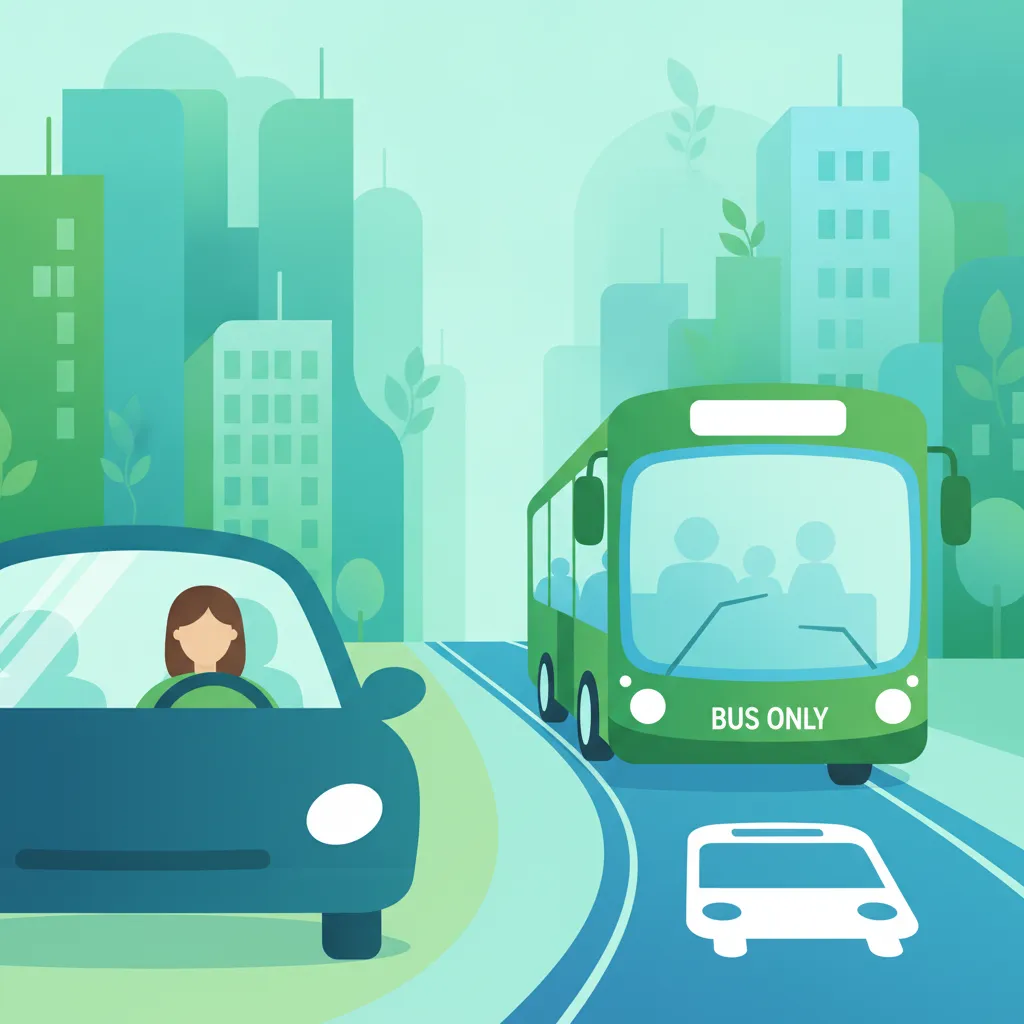
This lesson detail the exact laws governing the use of reserved bus lanes, detailing who may enter them and during what hours of operation. Drivers will study the penalties for unauthorized passenger cars occupying these lanes and the safety protocols for lane sharing with taxi cabs or cyclists. The lesson also highlights safe lane-merging practices when exiting reserved spaces to merge back into general urban traffic.
Find clear answers to common questions learners have about Rural Road Challenges and Strategies. Learn how the lesson is structured, which driving theory objectives it supports, and how it fits into the overall learning path of units and curriculum progression in France. These explanations help you understand key concepts, lesson flow, and exam focused study goals.
Service brakes can overheat during prolonged use on steep gradients, leading to brake fade. Using engine retardation maintains constant speed and keeps your primary brakes cool and ready for sudden stops or emergencies.
Reduce speed early, ensure you have sufficient clearance, and only overtake when visibility is perfect and no oncoming traffic is present. Often, it is safer to wait for a wider section of road to pass.
Check for width restriction signs well in advance. If the bridge is too narrow for two vehicles, respect the priority signs; if none are present, the vehicle that can yield most safely should do so.
Yes, you must be prepared to adjust your speed based on visibility. You should be able to stop within the distance illuminated by your headlights, and you must manage your high beams correctly when other road users are present.
Ready to focus your study? Use the practice search to find exactly the French driving theory questions you need for the Code de la route and permis de conduire ETG. Refine your knowledge on specific topics or challenging rules to boost your confidence and exam readiness.