
This lesson covers the critical steps following a traffic accident. You'll learn how to manage the accident scene safely and contact emergency services via the 112 number, essential knowledge for any Icelandic driver and for your Category B theory exam.
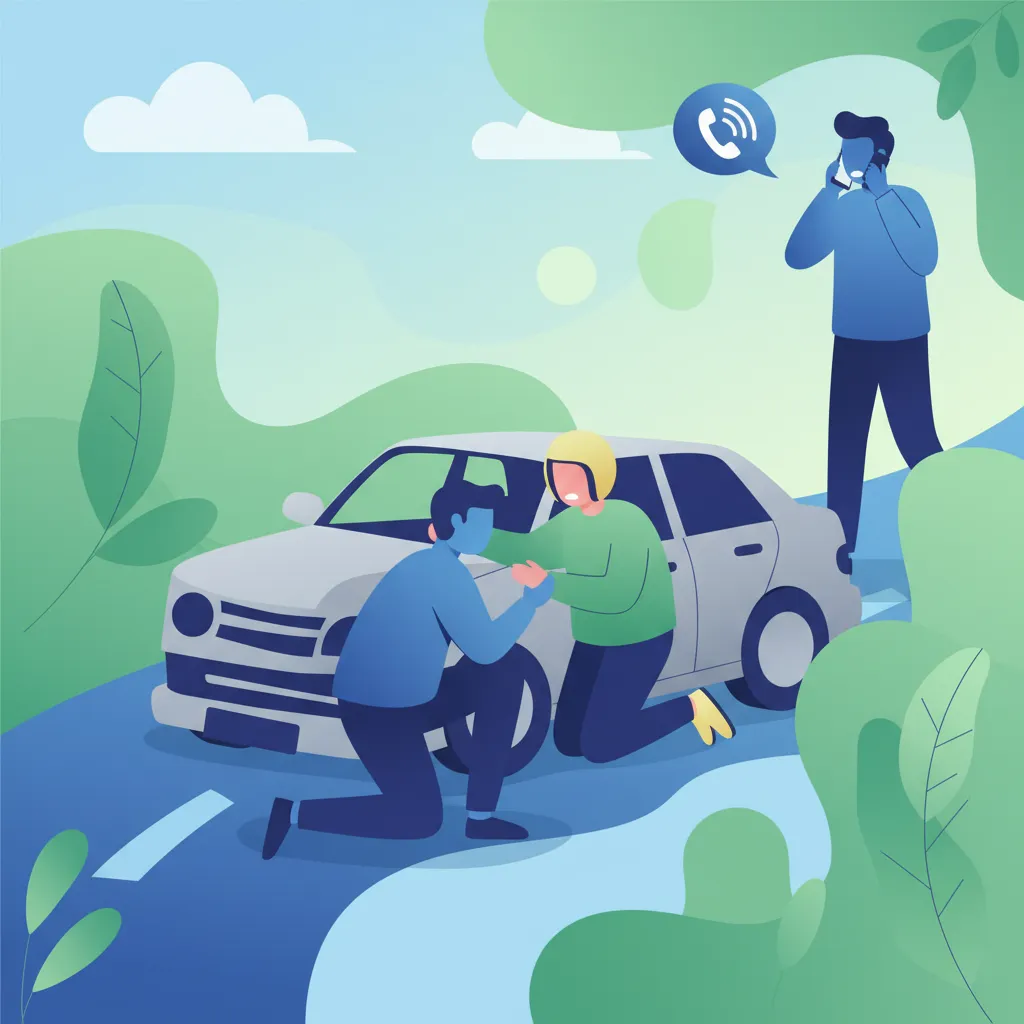
Lesson content overview
Navigating the complexities of traffic in Iceland requires not only skill and adherence to rules but also preparedness for unforeseen events. A traffic collision, no matter how minor, can be a stressful and potentially dangerous situation. Understanding the correct procedures for accident scene management and emergency contact is crucial for every driver. This knowledge protects yourself and others, prevents secondary collisions, and ensures you fulfill your legal obligations under Icelandic traffic law. This lesson will guide you through the essential actions to take immediately after an accident, focusing on securing the scene and contacting emergency services using the universal number 112.
The moments immediately following a collision are critical. Your primary goal is always to ensure safety – first your own, then that of your passengers, other road users, and finally, the accident scene itself. Panic can impair judgment, so having a clear plan of action is invaluable.
The first step is to quickly assess the situation for immediate dangers. This includes checking for injuries, the risk of fire, fuel leaks, or any other hazardous materials. If your vehicle is in a dangerous position, such as in the middle of a busy lane, and it can be moved safely, it should be done so without delay.
Never move an injured person unless they are in immediate danger (e.g., from fire or moving traffic). Moving someone with a spinal injury could cause further, irreversible harm.
After an accident, the scene itself can become a new hazard for oncoming traffic, potentially leading to secondary collisions. Your quick actions to make the scene visible and safe are paramount. Activating hazard lights, positioning the vehicle appropriately, and setting up warning devices are all part of securing the area. This proactive approach not only safeguards lives but also minimizes further damage and helps emergency services locate the incident more quickly.
Hazard warning lights are one of the most immediate and effective tools for alerting other drivers to a stationary or obstructed vehicle. These lights cause all the vehicle's turn signals to flash simultaneously, indicating an emergency or a potential danger on the road.
Flashing lights activated by the hazard switch, signalling a stationary or obstructed vehicle and warning other road users of a potential danger.
The primary purpose of hazard lights is to make your vehicle visible to approaching traffic, especially if it's unexpectedly stopped, moving slowly, or posing a hazard. This helps drivers anticipate a potential obstruction and adjust their speed or lane position accordingly, significantly reducing the risk of a secondary collision. In Iceland, using hazard lights is a mandatory requirement when your vehicle is immobilized on a public road or when you are attempting to clear the road after an incident.
You must activate your hazard lights immediately if your vehicle is involved in an accident and cannot move, or if it has broken down and is stopped on a public road. They should remain on until the vehicle is moved to a safe location or until emergency services arrive and take control of the scene. The hazard light switch is typically located on the dashboard, often marked with a red triangle symbol.
Familiarize yourself with the location of your vehicle's hazard light switch before an emergency occurs. Quick access can save valuable seconds.
It's important to note that hazard lights are not to be used as a signal for turning or changing lanes while driving, nor are they a substitute for indicating a temporary stop for purposes other than an emergency. Their use is strictly for warning other road users of a genuine hazard or emergency situation involving a stationary or significantly slowed vehicle. Misusing them can confuse other drivers and create additional risks.
The way you position your vehicle after a collision can have a significant impact on safety. The goal is to move the vehicle to a location that is as safe as possible for occupants and other road users, without causing further harm or exacerbating the situation.
Immediately after a collision, quickly assess if your vehicle can be moved safely. Consider the extent of the damage, whether anyone is injured, and the surrounding traffic conditions. If your vehicle is still operational and there are no immediate dangers (like fire or severe injuries that could be worsened by movement), it is generally advisable to move it off the main carriageway.
In Iceland, traffic law often requires drivers to remove vehicles from the traffic lane if it can be done without endangering persons or creating further hazards. This might mean moving to the hard shoulder on a highway, pulling into a parking lot, or simply moving a few meters to the side of a rural road.
There are critical circumstances when moving your vehicle would be unsafe or legally prohibited:
Assess immediate dangers: Check for injuries, fire, leaks, or immediate traffic hazards.
Activate hazard lights: Turn on your hazard lights immediately.
Evaluate movement: If safe and possible, move your vehicle to the nearest safe location off the main flow of traffic (e.g., hard shoulder, side street, parking area).
Secure the vehicle: Once moved, engage the parking brake and turn off the engine.
Use warning devices: Deploy a warning triangle and wear a safety vest (detailed in the next section).
Beyond hazard lights, physical warning devices like the warning triangle and personal safety vests are indispensable for securing an accident scene, especially in low visibility or on high-speed roads. These items are mandatory safety equipment in vehicles in Iceland.
A warning triangle is a portable, reflective device designed to be placed at a specific distance behind a stopped vehicle to provide an additional warning to approaching traffic. Its reflective properties make it highly visible even in adverse conditions.
The placement distance for warning triangles varies depending on the type of road:
Always ensure the triangle is stable and visible. When placing it, walk carefully against the flow of traffic, facing oncoming vehicles, to maximize your own safety.
A high-visibility safety vest (öryggisvesti) is a reflective garment designed to be worn by a driver or occupants when they exit a vehicle on a public road, especially in situations where visibility is poor or traffic is present.
In Iceland, it is mandatory for drivers to carry a safety vest in their vehicle and to wear it when exiting the vehicle on a road with traffic. This simple garment significantly increases your conspicuity to other road users, greatly reducing the risk of being struck by oncoming traffic while you are managing the scene or waiting for assistance.
Always keep your safety vest easily accessible within the passenger compartment of your vehicle, not buried in the trunk, so you can put it on before you exit.
After securing the immediate accident scene, the next crucial step is to contact emergency services. In Iceland, the universal emergency number for police, fire, and medical services is 112. Knowing when and how to call 112 is vital for ensuring a rapid and appropriate response.
The universal telephone number for contacting police, fire, and medical services in Iceland. It is accessible from all phones, free of charge.
You are legally obliged to call 112 immediately if:
For minor incidents where there are no injuries, no fire risk, and minimal damage (e.g., a minor fender-bender in a parking lot), and all parties are present and willing to exchange details, a 112 call might not be strictly necessary for emergency response, but police reporting might still be required later. When in doubt, it is always safer to call.
When you call 112, staying calm and providing clear, concise information is essential. The operator will guide you, but be prepared to provide the following details:
Identify yourself: State your name and contact number.
Exact location: Provide the precise location of the accident. Use road names, nearest landmarks, GPS coordinates if possible, or even kilometer markers on highways. "I'm on Road 1 (Hringvegur) near the Jökulsárlón glacier lagoon, about 5 km east of the bridge."
Nature of the incident: Clearly state that you are reporting a traffic accident.
Number and type of vehicles involved: "Two cars and a motorcycle."
Injuries: Report any injuries, how many people are injured, and their apparent condition. "There are three injured people, one appears to have a head injury and is unconscious."
Immediate dangers: Mention any risks such as fire, smoke, fuel leaks, or if the accident is blocking traffic.
Stay on the line: Do not hang up until the operator instructs you to do so. They may need more information or need to provide you with instructions.
It's natural to feel stressed after an accident. Take a deep breath, focus on the facts, and speak clearly. The 112 operator is trained to help you through this process. Listen carefully to their instructions, which might include advice on basic first aid or further scene management steps. Your cooperation helps them dispatch the correct resources quickly.
Beyond immediate safety and emergency contact, drivers involved in accidents in Iceland have specific legal obligations regarding reporting and police involvement. Fulfilling these duties is crucial for legal compliance, insurance purposes, and proper accident investigation.
The statutory requirement for drivers involved in certain types of collisions to inform the police or other authorities within a defined time frame.
Icelandic law (Road Traffic Act) specifies situations where reporting an accident to the police is mandatory. You must report to the police if:
For minor fender-benders without injuries, fire risk, or significant damage, and where all parties are present and exchange details, a direct police report might not be strictly required for immediate response, but an official report may still be needed for insurance purposes. When in doubt, it is always best to contact 112 for guidance or to report the incident.
If other vehicles or parties are involved in the accident, and it is safe to do so, you should exchange the following information:
It is advisable to take photographs of the scene, vehicle damage, and any relevant road conditions to aid in documentation for insurance claims and police reports.
Unless medically unable to do so, you must remain at the crash site until the police or emergency services have completed their assessment and given you permission to leave. Leaving the scene prematurely, especially if injuries are involved or significant damage has occurred, can lead to serious legal consequences, including fines, license suspension, or even criminal charges for hit-and-run.
Even in minor incidents where police presence is not immediately required, you must not leave until you have exchanged details with all involved parties.
Beyond managing the vehicle and contacting authorities, your personal safety and a basic awareness of first aid are crucial. The accident scene can present ongoing risks, and knowing how to respond safely can prevent further harm.
Upon assessing the scene, prioritize your own safety and that of others. Before exiting your vehicle, quickly scan for:
Always wear your high-visibility safety vest if you need to exit the vehicle on a public road. If you must walk on the road, face oncoming traffic and be aware of your surroundings.
While detailed first aid training is covered in a subsequent lesson (Lesson 12.2: Basic First-Aid and Injury Management), it is important to have a basic understanding of immediate injury management at the scene:
Your role as a driver is primarily to ensure the scene is safe and to alert professionals. Only administer first aid if you are trained and confident, otherwise, focus on keeping the injured person calm and safe until paramedics arrive.
Effective accident scene management is not a one-size-fits-all approach. Various external factors and conditions can influence the best course of action. Being aware of these variations helps in making appropriate decisions under pressure.
Iceland's weather can be challenging, and adverse conditions significantly impact accident response:
Darkness amplifies the need for visual warnings:
The environment where the accident occurs dictates specific actions:
When pedestrians, cyclists, or motorcyclists are involved, extra sensitivity and caution are required:
Accident scene management and emergency contact are not just about following rules; they are about responsible driving and protecting lives. By understanding and practicing the principles outlined in this lesson, you equip yourself with the knowledge to respond effectively and safely in the stressful aftermath of a collision on Icelandic roads. Remember the sequence: Secure the scene, contact emergencies, and fulfill your legal duties. Your preparedness can make a critical difference.
This lesson covers the essential procedures for managing an accident scene on Icelandic roads, emphasizing immediate safety assessment, hazard activation, and vehicle positioning. Key actions include activating hazard lights, deploying warning triangles at specific distances based on road type, and wearing high-visibility safety vests. The 112 emergency protocol requires providing your name, precise location, vehicle details, injury information, and any immediate dangers. Legal duties include mandatory reporting when injuries, significant damage, or traffic obstruction occur, and remaining at the scene until permitted to leave.
A short set of high-value points that capture the most important learning from this lesson.
Your first priority after any collision is personal safety, then protecting other road users from secondary collisions.
Activate hazard lights immediately when your vehicle is immobilized on any public road in Iceland.
Move vehicles off the traffic lane only when safe to do so; otherwise, keep them in place and await emergency services.
Always call 112 when injuries occur, fire risk exists, hazardous materials are involved, or traffic is blocked.
Never move an injured person unless they face immediate danger from fire or moving traffic.
Explore all units and lessons included in this driving theory course.
Warning triangle placement distances: 30 meters on highways, 15 meters on urban roads, 5 meters in residential areas.
The universal emergency number in Iceland is 112, usable free from any phone.
You must remain at the scene and exchange details with all parties unless prevented by injury or emergency services instruct otherwise.
Icelandic law mandates police reporting when injuries occur, significant property damage exceeds the legal threshold, or road traffic is obstructed.
Always wear a safety vest (öryggisvesti) before exiting your vehicle on a public road.
Using hazard lights while driving to signal a turn or lane change, which is prohibited and can confuse other drivers.
Moving an injured person with suspected spinal injuries, potentially causing irreversible harm.
Placing warning triangles too close to the vehicle instead of at the legally required distances.
Failing to call 112 for minor collisions because no immediate injuries are apparent, even when significant damage or obstruction occurs.
Leaving the scene after exchanging details without waiting for police clearance when required.
Lesson content overview
A short set of high-value points that capture the most important learning from this lesson.
Your first priority after any collision is personal safety, then protecting other road users from secondary collisions.
Activate hazard lights immediately when your vehicle is immobilized on any public road in Iceland.
Move vehicles off the traffic lane only when safe to do so; otherwise, keep them in place and await emergency services.
Always call 112 when injuries occur, fire risk exists, hazardous materials are involved, or traffic is blocked.
Never move an injured person unless they face immediate danger from fire or moving traffic.
Explore all units and lessons included in this driving theory course.
Warning triangle placement distances: 30 meters on highways, 15 meters on urban roads, 5 meters in residential areas.
The universal emergency number in Iceland is 112, usable free from any phone.
You must remain at the scene and exchange details with all parties unless prevented by injury or emergency services instruct otherwise.
Icelandic law mandates police reporting when injuries occur, significant property damage exceeds the legal threshold, or road traffic is obstructed.
Always wear a safety vest (öryggisvesti) before exiting your vehicle on a public road.
Using hazard lights while driving to signal a turn or lane change, which is prohibited and can confuse other drivers.
Moving an injured person with suspected spinal injuries, potentially causing irreversible harm.
Placing warning triangles too close to the vehicle instead of at the legally required distances.
Failing to call 112 for minor collisions because no immediate injuries are apparent, even when significant damage or obstruction occurs.
Leaving the scene after exchanging details without waiting for police clearance when required.
Explore search topics learners often look for when studying Accident Scene Management and Emergency Contact. These topics reflect common questions about road rules, driving situations, safety guidance, and lesson level theory preparation for learners in Iceland.
Browse additional driving theory lessons that cover connected traffic rules, road signs, and common driving situations related to this topic. Improve your understanding of how different rules interact across everyday traffic scenarios.
Learn the critical steps for managing an accident scene in Iceland. This guide covers securing the area, using hazard lights, safely positioning vehicles, and effectively contacting emergency services via 112 for rapid response.
This lesson examines the administrative and legal processes that follow a road accident, covering how to file a police report, document the scene with photographs, and gather witness statements. Learners will study the insurance claim process, including submission of documentation, arranging vehicle repairs, and understanding timelines for claim settlement. Additionally, the lesson outlines the legal obligations of drivers post-accident and the potential impact on their driving record.

This lesson provides foundational first-aid knowledge required for drivers who encounter an injury at a crash scene, covering how to control bleeding, perform basic CPR, and stabilize fractures. The content emphasizes maintaining scene safety while attending to injured parties, the correct use of an emergency kit, and effective communication with ambulance services. Mastering these basic medical interventions can contribute to better outcomes for accident victims.
This lesson provides an overview of the legal penalties for traffic violations and outlines the correct procedures to follow after an accident. It covers how to secure an accident scene, contact emergency services using 112, and provide basic first aid. Riders will also learn about their legal obligations for reporting incidents and the initial steps for making an insurance claim.
This lesson focuses on the operation of traffic lights in Iceland, describing standard three-phase cycles (red, amber, green) and variations such as flashing amber for yielding. Learners will also explore dedicated signals for pedestrians, cyclists, and turning movements, including arrow indications. The lesson explains how signal timing integrates with right-of-way rules at intersections, ensuring drivers can interpret and respond to each light state to maintain safety.
Understand your legal obligations following a traffic collision in Iceland. This lesson details when and how to report accidents to the police, required information exchange, and the consequences of failing to comply with Icelandic traffic laws.
This lesson examines the administrative and legal processes that follow a road accident, covering how to file a police report, document the scene with photographs, and gather witness statements. Learners will study the insurance claim process, including submission of documentation, arranging vehicle repairs, and understanding timelines for claim settlement. Additionally, the lesson outlines the legal obligations of drivers post-accident and the potential impact on their driving record.
This lesson explores the insurance landscape required for operating a vehicle in Iceland, emphasizing compulsory liability insurance and options for comprehensive coverage. The content explains the distinctions between third-party liability and full coverage policies, the documentation needed for proof of insurance, and the procedural steps for filing an accident claim. Learners also study the legal responsibilities associated with insurance renewal and risk assessment factors.
This lesson provides an overview of the legal penalties for traffic violations and outlines the correct procedures to follow after an accident. It covers how to secure an accident scene, contact emergency services using 112, and provide basic first aid. Riders will also learn about their legal obligations for reporting incidents and the initial steps for making an insurance claim.
This lesson examines the set of safety equipment required by Icelandic law to be present in every passenger vehicle, focusing on seat belts, airbags, fire extinguishers, and reflective vests. The content explains the correct placement and usage protocols for each item, including how to operate a fire extinguisher and don a reflective vest. Additionally, learners are introduced to the legal requirement for an emergency triangle and a first-aid kit.
This lesson explores the health criteria mandated by Icelandic law for operating a vehicle, focusing on visual and auditory acuity, as well as overall physical capability. Students will study required medical certifications and understand acceptable vision levels and hearing standards necessary for safe driving. The lesson also outlines how chronic illnesses, medication side-effects, and mental health conditions can influence driver fitness and legal compliance.
This lesson outlines the regulations governing pedestrian crossings, including zebra crossings, pedestrian traffic lights, and the driver’s obligations to yield. Learners will study how to identify crosswalk markings, interpret pedestrian signal phases, and understand the enhanced caution required in school zones and areas with high foot traffic. The content also emphasizes the need for drivers to anticipate vulnerable pedestrians and provide additional yielding in low-visibility conditions.
This lesson provides foundational first-aid knowledge required for drivers who encounter an injury at a crash scene, covering how to control bleeding, perform basic CPR, and stabilize fractures. The content emphasizes maintaining scene safety while attending to injured parties, the correct use of an emergency kit, and effective communication with ambulance services. Mastering these basic medical interventions can contribute to better outcomes for accident victims.
Find clear answers to common questions learners have about Accident Scene Management and Emergency Contact. Learn how the lesson is structured, which driving theory objectives it supports, and how it fits into the overall learning path of units and curriculum progression in Iceland. These explanations help you understand key concepts, lesson flow, and exam focused study goals.
The absolute first step is to ensure your own safety and the safety of others. Check for immediate dangers like oncoming traffic or fire. Then, turn on your hazard lights to warn other drivers and assess if anyone is injured. You must also call the emergency number 112 as soon as it is safe to do so.
For minor accidents where no one is injured and vehicles can be moved, it is often recommended to move them to a safe location, such as the side of the road, to avoid obstructing traffic and prevent further collisions. Ensure you use your hazard lights and are aware of your surroundings.
When you call 112, be prepared to state your exact location, the nature of the incident (e.g., collision, injury), the number of vehicles involved, and if there are any injuries. Speak clearly and calmly, and follow the dispatcher's instructions.
In Iceland, you are legally required to report accidents to the police, especially if there are injuries, significant property damage, or if a driver appears to be under the influence of alcohol or drugs. For minor fender-benders without injuries, follow the procedures outlined by your insurance provider, but always be aware of your legal duty to report.
If your vehicle cannot be moved safely, keep your hazard lights on and try to make the scene as visible as possible to oncoming traffic. Stay in a safe location away from moving vehicles and call 112 immediately to report the obstruction and request assistance.
Utilize our advanced practice set search to pinpoint the exact Icelandic driving theory topics you need to review. Filter by subject, difficulty, or question type to create a highly effective study plan and ensure you are fully prepared for your official driving licence test in Iceland.