
This lesson provides the foundational knowledge for operating a Category B vehicle in Poland. You'll learn the correct steps for starting the engine, performing smooth starts (even on hills), and securely stopping the vehicle. Understanding these procedures is crucial for your Polish driving theory exam and for developing safe, confident driving habits from the very beginning of your journey.
Lesson content overview
Welcome to this essential lesson in your Polish Driving Theory – Comprehensive Category B License Preparation course. Mastering the fundamental procedures for starting, stopping, and managing your vehicle's engine while stationary is crucial not only for passing your driving exam but also for safe, efficient, and environmentally responsible driving on Polish roads. This chapter will guide you through the correct use of the ignition system, handbrake, gear selection, and techniques for smooth acceleration and controlled deceleration. We will also delve into fuel-efficient idling practices and proper engine shutdown protocols, all in accordance with Polish traffic law.
The ability to start your vehicle smoothly, bring it to a controlled stop, and manage its engine efficiently when stationary forms the bedrock of competent driving. These seemingly simple actions are complex sequences of coordinated movements and decisions that directly impact safety, vehicle longevity, fuel economy, and environmental protection. A controlled start prevents unintended movement, while progressive stopping maintains vehicle stability and prevents loss of control. Furthermore, understanding the physics behind engine torque, friction, and inertia helps you anticipate how your vehicle will react, allowing for safer maneuvers.
Polish traffic law emphasizes securing a parked vehicle with the handbrake and prohibits unnecessary engine idling due to environmental concerns and safety. By adhering to these practices, you lay the groundwork for more advanced driving skills, such as hill starts, precise stops at intersections, and emergency braking.
The ignition system is the set of components responsible for bringing your vehicle's engine to life. Engaging it correctly is the first step in any journey and must be done with precision and awareness to prevent accidental movement.
Traditionally, vehicles are started with a key-based ignition system, where a physical metal key is inserted into an ignition lock and turned. This action typically progresses through several stages: "Accessory" (powering radio, etc.), "On" (powering dashboard lights, fuel pump), and "Start" (engaging the starter motor).
Modern vehicles often feature a push-button start system. With this setup, the vehicle detects a smart key fob inside the cabin, and the driver presses a button to start the engine. For safety, most push-button systems require the driver to depress the clutch pedal (in a manual transmission) or the brake pedal (in an automatic transmission) before the engine will engage. This safety interlock prevents the vehicle from unexpectedly lurching forward or backward if it was left in gear.
Regardless of the ignition type, certain steps are fundamental for a safe engine start:
Ensure Gear Neutral/Park: Before turning the key or pressing the start button, always confirm that your vehicle's transmission is in neutral (N) for manual cars, or park (P) for automatic cars. This prevents the vehicle from moving forward or backward as the engine starts.
Depress Clutch/Brake: In a manual car, fully depress the clutch pedal. In an automatic car, fully depress the brake pedal. This is often a safety requirement for the engine to start, especially with push-button systems.
Engage Handbrake: While not always strictly necessary on perfectly flat ground, it is a good habit to ensure the handbrake is engaged before starting the engine. This provides an additional layer of security against unintended movement.
Turn Key/Press Button: Once the above conditions are met, turn the ignition key to the "Start" position briefly until the engine fires, then release it. For push-button systems, press and hold the button until the engine starts.
Release Clutch (Manual): If starting a manual car, slowly release the clutch pedal after the engine has started, while keeping the gear in neutral.
Polish Road Traffic Act, § 74, mandates that the driver must start the vehicle only after ensuring the transmission is in neutral (or park) and the handbrake is applied. This rule is designed to prevent unintended vehicle movement and potential collisions. Starting a car while it's in gear can cause it to lurch forward unexpectedly, posing a significant safety risk.
The handbrake, also known as the parking brake, is a crucial safety component designed to immobilize your vehicle when it is stationary. Its primary purpose is to prevent the vehicle from rolling away, especially on inclines, and to protect the transmission from unnecessary strain when parked.
Most drivers are familiar with the cable-operated handbrake, which is typically a lever located between the front seats. To engage it, you usually press a button (or not, depending on the model) and pull the lever upwards. To release it, you pull the lever up slightly, press the button, and lower the lever completely.
Modern vehicles increasingly feature an Electronic Parking Brake (EPB), which is operated by a button or a small switch on the dashboard or center console. Engaging an EPB usually involves pulling or pushing the button, while releasing it often requires pressing the brake pedal and then operating the EPB switch. Some EPB systems can automatically engage when the engine is turned off and automatically release when the driver starts to move the vehicle.
The handbrake must be engaged whenever you leave your vehicle, even for a brief moment. It is particularly critical when parking on any incline, as it prevents the vehicle from rolling away.
Polish Road Traffic Act – § 5 explicitly states that the driver must secure the vehicle with a handbrake when parked. Furthermore, § 43 clarifies that using the foot brake alone is insufficient on steep slopes; the handbrake must be engaged to prevent roll-away due to potential brake fade or driver error. Failing to secure your vehicle properly can lead to significant consequences, including accidents and legal penalties.
When parking on an uphill slope:
The transmission system allows you to manage the power output from the engine to the wheels, enabling your vehicle to move at different speeds and torque levels. Understanding how to select the correct gear is fundamental for safe and efficient driving.
In a manual transmission vehicle, you manually select gears using a gear shift lever and the clutch pedal.
Polish law stipulates that moving the vehicle without being in gear (or with the clutch fully depressed, which is effectively disconnecting the engine) is prohibited. This is considered "rolling" and is unsafe as it significantly reduces driver control, especially when braking or needing immediate acceleration. Polish Road Traffic Act – § 81 clarifies that a driver must not move a vehicle while the transmission is in neutral unless the vehicle is being pushed.
Automatic transmissions simplify gear selection. The main positions are:
When starting an automatic car, ensure the selector is in "P" (or "N" for some older models) and your foot is on the brake pedal before pressing the start button or turning the key.
For manual transmission drivers, the clutch pedal is your interface between the engine and the wheels. It allows you to disengage engine power from the transmission temporarily, which is essential for changing gears and for moving off smoothly from a standstill.
The key to a smooth start in a manual car is the coordinated release of the clutch pedal with the gradual application of the accelerator pedal.
Full Clutch Depression: With the engine running, fully depress the clutch pedal and select first gear.
Gentle Acceleration: Gently press the accelerator pedal to raise the engine RPM slightly, typically to around 1500-2000 rpm. This provides the engine with enough power to start moving the vehicle.
Slow Clutch Release to Bite Point: Slowly release the clutch pedal. You will feel a slight change in the engine's sound or feel a subtle pull as the clutch plates begin to engage. This is known as the "bite point" or "friction point."
Coordinate Release and Throttle: At the bite point, hold the clutch briefly, and simultaneously increase the accelerator pressure slightly. As the vehicle begins to move, continue to slowly release the clutch fully while progressively applying more throttle.
Releasing the clutch too quickly without enough throttle will cause the engine to stall. Conversely, excessive throttle with a slow clutch release will cause the engine to rev high and waste fuel, potentially damaging the clutch. Practice is key to mastering this coordination.
Once the engine is running and the correct gear is selected, applying power to move the vehicle requires a progressive and controlled approach. Progressive acceleration means gradually increasing the throttle (accelerator pedal) to move the vehicle smoothly from rest or to increase speed.
The goal of progressive acceleration is to apply just enough engine power to overcome the vehicle's inertia and static friction without causing the wheels to spin. This is particularly important on surfaces with reduced traction, such as wet, icy, or gravel roads. Smooth acceleration improves traction, reduces wear on tires and drivetrain components, and enhances passenger comfort.
"Jerk starts," caused by releasing the clutch too quickly or abruptly pressing the accelerator, can lead to uncontrolled vehicle lurching, wheel spin, and discomfort for passengers. In traffic, sudden acceleration can startle following drivers and increase the risk of rear-end collisions. Polish regulations indirectly discourage excessive revving before movement, promoting smooth and controlled driving.
Bringing your vehicle to a complete and controlled halt is as critical as a smooth start. Smooth deceleration involves applying the brake pedal in a graduated manner, often combined with downshifting in manual cars, to bring the vehicle to rest without loss of control, skidding, or unnecessary wear on components.
To decelerate smoothly, release the accelerator and apply gentle, increasing pressure to the brake pedal. This graduated approach maintains vehicle stability, prevents abrupt weight transfer, and allows following drivers to anticipate your actions. Abrupt braking causes high temperatures in the brake pads and discs, accelerating wear. It can also lead to wheel lock-up, especially without an Anti-lock Braking System (ABS), resulting in a skid and loss of steering control. Even with ABS, smooth pressure is preferable for optimal stopping distance and control.
In a manual transmission vehicle, downshifting (shifting to a lower gear as your speed decreases) uses the engine's braking effect to aid deceleration. This reduces the strain on your friction brakes, helps maintain control, and positions you in the correct gear for accelerating again if the stop is brief. For instance, approaching a red light, you might release the accelerator, apply the brake gently, and then downshift from fourth to third, then to second, coming to a stop in second or first gear. As you come to a complete stop, fully depress the clutch and shift to neutral to prevent the engine from stalling.
At stop signs, traffic lights, or before pedestrian crossings, you must bring your vehicle to a full and complete stop. This means zero movement.
Polish Road Traffic Act requires drivers to stop at designated stop lines, before traffic lights showing a red signal, and before pedestrian crossings where pedestrians are present or about to enter. Failure to do so can result in fines and points on your license.
Idling refers to the period when your engine is running while your vehicle is stationary. While necessary for short stops, prolonged idling is inefficient, environmentally harmful, and often regulated by law.
When your engine idles, it continues to consume fuel, produce exhaust emissions, and contribute to engine wear, all without moving the vehicle. For modern cars, idling consumes approximately 0.6 litres of fuel per hour. This seemingly small amount adds up, contributing to higher fuel costs, increased air pollution (carbon dioxide, nitrogen oxides, particulate matter), and unnecessary noise.
To combat these issues, Polish regulations, like those in many other countries, advise (and in some municipalities, legally require) drivers to turn off their engines after a prolonged stop.
As a general guideline, if you anticipate being stationary for more than 30 seconds (e.g., at a long traffic light, a railway crossing with the barrier down, or waiting in a queue), it is recommended to turn off your engine. Many modern vehicles are equipped with "start-stop" systems that automatically shut off the engine when the vehicle comes to a halt and restart it when the brake pedal is released or the clutch is depressed.
Safely turning off your vehicle, known as the engine shut-down procedure, is the final step after a journey. It ensures the vehicle is secured, prevents battery drain, and sets the stage for your next safe start.
Come to a Complete Stop: Bring your vehicle to a complete stop at your desired parking spot.
Shift to Neutral/Park: For a manual car, shift the gear lever to neutral (N). For an automatic car, shift to park (P).
Engage Handbrake: Firmly engage the handbrake. This is critical for securing the vehicle, especially on any incline.
Disengage Foot Brake: Once the handbrake is engaged and the vehicle is secure, you can release the foot brake.
Turn Off Engine: Turn the ignition key to the "OFF" position or press the engine stop button.
Remove Key/Secure Car: Remove the key (if applicable) and ensure all doors are locked before leaving the vehicle.
Leaving a vehicle in gear with the engine off, particularly on a slope, without the handbrake engaged is extremely dangerous. The vehicle could roll, causing significant damage or injury. The handbrake provides reliable mechanical security. Always ensure your vehicle is fully secured before exiting, as mandated by Polish Road Traffic Act – § 5.
Adherence to Polish traffic law is not only about avoiding penalties but also about ensuring road safety for everyone. Several articles directly govern starting, stopping, and idling procedures.
Awareness of common errors is crucial for avoiding them and developing safe driving habits.
Driving is rarely static. External conditions, vehicle state, and the presence of vulnerable road users require constant adaptation of your starting, stopping, and idling techniques.
When starting or stopping near pedestrians, cyclists, or motorcyclists, always apply acceleration and deceleration as smoothly as possible. Sudden movements or excessive engine noise can startle them, potentially causing them to react unpredictably or lose balance. Maintain extra observation before moving off to ensure no vulnerable users are in your immediate path.
Mastering starting, stopping, and idling procedures is fundamental for any driver seeking a Polish Category B license. By consistently applying the core principles discussed, you ensure safety, prolong your vehicle's life, save fuel, and contribute to a cleaner environment.
By understanding the underlying physics, adhering to Polish Road Traffic Act regulations, and adapting your techniques to varying conditions, you will develop the confidence and competence required for responsible driving.
This lesson covers the essential procedures for starting, stopping, and managing vehicle idling as required for the Polish Category B theory exam. Key procedures include the correct ignition sequence with neutral/park and handbrake engaged, proper handbrake use on all inclines per Polish law, and smooth clutch-throttle coordination for manual starts. The content explains progressive acceleration and smooth deceleration techniques, the importance of staying in gear (neutral prohibited for movement), and Poland's idling regulations requiring engine shutdown during prolonged stops. Understanding these fundamentals prevents common mistakes such as stalling, roll-aways, and unnecessary clutch wear while ensuring compliance with Polish traffic law.
A short set of high-value points that capture the most important learning from this lesson.
Before starting the engine, always confirm neutral (manual) or park (automatic) and engage the handbrake as required by Polish Road Traffic Act § 74.
The handbrake is mandatory for securing a parked vehicle and on steep slopes; foot brake alone is insufficient per § 43.
Smooth manual starts require coordinating gradual clutch release at the bite point with progressive throttle application.
Polish law prohibits moving a vehicle in neutral unless it is being pushed (§ 81), meaning you must stay in gear for control.
Turn off your engine during prolonged stops (typically longer than 30 seconds) to comply with idling regulations and eco-driving principles.
Explore all units and lessons included in this driving theory course.
Pre-start sequence: neutral/park → depress clutch/brake → engage handbrake → then start engine.
On uphill parking: stop with foot brake → neutral/park → handbrake → release foot brake → turn off engine → turn wheels toward curb.
Riding the clutch (resting foot on pedal) causes excessive wear and should be avoided; only depress fully when changing gears or stopping.
Progressive acceleration prevents wheel spin and jerky movement; release clutch slowly to the bite point before adding throttle.
When stopping a manual car, depress the clutch before the vehicle stalls and shift to neutral before releasing the clutch pedal.
Rolling in neutral on slopes, which eliminates engine braking and reduces driver control.
Releasing the clutch too quickly without sufficient throttle, causing the engine to stall.
Failing to engage the handbrake on inclines, leading to unintended vehicle roll-back.
Keeping the engine idling for extended periods at traffic lights or in traffic jams, wasting fuel and increasing emissions.
Attempting to start an automatic vehicle while it is in Drive or Reverse, causing unexpected lurching.
Lesson content overview
A short set of high-value points that capture the most important learning from this lesson.
Before starting the engine, always confirm neutral (manual) or park (automatic) and engage the handbrake as required by Polish Road Traffic Act § 74.
The handbrake is mandatory for securing a parked vehicle and on steep slopes; foot brake alone is insufficient per § 43.
Smooth manual starts require coordinating gradual clutch release at the bite point with progressive throttle application.
Polish law prohibits moving a vehicle in neutral unless it is being pushed (§ 81), meaning you must stay in gear for control.
Turn off your engine during prolonged stops (typically longer than 30 seconds) to comply with idling regulations and eco-driving principles.
Explore all units and lessons included in this driving theory course.
Pre-start sequence: neutral/park → depress clutch/brake → engage handbrake → then start engine.
On uphill parking: stop with foot brake → neutral/park → handbrake → release foot brake → turn off engine → turn wheels toward curb.
Riding the clutch (resting foot on pedal) causes excessive wear and should be avoided; only depress fully when changing gears or stopping.
Progressive acceleration prevents wheel spin and jerky movement; release clutch slowly to the bite point before adding throttle.
When stopping a manual car, depress the clutch before the vehicle stalls and shift to neutral before releasing the clutch pedal.
Rolling in neutral on slopes, which eliminates engine braking and reduces driver control.
Releasing the clutch too quickly without sufficient throttle, causing the engine to stall.
Failing to engage the handbrake on inclines, leading to unintended vehicle roll-back.
Keeping the engine idling for extended periods at traffic lights or in traffic jams, wasting fuel and increasing emissions.
Attempting to start an automatic vehicle while it is in Drive or Reverse, causing unexpected lurching.
Explore search topics learners often look for when studying Starting, Stopping, and Idling Procedures. These topics reflect common questions about road rules, driving situations, safety guidance, and lesson level theory preparation for learners in Poland.
Browse additional driving theory lessons that cover connected traffic rules, road signs, and common driving situations related to this topic. Improve your understanding of how different rules interact across everyday traffic scenarios.
Learn how to adjust starting, stopping, and idling procedures for various conditions like adverse weather, heavy loads, and urban versus motorway driving. Essential theory for safe and compliant driving in Poland.
This lesson teaches drivers how to adapt their speed, following distance, and control inputs to safely navigate adverse conditions. It covers the challenges posed by rain, snow, and ice, explaining the loss of traction and the increased risk of skidding or aquaplaning. The content provides specific strategies for driving in fog, which reduces visibility, and strong crosswinds, which can affect the stability of a high-sided vehicle, promoting a proactive and defensive driving mindset.
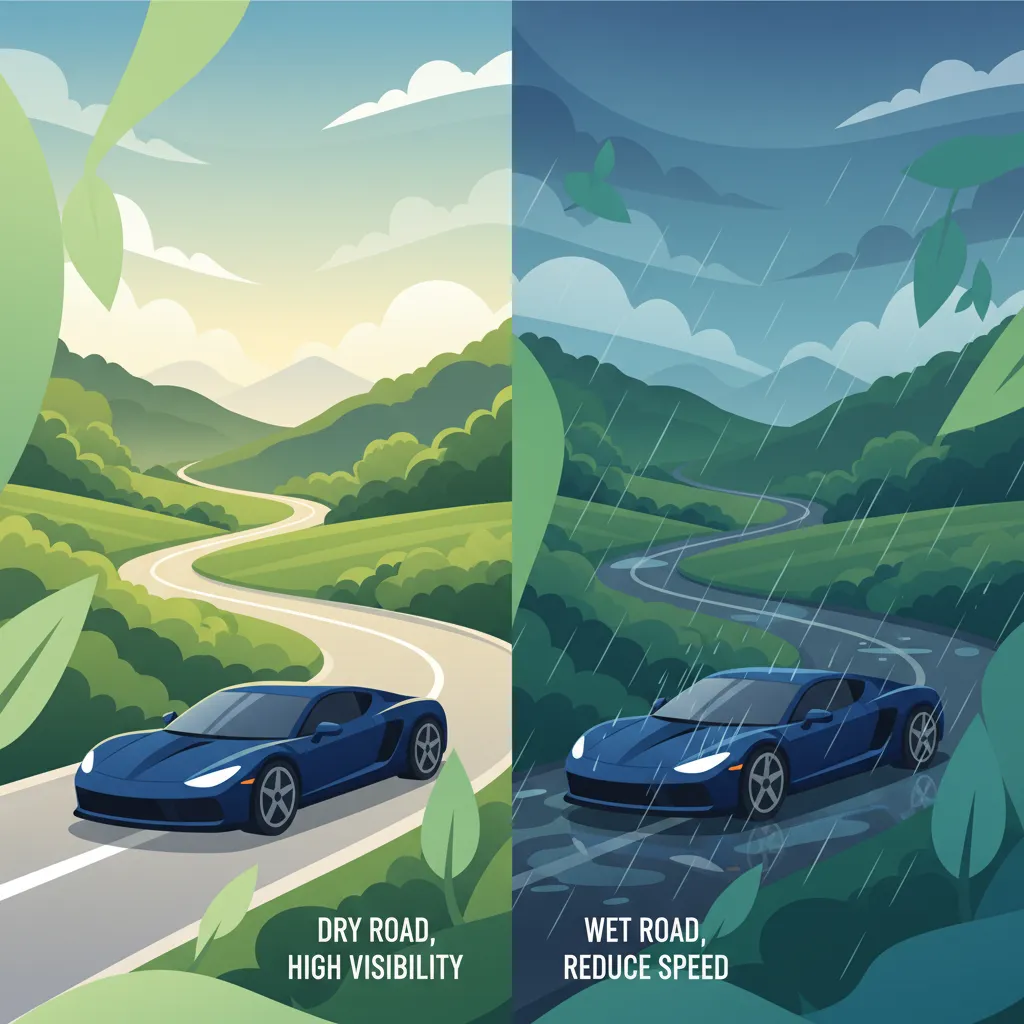
In this lesson, learners examine how environmental conditions such as rain, wind, ice, and reduced visibility necessitate adjustments in riding speed. The content provides guidelines for assessing road surfaces, judging appropriate cornering speeds, and reducing speed proactively in adverse weather. Learners will understand the impact of temperature on tyre performance and the need to increase safety margins, mastering adaptive speed management to maintain control.
This lesson teaches the crucial concept that drivers must always adapt their speed to the current conditions. It explains how factors like rain, fog, ice, heavy traffic, and poor visibility reduce safety margins and require a lower speed than the posted limit. This principle of defensive driving is essential for preventing accidents in challenging situations.
This lesson details the specific driving adjustments needed for adverse weather. It focuses on how rain, snow, and ice affect vehicle dynamics and driver perception. Learners will study techniques to prevent hydroplaning, use winter tires effectively, and increase following distances on slippery surfaces while using safety systems like fog lights.
This lesson focuses on the specific challenges of driving in rainy conditions. It explains the phenomenon of hydroplaning, where tires lose contact with the road surface, and how to prevent it by reducing speed. The importance of good tire condition, effective windscreen wipers, and extending following distances is also covered in detail.
Find clear answers to common questions learners have about Starting, Stopping, and Idling Procedures. Learn how the lesson is structured, which driving theory objectives it supports, and how it fits into the overall learning path of units and curriculum progression in Poland. These explanations help you understand key concepts, lesson flow, and exam focused study goals.
The general sequence involves ensuring the car is in neutral (or clutch depressed), applying the handbrake, inserting and turning the key (or pressing start button), checking warning lights, and then releasing the handbrake before engaging first gear. Always ensure safety before starting.
For a smooth hill start, use the handbrake to hold the vehicle. Engage first gear, slowly depress the accelerator to increase engine RPM slightly while gradually releasing the clutch. As you feel the biting point and the car wanting to move, fully release the handbrake and continue to smoothly release the clutch while adding more accelerator. This prevents rolling back.
Proper idling means avoiding unnecessary engine running when stationary for more than a few seconds. For fuel efficiency and environmental reasons, it's best to switch off the engine if you anticipate being stopped for a longer period, such as in heavy traffic or at railway crossings, in line with Polish regulations.
While general stopping procedures are universal (smooth braking, checking mirrors), Polish rules emphasize securing the vehicle correctly. Always engage the handbrake, select first gear (or reverse on a slope), and if parking on an incline, turn the wheels towards the curb to prevent rolling. Be aware of no-stopping/no-parking zones indicated by specific signs.
Clutch control is vital for smooth starts and stops as it manages the power transfer from the engine to the wheels. Incorrect clutch use can lead to stalling, jerky movements, or unnecessary wear on the vehicle's components, which could result in failing parts of your Polish driving exam.
Build custom practice sessions tailored precisely to your needs. Focus on areas requiring improvement, review specific Polish road signs, or master complex traffic rules to ensure full preparation for your official driving license exam.