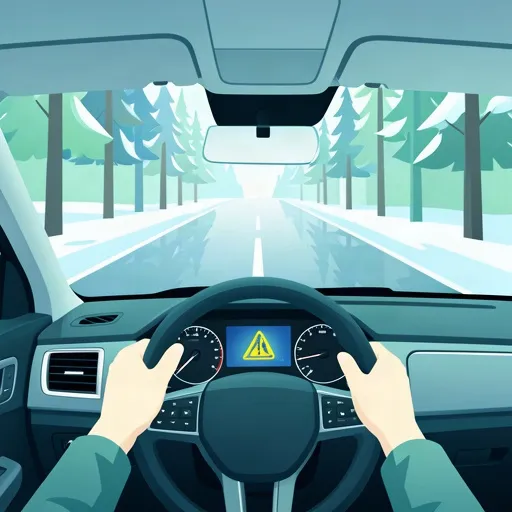
Black ice, or svarthalka, is a hidden hazard that demands constant vigilance during the Swedish winter months. By understanding the legal requirement to adapt your speed to current road conditions, you can better anticipate sudden loss of traction. This guide provides the practical behavioral strategies needed to navigate slippery roads safely and meet the requirements of the Swedish driving theory exam.
Article content overview
In Sweden, winter driving presents unique challenges that every learner must master to ensure both personal safety and success in the theory exam. One of the most dangerous, yet invisible, hazards you will face is "svarthalka," or black ice. Because it is often transparent and difficult to spot, it represents a frequent topic in both practical driving assessments and theoretical examinations. As a driver, you carry the primary legal responsibility to assess current road conditions and adapt your driving behavior accordingly, regardless of whether the road surface appears clear to the naked eye.
Black ice is a thin, nearly invisible layer of ice that forms on the road surface, often when temperatures fluctuate around the freezing point. It frequently occurs during late autumn and early spring, particularly during the transition hours of early mornings and late evenings. Moisture on the road freezes rapidly, creating an extremely slippery surface that can cause an immediate loss of vehicle control.
A thin, transparent layer of ice that forms on road surfaces when temperatures hover around 0°C, making the road extremely slippery despite appearing clear.
Certain parts of the road network are more susceptible to this phenomenon than others. Bridges, viaducts, areas near water, and sections of the road shaded by trees or buildings remain colder than the surrounding asphalt. As a prospective driver, you must learn to scan the road for these specific indicators and adjust your speed and alertness well in advance of entering these zones.
The Swedish Transport Agency, Trafikverket, emphasizes that the driver is always responsible for "anpassad hastighet" (adapted speed). This means that obeying the posted speed limit is not sufficient if the weather or road conditions are poor. You are legally required to reduce your speed to a level where you can maintain full control over the vehicle at all times.
Never assume the road is safe just because the air temperature is slightly above freezing. Always keep an increased following distance to the vehicle ahead to allow for longer braking distances on slippery surfaces.
When driving in winter conditions, smooth operation is the key to preventing skidding. Sudden movements are the primary cause of losing traction. You must strive to execute all maneuvers—braking, accelerating, and steering—with as much precision and softness as possible. If you find yourself in a situation where you feel the car beginning to slide, it is vital to keep your composure, avoid panic-braking, and steer in the direction you wish to go while maintaining a clear view of the path ahead.
Preparation is the cornerstone of safe winter driving in Sweden. Beyond driving techniques, the equipment you choose for your vehicle is a major safety factor. Using high-quality winter tires is not just a recommendation; it is a critical safety measure for anyone operating a vehicle on Swedish roads during the cold season.
| Condition | Recommended Driver Action |
|---|---|
| Temperatures around 0°C | Reduce speed, increase following distance, scan for ice on bridges. |
| Approaching shaded areas | Anticipate potential ice patches and steer/brake with extreme caution. |
| Sudden loss of traction | Avoid slamming on the brakes; steer gently into the direction of the slide. |
| Winter Season (Oct–Apr) | Ensure vehicle is equipped with approved winter tires and is in good working order. |
In the Swedish theory exam, questions regarding winter driving often focus on your ability to recognize hazardous situations and your understanding of driver responsibility. You might encounter scenarios describing a rainy morning with temperatures falling toward zero, asking you to identify the most appropriate response. The exam expects you to prioritize safety over speed and to demonstrate an understanding of why specific road sections (like bridges) pose higher risks.
Always remember that in the eyes of the law, "I didn't see the ice" is not a valid defense for an accident. Developing a defensive driving mindset—where you always expect the possibility of "svarthalka" during the winter months—is the best way to keep yourself and others safe on the road.
Article content overview
Explore related topics, search based questions, and concepts that learners often look up when studying Driving Safely on Black Ice. These themes reflect real search intent and help you understand how this topic connects to wider driving theory knowledge in Sweden.
Find clear and practical answers to common questions learners often have about Driving Safely on Black Ice. This section helps explain difficult points, remove confusion, and reinforce the key driving theory concepts that matter for learners in Sweden.
The best approach is to significantly lower your speed, increase the distance to the vehicle ahead, and perform all maneuvers—steering, braking, and accelerating—very smoothly to maintain traction.
These areas lose heat faster than the surrounding road, which causes moisture to freeze into invisible ice, known as black ice, even when other parts of the road appear clear.
Yes. In Sweden, the driver is legally required to assess and adapt their driving style and speed to the prevailing road conditions, regardless of whether the road appears safe at first glance.
Trafikverket generally operates with full winter preparedness starting October 1st, and drivers are strongly encouraged to equip their vehicles with winter tires by this time if conditions require it.
Continue your learning journey by exploring more detailed articles and guides. Clarify specific traffic rules, understand complex road signs, or review safe driving practices. Our extensive content library supports your Swedish driving license theory preparation.