As the Swedish Transport Agency, Transportstyrelsen, works to enhance safety for vulnerable road users, drivers must understand updated expectations for maneuvering around cyclists and mopedists. This guide clarifies how to position your vehicle correctly and when it is appropriate to cross solid lines, ensuring you meet modern defensive driving standards. Mastering these concepts will help you make safer decisions on the road and navigate tricky theoretical scenarios in your license exam.
Article content overview
When driving in Sweden, sharing the road with vulnerable road users—such as cyclists and mopedists—requires constant vigilance and a strong grasp of defensive driving principles. Recently, the Swedish Transport Agency, Transportstyrelsen, has proposed updated guidelines to clarify how drivers should handle these situations, particularly on rural roads with speed limits of 70 km/h or higher. Understanding these evolving expectations is not only vital for real-world safety but is also a critical component of preparing for the Swedish driving theory exam.
The primary goal of these proposed updates is to create a more predictable and secure traffic environment. While serious accidents involving overtakes remain relatively rare, the perceived risk often discourages people from cycling or using mopeds. By establishing clearer norms for vehicle positioning and speed adjustments, the authorities aim to harmonize interactions between motorized vehicles and vulnerable road users. For your theory exam, it is essential to internalize that "safe driving" often exceeds the minimum requirements of the law; it involves anticipating the needs of others and proactively reducing potential conflict points.
The proposed guidelines for overtaking are designed to increase predictability. Even before these become strict legal requirements in every scenario, adopting these habits early demonstrates the maturity and safety-consciousness expected of a licensed driver in Sweden.
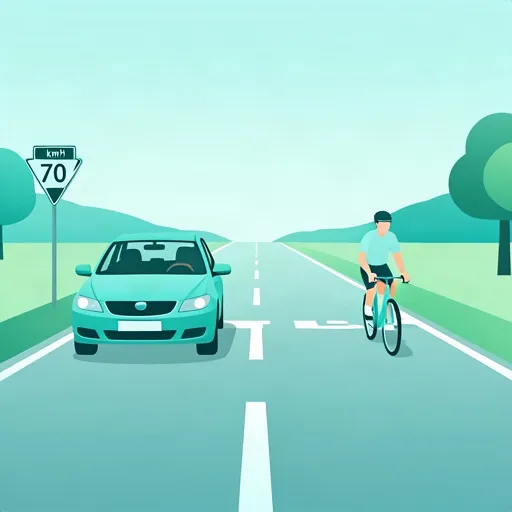
One of the most significant points of clarification involves where you position your car when preparing to pass a cyclist or a rider of a Moped Class II. The guidance suggests that when traffic conditions allow, drivers should move their vehicle further to the left, ideally placing the car entirely to the left of the center line or into an adjacent lane. This creates a generous safety buffer, minimizing the impact of wind turbulence and the potential for a lateral collision.
You may wonder about the legality of crossing a solid white line. While the solid line generally prohibits crossing, authorities have clarified that it is permissible to cross or drive over a solid line when necessary to safely overtake a cyclist or mopedist, provided that it can be done without endangering oncoming traffic or the vulnerable road user themselves. This nuance is a frequent trap in theoretical tests; always prioritize the safety distance over the strict adherence to lane markings when passing vulnerable traffic.
Beyond lane positioning, the speed at which you conduct the maneuver is a major factor in traffic safety. The proposal highlights that drivers should be prepared to reduce their speed when overtaking a cyclist or a Moped Class II, especially if the situation necessitates it. Factors such as narrow road widths, poor weather conditions, or the presence of children on the road should prompt you to slow down significantly.
It is important to distinguish between vehicle categories in your studies. A Moped Class II is designed for a maximum speed of 25 km/h and is intended to be driven on cycle paths, or on the road shoulder if no cycle path exists. Because these vehicles are slower and lack the acceleration of a car, they are particularly susceptible to being "squeezed" by faster traffic. As a driver, your responsibility is to ensure that your overtaking maneuver does not cause the mopedist to lose balance or be forced off the roadway.
In the Swedish theory exam, you will likely encounter scenarios that test your judgment rather than just your ability to memorize rules. Questions may present an image of a narrow road with a cyclist and ask you to determine the safest course of action. If given the choice between "passing quickly to clear the cyclist" and "slowing down and waiting for a safe gap," the exam expects you to prioritize the latter. Always look for the option that emphasizes patience, situational awareness, and the protection of vulnerable road users.
Article content overview
Explore related topics, search based questions, and concepts that learners often look up when studying Overtaking Cyclists and Mopedists. These themes reflect real search intent and help you understand how this topic connects to wider driving theory knowledge in Sweden.
Find clear and practical answers to common questions learners often have about Overtaking Cyclists and Mopedists. This section helps explain difficult points, remove confusion, and reinforce the key driving theory concepts that matter for learners in Sweden.
The proposal suggests that drivers should place their vehicle to the left of the center line or use an adjacent lane in the same direction to provide a safe distance during the overtake.
Under the proposed clarifications, it is considered acceptable to temporarily cross a solid line to overtake a cyclist or mopedist, provided that it can be done with the necessary caution and without endangering others.
Yes, the guidelines suggest that drivers should reduce their speed when the traffic situation demands it to ensure the safety of the vulnerable road user, similar to how speed is adjusted in other high-attention areas.
In this specific regulatory context, the focus is on cyclists and drivers of moped class II, who are at a higher risk of injury during traffic interactions.
Continue your learning journey by exploring more detailed articles and guides. Clarify specific traffic rules, understand complex road signs, or review safe driving practices. Our extensive content library supports your Swedish driving license theory preparation.