
Understanding the distinction between legally compliant e-scooters and prohibited high-capacity vehicles is essential for road safety. This guide clarifies the equipment requirements, such as lights and brakes, and the importance of helmet usage for young riders. Mastering these concepts is vital for both practical road behavior and your preparation for the Swedish driving theory exam.
Article content overview
In recent years, the popularity of electric scooters in Swedish urban areas has exploded, providing a convenient way for people of all ages to navigate cities. However, with this convenience comes a significant responsibility. The Swedish Transport Agency (Transportstyrelsen) has noted a sharp increase in accidents involving electric scooters, with thousands of individuals—many of whom are children and young people—injured each year. For parents and future drivers, understanding the legal framework surrounding these vehicles is not only a matter of road safety but also a requirement for compliance with Swedish traffic law.
To understand how to operate an electric scooter safely, you must first understand how the law defines them. In Sweden, an electric scooter is generally classified as a bicycle, provided it meets specific technical criteria. If a vehicle exceeds these parameters, it is no longer considered a bicycle, and it may be prohibited from use in general traffic altogether.
To be legally classified as a bicycle, an electric scooter must be designed for a maximum speed of 20 km/h and have a continuous rated power output of no more than 250 watts. Vehicles exceeding these limits are subject to more stringent regulations, including requirements for registration, insurance, and specific driver licensing.
As a parent, it is your responsibility to verify the technical specifications of the scooter your child is using. Allowing a child to operate a high-capacity vehicle that is not designed for the road can result in significant legal consequences and, more importantly, places your child at high risk of severe injury.
Traffic safety is built upon a foundation of visibility and protection. While the rules for electric scooters mirror those of bicycles, the speed at which they travel often requires a higher level of vigilance and protective gear.
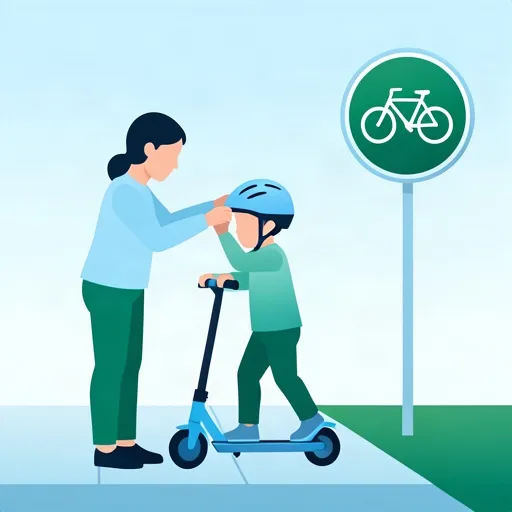
Children and youth under the age of 15 are legally required to wear an approved helmet when riding an electric scooter. Research indicates that head and facial injuries are among the most common outcomes of e-scooter accidents; failing to use a helmet significantly increases the risk of life-altering trauma.
In addition to head protection, the scooter itself must be equipped according to standard bicycle regulations to be legal for street use. This includes:
Knowing where you are allowed to ride is a core component of the Swedish driving theory. E-scooters should primarily be operated on cycle paths. When a cycle path is unavailable, riding on the road is permitted, but the rider must adhere to the same traffic rules as cyclists.
The role of the parent extends beyond purchasing the right equipment; it involves active coaching. Because the number of injuries among children aged 0–17 has risen so drastically, the Swedish Transport Agency emphasizes that parents must ensure their children understand the "rules of the road." This includes knowing how to interpret signage and how to interact with motorized traffic.
This article covers Sweden's legal framework for electric scooters used by children, emphasizing that compliant e-scooters are classified as bicycles only when they do not exceed 20 km/h or 250W continuous rated power. Safety requirements include mandatory helmets for riders under 15, functional brakes, bells, and proper lighting for night use. Young riders should primarily use cycle paths and follow standard bicycle traffic rules when on roads. Parents carry legal responsibility for ensuring their children use compliant equipment and understand road safety rules, which is essential knowledge for anyone studying Swedish driving theory.
A short set of high-value points that capture the most important ideas from this article.
In Sweden, electric scooters are legally classified as bicycles only if they have a maximum speed of 20 km/h and a continuous rated power output of no more than 250 watts
Children and youth under 15 years of age are legally required to wear an approved helmet when riding an electric scooter
E-scooters must be equipped with functional brakes, a bell, and mandatory lighting (front white and rear red lights) when used in traffic
Electric scooters should primarily be operated on cycle paths, and when unavailable, riders must follow the same traffic rules as cyclists on the road
Parents have a legal duty of care to ensure their children understand road rules and use only compliant vehicles on Swedish roads
Technical limit for legal e-scooter classification: 20 km/h maximum speed and 250 watts maximum continuous rated power
Helmet requirement applies specifically to riders under 15 years old in Sweden
Three mandatory equipment items: functional brake system, bell, and lighting (front white light and rear red light for night riding)
When a cycle path is unavailable, e-scooter riders must use the road and follow standard bicycle traffic rules
Transportstyrelsen is the Swedish Transport Agency responsible for traffic regulations and safety standards
Assuming all electric scooters are legal without checking technical specifications against the 20 km/h and 250W thresholds
Failing to use proper lighting and reflectors when riding in low-light conditions, which is mandatory for street-legal e-scooters
Allowing passengers on an electric scooter, which is prohibited as these vehicles are designed for single riders only
Not verifying that a child's helmet meets approved safety standards before riding
Assuming e-scooters can be ridden on any road infrastructure; they must use cycle paths when available and follow pedestrian crossing procedures carefully
Article content overview
A short set of high-value points that capture the most important ideas from this article.
In Sweden, electric scooters are legally classified as bicycles only if they have a maximum speed of 20 km/h and a continuous rated power output of no more than 250 watts
Children and youth under 15 years of age are legally required to wear an approved helmet when riding an electric scooter
E-scooters must be equipped with functional brakes, a bell, and mandatory lighting (front white and rear red lights) when used in traffic
Electric scooters should primarily be operated on cycle paths, and when unavailable, riders must follow the same traffic rules as cyclists on the road
Parents have a legal duty of care to ensure their children understand road rules and use only compliant vehicles on Swedish roads
Technical limit for legal e-scooter classification: 20 km/h maximum speed and 250 watts maximum continuous rated power
Helmet requirement applies specifically to riders under 15 years old in Sweden
Three mandatory equipment items: functional brake system, bell, and lighting (front white light and rear red light for night riding)
When a cycle path is unavailable, e-scooter riders must use the road and follow standard bicycle traffic rules
Transportstyrelsen is the Swedish Transport Agency responsible for traffic regulations and safety standards
Assuming all electric scooters are legal without checking technical specifications against the 20 km/h and 250W thresholds
Failing to use proper lighting and reflectors when riding in low-light conditions, which is mandatory for street-legal e-scooters
Allowing passengers on an electric scooter, which is prohibited as these vehicles are designed for single riders only
Not verifying that a child's helmet meets approved safety standards before riding
Assuming e-scooters can be ridden on any road infrastructure; they must use cycle paths when available and follow pedestrian crossing procedures carefully
Explore related topics, search based questions, and concepts that learners often look up when studying Swedish E-Scooter Rules for Kids. These themes reflect real search intent and help you understand how this topic connects to wider driving theory knowledge in Sweden.
Find clear and practical answers to common questions learners often have about Swedish E-Scooter Rules for Kids. This section helps explain difficult points, remove confusion, and reinforce the key driving theory concepts that matter for learners in Sweden.
An e-scooter is classified as a bicycle if it has a maximum speed of 20 km/h and a maximum continuous power output of 250 watts.
Yes, children and adolescents under 15 years old are required by law to wear an approved helmet when riding an e-scooter.
No, it is prohibited to carry passengers on an electric scooter in Sweden.
Parents can face legal consequences if they knowingly permit a child to operate a vehicle that does not meet Swedish traffic safety and classification requirements.
Continue your learning journey by exploring more detailed articles and guides. Clarify specific traffic rules, understand complex road signs, or review safe driving practices. Our extensive content library supports your Swedish driving license theory preparation.