
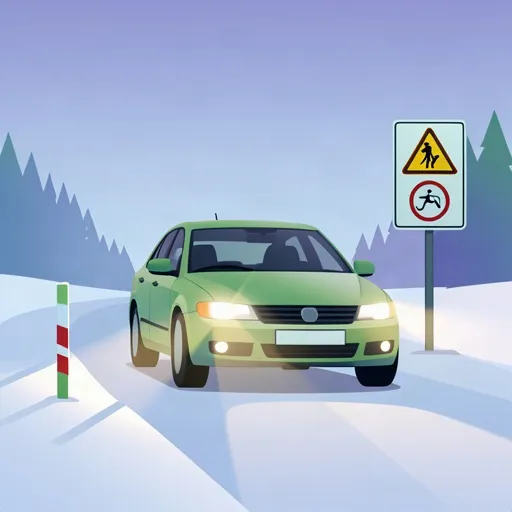
Driving in Swedish winter conditions requires a proactive approach to safety, including the correct use of equipment and constant adaptation to the environment. This guide explains how to handle common hazards like black ice and heavy snowfall, while highlighting your legal responsibilities as a driver. Mastering these concepts is crucial for both your personal safety and your performance in the Swedish theory exam.
Article content overview
Driving in Sweden during the winter months presents a unique set of challenges that every learner must master to pass the theory exam and ensure safety on the road. The Swedish landscape, characterized by long, dark winters and unpredictable weather, requires drivers to be highly proactive. Whether you are navigating urban streets or rural motorways, understanding how to adapt your driving style to snow, slush, and freezing temperatures is a fundamental skill.
In Sweden, vehicle equipment regulations are strictly enforced by the Swedish Transport Administration (Trafikverket). Between December 1 and March 31, if winter road conditions exist, you are legally required to use winter tires. These tires must be specifically designed for winter driving and marked with the M+S (Mud and Snow) designation.
While the law dictates the use of tires, it is the driver's responsibility to monitor the tread depth. For passenger cars during winter conditions, your tires must have a minimum tread depth of 3 millimeters to maintain adequate grip.
One of the most dangerous phenomena a driver can face in Sweden is "svarthalka," or black ice. This is particularly treacherous because it is often invisible, creating a thin, slippery layer on the road surface. It typically occurs when the temperature hovers around zero degrees Celsius, especially on damp roads during late evenings or early mornings.
Areas such as bridges, viaducts, and shaded sections of the road are high-risk zones where cold air can freeze surface moisture rapidly. When driving in these conditions, you must avoid sudden movements. Abrupt braking, accelerating, or sharp steering maneuvers can easily cause a vehicle to lose traction. Always keep a significantly longer distance to the vehicle in front of you than you would on a dry summer day.
During the dark winter months, visibility is often severely reduced by snowstorms, mist, or low light conditions. To ensure you are seen by others, it is vital to use the correct lighting on your vehicle. Your headlights should be kept clean, as accumulated snow and road grime can drastically reduce their effectiveness.
Adapt your speed to the visibility distance. A good rule of thumb is to drive slowly enough that you can come to a complete stop within the distance you can clearly see ahead. If you find yourself in a severe snowstorm, increase your following distance and ensure your rear fog lights are engaged if appropriate, provided they do not blind other road users.
Accidents involving pedestrians and cyclists frequently occur during the dark months, particularly near pedestrian crossings. As a driver, you must be vigilant. Using reflexes (reflectors) is a life-saving habit for pedestrians, but as a motorist, you must maintain a cautious speed in urban environments where these road users are present.
Article content overview
Explore related topics, search based questions, and concepts that learners often look up when studying Swedish Winter Driving Safety. These themes reflect real search intent and help you understand how this topic connects to wider driving theory knowledge in Sweden.
Find clear and practical answers to common questions learners often have about Swedish Winter Driving Safety. This section helps explain difficult points, remove confusion, and reinforce the key driving theory concepts that matter for learners in Sweden.
Winter tires or equivalent equipment are mandatory when there are winter road conditions from December 1st to March 31st.
For winter tires on passenger cars, the tread depth must be at least 3 millimeters during the mandatory winter period.
Black ice is a thin, often invisible layer of ice on the road surface that occurs when the temperature is near freezing. It makes the road extremely slippery, requiring drivers to reduce speed and avoid sudden maneuvers.
Rear fog lights should be used during conditions of limited visibility, such as heavy snow or thick fog, to ensure your vehicle is visible to drivers behind you.
Continue your learning journey by exploring more detailed articles and guides. Clarify specific traffic rules, understand complex road signs, or review safe driving practices. Our extensive content library supports your Swedish driving license theory preparation.