
Understanding first aid is a core requirement for passing the Turkish MTSK theory test. This guide explains how to prioritize safety at a crash site, perform initial casualty evaluations, and execute the correct emergency reporting steps. These foundational concepts are essential for both successfully passing your exam and ensuring safety on Turkish roads.
Article content overview
Understanding the fundamentals of first aid is a non-negotiable requirement for every candidate preparing for the Turkish MTSK (Motorlu Taşıt Sürücüleri Kursu) e-sınav. In the context of Turkish driving theory, first aid is not merely a medical topic; it is an extension of responsible driving and traffic safety. The theory exam frequently tests your ability to make rational, life-saving decisions under pressure, focusing on the correct sequence of actions to be taken at a traffic accident scene.
The most common trap for students in the MTSK exam involves the sequence of emergency actions. Many candidates mistakenly believe that they should immediately attempt to move an injured person to safety. However, the pedagogical approach favored by the Ministry of National Education (MEB) emphasizes that you must first protect yourself and the scene.
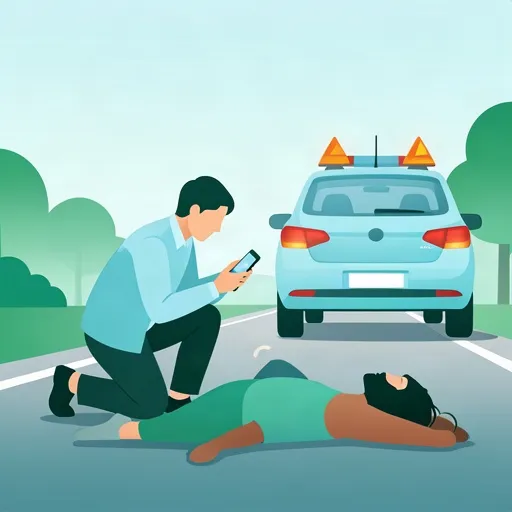
Before performing any medical intervention, you must ensure the safety of the accident scene. Failing to place warning signs or neglecting to check for fire, fuel leaks, or oncoming traffic risks creating secondary accidents, which is a critical failure in both the exam and real-life scenarios.
When you encounter an accident, your priority is to prevent further harm. This involves ensuring your own vehicle is parked safely off the road, using hazard lights, and placing warning triangles at a sufficient distance to alert approaching drivers. Only once the environment is secured can you proceed to assess the casualties.
The theory exam expects you to follow a logical, hierarchical approach to emergency response. This procedure is designed to keep the responder calm and ensure that the most urgent needs—such as life-sustaining functions—are prioritized over non-urgent injuries.
In the modern Turkish emergency response system, all calls are routed through the 112 emergency center. For the exam, it is vital to know that you should provide precise information, including your exact location, the number of vehicles involved, and the general condition of any injured parties. You must remain on the line until the dispatcher confirms they have received the necessary details and instructs you to hang up.
The unified emergency number in Türkiye used for reporting traffic accidents, requesting ambulances, or notifying fire services. It is designed to coordinate rapid, professional assistance to the accident site.
A frequent question type in the MTSK test involves "distractor" answers that suggest moving a victim immediately. Unless the victim is in direct danger of an explosion or a vehicle fire, you should never attempt to move an injured person. Moving someone with an undiagnosed spinal injury can lead to permanent damage. The exam rewards the candidate who chooses to stay with the victim, provide emotional support, and stabilize the situation without unnecessary physical intervention.
While you are not expected to be a paramedic, understanding basic first aid is a legal and ethical requirement for all drivers in Türkiye. The MEB includes these questions because a driver who understands the mechanics of an accident and the urgency of the "Golden Hour" is significantly more likely to act responsibly. Mastering these principles will help you pass your theory exam with confidence and prepare you for the realities of modern driving.
This article covers essential first aid protocols for the Turkish MTSK driving theory exam, focusing on the correct sequence of emergency actions at a traffic accident scene. The core principle is scene safety first—drivers must secure the environment with hazard lights and warning triangles before approaching casualties. The standard emergency response follows a five-step procedure: ensure safety, check consciousness, call 112, assess airway and breathing, and monitor the casualty until professional help arrives. Common exam pitfalls include premature victim movement and incorrect action sequencing, both of which the test uses as distractor answers. Mastering these protocols is a legal requirement for all drivers in Türkiye and directly tested in the e-sınav.
A short set of high-value points that capture the most important ideas from this article.
Always secure the accident scene before approaching casualties to prevent secondary collisions
The correct emergency response sequence is: secure scene → check consciousness → call 112 → assess airway and breathing → monitor until help arrives
Do not move an injured person unless they face immediate danger from fire, explosion, or other lethal hazard
When calling 112, provide precise location, number of vehicles involved, and condition of injured parties
Understanding the 'Golden Hour' concept reinforces why rapid, correct response is a legal and ethical driver responsibility
Scene safety is always the FIRST priority before any medical intervention
Verbal or gentle physical stimuli are used to check consciousness—never shake violently
Never move a casualty with a possible spinal injury unless there is immediate life threat
Stay on the line with 112 dispatch until explicitly instructed to hang up
MTSK stands for Motorlu Taşıt Sürücüleri Kursu—official driver education course
Moving an injured person before securing the scene, especially if no immediate danger exists
Calling 112 before checking consciousness and ensuring scene safety
Attempting to provide first aid without first parking safely, using hazard lights, and placing warning triangles
Hanging up the emergency call before the dispatcher confirms receipt of information
Confusing the priority order—breathing assessment comes after consciousness check and 112 notification
Article content overview
A short set of high-value points that capture the most important ideas from this article.
Always secure the accident scene before approaching casualties to prevent secondary collisions
The correct emergency response sequence is: secure scene → check consciousness → call 112 → assess airway and breathing → monitor until help arrives
Do not move an injured person unless they face immediate danger from fire, explosion, or other lethal hazard
When calling 112, provide precise location, number of vehicles involved, and condition of injured parties
Understanding the 'Golden Hour' concept reinforces why rapid, correct response is a legal and ethical driver responsibility
Scene safety is always the FIRST priority before any medical intervention
Verbal or gentle physical stimuli are used to check consciousness—never shake violently
Never move a casualty with a possible spinal injury unless there is immediate life threat
Stay on the line with 112 dispatch until explicitly instructed to hang up
MTSK stands for Motorlu Taşıt Sürücüleri Kursu—official driver education course
Moving an injured person before securing the scene, especially if no immediate danger exists
Calling 112 before checking consciousness and ensuring scene safety
Attempting to provide first aid without first parking safely, using hazard lights, and placing warning triangles
Hanging up the emergency call before the dispatcher confirms receipt of information
Confusing the priority order—breathing assessment comes after consciousness check and 112 notification
Explore related topics, search based questions, and concepts that learners often look up when studying First Aid for MTSK Exam. These themes reflect real search intent and help you understand how this topic connects to wider driving theory knowledge in Turkey.
Find clear and practical answers to common questions learners often have about First Aid for MTSK Exam. This section helps explain difficult points, remove confusion, and reinforce the key driving theory concepts that matter for learners in Turkey.
The absolute priority is to ensure the safety of the accident scene by taking necessary warning measures to prevent further collisions or injuries before approaching the victims.
No, you should never move an injured person unless there is an immediate threat, such as the vehicle catching fire or the risk of an explosion, as moving them can worsen spinal or internal injuries.
All emergency services, including medical assistance for traffic accidents, should be requested by calling the 112 Emergency Call Center, providing clear and concise information about the location and nature of the incident.
The MEB pedagogical approach emphasizes that if the scene is not secure, rescuers may become victims themselves, thus increasing the number of casualties and complicating the emergency response.
After finding the specific Turkish driving theory articles you need, dive deeper into related topics or challenge your knowledge with practice questions. Enhance your understanding of trafik işaretleri, road rules, and vehicle safety to ensure you are fully prepared for the official ehliyet sınavı.