
Achieving your driving licence in Turkey requires a deep understanding of the MTSK e-Sınav structure and the fundamental traffic laws enforced across the country. This guide breaks down the critical knowledge areas—ranging from road markings to mechanical basics—that you must master to pass the theory portion of your licence journey. Whether you are a first-time learner or preparing for a category upgrade, focusing on these core pillars will ensure you are ready for the test.
Article content overview
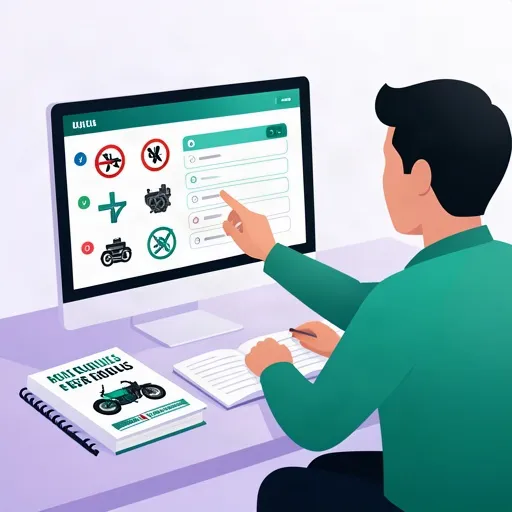
The Turkish e-Sınav is a computer-based theory test administered by the Ministry of National Education requiring a 70-point passing score across four curriculum pillars. The largest portion covers Traffic and Environmental Rules, including road sign recognition, intersection priority at unmarked junctions using the yield-to-right rule, and speed limits. First Aid knowledge emphasizes the Golden Hour principle and proper emergency notification without moving casualties unless danger exists. Vehicle Technique focuses on dashboard symbols, engine fluids, and pre-journey maintenance checks. All questions carry equal weight with no negative marking, making it essential to attempt every item.
A short set of high-value points that capture the most important ideas from this article.
The MTSK e-Sınav requires a minimum 70-point score with no penalty for wrong answers, so answer every question.
Four core pillars are tested: Traffic and Environmental Rules, First Aid, Vehicle Techniques, and Traffic Etiquette.
At unmarked intersections, the driver must yield to traffic approaching from the right.
The Golden Hour principle emphasizes that medical intervention within 60 minutes of a collision is critical.
Never move an injured person unless there is immediate risk of fire or explosion to avoid spinal injury.
Priority Road sign (B1) grants right of way over side roads; Stop sign (C1) requires complete halt regardless of visible traffic.
Emergency vehicles, pedestrians at marked crossings, and public transport pulling out always have priority.
Dashboard warning lights and engine fluid checks are testable vehicle technique topics.
Key Turkish terms: Geçiş Hakkı (right of way), Kavşak (intersection), Takip Mesafesi (following distance), İlk Yardım (first aid).
Practice questions often use scenarios to test understanding, not just memorization.
Assuming all intersections have traffic signs—unmarked intersections follow the 'yield to right' rule.
Believing incorrect answers reduce the score, leading some learners to skip questions they are unsure about.
Attempting to move injured accident victims without checking for fire or explosion hazards.
Focusing only on memorizing definitions without understanding how to apply rules in driving scenarios.
Neglecting Traffic Etiquette and Vehicle Technique sections, assuming they carry less weight than Traffic Rules.
Article content overview
A short set of high-value points that capture the most important ideas from this article.
The MTSK e-Sınav requires a minimum 70-point score with no penalty for wrong answers, so answer every question.
Four core pillars are tested: Traffic and Environmental Rules, First Aid, Vehicle Techniques, and Traffic Etiquette.
At unmarked intersections, the driver must yield to traffic approaching from the right.
The Golden Hour principle emphasizes that medical intervention within 60 minutes of a collision is critical.
Never move an injured person unless there is immediate risk of fire or explosion to avoid spinal injury.
Priority Road sign (B1) grants right of way over side roads; Stop sign (C1) requires complete halt regardless of visible traffic.
Emergency vehicles, pedestrians at marked crossings, and public transport pulling out always have priority.
Dashboard warning lights and engine fluid checks are testable vehicle technique topics.
Key Turkish terms: Geçiş Hakkı (right of way), Kavşak (intersection), Takip Mesafesi (following distance), İlk Yardım (first aid).
Practice questions often use scenarios to test understanding, not just memorization.
Assuming all intersections have traffic signs—unmarked intersections follow the 'yield to right' rule.
Believing incorrect answers reduce the score, leading some learners to skip questions they are unsure about.
Attempting to move injured accident victims without checking for fire or explosion hazards.
Focusing only on memorizing definitions without understanding how to apply rules in driving scenarios.
Neglecting Traffic Etiquette and Vehicle Technique sections, assuming they carry less weight than Traffic Rules.
Explore related topics, search based questions, and concepts that learners often look up when studying Mastering the Turkish e-Sınav. These themes reflect real search intent and help you understand how this topic connects to wider driving theory knowledge in Turkey.
Find clear and practical answers to common questions learners often have about Mastering the Turkish e-Sınav. This section helps explain difficult points, remove confusion, and reinforce the key driving theory concepts that matter for learners in Turkey.
To be successful in the e-Sınav, you must achieve a score of at least 70 points out of 100 based on the correct answers provided.
The exam covers four main pillars: traffic and environment rules, first aid knowledge, vehicle technique, and traffic etiquette.
No, wrong answers do not carry a penalty; the evaluation is based purely on the number of correct answers provided during the exam.
The exam questions and answers are not published after the test as the software maintains the integrity of the question bank.
After finding the specific Turkish driving theory articles you need, dive deeper into related topics or challenge your knowledge with practice questions. Enhance your understanding of trafik işaretleri, road rules, and vehicle safety to ensure you are fully prepared for the official ehliyet sınavı.