Understanding the hazards of lane filtering is a core component of defensive driving as assessed in the Turkish MTSK theory exam. This article explains how to manage blind spots and navigate through traffic queues while adhering to safe driving principles. Readers will learn the essential safety measures required to anticipate the movements of other road users and avoid high-risk collisions.
Article content overview
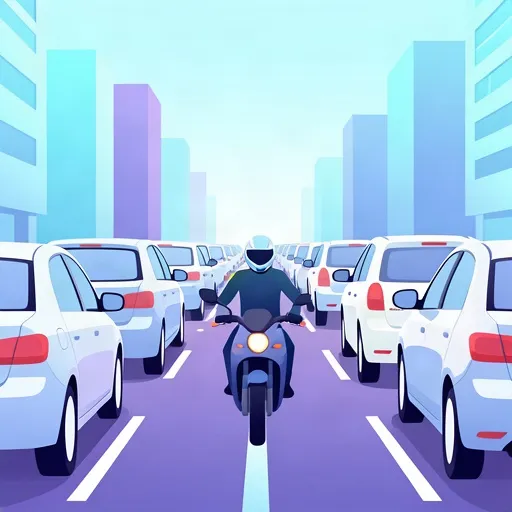
Motorcycle and scooter riders in Türkiye often navigate congested urban environments by moving between lanes, a practice commonly referred to as lane filtering. While this maneuver is a daily reality on busy boulevards and in city centers, it presents significant risks that every driver—whether in a car or on two wheels—must understand for the MTSK e-sınav. Mastering the mechanics of blind spots and traffic awareness is essential for passing your theory exam and, more importantly, for surviving the complex dynamics of Turkish road traffic.
In the context of Turkish driving theory, defensive driving is the cornerstone of safety. Lane filtering involves moving between rows of slow-moving or stationary vehicles. While local driving culture often sees this as a way to alleviate congestion, official traffic legislation emphasizes the danger of unpredictable movements. Vulnerable road users, such as motorcyclists and cyclists, are at a much higher risk of collision when they exit the field of vision of a heavy vehicle or a passenger car driver.
To pass the MTSK exam, you must demonstrate a deep understanding of how lane position affects visibility. When you are in the driver's seat of a car, you must constantly monitor your side mirrors and perform shoulder checks before changing lanes or turning, especially in urban settings where motorcycles might appear suddenly from your blind spots.
A "blind spot" is the area around your vehicle that cannot be directly observed by the driver using the interior or exterior mirrors. For professional drivers of heavy vehicles, these zones are significantly larger. When taking the theory test, you will likely encounter questions regarding the professional responsibility to account for cyclists and pedestrians who may linger in these invisible zones during maneuvers.
Effective hazard perception requires anticipating that a motorcycle might be filtering through traffic even if you do not see them immediately. Always assume that a two-wheeled vehicle could be occupying the space beside your rear bumper or front wheel. By adjusting your speed and maintaining a predictable path, you give other road users the space they need to operate safely.
The Turkish theory exam frequently tests your ability to identify the correct behavior in high-traffic scenarios. The examiners look for candidates who understand that "filtering" is not a right-of-way, but a maneuver that requires extreme caution. When a question asks how to handle urban traffic, the correct answer usually prioritizes caution, observation, and giving extra space to vulnerable road users.
Whether you are driving a car or a heavy vehicle, the legal and ethical burden is to look out for those less protected. The MTSK curriculum emphasizes that the driver is responsible for the safety of the entire immediate environment, not just the path directly in front of their vehicle. If you are involved in an incident with a motorcyclist, the investigation will often look at whether you performed the necessary observations to clear your blind spots.
Remember that even if a motorcyclist is acting aggressively, your duty as a driver is to prioritize safety. Avoid sudden lane changes and always signal your maneuvers, as unpredictable driving is the leading cause of collisions during heavy traffic hours in cities like Istanbul or Ankara.
This article covers the essential topic of motorcycle lane filtering and blind spot awareness as tested in the Turkish MTSK theory exam. Lane filtering is a common practice in Turkish urban traffic but carries significant risks, especially when drivers fail to account for blind spots. The key defensive driving principle is that drivers must anticipate the presence of motorcycles and vulnerable road users even in areas not visible in mirrors. Safe behavior includes adjusting mirrors before driving, performing shoulder checks, signaling early, and giving extra space to filtering riders. The MTSK exam expects candidates to demonstrate understanding that drivers bear responsibility for clearing blind spots and prioritizing the safety of less protected road users.
A short set of high-value points that capture the most important ideas from this article.
Lane filtering is a maneuver that requires extreme caution, not a right-of-way entitlement
Blind spots are areas around your vehicle not visible in mirrors, and heavy vehicles have significantly larger blind zones
Always perform shoulder checks before changing lanes or turning, as mirrors alone do not cover every angle
Drivers bear legal and ethical responsibility for the safety of vulnerable road users like motorcyclists and cyclists
Effective hazard perception means assuming motorcycles could be filtering beside your vehicle even when you cannot see them
Adjust mirrors before starting your journey to minimize blind spots
Lane filtering involves moving between rows of slow-moving or stationary vehicles
Vulnerable road users (pedestrians, cyclists, motorcyclists) face higher injury risk in collisions
The MTSK exam prioritizes candidates who demonstrate caution, observation, and awareness of blind spots
Heavy vehicles have expansive blind spots and should be avoided for extended side-by-side positioning
Relying solely on mirrors without performing shoulder checks before lane changes
Assuming that if you cannot see a motorcycle in your mirrors, none is present
Making sudden lane changes or turns without signaling, putting filtering riders at risk
Staying alongside large vehicles for extended periods where their blind spots obscure your presence
Treating lane filtering as an established right rather than a high-risk maneuver requiring extra caution
Article content overview
A short set of high-value points that capture the most important ideas from this article.
Lane filtering is a maneuver that requires extreme caution, not a right-of-way entitlement
Blind spots are areas around your vehicle not visible in mirrors, and heavy vehicles have significantly larger blind zones
Always perform shoulder checks before changing lanes or turning, as mirrors alone do not cover every angle
Drivers bear legal and ethical responsibility for the safety of vulnerable road users like motorcyclists and cyclists
Effective hazard perception means assuming motorcycles could be filtering beside your vehicle even when you cannot see them
Adjust mirrors before starting your journey to minimize blind spots
Lane filtering involves moving between rows of slow-moving or stationary vehicles
Vulnerable road users (pedestrians, cyclists, motorcyclists) face higher injury risk in collisions
The MTSK exam prioritizes candidates who demonstrate caution, observation, and awareness of blind spots
Heavy vehicles have expansive blind spots and should be avoided for extended side-by-side positioning
Relying solely on mirrors without performing shoulder checks before lane changes
Assuming that if you cannot see a motorcycle in your mirrors, none is present
Making sudden lane changes or turns without signaling, putting filtering riders at risk
Staying alongside large vehicles for extended periods where their blind spots obscure your presence
Treating lane filtering as an established right rather than a high-risk maneuver requiring extra caution
Explore related topics, search based questions, and concepts that learners often look up when studying Motorcycle Filtering and Blind Spots. These themes reflect real search intent and help you understand how this topic connects to wider driving theory knowledge in Turkey.
Find clear and practical answers to common questions learners often have about Motorcycle Filtering and Blind Spots. This section helps explain difficult points, remove confusion, and reinforce the key driving theory concepts that matter for learners in Turkey.
Turkish traffic laws prioritize maintaining lane discipline, and maneuvers such as filtering between lanes can be dangerous and often lead to conflicts with other road users. Defensive driving principles taught in the MTSK curriculum emphasize maintaining a safe position within the lane rather than weaving through traffic.
The MTSK exam tests your ability to detect vulnerable road users like motorcyclists and cyclists who often enter the blind spots of larger vehicles. Recognizing these areas is crucial for avoiding collisions during lane changes and urban maneuvers.
Maintain a regular scanning pattern, check mirrors frequently, and always perform a shoulder check before changing lanes. Anticipating the presence of smaller vehicles in blind spots is a fundamental requirement of safe and defensive driving in Turkey.
After finding the specific Turkish driving theory articles you need, dive deeper into related topics or challenge your knowledge with practice questions. Enhance your understanding of trafik işaretleri, road rules, and vehicle safety to ensure you are fully prepared for the official ehliyet sınavı.