
Understanding where you are permitted to park and where you are strictly prohibited is a cornerstone of the Turkish driving theory curriculum. This article clarifies the nuances of stopping versus parking, sign interpretation, and the mandatory distances from junctions, bus stops, and fire hydrants that you must know to pass the MTSK e-sınav with confidence.
Article content overview
Understanding the nuances of stopping and parking is a fundamental requirement for every driver in Türkiye. Under the Highway Traffic Regulation (Karayolları Trafik Yönetmeliği), stationary vehicle management is not merely a matter of convenience; it is a critical component of traffic safety and flow. For students preparing for the MTSK e-sınav, distinguishing between authorized zones and restricted areas is essential, as these topics frequently appear in theoretical exam questions to test your knowledge of legal positioning and hazard awareness.
One of the most common pitfalls in the Turkish theory exam involves the confusion between "stopping" (duraklama) and "parking" (park etme). In the context of the MTSK e-sınav, you must be able to identify these definitions clearly. Stopping refers to the act of halting the vehicle for a very short duration, typically to pick up or drop off passengers or to load/unload items, while the driver remains behind the wheel or close by.
Parking, by contrast, refers to any stop that exceeds the time necessary for picking up or dropping off passengers or unloading cargo. If you leave your vehicle unattended or remain stationary for an extended period, it is legally classified as parking. Understanding this distinction is vital because many road signs prohibit parking while allowing short-term stopping, and vice versa.
The temporary halting of a vehicle for the minimum time required to load or unload passengers or cargo, during which the driver remains in or near the vehicle.
The act of leaving a vehicle stationary for a period exceeding what is necessary for loading or unloading, or leaving it unattended in a manner not classified as stopping.
The Turkish Highway Traffic Regulation strictly defines areas where parking is prohibited to ensure traffic safety and unobstructed access for emergency services. Questions in the theory exam often focus on specific distance requirements near critical infrastructure. For instance, you are generally prohibited from parking within 5 meters of a pedestrian crossing or a school crossing to ensure that children and pedestrians are visible to other road users.
Similarly, parking is strictly forbidden within 15 meters of bus stops (marked with appropriate signs) and within 10 meters of fire hydrants. Failing to account for these buffers leads to significant safety risks and is a frequent cause of penalty points in the eyes of traffic inspectors. Always remember that these distances are measured from the boundary of the relevant installation, not from the center.
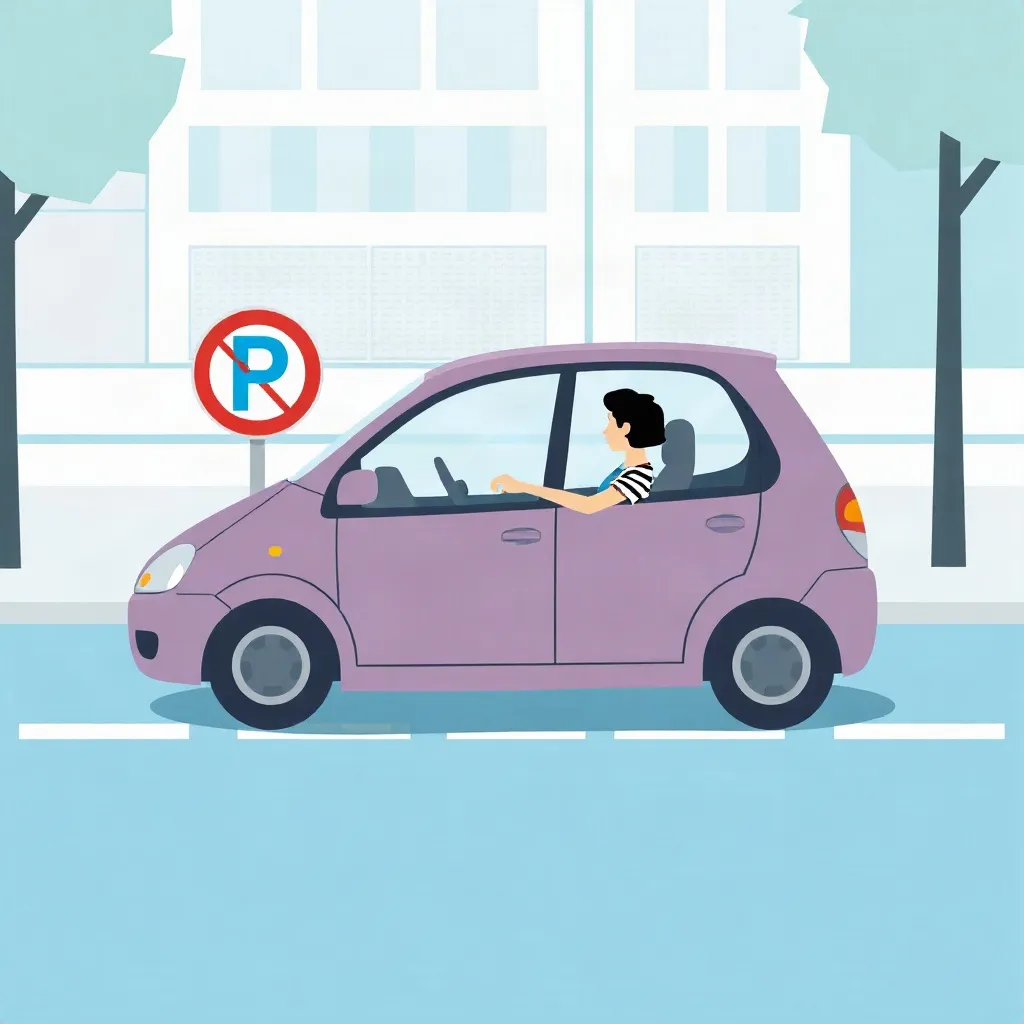
Road signs in Türkiye are designed to be universally understood, yet they often contain nuances that students overlook. The circular sign with a red border and a blue background crossed by a single red line prohibits parking, yet it allows for short-term stopping. Conversely, the sign with a blue background and a red "X" completely forbids both stopping and parking.
Always be alert for "Clearway" or "Tow-away" notices often found in metropolitan areas. In the MTSK e-sınav, ignore signs of minor visual damage and focus on the primary intent of the prohibition symbol, as the exam tests your legal compliance above all else.
The following table provides a quick reference for common parking prohibitions that frequently appear in the Turkish theory examination.
| Location | Rule |
|---|---|
| Pedestrian Crossing | Prohibited within 5 meters |
| School Crossing | Prohibited within 5 meters |
| Bus Stop (Sign-posted) | Prohibited within 15 meters |
| Fire Hydrant | Prohibited within 10 meters |
| Intersections | Prohibited within 5 meters of the corner |
To pass your theory exam, you must apply these legal concepts to various scenarios, such as uphill starts, parking on narrow streets, or positioning your vehicle in relation to traffic lights. Many questions will ask you to identify the "incorrect" behavior in a given traffic setup. Focus on identifying the obstruction of vision or the hindrance of other vehicles, as these are the core principles underlying every parking regulation in the Turkish Highway Traffic Regulation.
This guide clarifies the essential distinction between duraklama (stopping) and park etme (parking) as defined in Turkish traffic law, emphasizing that stopping requires the driver to remain present for immediate passenger or cargo exchange. It establishes critical distance rules: 5 meters from pedestrian and school crossings, 5 meters from intersection corners, 10 meters from fire hydrants, and 15 meters from bus stops. The article also teaches how to interpret official traffic signs, differentiating between signs that prohibit parking while allowing stopping versus signs that prohibit both activities entirely. Understanding these rules prepares learners to identify prohibited parking scenarios in the MTSK e-sınav by focusing on visibility obstruction and safety access principles.
A short set of high-value points that capture the most important ideas from this article.
The key distinction is that duraklama (stopping) requires the driver to remain near the vehicle for brief passenger/cargo exchange, while park etme (parking) means leaving the vehicle unattended or stationary for extended periods
Parking is prohibited within 5 meters of pedestrian crossings and school crossings, measured from the boundary of the crossing area
Bus stops require a 15-meter clearance, and fire hydrants require a 10-meter clearance from their boundary markers
The circular no-parking sign (red border, blue background with red line) allows short-term stopping, while the blue sign with red X prohibits both stopping and parking entirely
Parking regulations fundamentally aim to prevent obstruction of visibility and safe passage for pedestrians, emergency vehicles, and other road users
Distance rules: 5m for crossings and intersections, 10m for fire hydrants, 15m for bus stops—always measured from the boundary, not the center
A no-parking sign permits brief stopping; a no-stopping sign forbids both stopping and parking completely
If the driver leaves the vehicle or stays stationary beyond immediate loading/unloading needs, it legally becomes parking
Yellow and black curb markings indicate areas where parking is prohibited regardless of signage
The Turkish Highway Traffic Regulation (Karayolları Trafik Yönetmeliği) is the governing authority for all parking rules
Assuming the no-parking sign means no stopping at all, when it actually allows brief passenger drop-off or pickup
Measuring prohibited distances from the center of junctions or crossings instead of their boundaries
Confusing duraklama and park etme by thinking any brief stop qualifies as stopping rather than considering driver presence and intent
Overlooking additional restrictions from curb markings and painted lines in favor of only watching for vertical signs
Believing parking is permitted if no sign is visible, when other restrictions like fire hydrants or bus stops still apply
Article content overview
A short set of high-value points that capture the most important ideas from this article.
The key distinction is that duraklama (stopping) requires the driver to remain near the vehicle for brief passenger/cargo exchange, while park etme (parking) means leaving the vehicle unattended or stationary for extended periods
Parking is prohibited within 5 meters of pedestrian crossings and school crossings, measured from the boundary of the crossing area
Bus stops require a 15-meter clearance, and fire hydrants require a 10-meter clearance from their boundary markers
The circular no-parking sign (red border, blue background with red line) allows short-term stopping, while the blue sign with red X prohibits both stopping and parking entirely
Parking regulations fundamentally aim to prevent obstruction of visibility and safe passage for pedestrians, emergency vehicles, and other road users
Distance rules: 5m for crossings and intersections, 10m for fire hydrants, 15m for bus stops—always measured from the boundary, not the center
A no-parking sign permits brief stopping; a no-stopping sign forbids both stopping and parking completely
If the driver leaves the vehicle or stays stationary beyond immediate loading/unloading needs, it legally becomes parking
Yellow and black curb markings indicate areas where parking is prohibited regardless of signage
The Turkish Highway Traffic Regulation (Karayolları Trafik Yönetmeliği) is the governing authority for all parking rules
Assuming the no-parking sign means no stopping at all, when it actually allows brief passenger drop-off or pickup
Measuring prohibited distances from the center of junctions or crossings instead of their boundaries
Confusing duraklama and park etme by thinking any brief stop qualifies as stopping rather than considering driver presence and intent
Overlooking additional restrictions from curb markings and painted lines in favor of only watching for vertical signs
Believing parking is permitted if no sign is visible, when other restrictions like fire hydrants or bus stops still apply
Explore related topics, search based questions, and concepts that learners often look up when studying Turkish Parking Rules Guide. These themes reflect real search intent and help you understand how this topic connects to wider driving theory knowledge in Turkey.
Find clear and practical answers to common questions learners often have about Turkish Parking Rules Guide. This section helps explain difficult points, remove confusion, and reinforce the key driving theory concepts that matter for learners in Turkey.
In Turkey, stopping (duraklama) is a short-term action for loading/unloading or passenger movement, while parking (park etme) involves leaving the vehicle stationary for a longer duration. Theory questions often test the specific prohibited zones for each.
According to the Highway Traffic Regulation, parking is generally prohibited within 5 meters of an intersection to ensure clear visibility and safe traffic flow.
Yes, parking is prohibited within 15 meters before and after bus stops or marked public transport boarding areas, as these zones must remain accessible for transit vehicles.
No, a 'No Parking' sign typically allows for short-term stopping (e.g., dropping off a passenger), whereas a 'No Stopping and No Parking' sign strictly forbids any stationary vehicle presence.
After finding the specific Turkish driving theory articles you need, dive deeper into related topics or challenge your knowledge with practice questions. Enhance your understanding of trafik işaretleri, road rules, and vehicle safety to ensure you are fully prepared for the official ehliyet sınavı.