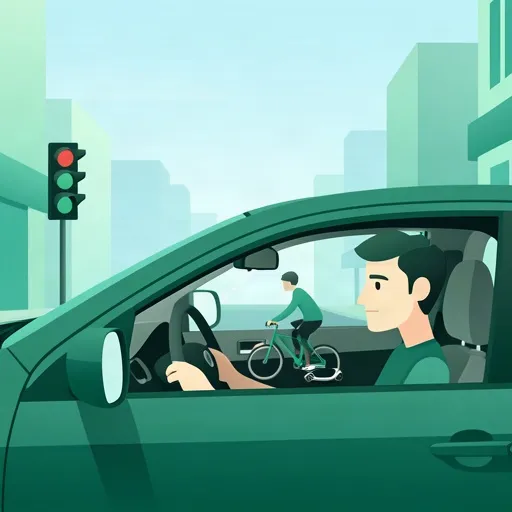
Understanding how to interact safely with vulnerable road users is a core requirement for any professional or private driver in Turkey. This guide breaks down the essential traffic etiquette and legal mandates for maneuvering near cyclists and e-scooter riders to help you prepare for the MTSK theory exam and real-world driving scenarios.
Article content overview
Navigating the vibrant streets of Türkiye requires more than just knowing basic traffic rules; it demands a high level of situational awareness, especially when sharing the road with vulnerable road users. Cyclists and e-scooter riders are becoming increasingly common in urban centers across the country, and as a driver, your ability to anticipate their movements is a critical component of the MTSK (Motorlu Taşıt Sürücü Kursu) theory exam. Understanding how to manage these interactions is not only a legal requirement but a fundamental aspect of defensive driving.
In the context of Turkish traffic legislation, vulnerable road users are those who lack the physical protection provided by a vehicle chassis. Whether you are driving a private car or a professional heavy vehicle, you are legally expected to exercise extra caution in areas where these users are present. The MTSK theory exam frequently tests your understanding of blind spots and safe passing distances, as these are the areas where the most frequent and severe accidents occur.
For professional drivers operating heavy vehicles, the risk associated with blind spots is significantly magnified. When driving in city traffic, your vehicle’s size creates large areas around the chassis where a cyclist or e-scooter rider can be completely hidden from your view. Professional drivers must perform a constant "scan" of their surroundings, particularly before executing right-hand turns or navigating narrow urban intersections where vulnerable users might attempt to filter through traffic.
The official Turkish theory exam expects you to identify that cyclists and e-scooters are particularly susceptible to being "squeezed" against the curb if you do not provide enough lateral clearance. Maintaining a consistent gaze through your mirrors and checking over your shoulder—the "shoulder check"—is a mandatory habit that should be ingrained in every driver.
Intersections are high-risk zones for accidents involving bicycles and electric scooters. When approaching a junction, you should never assume that a cyclist or scooter rider will follow the same path as a car. They may attempt to move across lanes or continue straight when you are intending to turn, which creates a collision risk if you haven't signaled your intent early.
When you sit for your e-sınav, you will likely encounter questions that depict scenarios involving vulnerable road users. The examiners are testing your "hazard perception" capabilities. A key theme in these questions is the necessity of "soft and gradual" control inputs—whether you are braking or steering—especially in mixed traffic conditions where a sudden move by a driver could startle a cyclist or cause an e-scooter rider to lose balance.
If you encounter a question about maneuvering on slippery surfaces or in heavy traffic, remember that smooth operation is the safest strategy. Abrupt actions on a wet road, particularly near a cyclist, can lead to a loss of traction and disastrous consequences. Always prioritize the safety of those outside your vehicle as a core principle of your driving habits.
This article teaches Turkish drivers how to safely interact with cyclists and e-scooter riders, who are classified as vulnerable road users under Turkish traffic legislation. The core principles emphasize constant blind spot vigilance through mirror checks and mandatory shoulder checks, particularly for professional heavy vehicle drivers. Safe passing requires maintaining adequate lateral clearance to prevent cyclists being squeezed against curbs, and all turns at intersections demand early signaling and speed reduction to account for unexpected cyclist movements. The MTSK theory exam specifically tests these hazard perception skills, rewarding drivers who demonstrate smooth, gradual control inputs rather than abrupt maneuvers that could endanger vulnerable road users.
A short set of high-value points that capture the most important ideas from this article.
Cyclists and e-scooter riders are legally entitled to use Turkish roads and must receive the same care as motor vehicles
Blind spots around vehicles, especially heavy ones, can completely hide vulnerable road users from mirrors
A mandatory shoulder check is required before turning or changing lanes to detect cyclists in your blind spot
Intersections are high-risk zones where cyclists may attempt unexpected lane changes or continue straight through your intended turn
Smooth and gradual control inputs are safer than abrupt maneuvers when sharing space with vulnerable users
Heavy vehicles create significantly larger blind spots requiring constant environmental scanning
Lateral clearance must be sufficient to prevent cyclists being squeezed against the curb
Signal your turn early to give vulnerable users time to react to your intended maneuver
Wet or slippery road conditions near cyclists require even softer control inputs to prevent loss of traction
The MTSK exam tests hazard perception skills specifically around blind spots and safe passing distances
Failing to perform a physical head-turn (shoulder check) before executing turns or lane changes
Assuming cyclists will follow the same trajectory as motor vehicles at intersections
Making sudden steering or braking inputs that could startle or destabilize e-scooter riders
Not reducing speed when approaching junctions with potential cyclist presence
Insufficient lateral clearance when passing cyclists, risking squeezing them against obstacles
Article content overview
A short set of high-value points that capture the most important ideas from this article.
Cyclists and e-scooter riders are legally entitled to use Turkish roads and must receive the same care as motor vehicles
Blind spots around vehicles, especially heavy ones, can completely hide vulnerable road users from mirrors
A mandatory shoulder check is required before turning or changing lanes to detect cyclists in your blind spot
Intersections are high-risk zones where cyclists may attempt unexpected lane changes or continue straight through your intended turn
Smooth and gradual control inputs are safer than abrupt maneuvers when sharing space with vulnerable users
Heavy vehicles create significantly larger blind spots requiring constant environmental scanning
Lateral clearance must be sufficient to prevent cyclists being squeezed against the curb
Signal your turn early to give vulnerable users time to react to your intended maneuver
Wet or slippery road conditions near cyclists require even softer control inputs to prevent loss of traction
The MTSK exam tests hazard perception skills specifically around blind spots and safe passing distances
Failing to perform a physical head-turn (shoulder check) before executing turns or lane changes
Assuming cyclists will follow the same trajectory as motor vehicles at intersections
Making sudden steering or braking inputs that could startle or destabilize e-scooter riders
Not reducing speed when approaching junctions with potential cyclist presence
Insufficient lateral clearance when passing cyclists, risking squeezing them against obstacles
Explore related topics, search based questions, and concepts that learners often look up when studying Cyclists and E-Scooters in Traffic. These themes reflect real search intent and help you understand how this topic connects to wider driving theory knowledge in Turkey.
Find clear and practical answers to common questions learners often have about Cyclists and E-Scooters in Traffic. This section helps explain difficult points, remove confusion, and reinforce the key driving theory concepts that matter for learners in Turkey.
The most significant risk is failing to detect cyclists and e-scooter riders in your vehicle's blind spots during maneuvers, such as turning or changing lanes.
Drivers must maintain a safe lateral distance, anticipate sudden movements from these smaller vehicles, and remain extra vigilant at intersections where riders may be obscured.
Yes, detecting vulnerable road users like cyclists, pedestrians, and scooter riders who are in your blind spot is a frequent focus in both theory and practical exam scenarios.
After finding the specific Turkish driving theory articles you need, dive deeper into related topics or challenge your knowledge with practice questions. Enhance your understanding of trafik işaretleri, road rules, and vehicle safety to ensure you are fully prepared for the official ehliyet sınavı.