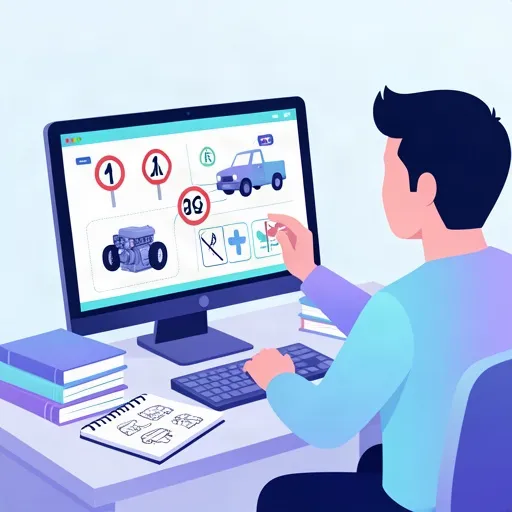
Preparing for your Turkish driving licence requires a deep understanding of the official MTSK syllabus. This article breaks down the essential theory topics to help you navigate the exam structure, ensuring you are fully prepared for the content, safety principles, and legal requirements mandated by Turkish traffic legislation.
Article content overview
The Turkish driving theory exam, known officially as the MTSK e-sınav, is a comprehensive assessment designed to ensure that every new driver possesses the theoretical knowledge necessary to navigate Turkish roads safely and responsibly. Achieving a passing grade of 70 requires more than just memorizing answers; it demands a deep understanding of the four primary pillars of the curriculum: traffic and environment, first aid, vehicle technique, and traffic etiquette. By mastering these core areas, you prepare yourself not only to pass the computer-based test but to handle the complex realities of driving in urban and rural environments across Türkiye.
The traffic and environment module is the largest section of the exam, covering the fundamental "rules of the road" as defined by Turkish traffic legislation. You will be tested on your ability to interpret various road signs, pavement markings, and situational priorities at intersections. Understanding how to manage speed limits, maintain safe following distances, and respect the rights of vulnerable road users like cyclists and pedestrians is critical.
One common area where learners struggle is identifying priority at unmarked intersections. Always remember that, unless stated otherwise by signs or signals, the general rule in Turkish traffic law is that vehicles entering from the left must yield to those approaching from the right, and all vehicles must yield to those already established within a roundabout.
In the unfortunate event of a road accident, a driver's initial actions can be life-saving. The Turkish driving theory exam includes a rigorous section on first aid to ensure you know how to assess an emergency scene, call 112, and perform basic life support until professional medical help arrives. You must be familiar with the "CAB" (Circulation, Airway, Breathing) protocol and understand how to manage common injuries like fractures, burns, or heavy bleeding without causing further harm to the victim.
You do not need to be a mechanic to pass the vehicle technique module, but you do need to understand how your car functions and how to perform basic safety checks. This section covers the dashboard indicators, the importance of engine oil, coolant levels, and tyre pressure, as well as the basic operation of the transmission, braking systems, and lighting controls. Being able to identify a dashboard warning light—such as the oil pressure or battery charge indicator—is essential for vehicle maintenance and avoiding engine failure on the motorway.
Traffic etiquette, or trafik adabı, focuses on the psychological and social aspects of driving. The exam will challenge you to consider how your behavior—such as aggressive honking, tailgating, or failing to signal—affects other road users and overall traffic flow. Respect for others, patience in heavy traffic, and the willingness to yield even when you technically have the right of way are treated as vital components of professional driving conduct in the Turkish curriculum.
Article content overview
Explore related topics, search based questions, and concepts that learners often look up when studying Turkish Driving Exam Study Guide. These themes reflect real search intent and help you understand how this topic connects to wider driving theory knowledge in Turkey.
Find clear and practical answers to common questions learners often have about Turkish Driving Exam Study Guide. This section helps explain difficult points, remove confusion, and reinforce the key driving theory concepts that matter for learners in Turkey.
The exam consists of four core pillars: Traffic and Environment, First Aid, Vehicle Technique, and Traffic Etiquette.
While the core theory pillars remain consistent, the specific questions and depth may vary based on the vehicle category (e.g., M, A, B, C, D) you are applying for.
The exam is scored out of 100 points based on the number of correct answers. A score of 70 or higher is required to pass, with all questions carrying equal weight.
No, the theory exam focuses exclusively on legal, technical, and behavioural knowledge. Practical driving skills are assessed separately in the driving application exam.
After finding the specific Turkish driving theory articles you need, dive deeper into related topics or challenge your knowledge with practice questions. Enhance your understanding of trafik işaretleri, road rules, and vehicle safety to ensure you are fully prepared for the official ehliyet sınavı.