Understanding where and how you can legally park is a fundamental skill for every driver in Turkey and a frequent topic in the MTSK exam. This guide breaks down the essential legal distinctions between stopping and parking while explaining how to identify prohibited zones and interpret supplemental time-limit signage. You will gain the knowledge necessary to handle real-world parking scenarios and tricky test questions alike.
Article content overview
Mastering the rules of stopping and parking is a cornerstone of becoming a safe driver in Türkiye. For students preparing for the MTSK e-sınav, understanding the nuances between legal parking zones and prohibited areas is not just about passing the exam; it is about ensuring traffic flow and safety on busy Turkish streets. Many candidates lose valuable marks by confusing the legal definition of "stopping" with "parking," a distinction that is strictly enforced by Turkish traffic legislation.
In the context of the Turkish driving theory exam, the legal difference between stopping (durma) and parking (park etme) is significant. Stopping refers to a temporary, involuntary action or a short-term pause, such as waiting for a red light, yielding to pedestrians, or loading/unloading passengers. This action is usually short in duration and occurs as part of the normal flow of traffic.
The temporary cessation of a vehicle's movement due to traffic situations, signals, or the need for passengers to board or alight, provided the vehicle remains under the driver's control at all times.
In contrast, parking implies a longer duration of inactivity where the driver leaves the vehicle or remains stationary in a way that is not dictated by immediate traffic conditions. Understanding this distinction is vital because many signs that prohibit parking do not necessarily forbid temporary stopping for passenger boarding.
The intentional halting of a vehicle for a period longer than what is required for immediate loading, unloading, or traffic-related pauses, typically with the driver vacating the vehicle or keeping it stationary for an extended time.
Turkish road signs are designed to be universally understood, yet they contain specific details that learners often overlook. The most recognizable sign is the "Park Etmek Yasaktır" sign, which features a red circle with a blue background and a single red diagonal line.
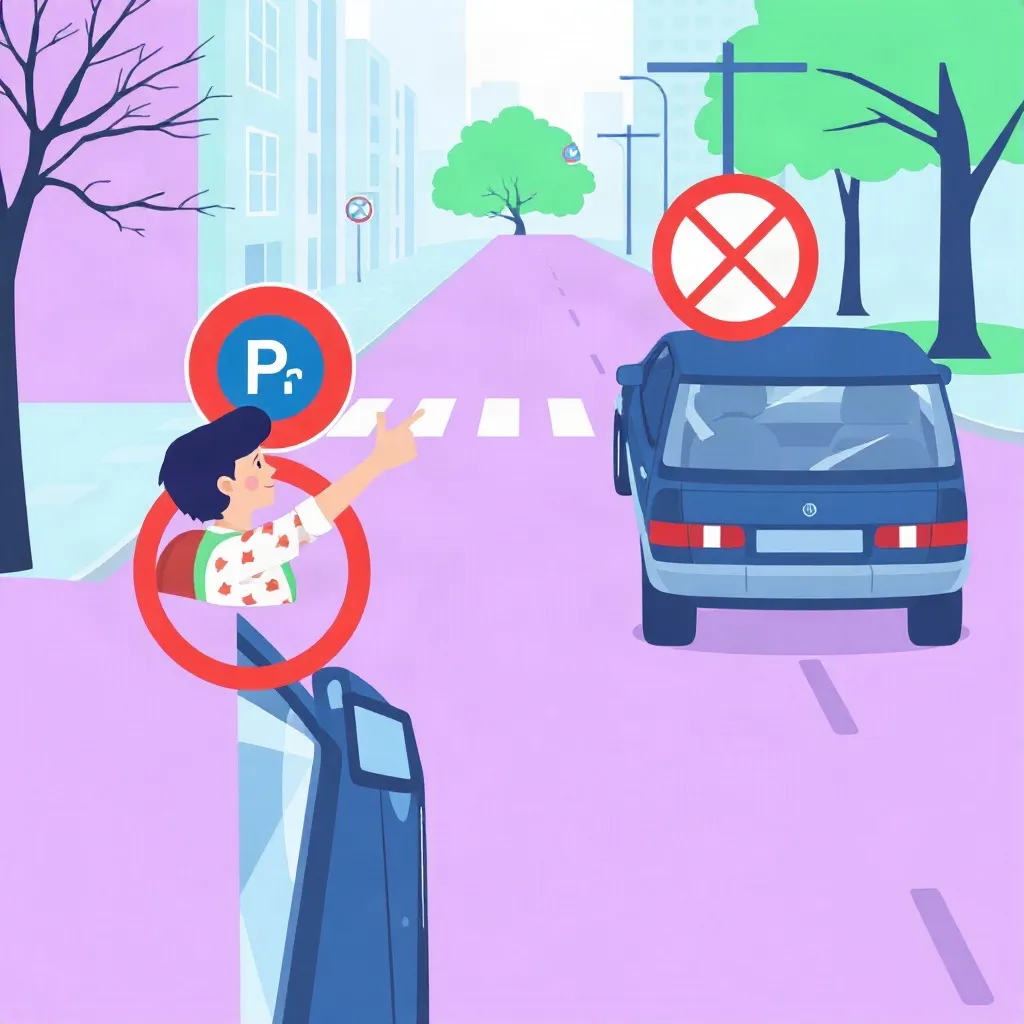
However, learners must be aware of more restrictive variants. If the sign displays two crossing red lines, it indicates a total prohibition on both parking and stopping.
The MTSK exam frequently tests your knowledge of "automatic" prohibitions—areas where parking is banned even if no specific sign is present. As a driver, you are expected to know these rules by heart to avoid fines and ensure road safety.
Common Exam Trap: Questions often present a scenario where a driver stops "just for a minute" near a fire hydrant or a crosswalk. Regardless of the short time, this is considered a violation under Turkish traffic law. Always look for these "automatic" prohibition zones in exam diagrams.
In urban centers like Istanbul, Ankara, or Izmir, parking is often managed through supplemental plates attached below the main "Park Etmek Yasaktır" sign. These plates clarify the specific rules, such as the duration of allowed parking or the types of vehicles exempt from the restriction. For example, a plate showing "08:00 - 20:00" means the parking prohibition is only active during those business hours. Similarly, plates indicating vehicle categories—such as "only for taxis" or "only for motorcycles"—must be strictly followed.
This article clarifies the legal difference between durma (temporary stopping) and park etme (intentional parking) under Turkish traffic law, explaining how two key prohibition signs (C1 and C2) apply differently to each. It identifies automatic no-parking zones requiring no signage—within 5m of crossings, fire hydrants, and hospital entrances; within 15m of bus stops; on bridges and in tunnels; and on all sidewalks. The content also covers supplemental plates that restrict prohibition periods to specific hours or vehicle types, which are common MTSK exam question triggers. Learners should memorize exact distances and sign variations to avoid the exam trap of assuming short stops are permitted in prohibited zones.
A short set of high-value points that capture the most important ideas from this article.
The legal distinction between durma (stopping) and park etme (parking) is tested on the MTSK exam and affects sign interpretation.
The C1 sign (single red diagonal) prohibits parking but may allow temporary stopping for passengers; the C2 sign (double red cross) prohibits both stopping and parking.
Prohibited parking zones apply automatically even without visible signs, including within 5m of crossings, fire hydrants, and 15m of bus stops.
Supplemental time plates narrow prohibition periods (e.g., 08:00-20:00) and vehicle categories, making sign interpretation context-dependent.
Parking on sidewalks or in tunnels and bridges is always prohibited regardless of duration.
Durma (stopping) is short, involuntary, and tied to traffic conditions; park etme (parking) is longer, intentional, and often involves leaving the vehicle.
Within 5 meters of pedestrian crossings, intersections, or fire hydrant entrances is an automatic no-parking zone.
Within 15 meters of bus stops or public transport stations is prohibited.
Two crossing red lines (C2) mean total prohibition of both stopping and parking—more restrictive than the single-slash C1 sign.
Supplemental plates below prohibition signs specify active hours and vehicle exemptions, which override general rules.
Confusing the single-slash C1 sign with a total stop prohibition; C1 allows durma but not park etme.
Assuming a short stop 'just for a minute' near a fire hydrant or crosswalk is acceptable—it is still a violation.
Ignoring supplemental time plates and assuming a parking prohibition applies 24/7.
Parking on sidewalks because no explicit 'no parking' sign is visible, unaware of automatic sidewalk restrictions.
Misreading double-cross (X) signs as equivalent to single-slash signs, losing marks on diagram-based questions.
Article content overview
A short set of high-value points that capture the most important ideas from this article.
The legal distinction between durma (stopping) and park etme (parking) is tested on the MTSK exam and affects sign interpretation.
The C1 sign (single red diagonal) prohibits parking but may allow temporary stopping for passengers; the C2 sign (double red cross) prohibits both stopping and parking.
Prohibited parking zones apply automatically even without visible signs, including within 5m of crossings, fire hydrants, and 15m of bus stops.
Supplemental time plates narrow prohibition periods (e.g., 08:00-20:00) and vehicle categories, making sign interpretation context-dependent.
Parking on sidewalks or in tunnels and bridges is always prohibited regardless of duration.
Durma (stopping) is short, involuntary, and tied to traffic conditions; park etme (parking) is longer, intentional, and often involves leaving the vehicle.
Within 5 meters of pedestrian crossings, intersections, or fire hydrant entrances is an automatic no-parking zone.
Within 15 meters of bus stops or public transport stations is prohibited.
Two crossing red lines (C2) mean total prohibition of both stopping and parking—more restrictive than the single-slash C1 sign.
Supplemental plates below prohibition signs specify active hours and vehicle exemptions, which override general rules.
Confusing the single-slash C1 sign with a total stop prohibition; C1 allows durma but not park etme.
Assuming a short stop 'just for a minute' near a fire hydrant or crosswalk is acceptable—it is still a violation.
Ignoring supplemental time plates and assuming a parking prohibition applies 24/7.
Parking on sidewalks because no explicit 'no parking' sign is visible, unaware of automatic sidewalk restrictions.
Misreading double-cross (X) signs as equivalent to single-slash signs, losing marks on diagram-based questions.
Explore related topics, search based questions, and concepts that learners often look up when studying Turkish Parking Rules and Signs. These themes reflect real search intent and help you understand how this topic connects to wider driving theory knowledge in Turkey.
Find clear and practical answers to common questions learners often have about Turkish Parking Rules and Signs. This section helps explain difficult points, remove confusion, and reinforce the key driving theory concepts that matter for learners in Turkey.
Stopping is a brief, mandatory action such as loading or unloading passengers or cargo, while parking involves leaving the vehicle stationary for a period longer than necessary for these tasks.
It means 'Parking is Prohibited'. You are not permitted to leave your vehicle stationary in this area, though stopping for immediate passenger drop-off is generally allowed unless specifically marked otherwise.
Yes, parking is strictly prohibited in areas such as near fire hydrants, intersections, pedestrian crossings, tunnel entrances, and on bridges, as these pose significant safety hazards.
Supplemental plates usually specify time limits, the types of vehicles affected, or the specific hours during which the parking restriction applies, helping you determine if you are authorized to park.
After finding the specific Turkish driving theory articles you need, dive deeper into related topics or challenge your knowledge with practice questions. Enhance your understanding of trafik işaretleri, road rules, and vehicle safety to ensure you are fully prepared for the official ehliyet sınavı.