
Drivers in Türkiye must remain hyper-vigilant towards cyclists, pedestrians, and e-scooter users who share the urban road network. This article explains your legal obligations and the defensive maneuvers required to keep these road users safe, helping you identify and avoid common exam traps that appear in the MTSK e-sınav.
Article content overview
Navigating the urban landscape in Türkiye requires more than just mastering vehicle mechanics; it demands a high level of situational awareness regarding those who share the road without the protection of a chassis. As a candidate for your Turkish driving license, understanding your legal and ethical obligations toward vulnerable road users—such as pedestrians, cyclists, and e-scooter riders—is a cornerstone of the MTSK e-sınav. These groups are at a significantly higher risk of injury, and the theory exam frequently tests your ability to anticipate their movements and prioritize their safety above your own convenience.
In the context of the Turkish Traffic Law, professional and novice drivers alike must treat city centers as zones of shared responsibility. Vulnerable road users often move unpredictably, and factors such as poor visibility, weather conditions, or the rapid increase in e-scooter usage have made defensive driving a mandatory skill. During your exam, you will likely encounter scenarios involving cyclists or pedestrians in blind spots. The correct mindset is always to assume that these individuals may not see you, meaning you must actively manage the distance and speed of your vehicle to compensate for potential hazards.
Common Exam Trap: Never assume that a cyclist or pedestrian will follow traffic rules perfectly. Many MTSK questions test your reaction to "unpredictable" movements; the correct answer almost always involves reducing speed and maintaining a safe lateral distance.
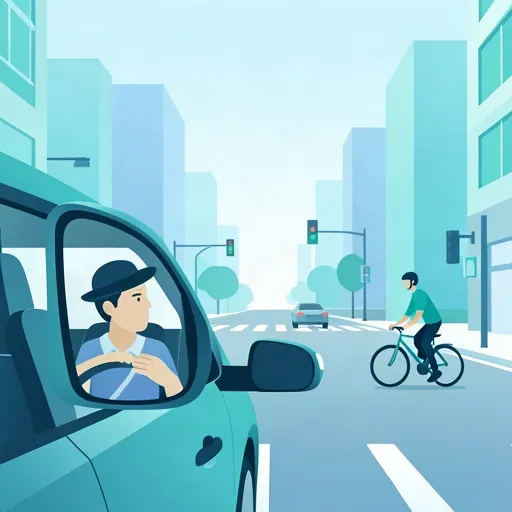
One of the most frequent topics in the MTSK e-sınav involves the management of vehicle blind spots. Whether you are driving a heavy vehicle or a standard passenger car, your vision is limited by the structure of the vehicle. Cyclists and motorcyclists are particularly susceptible to being caught in these zones, especially when you are making turns at an intersection.
To pass the theory exam, you must demonstrate that you understand the necessity of checking mirrors repeatedly before initiating any maneuver. If you are operating a heavy vehicle, you are legally expected to be even more vigilant, as your stopping distance and blind spots are significantly greater.
The area around your vehicle that cannot be directly observed by the driver while looking through the front or side mirrors. In the context of Turkish theory tests, this is a frequent source of "hazard awareness" questions.
The law in Türkiye is clear regarding the protection of those who are most exposed. When approaching an intersection, especially one without clear signaling, you must be prepared to yield to pedestrians crossing the road, even if they are not at a designated crossing point. Furthermore, e-scooters have specific regulations, and drivers must afford them the same caution as bicycles.
Traffic signs serve as the primary communication tool between road authorities and drivers. Recognizing these signs instantly is essential for maintaining safety.
Mastering these rules requires consistent practice. The Turkish driving theory exam often uses specific scenarios to test if you prioritize human life over speed or convenience. When you encounter practice questions regarding cyclists or pedestrians, look for the options that emphasize "reducing speed," "checking blind spots," and "yielding."
This guide covers the essential legal and practical responsibilities drivers have toward vulnerable road users in Turkish traffic, focusing on the critical skill of defensive driving around cyclists, pedestrians, and e-scooter riders. Key exam topics include blind spot management (the unseen areas around your vehicle), the mandatory practice of continuously checking mirrors before maneuvers, and the principle that safety always overrides legal priority at intersections. The content highlights that unpredictable movements from vulnerable users should trigger immediate speed reduction and increased lateral distance, with special attention needed for heavy vehicles which have greater blind spots. Understanding these concepts is essential for passing the MTSK e-sınav and operating safely in Turkey's urban traffic environment.
A short set of high-value points that capture the most important ideas from this article.
Vulnerable road users (pedestrians, cyclists, e-scooter riders) must always be given priority as they lack vehicle protection
Adopt a defensive mindset: always assume vulnerable road users may not see you and compensate by reducing speed and distance
Blind spots pose the greatest danger to cyclists and motorcyclists, especially during turns at intersections
Safety takes precedence over legal right-of-way whenever a collision becomes imminent
Heavy vehicles require even greater vigilance due to larger blind spots and longer stopping distances
Check mirrors repeatedly before initiating any maneuver, not just once
Never assume cyclists or pedestrians will follow traffic rules perfectly in exam scenarios
E-scooters receive the same legal caution and protection as bicycles under Turkish traffic law
Reduce speed significantly when approaching intersections in urban areas
Maintain adequate lateral distance when passing vulnerable road users at all times
Assuming cyclists will stay in their lane and not weave or change position unexpectedly
Checking mirrors only once before turning rather than continuously scanning blind spots
Prioritizing your legal right-of-way over taking evasive action to prevent an accident
Failing to slow down in urban zones where e-scooter usage has increased unpredictably
Assuming pedestrians at crossings always have clear visibility of approaching vehicles
Article content overview
A short set of high-value points that capture the most important ideas from this article.
Vulnerable road users (pedestrians, cyclists, e-scooter riders) must always be given priority as they lack vehicle protection
Adopt a defensive mindset: always assume vulnerable road users may not see you and compensate by reducing speed and distance
Blind spots pose the greatest danger to cyclists and motorcyclists, especially during turns at intersections
Safety takes precedence over legal right-of-way whenever a collision becomes imminent
Heavy vehicles require even greater vigilance due to larger blind spots and longer stopping distances
Check mirrors repeatedly before initiating any maneuver, not just once
Never assume cyclists or pedestrians will follow traffic rules perfectly in exam scenarios
E-scooters receive the same legal caution and protection as bicycles under Turkish traffic law
Reduce speed significantly when approaching intersections in urban areas
Maintain adequate lateral distance when passing vulnerable road users at all times
Assuming cyclists will stay in their lane and not weave or change position unexpectedly
Checking mirrors only once before turning rather than continuously scanning blind spots
Prioritizing your legal right-of-way over taking evasive action to prevent an accident
Failing to slow down in urban zones where e-scooter usage has increased unpredictably
Assuming pedestrians at crossings always have clear visibility of approaching vehicles
Explore related topics, search based questions, and concepts that learners often look up when studying Safety for Vulnerable Road Users. These themes reflect real search intent and help you understand how this topic connects to wider driving theory knowledge in Turkey.
Find clear and practical answers to common questions learners often have about Safety for Vulnerable Road Users. This section helps explain difficult points, remove confusion, and reinforce the key driving theory concepts that matter for learners in Turkey.
The primary risk is the driver's failure to check blind spots before turning or changing lanes, which often leads to accidents with cyclists or e-scooter riders.
Yes, e-scooter riders are vulnerable road users and must be treated with the same caution as cyclists and pedestrians according to current Turkish traffic regulations.
It refers to anticipating the mistakes of others, maintaining a safe distance, and being ready to react to the unpredictable movements of pedestrians and two-wheeled vehicle users.
After finding the specific Turkish driving theory articles you need, dive deeper into related topics or challenge your knowledge with practice questions. Enhance your understanding of trafik işaretleri, road rules, and vehicle safety to ensure you are fully prepared for the official ehliyet sınavı.