
This lesson details the legal consequences of traffic violations, including financial fines, penalty points, and potential licence suspension under Turkish law. It provides critical knowledge to help you maintain a clean driving record and understand the serious implications of disobeying traffic regulations. This is a vital component of your Category B theory preparation, ensuring you drive responsibly and safely.
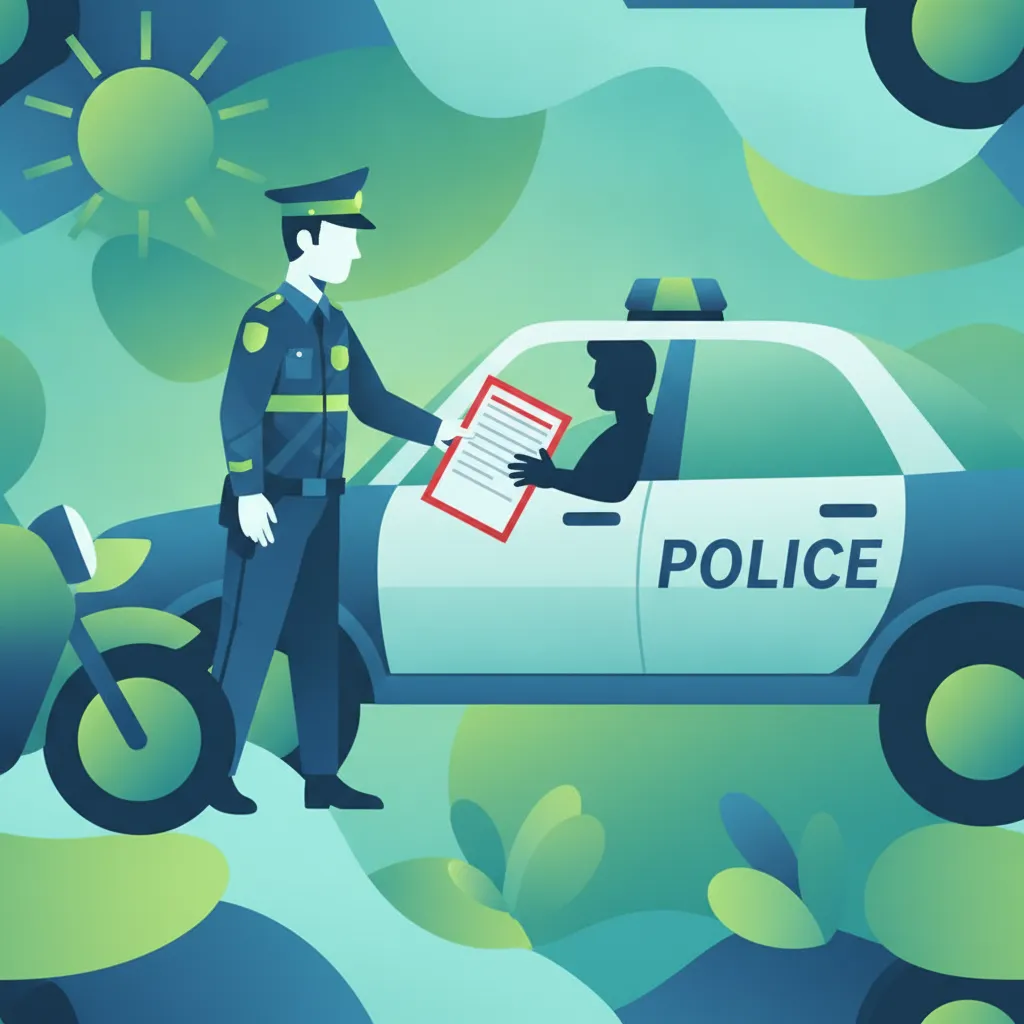
Lesson content overview
Operating a motor vehicle is a significant responsibility that is heavily regulated to protect public safety. In Turkey, the legal framework governing road safety relies on a combination of administrative actions, financial penalties, and criminal prosecutions. Understanding these legal consequences is not only a key requirement for passing the Category B driving licence theory exam (MTSK e-sınav) but also essential for safeguarding your driving privileges and avoiding severe criminal liabilities.
This lesson covers the administrative and judicial structures defined by the Turkish Highway Traffic Code (Karayolları Trafik Kanunu or KTK) and the Turkish Penal Code (Türk Ceza Kanunu or TCK). It details how demerit points accumulate, when licences are suspended or revoked, how vehicles are impounded, and the long-term impact of traffic offenses on your criminal record.
The enforcement of traffic laws in Turkey is designed around five core principles:
Understanding the legal framework helps drivers anticipate the immediate consequences of risky behaviors, reinforcing compliance and emphasizing that driving is a privilege, not an absolute right.
Turkey utilizes a numeric demerit points system to monitor and log driver behavior over time. Every traffic violation is assigned a specific point value based on its danger level. For instance, failing to wear a seatbelt might carry a minor point penalty, while reckless overtaking or running a red light carries much higher demerit points.
Under the Turkish points system, points accumulate over a rolling two-year period from the date of the first infraction. The system operates under strict threshold tiers:
If your driving licence is suspended due to accumulating 100 points, you cannot simply wait out the suspension period. You must actively complete a rehabilitation process.
Serve the Suspension Period: The physical licence card must be surrendered to the traffic police or local registry for the duration of the suspension.
Complete Driver Retraining: You must enroll in and successfully complete a mandatory driver retraining course (Sürücü Davranışlarını Geliştirme Eğitimi).
Undergo Psychotechnical Evaluation: For repeated point accumulations, a psychotechnical test evaluating cognitive, reflex, and psychological fitness is legally required.
Apply for Licence Reactivation: Once all conditions and waiting periods are met, present your training certificates to the registration authority to retrieve your licence.
A driving licence suspension is the temporary withdrawal of your legal right to operate a motor vehicle. Suspensions in Turkey fall into two categories: administrative and judicial.
These are executed directly by the traffic police or registry office based on statutory thresholds. They occur automatically without requiring a court trial.
These are handed down by a judge as part of a court ruling following a criminal trial.
Licence revocation is the permanent cancellation of your driving privileges. Unlike a suspension, a revoked licence cannot simply be returned or reactivated. The driver’s record is wiped clean, and they are treated legally as a non-driver.
Revocation is reserved for the most severe infractions, including:
To drive legally again after a revocation, you must undergo a lengthy re-licensing process:
Financial penalties serve as an immediate economic deterrent. Under Turkish traffic law, fines are split into two primary types:
Payment Deadlines and Penalties: Traffic fines should be paid promptly. Under Turkish law, paying a traffic fine within 15 calendar days of notification grants a 25% discount. Conversely, delaying payment past the 30-day statutory deadline results in a monthly interest penalty of 5% added to the original fine amount.
Vehicle impoundment involves the physical seizure and towing of a vehicle to an authorized state-run secure parking lot. This action removes an immediate safety hazard or unlawful vehicle from public roads.
In addition to incurring the base traffic fine, the vehicle owner is financially liable for all towing fees and daily storage costs accrued at the impound lot before the vehicle can be legally released.
When a traffic violation crosses the line from a simple administrative infraction into an act that causes physical harm, death, or extreme public endangerment, it is prosecuted under criminal law.
Criminal convictions are permanently recorded in your official criminal record registry (Adli Sicil Kaydı). A criminal record resulting from a traffic crime has severe, long-term consequences:
The following table summarizes the legal articles, their applicability, and key real-world scenarios under Turkish traffic regulations:
| Article (KTK) | Key Legal Provision | Legal Status | Core Rationale | Correct Driver Action | Violation Action |
|---|---|---|---|---|---|
| Article 80 | Points System: Accumulation of 100 demerit points within 2 years results in automatic suspension. | Mandatory | Provides a quantitative tracking mechanism to identify and correct high-risk driving habits. | The driver monitors their violations, drives defensively, and avoids accumulating demerit points. | Driver continues committing violations, ignoring warning letters until reaching 100 points. |
| Article 81 | Suspension Durations: Administrative suspensions range from 15 days to 2 years based on points or offenses. | Mandatory | Scales punishment based on risk and repeat infractions. | Driver surrenders their licence immediately upon receiving a suspension notice. | Driver ignores the suspension notice and continues to drive, risking arrest. |
| Article 85 | Licence Revocation: Complete cancellation for severe offences (e.g., fatal accidents). | Mandatory | Protects the public by permanently removing high-risk individuals from the road. | A driver maintains complete focus on safety, respecting vulnerable road users and traffic laws. | Driver operates a vehicle recklessly, causing a fatal crash, resulting in licence cancellation. |
| Article 91 | Vehicle Impoundment: Vehicles used in major violations or lacking registration/insurance are impounded. | Mandatory | Directly removes unsafe or uninsured vehicles from active public road networks. | Owner maintains active insurance, valid registration, and drives sober. | Operating a vehicle with expired mandatory insurance, leading to towing and impound fees. |
| Article 86/1 | Mandatory Retraining: Suspended drivers must complete rehabilitation programs. | Mandatory | Re-educates drivers on defensive driving and legal responsibilities before restoring driving privileges. | Driver attends all hours of the mandatory retraining program and passes the assessment. | Driver attempts to drive or retrieve their licence card without enrolling in or completing the training. |
Understanding how these laws apply in practical situations helps clarify potential legal gray areas.
Severe penalties are not arbitrary; they are rooted in science and human psychology.
Kinetic energy increases exponentially with speed (). When speed doubles, the kinetic energy involved in a potential collision quadruples. This massive increase in energy drastically reduces a driver's ability to stop in time and increases the severity of potential injuries, justifying strict, escalating penalties for speeding.
Alcohol and drugs impair key cognitive functions, such as spatial awareness, hazard perception, and reaction times. These impairments lead to delayed emergency braking and poor decision-making.
Because safe driving requires split-second reactions, driving under the influence carries immediate licence suspension, heavy fines, and vehicle impoundment. This zero-tolerance approach prioritizes public safety by removing impaired drivers from the road before an accident can occur.
This lesson covers the Turkish traffic penalty framework under the Karayolları Trafik Kanunu (KTK) and Türk Ceza Kanunu (TCK), explaining how demerit points accumulate over a rolling 2-year period up to the 100-point suspension threshold. It distinguishes between administrative suspensions (immediate, point-based, or DUI-related) and judicial suspensions or revocations (court-ordered, permanent). Key topics include vehicle impoundment triggers, fine payment deadlines with discount/penalty structures, mandatory driver retraining requirements, and criminal prosecution for serious offences like reckless homicide or endangering traffic safety. The content prepares learners for exam questions on legal consequences while reinforcing that driving is a regulated privilege requiring ongoing legal compliance.
A short set of high-value points that capture the most important learning from this lesson.
Turkish demerit points accumulate over a rolling 2-year period, with 100 points triggering automatic administrative licence suspension.
Driving licence suspension is temporary and requires retraining for reactivation, while revocation is permanent and demands a full re-licensing process.
Vehicle impoundment occurs for DUI, unlicensed driving, and operating unregistered or uninsured vehicles, with owners liable for towing and storage fees.
Severe traffic violations causing injury or death are prosecuted under the Turkish Penal Code and permanently recorded in the driver's criminal record.
Drivers must adhere to speed limits specific to their vehicle class; Category B licence holders driving panel vans cannot use passenger car speed limits as their threshold.
Explore all units and lessons included in this driving theory course.
Points accumulate over 2 years: 0-24 safe, 25-50 warning stage, 50+ risk of action, 100 triggers mandatory suspension.
Paying traffic fines within 15 days grants a 25% discount; delaying past 30 days adds 5% monthly interest.
Driving while licence is suspended is a separate major offense that extends the suspension and results in immediate vehicle impoundment.
Reinstating after a points-based suspension requires completing SÜDGE (mandatory driver retraining) and psychotechnical evaluation.
Legal liability for a violation begins when the infraction is recorded, not when formal notice is received.
Assuming the 100-point threshold can be temporarily avoided by relying on administrative processing delays; police checks reveal point overages immediately.
Confusing licence suspension (temporary) with revocation (permanent), leading to incorrect expectations about the reinstatement process.
Believing that paying fines removes demerit points; fines and points operate independently in the Turkish system.
Underestimating that driving without mandatory insurance (Zorunlu Mali Sorumluluk Sigortası) triggers immediate vehicle impoundment, not just a fine.
Assuming BAC limits and penalties are the same for all offences; DUI with BAC exceeding 1.00 g/l triggers automatic criminal prosecution even without an accident.
Lesson content overview
A short set of high-value points that capture the most important learning from this lesson.
Turkish demerit points accumulate over a rolling 2-year period, with 100 points triggering automatic administrative licence suspension.
Driving licence suspension is temporary and requires retraining for reactivation, while revocation is permanent and demands a full re-licensing process.
Vehicle impoundment occurs for DUI, unlicensed driving, and operating unregistered or uninsured vehicles, with owners liable for towing and storage fees.
Severe traffic violations causing injury or death are prosecuted under the Turkish Penal Code and permanently recorded in the driver's criminal record.
Drivers must adhere to speed limits specific to their vehicle class; Category B licence holders driving panel vans cannot use passenger car speed limits as their threshold.
Explore all units and lessons included in this driving theory course.
Points accumulate over 2 years: 0-24 safe, 25-50 warning stage, 50+ risk of action, 100 triggers mandatory suspension.
Paying traffic fines within 15 days grants a 25% discount; delaying past 30 days adds 5% monthly interest.
Driving while licence is suspended is a separate major offense that extends the suspension and results in immediate vehicle impoundment.
Reinstating after a points-based suspension requires completing SÜDGE (mandatory driver retraining) and psychotechnical evaluation.
Legal liability for a violation begins when the infraction is recorded, not when formal notice is received.
Assuming the 100-point threshold can be temporarily avoided by relying on administrative processing delays; police checks reveal point overages immediately.
Confusing licence suspension (temporary) with revocation (permanent), leading to incorrect expectations about the reinstatement process.
Believing that paying fines removes demerit points; fines and points operate independently in the Turkish system.
Underestimating that driving without mandatory insurance (Zorunlu Mali Sorumluluk Sigortası) triggers immediate vehicle impoundment, not just a fine.
Assuming BAC limits and penalties are the same for all offences; DUI with BAC exceeding 1.00 g/l triggers automatic criminal prosecution even without an accident.
Explore search topics learners often look for when studying Legal Penalties and Consequences. These topics reflect common questions about road rules, driving situations, safety guidance, and lesson level theory preparation for learners in Turkey.
Browse additional driving theory lessons that cover connected traffic rules, road signs, and common driving situations related to this topic. Improve your understanding of how different rules interact across everyday traffic scenarios.
Understand the physiological and psychological impact of substance use on hazard perception and reaction times. This lesson explains the legal thresholds for blood alcohol concentration and the serious road safety implications for drivers under the influence in Turkey.
This lesson details the physiological effects of alcohol, illegal drugs, and prescription medications on driving performance. It explains how these substances impair coordination, slow down reaction times, and skew risk perception behind the wheel. Motorists will learn the absolute legal blood-alcohol limits and the danger of any level of impairment.

This lesson focuses on the extreme dangers of driver fatigue, micro-sleep episodes, and the signs of physical exhaustion. It details how sleep deprivation compromises driving safety in a manner comparable to moderate alcohol intoxication. Drivers will learn proactive fatigue management strategies, including scheduling regular rest stops.

Learners will explore the risks associated with driver fatigue, distraction, and stress, particularly during long trips with passengers. The lesson provides strategies for recognizing fatigue, scheduling appropriate rest breaks, and employing techniques to maintain focus and reduce stress. Emphasis is placed on the impact of these factors on safety and passenger comfort.

This lesson emphasizes the ethical dimension of driving, encouraging a responsible and considerate attitude towards all road users. Learners will explore the principles of defensive driving, risk awareness, and the moral obligations that come with operating a vehicle. The importance of respecting pedestrians, cyclists, and vulnerable road users is highlighted, along with the broader societal benefits of ethical driving.
This lesson focuses on recognizing the signs of driver fatigue and implementing effective strategies to manage it while operating a goods vehicle. Learners will understand the health risks associated with prolonged driving periods, the importance of regular rest breaks, and techniques to maintain alertness. Emphasis is placed on fatigue mitigation measures to ensure safe driving and prevent accidents.
This lesson covers the unique challenges of nighttime driving, focusing on reduced visual perception, headlight glare, and driver fatigue. It explains how to adjust speed to remain within the headlight beam range and react to poorly illuminated road hazards. Motorists will learn techniques to maintain maximum focus and safety after sunset.

Learners will explore the specific challenges presented by adverse weather conditions, such as rain, fog, and nighttime driving. The lesson emphasizes the importance of adjusting speed, increasing following distances, and using appropriate lighting to maintain safety. Strategies for handling reduced road surface grip and visibility issues are discussed, ensuring drivers can adapt to changing weather while protecting passengers and other road users.
This lesson examines the integral role of the goods vehicle driver in contributing to overall traffic safety and a positive safety culture. It focuses on proactive driving behaviors, hazard identification, and effective risk management strategies. Communication techniques with other road users, compliance with traffic flow regulations, and competent emergency responses are highlighted as essential skills.
Human error and deliberate risk-taking represent the leading causes of traffic collisions among novice moped riders. This lesson analyzes the high dangers of using mobile phones while riding, weaving unsafely between lanes, and tailgating other motorists. It also covers the severe legal limits on alcohol and drug consumption under Turkish law, explaining how even minor impairments can drastically slower your hazard response times and lead to catastrophic accidents.

This lesson promotes a responsible, safe, and sustainable driving culture, emphasizing personal accountability and environmental protection. It covers eco-driving techniques that reduce emissions and fuel consumption while enhancing overall traffic flow. Motorists will learn to view driving as a privilege that demands constant civic responsibility.
Learn the essential legal duties and correct actions required during traffic accidents in Turkey. This lesson provides an overview of emergency management, the priority of actions at a collision scene, and basic first aid concepts to help minimize injuries until professional medical assistance arrives.
This lesson explains the critical steps to take during a road accident, focusing on scene safety, emergency calling, and basic first aid. It details how to secure the crash scene using reflectors to prevent secondary collisions and how to assess injured victims safely. Drivers will learn essential life-saving techniques required by Turkish law.
This lesson provides guidance on appropriate actions to take in the event of an accident or emergency while operating a goods vehicle. Learners will understand how to secure the scene, call Turkish emergency services (112), provide basic first aid, and complete necessary documentation. Emphasis is placed on ensuring personal safety, preventing further incidents, and facilitating rescue teams.
Knowing how to act immediately following a traffic accident or mechanical breakdown is crucial for saving lives and preventing secondary collisions. This lesson provides clear instructions on securing the scene using warning markers, assessing injuries, and immediately dialing the national 112 emergency number. You will learn what critical information to report, how to administer basic life-saving first aid within your capacity, and how to position a disabled moped safely out of active traffic lanes.
Find clear answers to common questions learners have about Legal Penalties and Consequences. Learn how the lesson is structured, which driving theory objectives it supports, and how it fits into the overall learning path of units and curriculum progression in Turkey. These explanations help you understand key concepts, lesson flow, and exam focused study goals.
In Turkey, traffic violations result in penalty points being added to your driving record. If you accumulate a specific number of points within a set timeframe, your driving license can be suspended temporarily, requiring you to undergo further training before reinstatement.
While most traffic fines are administrative, severe violations, such as driving under the influence or causing a serious accident, can lead to criminal charges, prosecution, and a permanent mark on your criminal record.
Yes, for certain high-risk violations or after accumulating a threshold of penalty points, Turkish law mandates that drivers attend specific education or retraining programs to address their driving behavior before they can regain their driving privileges.
Vehicle impoundment occurs in cases where a driver is found operating a vehicle without proper insurance, an invalid license, or under conditions that pose a severe threat to public safety, such as extreme speeding or impaired driving.
Use our comprehensive practice search to find exactly the Turkish driving theory questions you need to master. Whether reviewing specific road signs, traffic rules, or first aid scenarios, select your perfect practice set and boost your confidence for the official ehliyet sınavı.