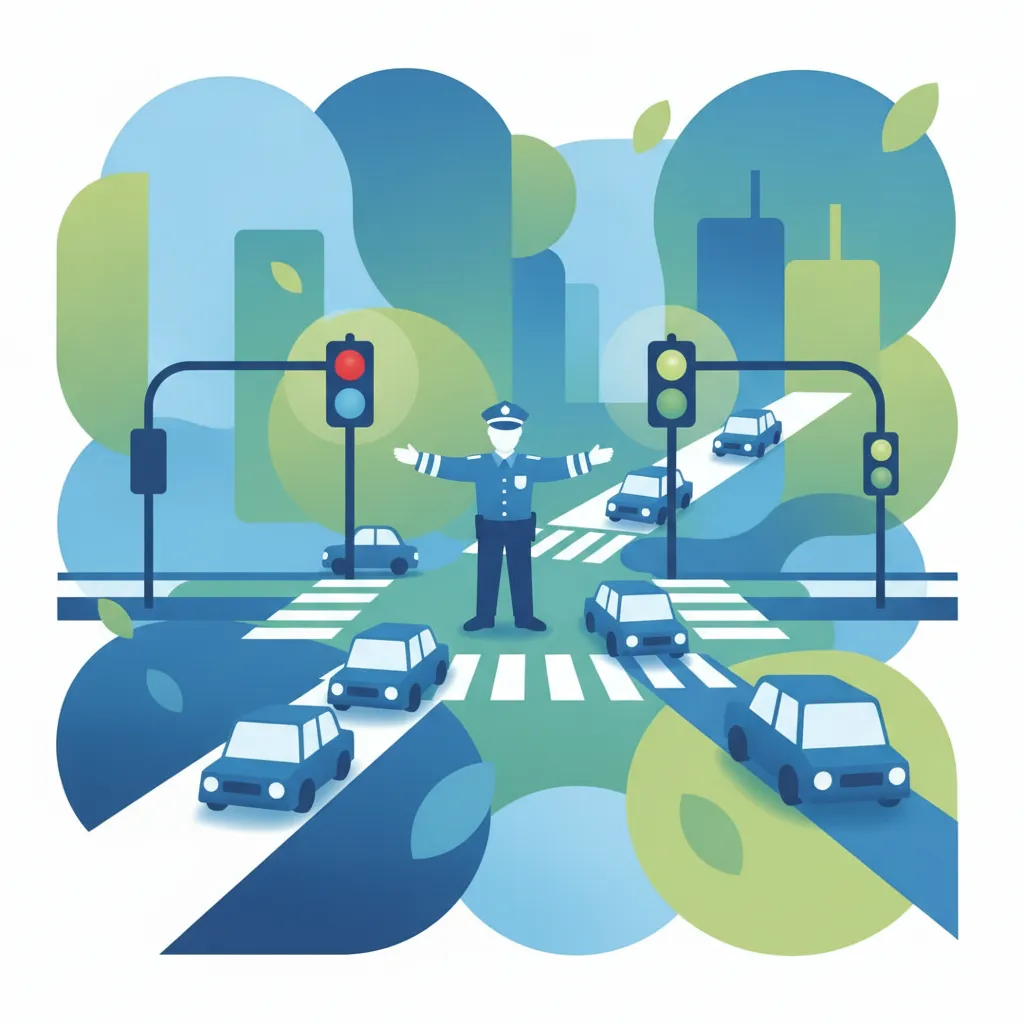
This lesson provides essential knowledge on how to interpret traffic light signals and official police instructions while riding your moped or scooter. Understanding these signals is a critical requirement for the German AM licence theory exam, as they take precedence over standard road signs.
Lesson content overview
Navigating the roads safely and efficiently as an AM licence holder in Germany requires a comprehensive understanding of traffic control devices. This lesson delves into the meaning and handling of various traffic signals, from the predictable cycles of traffic lights to the imperative instructions of police officers. Mastering these concepts is fundamental for safe interaction at junctions, pedestrian crossings, and in dynamic traffic situations.
Effective traffic management relies on a clear system of control devices. However, not all signals carry the same weight. It is crucial for every road user, particularly AM licence riders, to understand the established hierarchy of traffic control. This hierarchy ensures order and safety, especially when multiple signals might appear to give conflicting instructions.
The order of precedence for traffic control signals in Germany is as follows:
Understanding this hierarchy is not merely a legal requirement; it is a critical safety principle. In emergency situations or during roadworks, police officers might need to intervene directly, and their instructions ensure immediate adaptation to changing conditions.
Traffic lights, known as Lichtzeichenanlagen in Germany, are vital for managing traffic flow at intersections, pedestrian crossings, and other conflict points. Their standard sequence is universally recognized and designed to facilitate orderly movement while minimizing the risk of collisions. As an AM licence rider, correctly interpreting these signals is paramount for your safety and the safety of others.
A red light (Rotes Licht) means stop. You must bring your moped or scooter to a complete halt before the stop line (Haltlinie). If there is no stop line, you must stop before the intersection in a position where you can clearly see cross-traffic without entering the intersection.
Key Rules:
When the red and yellow lights (Rot und Gelb) illuminate simultaneously, it signals that the green light is about to appear. This is a preparation phase, giving drivers a brief moment to get ready to move.
Key Rules:
A green light (Grünes Licht) indicates that you may proceed through the intersection. However, this permission is always conditional on safety.
Key Rules:
Never assume a green light grants absolute right-of-way without checking your surroundings. Other vehicles might run a red light, or pedestrians might enter the crossing. Always be prepared to react.
A yellow light (Gelbes Licht), sometimes referred to as amber, appears after green and before red. It warns that the light is about to change to red.
Key Rules:
When approaching a yellow light, assess your distance to the stop line and your speed. Your primary goal should be to stop safely, not to rush through.
Beyond the standard red, yellow, and green cycle, traffic systems also utilize flashing lights to convey specific warnings or instructions. These signals require careful attention and a clear understanding of their distinct meanings, which can differ significantly from steady lights.
A flashing red light (Blinkendes Rotes Licht) is one of the most critical signals. It is treated exactly like a STOP sign.
Practical Meaning:
Common Locations:
Never confuse a flashing red light with a steady red light that simply changed to flashing. It demands a full stop and yielding, just like a stop sign.
A flashing yellow light (Blinkendes Gelbes Licht) serves as a warning signal, instructing drivers to proceed with extreme caution. It often indicates that the regular traffic light system is out of order or that special rules apply.
Practical Meaning:
Common Locations:
Zebrastreifen).While less common than flashing red or yellow, a flashing green light (Blinkendes Grünes Licht) can also be encountered in specific situations, particularly in conjunction with signals indicating a priority road.
Practical Meaning:
Specific Use Cases:
Vorrangstraße (priority road) where traffic from the priority road proceeds, but attention is still required for other traffic users, especially those turning.Always be prepared to yield or stop, even with a flashing green light, if an unforeseen situation arises or another road user acts unexpectedly. Defensive driving is key.
When a uniformed police officer is directing traffic, their instructions supersede all other traffic control devices, including traffic lights, road signs, and road markings. This is a fundamental rule of German road traffic law (Straßenverkehrs-Ordnung - StVO) and is crucial for maintaining safety, particularly during emergencies, special events, or road maintenance.
Police officers have the authority to override static traffic rules because they can respond dynamically to real-time situations. They can quickly adapt to accidents, congestion, or unexpected hazards, ensuring the safest and most efficient flow of traffic under changing circumstances. Disobeying a police officer's signal is not only illegal but also extremely dangerous, as it can disrupt controlled traffic flow and lead to collisions.
As an AM licence rider, you must be able to recognize and immediately obey these common signals:
Hand Raised Vertically, Palm Towards Traffic (Stop):
STOP for all traffic approaching the officer from the front or the rear.Arm Extended Horizontally Sideways (Go or Stop):
GO for traffic approaching parallel to the officer's extended arm (i.e., from their sides). It means STOP for traffic approaching from the front or the back (i.e., perpendicular to the extended arm).Hand Waving Forward (Proceed):
PROCEED in the indicated direction.Arm Moving Up and Down (Slow Down):
SLOW DOWN.Always focus on the officer's signals, even if they appear to contradict other signals. Your immediate obedience is vital for maintaining safety and preventing accidents.
The rules governing traffic signals and police instructions are enshrined in the German Straßenverkehrs-Ordnung (StVO), which is the country's road traffic regulations. Compliance with these rules is mandatory for all road users, including AM licence riders, and carries significant legal weight.
Every driver and rider is legally obligated to obey traffic light signals at intersections and crossings. This includes:
The StVO explicitly states that instructions from police officers (Polizeibeamte) always take precedence over traffic signs, traffic lights, and road markings. This provision ensures that public safety can be managed dynamically by trained personnel in critical situations.
The German Road Traffic Regulations, a comprehensive set of rules governing road users and traffic in Germany.
Example: If a police officer signals you to stop at an intersection where the traffic light is green, you must stop immediately and comply with the officer's signal. Ignoring the officer could lead to severe penalties and poses an immediate risk to safety.
Violating traffic signal rules can lead to various penalties, depending on the severity and specific circumstances. These can include:
Fahreignungsregister). Accumulating too many points can lead to driving restrictions or even license revocation.The visibility and interpretation of traffic signals can be affected by various environmental and situational factors. As an AM licence rider, being aware of these conditional variations and practicing defensive riding is essential for your safety and the safety of other road users.
Adverse weather significantly reduces the visibility of traffic lights and police signals, and increases reaction times.
Safety Measure: Reduce your speed, increase your following distance, and scan carefully for signals well in advance. If you are unsure of a signal's meaning, assume the safest option (e.g., stopping or yielding).
The placement and meaning of signals can vary slightly depending on the type of road or intersection.
Your vehicle's condition and the presence of vulnerable road users also influence how you interact with signals.
Even with clear rules, misunderstandings about traffic signals can lead to dangerous situations. Recognizing these common pitfalls and adopting safe riding practices is crucial for AM licence riders.
By actively practicing these safe habits and being vigilant for potential misinterpretations, AM licence riders can significantly reduce their risk on the road.
This lesson covers the complete hierarchy of traffic control in Germany, establishing that police hand signals take absolute precedence over all other signals. Standard traffic light cycles progress through red, red+yellow, green, and yellow, each carrying specific legal obligations - red demands a complete stop before the Haltlinie, while green requires safe passage only after confirming the intersection is clear. Specialized flashing signals include mandatory stops at flashing red, cautious proceeding at flashing yellow, and heightened vigilance at flashing green. Police hand signals use distinct gestures including a raised palm for stopping, horizontal arm for directional GO/STOP, and waving motions to indicate proceed or slow down. Understanding these signals is essential for safe AM licence riding and mandatory compliance under the StVO, with violations carrying fines, penalty points, and potential driving bans.
A short set of high-value points that capture the most important learning from this lesson.
Police hand signals always override traffic lights, road signs, and road markings - they are the supreme authority on German roads.
A green light permits movement only when safe - always scan the intersection before proceeding and be prepared to yield.
A flashing red light requires a complete stop, equivalent to a STOP sign, before proceeding with caution.
A yellow light means prepare to stop - you may only proceed if stopping safely is impossible.
At complex junctions with multiple signals, identify which light applies to your lane and direction before taking action.
Explore all units and lessons included in this driving theory course.
The hierarchy is: Police > Traffic Lights > Road Signs > Road Markings.
Red+yellow simultaneously means prepare to move but do not enter the intersection yet.
Flashing yellow means proceed with caution - reduce speed and be ready to yield or stop.
Police stop signal (hand raised, palm forward) applies to all traffic approaching from front and rear.
Flashing green indicates priority but requires heightened awareness of cross-traffic and turning vehicles.
Rolling through a red light - a gradual stop before the line is still considered running a red light.
Treating a flashing red light as a yield-with-caution signal instead of a mandatory stop.
Assuming absolute priority on a green light without checking for pedestrians or vehicles running red.
Misunderstanding police arm signals - an extended horizontal arm means GO for parallel traffic and STOP for front/back traffic.
Accelerating to beat a yellow light when a safe stop was possible, creating dangerous intersection blocking.
Lesson content overview
A short set of high-value points that capture the most important learning from this lesson.
Police hand signals always override traffic lights, road signs, and road markings - they are the supreme authority on German roads.
A green light permits movement only when safe - always scan the intersection before proceeding and be prepared to yield.
A flashing red light requires a complete stop, equivalent to a STOP sign, before proceeding with caution.
A yellow light means prepare to stop - you may only proceed if stopping safely is impossible.
At complex junctions with multiple signals, identify which light applies to your lane and direction before taking action.
Explore all units and lessons included in this driving theory course.
The hierarchy is: Police > Traffic Lights > Road Signs > Road Markings.
Red+yellow simultaneously means prepare to move but do not enter the intersection yet.
Flashing yellow means proceed with caution - reduce speed and be ready to yield or stop.
Police stop signal (hand raised, palm forward) applies to all traffic approaching from front and rear.
Flashing green indicates priority but requires heightened awareness of cross-traffic and turning vehicles.
Rolling through a red light - a gradual stop before the line is still considered running a red light.
Treating a flashing red light as a yield-with-caution signal instead of a mandatory stop.
Assuming absolute priority on a green light without checking for pedestrians or vehicles running red.
Misunderstanding police arm signals - an extended horizontal arm means GO for parallel traffic and STOP for front/back traffic.
Accelerating to beat a yellow light when a safe stop was possible, creating dangerous intersection blocking.
Explore search topics learners often look for when studying Traffic Signals, Light Signals, and Police Instructions. These topics reflect common questions about road rules, driving situations, safety guidance, and lesson level theory preparation for learners in Germany.
Browse additional driving theory lessons that cover connected traffic rules, road signs, and common driving situations related to this topic. Improve your understanding of how different rules interact across everyday traffic scenarios.
Learn the critical hierarchy of traffic control in Germany. Understand how police officer signals take precedence over traffic lights and road signs, ensuring safe navigation through intersections and emergency situations.

This lesson provides a thorough explanation of traffic light systems ('Lichtzeichenanlagen') used in Germany. It details the meaning of red, amber, and green lights and the correct response to each phase of the signal sequence. The lesson also covers special signals, such as the green arrow for turning right on red, pedestrian and cyclist signals, and the authority of signals given by a police officer, which override all other signs.
Effective communication is critical for road safety, and this lesson details the correct use of a vehicle's signaling devices. It explains when and how to use turn signals (indicators), hazard warning lights, the horn, and headlight flashes to clearly communicate your intentions to other road users. Proper signaling helps prevent misunderstandings and is a key component of defensive and cooperative driving.
This lesson provides comprehensive guidance on using vehicle signals to communicate with other road users. It covers the correct timing and use of turn indicators, the application of hand signals when necessary, and the proper use of hazard lights. Effective signaling is presented as a cornerstone of predictable and safe driving.

This lesson focuses on how motorcyclists can clearly communicate their intentions to other road users to prevent misunderstandings and collisions. It covers the correct use of indicators, brake lights, and standardized hand signals for turning and stopping. The importance of making eye contact with other drivers to confirm they have seen you is also a key topic for enhancing safety.
This lesson familiarizes drivers with the various special traffic signals and signs that apply exclusively to buses and other public transport vehicles. It covers the interpretation of bus-only signals (often showing bars or letters), flashing priority indicators, and lane-use control signs. Correctly understanding these signals is crucial for legal compliance and for taking advantage of public transport priority measures in urban areas.
This lesson covers regulatory signs, which are legally enforceable and command specific actions from drivers. You will learn the meaning of critical signs such as the stop sign, yield sign, no-entry signs, and various parking and stopping prohibitions. The content also explains signs that establish speed limits, one-way streets, and restricted areas like environmental or pedestrian zones.

This lesson explains the concept of a priority road ('Vorfahrtstraße'), where you have right-of-way over traffic from intersecting roads. You will learn to recognize the signs that mark the beginning and end of a priority road. The lesson also covers how priority is managed through signals, including standard traffic lights, the special 'Grünpfeil' (green arrow) sign, and the overriding authority of a police officer directing traffic.

This lesson explains the various types of road markings and their significance for guiding traffic and ensuring safety. It covers the difference between solid and broken lines for lane separation and overtaking rules, the function of stop lines at intersections, and the markings for pedestrian crosswalks. You will also learn to interpret directional arrows, bicycle lane markings, and other symbols painted on the road.
This lesson explains the function of informational signs, which provide helpful guidance for navigation and services. You will learn how to read directional signs on all types of roads, including the Autobahn, and understand distance markers to upcoming cities and exits. The lesson also covers the symbols for services such as fuel stations, restaurants, and tourist attractions.

This lesson provides a comprehensive guide to a vehicle's lighting systems, explaining the purpose and correct usage of each type of light. It covers dipped and main beam headlights, fog lights, and the legally required use of lights during the day or in poor visibility. You will also review the function of brake lights, indicators, and hazard warning lights for communication and safety.
Gain a thorough understanding of standard traffic lights, including arrows, flashing lights, and special signals used in Germany. This lesson ensures you can safely interpret and respond to all light-based traffic controls.
This lesson provides a thorough explanation of traffic light systems ('Lichtzeichenanlagen') used in Germany. It details the meaning of red, amber, and green lights and the correct response to each phase of the signal sequence. The lesson also covers special signals, such as the green arrow for turning right on red, pedestrian and cyclist signals, and the authority of signals given by a police officer, which override all other signs.
Effective communication is critical for road safety, and this lesson details the correct use of a vehicle's signaling devices. It explains when and how to use turn signals (indicators), hazard warning lights, the horn, and headlight flashes to clearly communicate your intentions to other road users. Proper signaling helps prevent misunderstandings and is a key component of defensive and cooperative driving.
This lesson provides a comprehensive guide to a vehicle's lighting systems, explaining the purpose and correct usage of each type of light. It covers dipped and main beam headlights, fog lights, and the legally required use of lights during the day or in poor visibility. You will also review the function of brake lights, indicators, and hazard warning lights for communication and safety.
This lesson familiarizes drivers with the various special traffic signals and signs that apply exclusively to buses and other public transport vehicles. It covers the interpretation of bus-only signals (often showing bars or letters), flashing priority indicators, and lane-use control signs. Correctly understanding these signals is crucial for legal compliance and for taking advantage of public transport priority measures in urban areas.
This lesson explains the various types of road markings and their significance for guiding traffic and ensuring safety. It covers the difference between solid and broken lines for lane separation and overtaking rules, the function of stop lines at intersections, and the markings for pedestrian crosswalks. You will also learn to interpret directional arrows, bicycle lane markings, and other symbols painted on the road.
This lesson provides comprehensive guidance on using vehicle signals to communicate with other road users. It covers the correct timing and use of turn indicators, the application of hand signals when necessary, and the proper use of hazard lights. Effective signaling is presented as a cornerstone of predictable and safe driving.
This lesson explains the concept of a priority road ('Vorfahrtstraße'), where you have right-of-way over traffic from intersecting roads. You will learn to recognize the signs that mark the beginning and end of a priority road. The lesson also covers how priority is managed through signals, including standard traffic lights, the special 'Grünpfeil' (green arrow) sign, and the overriding authority of a police officer directing traffic.
This lesson focuses on how motorcyclists can clearly communicate their intentions to other road users to prevent misunderstandings and collisions. It covers the correct use of indicators, brake lights, and standardized hand signals for turning and stopping. The importance of making eye contact with other drivers to confirm they have seen you is also a key topic for enhancing safety.
This lesson covers regulatory signs, which are legally enforceable and command specific actions from drivers. You will learn the meaning of critical signs such as the stop sign, yield sign, no-entry signs, and various parking and stopping prohibitions. The content also explains signs that establish speed limits, one-way streets, and restricted areas like environmental or pedestrian zones.
This lesson explains the function of informational signs, which provide helpful guidance for navigation and services. You will learn how to read directional signs on all types of roads, including the Autobahn, and understand distance markers to upcoming cities and exits. The lesson also covers the symbols for services such as fuel stations, restaurants, and tourist attractions.
Find clear answers to common questions learners have about Traffic Signals, Light Signals, and Police Instructions. Learn how the lesson is structured, which driving theory objectives it supports, and how it fits into the overall learning path of units and curriculum progression in Germany. These explanations help you understand key concepts, lesson flow, and exam focused study goals.
Yes. According to the StVO, instructions given by police officers at an intersection take absolute precedence over traffic lights, road signs, and standard priority rules.
A flashing yellow light means the traffic signal is out of service or inactive. You must revert to the traffic signs present at the intersection, such as yield or stop signs, to determine your priority.
Moped riders must follow the same traffic signal rules as cars. You must stop completely behind the stop line when the light is red and should never filter through traffic in a way that blocks pedestrian crossings or junction areas.
A green arrow signal allows you to proceed in the direction of the arrow. However, you must still be cautious of other road users who may have priority, such as cyclists or pedestrians crossing your path.
Begin your targeted revision now. Use our practice search to quickly find specific German driving theory questions. Filter by StVO rules, road signs, or hazard perception to create your focused study plan. Master challenging areas and prepare confidently for your theoretical driving test.