
This lesson provides a deep dive into the language of the road, focusing on how markings and surface indicators guide drivers in Germany. You will learn to correctly interpret lines, arrows, and symbols to ensure you follow the StVO and make safe, legal decisions while driving. This knowledge is vital for navigating complex junctions and is a frequent topic in official Category B theory exam questions.

Lesson content overview
Understanding road markings and surface indicators is fundamental for safe and compliant driving on German roads. These visual cues form a critical part of the StVO (Straßenverkehrs-Ordnung – German Road Traffic Regulations), guiding drivers on lane usage, overtaking rules, stopping points, and pedestrian priority. Mastering these markings is crucial for your German Driving License Theory – Comprehensive Category B Course, ensuring you can anticipate traffic flow, react appropriately, and maintain safety for yourself and other road users.
Road markings are more than just paint on the asphalt; they are a standardized language designed to enhance traffic safety and efficiency. Several core principles underpin their design and application across Germany.
For road markings to be effective, they must be clearly visible under all possible driving conditions. This means they are engineered to be detectable day and night, in varying weather such as rain, fog, or even light snow. Modern road markings often incorporate reflective materials and are designed to resist wear and tear from constant vehicle traffic, ensuring their clarity over time. Drivers must be aware that extreme conditions, like heavy snowfall, can obscure markings, requiring increased reliance on other cues like road alignment and traffic signs.
Across Germany, road markings adhere to a strict set of national standards regarding their width, color, and patterns. This standardization is vital to prevent confusion and reduce the learning curve for drivers, regardless of where they are on the road network. Consistent application ensures that a solid white line, for example, always conveys the same mandatory instruction, building predictable driver expectations and contributing significantly to overall road safety.
A key principle in German road markings is the regulatory hierarchy, particularly evident in lane separation lines. Solid lines generally indicate a prohibition or a compulsory action, meaning they should not be crossed. Broken or dashed lines, in contrast, offer discretionary guidance, permitting actions like lane changes or overtaking, provided it is safe to do so. Recognizing this hierarchy is essential for correctly interpreting instructions conveyed by the road surface.
Many symbols painted on the road surface, such as those indicating bicycle lanes or directional arrows, utilize universal imagery. This ensures quick recognition and understanding, often transcending language barriers. Clear and unambiguous symbolism allows for immediate driver compliance and reduces cognitive load, enabling faster decision-making in dynamic traffic situations.
Road markings play a vital role in defining traffic lanes, separating opposing flows, and marking the boundaries of the carriageway. Understanding these lines is fundamental for maintaining lane discipline and performing maneuvers safely.
Lane separation lines are painted on the road surface to organize traffic, either moving in the same direction or separating opposing traffic streams. Their design dictates where lane changes or overtaking are permissible.
A solid white line (durchgezogene Linie) indicates mandatory lane separation for traffic moving in the same direction. Crossing a solid white line is generally prohibited. This includes situations like changing lanes, overtaking, or turning. You must stay within your lane. Exceptions are extremely rare and typically only for avoiding immediate danger, or if explicitly directed by a traffic police officer.
A broken white line (Leitlinie or unterbrochene Linie) signifies that lane changes and overtaking maneuvers are permitted. However, this permission is always conditional on safety. Before crossing a broken white line to change lanes or overtake, you must ensure that the maneuver can be executed without endangering yourself or other road users. This includes checking mirrors, blind spots, and signaling your intention.
On some roads, particularly where traffic conditions require strict separation, you may encounter double solid white lines. These markings reinforce the prohibition against crossing, often used to separate traffic in critical areas or high-speed sections.
While less common for lane separation within the same direction of travel, a solid yellow line is specifically used to separate traffic moving in opposite directions where crossing is strictly forbidden. This is a powerful regulatory marking to prevent head-on collisions.
Edge markings (Fahrbahnrandlinien) delineate the outer limits of the drivable carriageway, helping drivers stay within the road boundaries and preventing accidental departure.
A solid white line used as an edge marking on the outside of the carriageway typically means you should not cross it. This is common on motorways (Autobahnen) or federal roads (Bundesstraßen) to separate the driving lanes from the hard shoulder (Standstreifen) or roadside. Driving on the hard shoulder is generally forbidden unless in an emergency or directed.
On single carriageway roads, especially in rural areas, you might find a broken white line defining the road edge. While not as restrictive as a solid line, it still serves to advise drivers of the carriageway's boundary. Crossing it during normal operation is discouraged, but it might be permissible if necessary, for example, to allow another vehicle to pass safely on a very narrow road, provided the ground beyond is safe and suitable.
Always pay close attention to the condition of the road beyond any edge marking. Even a broken line does not grant permission to drive onto unsafe or unsuitable terrain.
Stop lines and holding lines are crucial markings that dictate where vehicles must halt, ensuring orderly traffic flow and pedestrian safety, particularly at intersections and pedestrian crossings.
A solid white line painted across the road at an intersection is a stop line (Haltlinie). Its primary function is to indicate precisely where vehicles must stop when instructed by a red traffic light, a "STOP" sign (Zeichen 206), or to give way. You must bring your vehicle to a complete halt before this line. Rolling over the stop line is a violation and can endanger other road users or disrupt cross-traffic.
Similar to intersections, a white stop line is often positioned before a marked pedestrian crossing (Zebrastreifen). This line is mandatory: vehicles must stop behind it and yield to pedestrians who are crossing or are about to cross. It is illegal to stop on or over the pedestrian crossing itself. This ensures that pedestrians have an unobstructed path and are clearly visible to drivers.
Failing to stop completely before a stop line at a pedestrian crossing, or stopping on the crossing itself, is a serious violation that directly endangers vulnerable road users and can result in significant penalties.
Pedestrian crossings are specially marked areas designed to give pedestrians priority when crossing the road. The most common type is the zebra crossing.
A zebra crossing (Zebrastreifen) is easily recognizable by its alternating white stripes painted across the road. These markings signify a dedicated area where pedestrians have the absolute right-of-way. Vehicles approaching a zebra crossing must stop and allow any pedestrian who is crossing or clearly intending to cross to pass safely. It is imperative to stop before the crossing itself, allowing ample space for pedestrians.
Zebra crossings are often accompanied by specific traffic signs, such as a blue square sign with a white triangle containing a walking person (Zeichen 350 – Fußgängerüberweg) or sometimes triangular "Give Way" signs (Zeichen 205 – Vorfahrt gewähren) to reinforce the obligation to yield.
In addition to zebra stripes, road surfaces may display other symbols indicating areas primarily for pedestrians, such as a "Fußgängerzone" (pedestrian zone) symbol. These areas prioritize pedestrian movement, and vehicle access is often restricted or prohibited entirely, sometimes with specific exceptions for delivery vehicles or residents at certain times. Always observe accompanying signs that clarify vehicle access rules in such zones.
Directional arrows painted on the road surface are crucial for guiding drivers into the correct lanes for their intended direction of travel, particularly at complex intersections or multi-lane roads.
Directional arrows (Fahrtrichtungs-Pfeile) indicate the permissible direction(s) of travel from a particular lane.
You must choose your lane in advance according to your intended direction and follow the instruction of the arrow. Ignoring these arrows can lead to illegal turns, wrong-way driving, or impeding traffic flow. Once you are in a lane marked with a specific directional arrow, you are generally committed to that direction.
Beyond simple arrows, more complex markings can indicate specific lane usage. For instance, sometimes arrows are accompanied by text or symbols to clarify their function further. On multi-lane roads, these markings help streamline traffic, reducing last-minute lane changes and potential collisions. Always observe these markings carefully as you approach junctions, especially in unfamiliar areas.
Certain road markings are dedicated to specific types of road users or vehicles, ensuring their safety and optimizing traffic flow.
Bicycle lane markings (Radfahrstreifen-Markierungen) are used to designate lanes exclusively for cyclists. These are typically marked by a solid white line separating the bicycle lane from the main carriageway, often accompanied by a bicycle symbol painted on the lane itself. In some cases, a broken white line might indicate a shared space or an area where crossing is permissible for turning, but motorists should always prioritize cyclists.
Lanes reserved for public transport, such as buses or trams, are common in urban areas. These reserved lane markings (Sonderfahrstreifen) are typically delineated by a solid white line and often feature specific symbols like a bus (Bussonderfahrstreifen) or tram painted on the lane surface. Only authorized vehicles (buses, trams, and sometimes taxis depending on local regulations) may use these lanes. Motor vehicles are prohibited from driving in or crossing these lanes unless otherwise indicated by signs (e.g., for turning).
Beyond lines and arrows, various other symbols and surface indicators provide important information or warnings to drivers.
Road surfaces can feature advanced symbols that provide more detailed usage rules. For example, a "BUS" or "TAXI" symbol within a lane clarifies its exclusive purpose. These symbols reinforce the regulatory nature of the lane, ensuring that only designated vehicles utilize them, especially during specified hours. Always be aware of any accompanying signs that might define time restrictions or exceptions for these lanes.
While typically communicated by signs, some priority situations can be reinforced by road markings. For instance, a shark-tooth line (Haifischzähne) on the road surface indicates that drivers must give way (Vorfahrt gewähren), often accompanying a "Give Way" sign (Zeichen 205). This serves as a visual reminder of the obligation to yield to traffic on the intersecting road.
Adherence to road markings is not merely good practice; it is legally mandated by the StVO. Non-compliance can lead to fines, penalty points, and dangerous situations.
No Crossing of Solid White Lines: Drivers must strictly stay within their lane and must not cross a solid white line (Zeichen 295) unless absolutely necessary to avoid an immediate danger or if explicitly directed by a traffic officer. This rule is mandatory to prevent unsafe lane changes and potential side-swipe collisions.
Crossing Broken Lines Safely: Drivers may change lanes or overtake by crossing broken (dash) lines (Zeichen 340) provided it is safe to do so. This rule permits flexibility in traffic flow but places the full responsibility for safety on the driver.
Stopping at Stop Lines: Drivers must stop before the stop line (Zeichen 294) at traffic lights, "STOP" signs, and pedestrian crossings. This is a mandatory safety measure to ensure clear visibility for cross-traffic and safe passage for pedestrians.
Yielding at Pedestrian Crossings: Drivers must yield to pedestrians who are crossing or are about to cross at marked zebra crossings (Zeichen 293 and associated signs). This rule is mandatory and protects vulnerable road users.
Bicycle Lane Usage: Only bicycles are permitted to use designated bike lanes (Radfahrstreifen, Zeichen 340 with bicycle symbol), unless otherwise indicated by supplementary signs. This rule is mandatory to protect cyclists and ensure their safe and efficient movement.
Observing Directional Arrow Markings: Vehicles must follow the direction indicated by painted arrows (Fahrtrichtungs-Pfeile, Zeichen 297). This rule is mandatory to prevent wrong-way driving, illegal turns, and to maintain orderly traffic flow.
Misinterpreting or deliberately ignoring road markings is a significant cause of traffic incidents and legal penalties in Germany.
The effectiveness and interpretation of road markings are influenced by various environmental and situational factors. Drivers must adapt their driving behavior accordingly.
In areas with designated bicycle lanes or frequent pedestrian crossings, road markings take on heightened importance. Drivers must always be prepared to yield to cyclists and pedestrians, giving them ample space and ensuring their safety, even if the markings seem permissive for vehicles. The presence of these markings signals a need for increased caution and a defensive driving approach.
Construction zones (Baustellen) frequently feature temporary lane markings, often in yellow or orange. These temporary markings always supersede permanent white markings. Drivers must pay close attention to these changes, as they dictate new lane configurations, reduced speeds, and potential hazards within the work area. Adapting to these temporary layouts is crucial for safety.
Always prioritize temporary construction markings over permanent ones. They are put in place for your safety and to guide you through modified traffic patterns.
Road markings and surface indicators are an indispensable part of the German road traffic system, working in conjunction with traffic signs and signals to provide a comprehensive set of instructions for drivers.
Mastering the interpretation of these markings, understanding their regulatory hierarchy, and adhering to the associated StVO rules is not just about passing your German driving theory exam; it is crucial for ensuring legal compliance, fostering smooth traffic flow, and most importantly, guaranteeing your safety and the safety of all road users on German roads. Vigilance and constant awareness of the road surface are vital for every driver.
German road markings follow a strict regulatory hierarchy communicated through line types and symbols. Solid white lines mandate lane separation and prohibit crossing except in emergencies, while broken white lines permit lane changes when safe. Stop lines require complete halts at intersections and zebra crossings where pedestrians have absolute priority. Directional arrows guide lane selection and become binding once you enter the lane, while bicycle lanes and public transport lanes restrict access to authorized vehicles only. Adherence to these markings is legally mandated by the StVO and is a frequent topic in the Category B theory exam.
A short set of high-value points that capture the most important learning from this lesson.
Solid white lines prohibit crossing except in emergencies; they establish mandatory lane separation
Broken white lines permit lane changes and overtaking only when it is safe to do so
Stop lines (Haltlinien) require a complete halt before the line at traffic lights, STOP signs, and pedestrian crossings
Directional arrows painted on the road commit you to that direction once you enter the lane
Bicycle lanes marked with a solid white line and bicycle symbol are reserved exclusively for cyclists
Explore all units and lessons included in this driving theory course.
Solid white = must not cross (durchgezogene Linie); broken white = may cross if safe (unterbrochene Linie)
Stop completely behind the stop line, not on or over it, to avoid penalties and protect pedestrians
Yellow lines separate opposing traffic and always prohibit crossing
At zebra crossings (Zebrastreifen), pedestrians have absolute right-of-way and you must yield
Temporary yellow or orange construction markings always override permanent white markings
Crossing a solid white line to overtake slower traffic, which is prohibited and dangerous
Rolling through a stop line without coming to a complete halt, especially at pedestrian crossings
Changing lanes across broken lines without checking mirrors, blind spots, or using indicators
Driving motor vehicles in designated bicycle lanes (Radfahrstreifen) to bypass congestion
Attempting to turn or go straight when already committed to a directional arrow lane
Lesson content overview
A short set of high-value points that capture the most important learning from this lesson.
Solid white lines prohibit crossing except in emergencies; they establish mandatory lane separation
Broken white lines permit lane changes and overtaking only when it is safe to do so
Stop lines (Haltlinien) require a complete halt before the line at traffic lights, STOP signs, and pedestrian crossings
Directional arrows painted on the road commit you to that direction once you enter the lane
Bicycle lanes marked with a solid white line and bicycle symbol are reserved exclusively for cyclists
Explore all units and lessons included in this driving theory course.
Solid white = must not cross (durchgezogene Linie); broken white = may cross if safe (unterbrochene Linie)
Stop completely behind the stop line, not on or over it, to avoid penalties and protect pedestrians
Yellow lines separate opposing traffic and always prohibit crossing
At zebra crossings (Zebrastreifen), pedestrians have absolute right-of-way and you must yield
Temporary yellow or orange construction markings always override permanent white markings
Crossing a solid white line to overtake slower traffic, which is prohibited and dangerous
Rolling through a stop line without coming to a complete halt, especially at pedestrian crossings
Changing lanes across broken lines without checking mirrors, blind spots, or using indicators
Driving motor vehicles in designated bicycle lanes (Radfahrstreifen) to bypass congestion
Attempting to turn or go straight when already committed to a directional arrow lane
Explore search topics learners often look for when studying Road Markings and Surface Indicators. These topics reflect common questions about road rules, driving situations, safety guidance, and lesson level theory preparation for learners in Germany.
Browse additional driving theory lessons that cover connected traffic rules, road signs, and common driving situations related to this topic. Improve your understanding of how different rules interact across everyday traffic scenarios.
Learn the significance of lines, symbols, and text on German roads. This lesson covers lane dividers, stop lines, pedestrian crossings, and directional arrows to ensure clear understanding of road surface indicators for safe driving and theory.
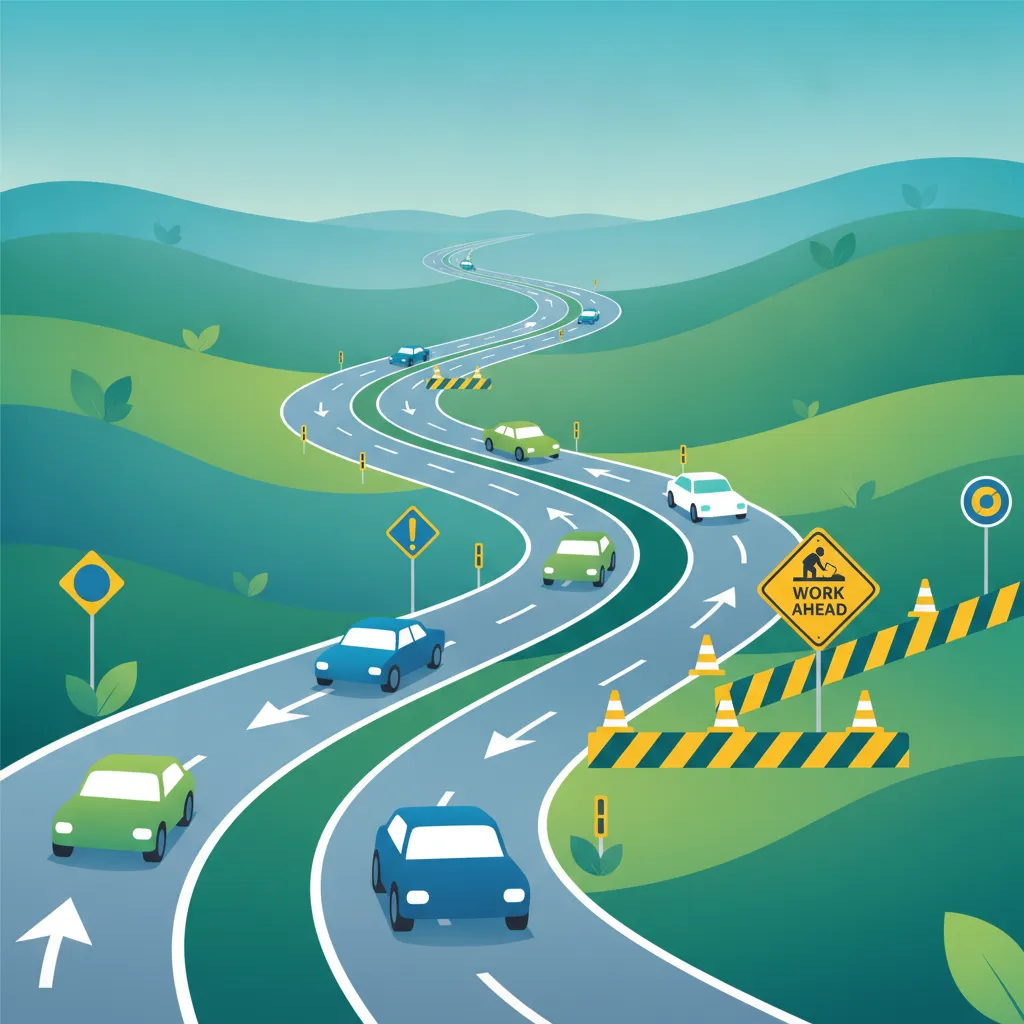
This lesson focuses on interpreting various road markings, from lane lines and directional arrows to stop lines and pedestrian crossings. It explains the rules associated with solid versus broken lines and how to navigate temporary markings found in construction zones. Correctly reading these markings is vital for proper lane discipline and safety.
This lesson explains the function of informational signs, which provide helpful guidance for navigation and services. You will learn how to read directional signs on all types of roads, including the Autobahn, and understand distance markers to upcoming cities and exits. The lesson also covers the symbols for services such as fuel stations, restaurants, and tourist attractions.
This lesson covers the principles of correct vehicle positioning and lane discipline, which are essential for predictable and safe driving. It reinforces the 'Rechtsfahrgebot' (drive on the right) principle and explains how to choose the appropriate lane on multi-lane roads and motorways. Proper positioning for turns and maintaining a safe space cushion around the vehicle are also key topics.
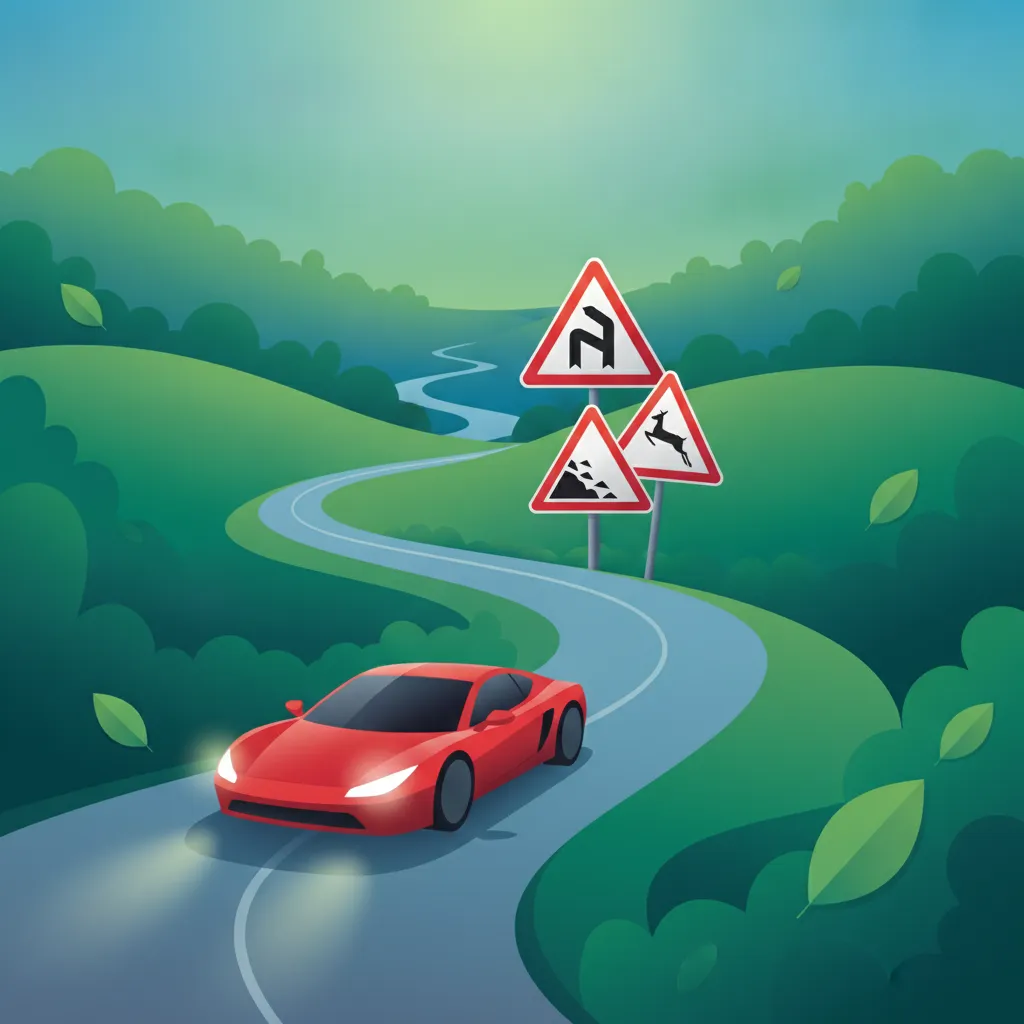
This lesson focuses on warning signs, which are designed to alert drivers to potential dangers or unusual conditions on the road ahead. You will learn to identify signs indicating sharp bends, upcoming intersections, railway crossings, road works, and risks like slippery surfaces or wildlife. Recognizing these signs allows you to anticipate hazards and adjust your driving proactively.

This lesson provides a thorough explanation of traffic light systems ('Lichtzeichenanlagen') used in Germany. It details the meaning of red, amber, and green lights and the correct response to each phase of the signal sequence. The lesson also covers special signals, such as the green arrow for turning right on red, pedestrian and cyclist signals, and the authority of signals given by a police officer, which override all other signs.

This lesson provides a comprehensive guide to a vehicle's lighting systems, explaining the purpose and correct usage of each type of light. It covers dipped and main beam headlights, fog lights, and the legally required use of lights during the day or in poor visibility. You will also review the function of brake lights, indicators, and hazard warning lights for communication and safety.
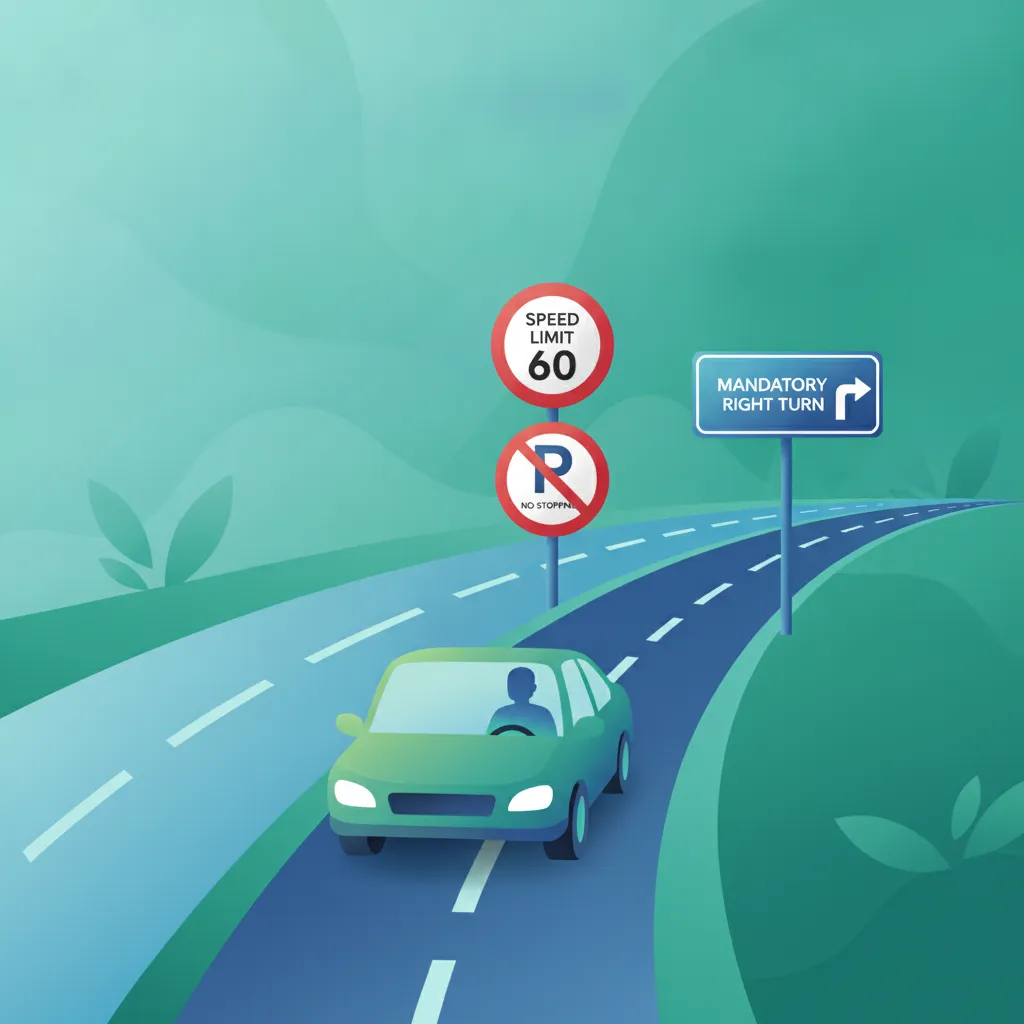
This lesson covers regulatory signs, which are legally enforceable and command specific actions from drivers. You will learn the meaning of critical signs such as the stop sign, yield sign, no-entry signs, and various parking and stopping prohibitions. The content also explains signs that establish speed limits, one-way streets, and restricted areas like environmental or pedestrian zones.

Effective communication is critical for road safety, and this lesson details the correct use of a vehicle's signaling devices. It explains when and how to use turn signals (indicators), hazard warning lights, the horn, and headlight flashes to clearly communicate your intentions to other road users. Proper signaling helps prevent misunderstandings and is a key component of defensive and cooperative driving.
This lesson focuses on the critical maneuver of changing lanes ('Fahrstreifenwechsel'), a common cause of accidents if done incorrectly. It teaches a systematic, safe procedure based on thorough observation, clear signaling, and a final blind spot check. You will learn how to assess traffic speed and identify a safe gap before smoothly moving into the adjacent lane.

This lesson focuses on the importance of strategic road positioning for enhancing safety and visibility. Learners explore different lane positions and understand when to use them to see, be seen, and create a safety buffer. The content emphasizes maintaining a long visual focus down the road to anticipate hazards and avoid target fixation, particularly when cornering.
Understand how road markings guide vehicle positioning and lane discipline. This lesson explains how different line types and surface indicators dictate when and how to change lanes, overtake, and navigate junctions safely according to German traffic laws.
This lesson focuses on interpreting various road markings, from lane lines and directional arrows to stop lines and pedestrian crossings. It explains the rules associated with solid versus broken lines and how to navigate temporary markings found in construction zones. Correctly reading these markings is vital for proper lane discipline and safety.
This lesson covers the principles of correct vehicle positioning and lane discipline, which are essential for predictable and safe driving. It reinforces the 'Rechtsfahrgebot' (drive on the right) principle and explains how to choose the appropriate lane on multi-lane roads and motorways. Proper positioning for turns and maintaining a safe space cushion around the vehicle are also key topics.
This lesson focuses on the critical maneuver of changing lanes ('Fahrstreifenwechsel'), a common cause of accidents if done incorrectly. It teaches a systematic, safe procedure based on thorough observation, clear signaling, and a final blind spot check. You will learn how to assess traffic speed and identify a safe gap before smoothly moving into the adjacent lane.
This lesson focuses on the importance of strategic road positioning for enhancing safety and visibility. Learners explore different lane positions and understand when to use them to see, be seen, and create a safety buffer. The content emphasizes maintaining a long visual focus down the road to anticipate hazards and avoid target fixation, particularly when cornering.

This lesson provides a step-by-step guide to executing turns safely at intersections and other locations. It details the full observation sequence (mirrors, signal, blind spot check) required before initiating a turn. The lesson covers correct lane positioning for both left and right turns and explains the rules for performing U-turns or three-point turns where permitted.

This lesson focuses on strategic road positioning to enhance safety and visibility. It explains where to ride within a lane under different circumstances, such as approaching intersections or riding alongside parked cars. A key skill covered is anticipating the potential actions of other drivers, cyclists, and pedestrians.
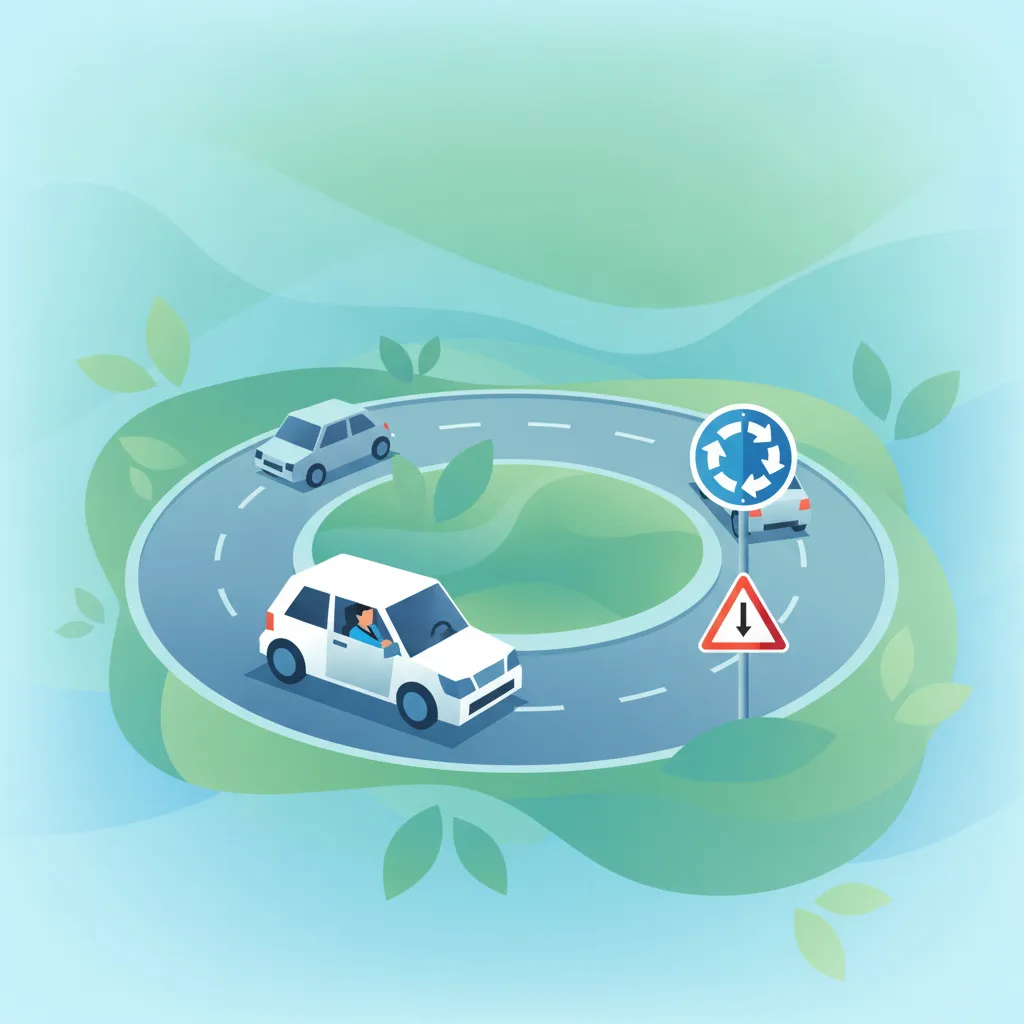
This lesson provides clear instructions on how to navigate roundabouts in Germany. It explains the crucial rule of yielding to traffic already inside the circle, proper lane choice for your intended exit, and the correct use of signals. Safe interaction with cyclists and pedestrians at roundabout exits is also covered.
Effective communication is critical for road safety, and this lesson details the correct use of a vehicle's signaling devices. It explains when and how to use turn signals (indicators), hazard warning lights, the horn, and headlight flashes to clearly communicate your intentions to other road users. Proper signaling helps prevent misunderstandings and is a key component of defensive and cooperative driving.
This lesson explains the function of informational signs, which provide helpful guidance for navigation and services. You will learn how to read directional signs on all types of roads, including the Autobahn, and understand distance markers to upcoming cities and exits. The lesson also covers the symbols for services such as fuel stations, restaurants, and tourist attractions.

This lesson explains the specific rules for driving in roundabouts ('Kreisverkehr'), a common feature on German roads. It covers the correct procedure for approaching and entering, the rule that traffic already in the circle has priority, and the requirement to signal before exiting. The lesson also addresses the unique characteristics of mini-roundabouts and how to interact with cyclists and pedestrians around them.
Find clear answers to common questions learners have about Road Markings and Surface Indicators. Learn how the lesson is structured, which driving theory objectives it supports, and how it fits into the overall learning path of units and curriculum progression in Germany. These explanations help you understand key concepts, lesson flow, and exam focused study goals.
Generally, you must not cross a solid white line. It is there to separate traffic flows or indicate restricted areas, and driving over it is a violation of the StVO, which will likely lead to exam point deductions or fines.
A stop line is a solid, thick white line indicating that you must come to a complete halt before proceeding, even if no other traffic is visible. A give-way line consists of a series of white triangles or a broken line, requiring you to slow down and stop only if necessary to yield.
Yes, if there are directional arrows painted in your lane at a junction, you are legally required to follow the direction indicated by the arrow. Ignoring these markings is a common reason for failure in practical and theory exams.
Yes, bicycle lanes are often marked with a bicycle symbol painted on the road surface or separated by a solid white line. You must not drive in these lanes or block them, especially when turning or parking.
Begin your targeted revision now. Use our practice search to quickly find specific German driving theory questions. Filter by StVO rules, road signs, or hazard perception to create your focused study plan. Master challenging areas and prepare confidently for your theoretical driving test.