
This lesson teaches you the critical techniques for performing an emergency stop on a motorcycle. By mastering progressive braking and understanding how your ABS functions, you will gain the skills necessary to handle high-pressure situations safely and confidently on the road.

Lesson content overview
Effective emergency braking is a critical skill for every motorcyclist, especially for those preparing for the German Motorcycle Licence Theory Course (Classes A, A1, A2). In unexpected situations, the ability to bring your motorcycle to a rapid and controlled stop can mean the difference between a near miss and a serious accident. This lesson will equip you with the knowledge to perform emergency stops correctly, understand the vital role of Anti-lock Braking Systems (ABS), and enhance your overall road safety.
Emergency braking refers to the technique of applying maximum brake pressure in a controlled, progressive manner to achieve the shortest possible stopping distance without locking the wheels. It's a skill you hope never to use, but must be proficient in, as unexpected hazards on the road can emerge at any moment. From a sudden vehicle braking ahead to an unforeseen obstruction, rapid deceleration is often the only option to prevent a collision.
The importance of mastering this technique cannot be overstated. Proper execution significantly reduces your stopping distance and helps you maintain steering control, allowing for potential evasive action even while braking. This proactive preparation is a cornerstone of defensive riding.
At its core, emergency braking involves harnessing the full braking potential of your motorcycle while maintaining stability and control. This means utilizing both the front and rear brakes in a coordinated fashion, applying pressure progressively, and avoiding wheel lock-up. Understanding the physics behind this process – specifically, how weight transfer affects traction during deceleration – is key. As you brake hard, the motorcycle's weight shifts forward, placing significantly more load and therefore greater grip potential on the front wheel.
Performing an emergency stop effectively requires practice and a deep understanding of your motorcycle's capabilities. The goal is to apply maximum braking force without exceeding the tires' grip limit, which would lead to a skid and loss of control.
Initial Reaction and Body Position: Upon identifying an emergency, immediately adjust your body position. Firmly grip the handlebars and brace your core. This helps prevent your body from being thrown forward violently and allows you to better control the bike.
Simultaneous Brake Application: Engage both the front and rear brakes almost simultaneously. The front brake, due to weight transfer, provides approximately 70-90% of your total stopping power, while the rear brake contributes to stability and additional deceleration.
Progressive Pressure Application: This is crucial. Instead of grabbing the brakes abruptly, increase pressure on both levers progressively and firmly. Squeeze the front brake lever smoothly but quickly, building up to maximum pressure. Apply firm, controlled pressure to the rear brake pedal. The aim is to reach the threshold of maximum braking just before either wheel locks up.
Maintain Control and Stability: As you apply brakes, keep your eyes focused on the escape path or where you want the motorcycle to go, rather than on the obstacle itself. This helps maintain steering input and balance. Avoid sudden steering inputs during heavy braking unless it's a controlled evasive maneuver.
Look Where You Want to Go: Your motorcycle tends to follow your gaze. By looking towards your intended path or away from the hazard, you instinctively steer towards safety.
Post-Brake Action: Once the motorcycle has stopped or the immediate danger is averted, release the brakes smoothly and prepare to ride away or take further action. Do not release brakes abruptly during the stop unless absolutely necessary, as this can cause instability.
A common mistake is applying too much brake pressure too quickly, especially on the front wheel, which can cause it to lock up and lead to a fall. Conversely, over-relying on the rear brake alone will result in significantly longer stopping distances and potential skidding of the rear wheel.
Many modern motorcycles, particularly those used for German motorcycle licence training, are equipped with an Anti-lock Braking System (ABS). This electronic safety feature is designed to prevent wheel lock-up during heavy braking, thereby maintaining tire traction and allowing the rider to retain steering control.
An electronic safety system that automatically modulates brake pressure to prevent the wheels from locking up during heavy braking, ensuring steering control and stability.
ABS operates through a sophisticated network of sensors, a hydraulic control unit, and an electronic control unit (ECU). Each wheel has a speed sensor that constantly monitors its rotation.
The most important rule when ABS activates is to maintain full brake pressure. Do not reduce your grip on the brake lever or ease off the pedal just because you feel the pulsations. The ABS is doing its job, which is to modulate pressure far faster and more precisely than any human can, ensuring maximum braking force without skidding. Reducing pressure will only diminish the system's effectiveness and increase your stopping distance.
When ABS activates, you will feel a pulsing sensation in the brake lever and/or pedal, and sometimes hear a buzzing or grinding noise. This is normal. Continue to squeeze the brakes firmly.
ABS is particularly beneficial in low-traction conditions such as wet roads, gravel, or emergency situations where panic might cause a rider to apply too much brake force too quickly. It significantly enhances safety by allowing the rider to steer around an obstacle even while performing a full-force emergency stop.
A fundamental aspect of motorcycle braking, especially in an emergency, is understanding the distinct roles and contributions of the front and rear brakes.
The front brake is undeniably the most powerful braking component on a motorcycle. During deceleration, the motorcycle's weight shifts forward, compressing the front suspension and increasing the load on the front tire. This increased load means the front tire can generate significantly more grip or friction with the road surface before locking up. As a result, the front brake alone can provide the majority of the stopping force – typically 70-90% under hard braking. Proper technique with the front brake involves a progressive squeeze, building pressure quickly but smoothly, to avoid exceeding the tire's grip limit.
While less powerful for stopping, the rear brake plays a crucial role in motorcycle stability and contributes supplementary braking force. When applied correctly, it helps settle the chassis and can prevent the rear wheel from lifting during extremely hard front braking. It's particularly useful at low speeds for balance and fine control. In an emergency stop, the rear brake should be applied firmly, complementing the front brake, but it's important to be aware that the rear wheel is more prone to locking up due to the weight transfer away from it.
For an emergency stop, both brakes must be used. A balanced application allows for maximum deceleration while maintaining control. The precise ratio of front-to-rear pressure is difficult to quantify as it depends on the motorcycle, road surface, and rider technique, but the emphasis remains on progressive application, primarily from the front, with the rear supporting stability. Motorcycles equipped with linked braking systems or advanced ABS might automatically distribute brake force, further simplifying this for the rider.
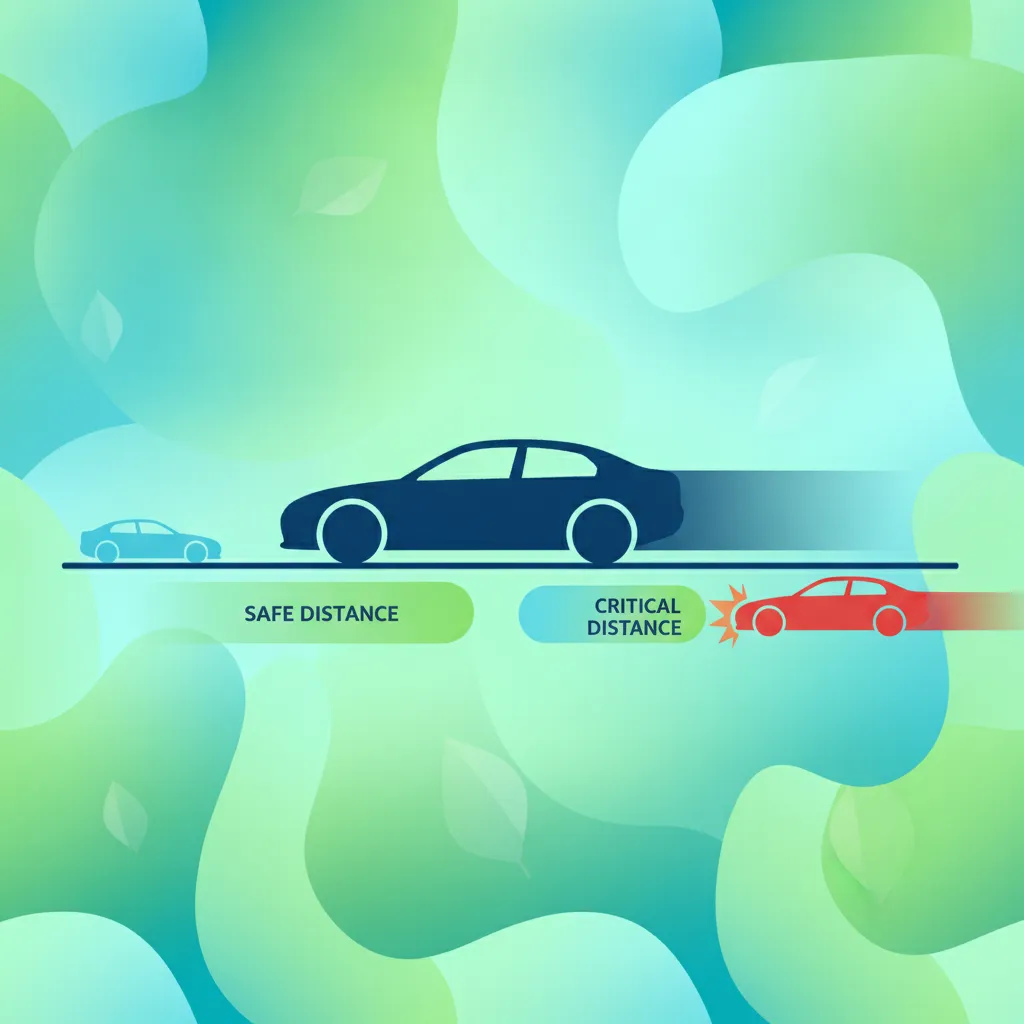
Before an emergency stop even becomes necessary, maintaining a safe following distance is your first line of defense. It provides crucial reaction time and space to initiate braking safely.
A guideline for maintaining a safe following distance by ensuring at least a two-second time gap between your vehicle and the vehicle directly ahead.
To apply the two-second rule, choose a fixed point on the road, such as a road sign or a tree, that the vehicle ahead of you is about to pass. As soon as the rear of their vehicle passes that point, begin counting "one thousand one, one thousand two." If the front of your motorcycle reaches that same point before you finish counting "one thousand two," you are following too closely.
Motorcyclists generally require more stopping distance than cars due to their narrower tire contact patches and the inherent challenge of braking a two-wheeled vehicle at its limit. Furthermore, motorcycles are less visible to other drivers, making reaction time even more critical. A safe following distance allows:
The two-second rule is a minimum under ideal conditions. You must increase your following distance in:
Even experienced riders can make mistakes under pressure. Being aware of these common pitfalls can help you avoid them:
The road and environmental conditions significantly impact braking effectiveness. Always adapt your technique and awareness.
While specific German traffic laws don't dictate the exact technique for emergency braking, they implicitly require drivers and riders to operate their vehicles safely and in a manner that allows them to react to hazards. This includes maintaining an appropriate following distance and demonstrating control of the vehicle.
The principles covered in this lesson are mandatory for safe operation and contribute directly to your ability to pass the German motorcycle theory and practical tests. The ability to perform a controlled emergency stop is a fundamental requirement for obtaining your licence.
To reiterate the most critical points for emergency braking and ABS utilization for your German Motorcycle Licence Theory Course:
By internalizing these principles and practicing them responsibly, you will significantly enhance your safety and confidence on German roads.
This lesson covers the critical skill of emergency braking for motorcycle riders, emphasizing progressive application of both front and rear brakes to achieve maximum deceleration without wheel lock-up. The front brake delivers the majority of stopping power through weight transfer, while the rear brake provides stability and supplementary force. For motorcycles equipped with ABS, riders must maintain full brake pressure when the system activates to preserve steering control. The two-second rule establishes minimum following distance requirements, which must be extended in adverse conditions such as rain, gravel, or night riding. Understanding these principles and practicing them in controlled environments is essential for safe operation on German roads and for passing the motorcycle theory examination.
A short set of high-value points that capture the most important learning from this lesson.
Emergency braking requires applying both front and rear brakes simultaneously and progressively to maximize stopping force without locking wheels
The front brake provides 70-90% of total stopping power due to weight transfer during deceleration, while the rear brake maintains stability
ABS automatically modulates brake pressure to prevent wheel lock-up and preserve steering control during heavy braking
When ABS activates, riders must maintain full brake pressure and not release the levers due to pulsation sensations
The two-second rule establishes a minimum safe following distance and must be extended in adverse conditions
Explore all units and lessons included in this driving theory course.
Apply brakes progressively and firmly, building to maximum pressure without exceeding tire grip limits
Always look where you want to go, not at the hazard, to avoid target fixation and steer safely
ABS pulsations at the brake lever or pedal indicate the system is functioning normally - do not ease off
Increase following distance in rain, fog, gravel, night riding, or when carrying a passenger or heavy load
Weight transfer forward during braking increases front tire traction but reduces rear tire grip, making rear wheel lock-up more likely
Grabbing the brakes too aggressively causes front wheel lock-up and loss of control before weight transfer occurs effectively
Releasing brake pressure when ABS activates due to unfamiliar pulsation sensations, which increases stopping distance unnecessarily
Over-relying on rear brake alone dramatically extends stopping distance and risks rear wheel skidding
Target fixation - staring at the obstacle causes riders to steer toward it rather than toward their intended escape path
Failing to adjust braking technique for wet roads or low-traction surfaces, underestimating increased stopping distances
Lesson content overview
A short set of high-value points that capture the most important learning from this lesson.
Emergency braking requires applying both front and rear brakes simultaneously and progressively to maximize stopping force without locking wheels
The front brake provides 70-90% of total stopping power due to weight transfer during deceleration, while the rear brake maintains stability
ABS automatically modulates brake pressure to prevent wheel lock-up and preserve steering control during heavy braking
When ABS activates, riders must maintain full brake pressure and not release the levers due to pulsation sensations
The two-second rule establishes a minimum safe following distance and must be extended in adverse conditions
Explore all units and lessons included in this driving theory course.
Apply brakes progressively and firmly, building to maximum pressure without exceeding tire grip limits
Always look where you want to go, not at the hazard, to avoid target fixation and steer safely
ABS pulsations at the brake lever or pedal indicate the system is functioning normally - do not ease off
Increase following distance in rain, fog, gravel, night riding, or when carrying a passenger or heavy load
Weight transfer forward during braking increases front tire traction but reduces rear tire grip, making rear wheel lock-up more likely
Grabbing the brakes too aggressively causes front wheel lock-up and loss of control before weight transfer occurs effectively
Releasing brake pressure when ABS activates due to unfamiliar pulsation sensations, which increases stopping distance unnecessarily
Over-relying on rear brake alone dramatically extends stopping distance and risks rear wheel skidding
Target fixation - staring at the obstacle causes riders to steer toward it rather than toward their intended escape path
Failing to adjust braking technique for wet roads or low-traction surfaces, underestimating increased stopping distances
Explore search topics learners often look for when studying Emergency Braking Techniques and ABS Utilization. These topics reflect common questions about road rules, driving situations, safety guidance, and lesson level theory preparation for learners in Germany.
Browse additional driving theory lessons that cover connected traffic rules, road signs, and common driving situations related to this topic. Improve your understanding of how different rules interact across everyday traffic scenarios.
Explore the physics and mechanics behind motorcycle braking. Understand how to apply braking force effectively, the role of different brake components, and how to maintain control during sudden stops. This lesson details the interplay between rider input and vehicle response.

This lesson introduces the essential components of a motorcycle's braking system, including disc brakes, drum brakes, and the function of an Anti-lock Braking System (ABS). It teaches learners how to inspect brake pads and rotors for wear and understand the feel of the brake levers. The concept of balanced braking force distribution between the front and rear wheels is explained for maintaining stability.

This lesson explains the function of a vehicle's braking system and the technology designed to enhance its effectiveness. It describes how the Anti-lock Braking System (ABS) prevents wheels from locking up during hard braking, allowing the driver to maintain steering control. The role of the Electronic Stability Program (ESP) in preventing skids is also covered.
This lesson breaks down the concept of total stopping distance into reaction distance and braking distance. It teaches various braking techniques, including how to perform an emergency stop safely and the function of an Anti-lock Braking System (ABS). The relationship between speed, road condition, and braking effectiveness is a central theme.

This lesson introduces the fundamentals of a motorcycle's braking system, emphasizing the dominant role of the front brake due to forward weight transfer during deceleration. It explains how to apply both front and rear brakes in a coordinated manner to achieve maximum, stable stopping power. The content also covers how to modulate brake pressure smoothly and progressively to avoid losing traction and locking a wheel.

This lesson delves into the critical control systems of a passenger vehicle: steering, braking, and acceleration. It explains the mechanics of hydraulic and pneumatic brakes and the function of safety aids like ABS and ESP. Learners will understand how to apply smooth acceleration and deceleration techniques to ensure passenger comfort and maintain vehicle stability under various driving conditions.
Learn how Anti-lock Braking Systems (ABS) function on motorcycles during emergency braking. Understand what happens when ABS activates and how to respond to safely maintain steering control and avoid skidding. Essential knowledge for navigating critical situations on German roads.
This lesson introduces the essential components of a motorcycle's braking system, including disc brakes, drum brakes, and the function of an Anti-lock Braking System (ABS). It teaches learners how to inspect brake pads and rotors for wear and understand the feel of the brake levers. The concept of balanced braking force distribution between the front and rear wheels is explained for maintaining stability.
This lesson explains the function of a vehicle's braking system and the technology designed to enhance its effectiveness. It describes how the Anti-lock Braking System (ABS) prevents wheels from locking up during hard braking, allowing the driver to maintain steering control. The role of the Electronic Stability Program (ESP) in preventing skids is also covered.
This lesson introduces the fundamentals of a motorcycle's braking system, emphasizing the dominant role of the front brake due to forward weight transfer during deceleration. It explains how to apply both front and rear brakes in a coordinated manner to achieve maximum, stable stopping power. The content also covers how to modulate brake pressure smoothly and progressively to avoid losing traction and locking a wheel.
This lesson breaks down the concept of total stopping distance into reaction distance and braking distance. It teaches various braking techniques, including how to perform an emergency stop safely and the function of an Anti-lock Braking System (ABS). The relationship between speed, road condition, and braking effectiveness is a central theme.

This lesson provides a detailed guide to the functional layout of a motorcycle's primary controls. It covers the purpose and correct operation of the handlebars, throttle, clutch, brake levers, and foot pedals. The content emphasizes proper hand and foot positioning to ensure precise manipulation and reduce rider fatigue for enhanced safety and response times.

This lesson explains the crucial role of the suspension system in motorcycle handling and ride quality. It describes how front forks and rear shock absorbers work to absorb road imperfections and maintain stability. Learners are introduced to fundamental setup principles, such as preload and damping adjustments, to optimize the bike's response to different loads and road conditions.
This lesson delves into the critical control systems of a passenger vehicle: steering, braking, and acceleration. It explains the mechanics of hydraulic and pneumatic brakes and the function of safety aids like ABS and ESP. Learners will understand how to apply smooth acceleration and deceleration techniques to ensure passenger comfort and maintain vehicle stability under various driving conditions.
Find clear answers to common questions learners have about Emergency Braking Techniques and ABS Utilization. Learn how the lesson is structured, which driving theory objectives it supports, and how it fits into the overall learning path of units and curriculum progression in Germany. These explanations help you understand key concepts, lesson flow, and exam focused study goals.
Yes, you should always use both brakes in an emergency. The front brake provides the majority of your stopping power, while the rear brake adds stability. Your training will emphasize how to use both progressively to maximize efficiency.
If you feel the ABS pulsing through the levers, do not release them. This is the system working to prevent wheel lockup. You must maintain firm, constant pressure until the vehicle has stopped or the danger has passed.
Yes, the theory exam often features questions regarding modern safety technology, including ABS. You need to understand that while ABS significantly improves safety, it does not bypass the laws of physics regarding stopping distances.
Locking the wheels causes a loss of traction, which can lead to a skid and a loss of steering control. When the front wheel locks, the bike becomes impossible to steer; when the rear locks, the bike can fishtail and become unstable.
Begin your targeted revision now. Use our practice search to quickly find specific German driving theory questions. Filter by StVO rules, road signs, or hazard perception to create your focused study plan. Master challenging areas and prepare confidently for your theoretical driving test.