
This lesson details the critical safety practice of maintaining a safe gap between you and the vehicle ahead. It explains how to apply the two-second rule in various road conditions, a vital skill for both your German motorcycle theory exam and everyday riding.

Lesson content overview
Maintaining an appropriate following distance is one of the most fundamental safety practices for any road user, but it holds particular significance for motorcyclists. Unlike drivers in cars, motorcyclists have less inherent stability, are more exposed to the elements and external factors, and typically require more precise control inputs for braking and steering. This lesson provides an in-depth understanding of how to judge and maintain a safe following distance, focusing on the practical application of the 'two-second rule' and its necessary adjustments under various conditions.
Safe following distance is not merely a recommendation; it is a critical buffer that provides you with the time and space needed to react to unexpected events, such as the vehicle ahead braking suddenly, swerving, or encountering a hazard. For motorcyclists, the stakes are even higher. A rear-end collision, even at low speeds, can lead to severe injuries or fatalities due to the lack of protective enclosure offered by a car.
Motorcycles, by their very nature, possess different dynamics compared to four-wheeled vehicles. They require balance, precise steering, and coordinated braking. In an emergency, a rider must not only react mentally but also physically execute braking and potentially evasive maneuvers while maintaining balance. This often means that the effective reaction time for a motorcyclist, from perceiving a hazard to initiating a full, stable response, can be longer or more complex than for a car driver. Furthermore, the smaller profile of a motorcycle can sometimes make it less visible to other drivers, increasing the importance of having your own safety buffer.
Every moment spent riding is a constant negotiation with physics, primarily concerning reaction time and braking distance. Your reaction time is the period from when you perceive a hazard to when you physically begin to take action (e.g., applying the brakes). Braking distance is the distance your motorcycle travels from the moment you apply the brakes until it comes to a complete stop. A safe following distance directly accounts for both of these critical factors, ensuring that even if you react optimally, you still have enough road ahead to bring your motorcycle to a halt without colliding with the vehicle in front. Without adequate space, even the quickest reflexes and best braking technique might not prevent a collision.
The two-second rule is a widely accepted and highly effective method for motorcyclists and all drivers to maintain a safe following distance in ideal conditions. It provides a simple, time-based measurement that automatically adjusts the physical distance as your speed increases or decreases. This is crucial because a fixed physical distance, like a car length, becomes dangerously insufficient at higher speeds.
A time-based safety buffer where a rider maintains at least a two-second gap between their motorcycle and the vehicle ahead under normal, ideal riding conditions.
Applying the two-second rule is straightforward and requires only a fixed reference point on the side of the road.
Choose a Fixed Point: As the vehicle ahead of you passes a fixed, easily identifiable object on the side of the road (e.g., a signpost, a bridge, a specific tree, or a road marking), make a mental note of it.
Start Counting: Immediately begin counting "one thousand and one, one thousand and two." This helps you approximate two full seconds.
Check Your Position: If your motorcycle reaches the chosen fixed point before you finish counting "one thousand and two," you are following too closely. You need to increase your distance.
Maintain the Gap: If you reach the fixed point after or just as you finish counting "one thousand and two," you are maintaining an appropriate minimum following distance for ideal conditions. Continue to apply this method periodically to ensure your gap remains safe.
This method ensures that whether you are traveling at 50 km/h in urban traffic or 100 km/h on a rural road, your time buffer remains consistent. At 50 km/h, two seconds translates to approximately 28 meters. At 100 km/h, it’s about 56 meters. This dynamic adjustment is one of the rule's greatest strengths.
The primary purpose of the two-second rule is to provide a sufficient safety buffer. This buffer offers several critical benefits for motorcyclists:
While the two-second rule is an excellent baseline, it represents the minimum safe distance for ideal conditions (dry roads, good visibility, daylight, light traffic). As a responsible motorcyclist undertaking the German Motorcycle Licence Theory Course, you must understand that this gap needs to be significantly increased when conditions are anything but perfect. This concept is known as adjusted following distance.
An increased time gap beyond the minimum two seconds, dynamically adapted based on environmental factors, road conditions, speed, vehicle load, and rider's state.
Wet or slippery road surfaces drastically reduce tire grip, leading to much longer braking distances. Poor visibility further impairs your ability to perceive hazards and react in time.
The faster you travel, the greater your stopping distance (reaction distance + braking distance). Since braking distance increases quadratically with speed (doubling your speed roughly quadruples your braking distance), a linear time-based rule needs some adjustment at very high speeds.
The added weight of a passenger, luggage, or a heavy load significantly affects your motorcycle's braking performance and handling characteristics.
The type and condition of the road surface also play a critical role in how quickly you can stop.
A deep understanding of following distance requires recognizing the interplay between your mental and physical capabilities and the motorcycle's physics.
Reaction time is not a single, instantaneous event but a multi-stage process:
For the average alert motorcyclist, this entire process typically takes around 1.5 seconds. However, factors like fatigue, distractions (even internal thoughts), alcohol, drugs, or even emotional state can significantly lengthen this time. Motorcyclists often require more precise and coordinated physical inputs than car drivers, which can add to the execution phase. This inherent "delay" is why the two-second rule is a minimum and why a larger buffer is always safer.
Braking distance is the distance your motorcycle travels from the moment you apply the brakes until it comes to a complete stop. This distance is influenced by several critical factors:
While the German road traffic regulations (Straßenverkehrs-Ordnung - StVO) do not explicitly codify the "two-second rule" as a specific legal requirement, the underlying principle of maintaining a safe following distance is absolutely mandatory.
The overarching legal framework for safe driving in Germany is established by StVO § 1 (Grundregeln - Basic Rules), which states:
"(1) Die Teilnahme am Straßenverkehr erfordert ständige Vorsicht und gegenseitige Rücksicht. (2) Wer am Verkehr teilnimmt, hat sich so zu verhalten, dass kein Anderer geschädigt, gefährdet oder mehr, als nach den Umständen unvermeidbar, behindert oder belästigt wird."
(Translation: (1) Participation in road traffic requires constant caution and mutual consideration. (2) Anyone participating in traffic must behave in such a way that no other person is harmed, endangered or, more than is unavoidable under the circumstances, obstructed or inconvenienced.)
This general duty of care implies that every driver, including motorcyclists, must maintain a following distance that allows them to react and stop safely to prevent harming others. Failing to maintain such a distance is a violation of this fundamental principle and can lead to legal consequences if it results in an accident or a dangerous situation.
In practice, if you are involved in a rear-end collision, German traffic law typically places the primary fault on the following driver for failing to maintain a safe distance. Penalties for following too closely (Abstandsunterschreitung) can range from fines to penalty points on your driving record, and in severe cases or repeat offenses, even a driving ban, especially at higher speeds or in dangerous situations. The specific penalties depend on the speed and the severity of the distance violation.
Many new and even experienced riders make common errors when judging and maintaining a safe following distance. Being aware of these can help you avoid them.
One of the most frequent misconceptions is believing that a fixed physical distance (e.g., "two motorcycle lengths" or "one car length") is always sufficient. As explained, this quickly becomes inadequate as speed increases. A two-car-length gap at 30 km/h might be safe, but at 100 km/h, it would be dangerously insufficient. The time-based two-second rule automatically scales with speed, making it superior to fixed-distance estimations.
Another common mistake is failing to adequately adjust the following distance for adverse conditions or when the motorcycle's performance is compromised. Riders might assume their reaction time is faster than it is or underestimate how much longer it takes to stop on a wet road. Always err on the side of caution and increase your gap generously in challenging situations. Remember, your motorcycle's braking capabilities are affected by its load, tire condition, and the road surface.
Even with good intentions, distractions (internal thoughts, observing scenery, adjusting gear) can subtly extend your reaction time. Complacency, especially on familiar roads or during monotonous stretches of road, can lead to a reduced mental buffer and, consequently, a reduced physical following distance. Active, conscious application of the two-second rule, even when you feel comfortable, is essential for consistent safety.
Let's look at a couple of real-world scenarios to illustrate how the two-second rule and its adjustments are applied.
You are riding your motorcycle at 40 km/h in a German city on a clear, dry day. Traffic is moderate, with cars ahead frequently braking for intersections or pedestrians.
You are riding on the Autobahn at 100 km/h, and it begins to rain moderately. The road is wet, and visibility is somewhat reduced.
Always assess the worst-case scenario. If the vehicle ahead suddenly loses control or brakes to a standstill, do you have enough time and space to react and stop safely given the current conditions? If not, increase your distance.
Understanding following distance is an integral part of becoming a safe and responsible motorcyclist. It builds upon foundational knowledge and connects to several other crucial safety concepts. To deepen your understanding and prepare thoroughly for your German Motorcycle Licence Theory Course, consider exploring the following related topics:
This lesson teaches the two-second rule as the minimum safe following distance for motorcyclists, applied by counting two seconds after the vehicle ahead passes a fixed reference point. The rule scales automatically with speed—at 50 km/h this equals approximately 28 meters, while at 100 km/h it stretches to about 56 meters. Critical adjustments are required for adverse conditions: wet roads need four seconds, fog or ice requires six seconds or more. Motorcyclists must also consider reaction time (typically 1.5 seconds), braking distance factors (speed, road surface, tire condition, load), and legal obligations under StVO § 1, which mandates maintaining sufficient distance to prevent harm to others. The lesson covers practical urban and motorway scenarios, common misconceptions about fixed distances, and emphasizes that erring on the side of caution with a larger gap is always preferable.
A short set of high-value points that capture the most important learning from this lesson.
The two-second rule provides a minimum safe following distance by counting two seconds after the vehicle ahead passes a fixed reference point.
This time-based method automatically scales with speed, unlike fixed distances such as car lengths, making it effective from urban streets to motorways.
Adverse weather conditions (rain, fog, ice) require significantly increased gaps: four seconds for wet roads, six seconds or more for fog, heavy rain, or icy conditions.
Motorcyclists must account for additional factors including high speed, passenger or cargo load, and challenging road surfaces when calculating safe following distance.
Under German traffic law (StVO § 1), maintaining a following distance that allows safe stopping is a legal obligation, with penalties for Abstandsunterschreitung.
Explore all units and lessons included in this driving theory course.
Count 'one thousand and one, one thousand and two' to approximate two seconds when applying the rule to a fixed roadside reference point.
For wet roads, double the gap to four seconds; for fog, heavy rain, or ice, increase to six seconds or more while also reducing speed.
Braking distance increases exponentially with speed—doubling your speed roughly quadruples your braking distance.
A passenger (pillion) or heavy luggage increases braking distance, requiring at least three to four seconds even in ideal conditions.
Reaction time for a motorcyclist is typically 1.5 seconds and includes perception, identification, decision, and execution phases.
Using a fixed physical distance (like one car length) instead of the time-based two-second rule, which becomes dangerously insufficient at higher speeds.
Failing to increase following distance in wet conditions, underestimating how much longer braking takes on slippery surfaces.
Assuming reaction time is instantaneous or faster than the typical 1.5 seconds, especially when fatigued or distracted.
Not adjusting for higher speeds on motorways, where many instructors recommend a three-second minimum instead of two seconds.
Becoming complacent on familiar routes and neglecting to actively apply the two-second rule consistently.
Lesson content overview
A short set of high-value points that capture the most important learning from this lesson.
The two-second rule provides a minimum safe following distance by counting two seconds after the vehicle ahead passes a fixed reference point.
This time-based method automatically scales with speed, unlike fixed distances such as car lengths, making it effective from urban streets to motorways.
Adverse weather conditions (rain, fog, ice) require significantly increased gaps: four seconds for wet roads, six seconds or more for fog, heavy rain, or icy conditions.
Motorcyclists must account for additional factors including high speed, passenger or cargo load, and challenging road surfaces when calculating safe following distance.
Under German traffic law (StVO § 1), maintaining a following distance that allows safe stopping is a legal obligation, with penalties for Abstandsunterschreitung.
Explore all units and lessons included in this driving theory course.
Count 'one thousand and one, one thousand and two' to approximate two seconds when applying the rule to a fixed roadside reference point.
For wet roads, double the gap to four seconds; for fog, heavy rain, or ice, increase to six seconds or more while also reducing speed.
Braking distance increases exponentially with speed—doubling your speed roughly quadruples your braking distance.
A passenger (pillion) or heavy luggage increases braking distance, requiring at least three to four seconds even in ideal conditions.
Reaction time for a motorcyclist is typically 1.5 seconds and includes perception, identification, decision, and execution phases.
Using a fixed physical distance (like one car length) instead of the time-based two-second rule, which becomes dangerously insufficient at higher speeds.
Failing to increase following distance in wet conditions, underestimating how much longer braking takes on slippery surfaces.
Assuming reaction time is instantaneous or faster than the typical 1.5 seconds, especially when fatigued or distracted.
Not adjusting for higher speeds on motorways, where many instructors recommend a three-second minimum instead of two seconds.
Becoming complacent on familiar routes and neglecting to actively apply the two-second rule consistently.
Explore search topics learners often look for when studying Following Distance and the Two-Second Rule for Motorcyclists. These topics reflect common questions about road rules, driving situations, safety guidance, and lesson level theory preparation for learners in Germany.
Browse additional driving theory lessons that cover connected traffic rules, road signs, and common driving situations related to this topic. Improve your understanding of how different rules interact across everyday traffic scenarios.
Go beyond the basic two-second rule. Learn how to increase your following distance for poor weather, different road surfaces, and increased speeds in German driving theory. Understand the impact on braking and reaction times.

This lesson explains the two components of total stopping distance: reaction distance and braking distance. It teaches learners how factors like speed, road conditions, and rider attentiveness influence how far the motorcycle travels before coming to a complete stop. By understanding these principles, riders can make better decisions about safe speeds and following distances to ensure they can stop in time.
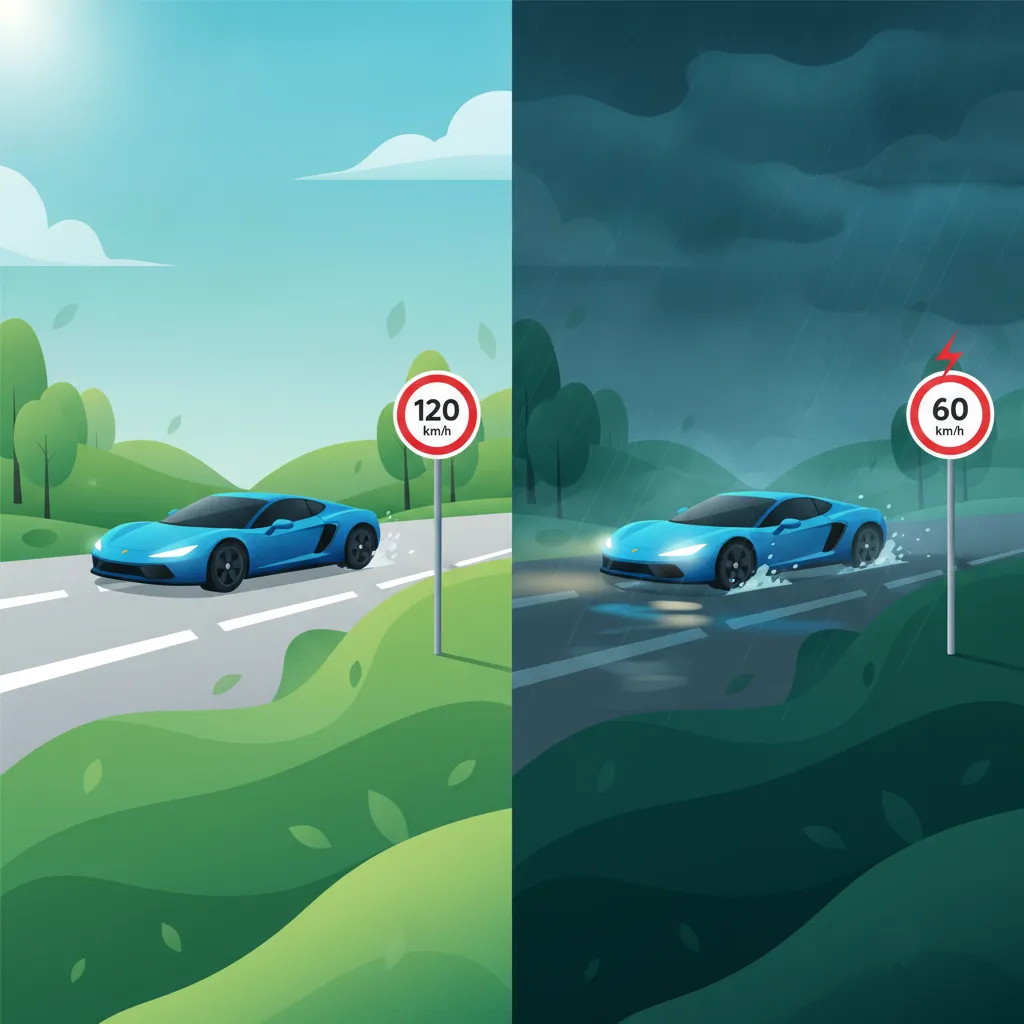
This lesson details the various speed limits applicable in Germany, from urban zones to rural roads. It emphasizes the critical skill of adapting speed to prevailing conditions such as rain, fog, or poor road surfaces. The content explains how external factors significantly impact vehicle handling and stopping distances.

This lesson focuses on maintaining a safe buffer around the vehicle in traffic. It explains the 'two-second rule' as a simple method for ensuring adequate following distance and discusses how to adjust this for adverse conditions. A key focus is on developing hazard anticipation skills through continuous scanning and risk assessment.
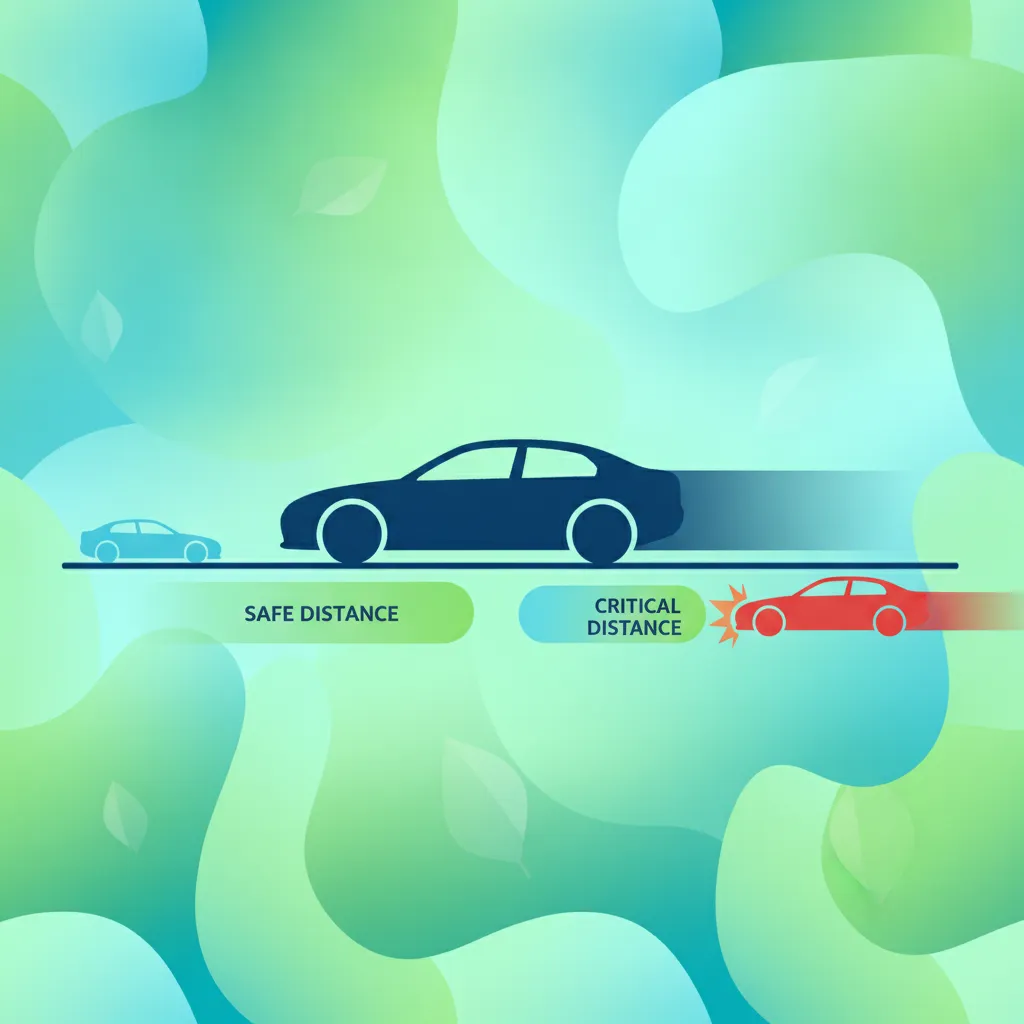
This lesson breaks down the concept of total stopping distance into reaction distance and braking distance. It teaches various braking techniques, including how to perform an emergency stop safely and the function of an Anti-lock Braking System (ABS). The relationship between speed, road condition, and braking effectiveness is a central theme.

This lesson focuses on the importance of maintaining a safe following distance ('Sicherheitsabstand') to the vehicle ahead. It teaches practical methods for judging this distance, including the universally applicable two-second rule and the German 'halber Tacho' (half the speedometer reading in meters) rule. The lesson stresses the need to increase this distance in poor weather or when visibility is reduced.

This lesson explains the physics behind stopping a vehicle, breaking down the total stopping distance ('Anhalteweg') into its two key components: reaction distance and braking distance. It provides formulas for estimating these distances at various speeds and discusses the critical factors that can increase them, such as driver fatigue, poor weather, and worn tires. Understanding this relationship is vital for appreciating the need for safe speeds and distances.

This lesson examines how different weather conditions, such as rain, strong winds, and fog, directly impact motorcycle safety. It explains how wet surfaces reduce tyre grip and increase braking distances, requiring smoother rider inputs. The content also provides strategies for managing reduced visibility and the physical effects of crosswinds on the motorcycle's stability.

This lesson examines the specific hazards posed by different weather conditions. It explains how rain can lead to hydroplaning and reduced grip, how fog impairs visibility, and how strong winds can affect stability. Riders will learn practical strategies, such as reducing speed and increasing following distance, to mitigate these risks.

This lesson introduces the fundamentals of a motorcycle's braking system, emphasizing the dominant role of the front brake due to forward weight transfer during deceleration. It explains how to apply both front and rear brakes in a coordinated manner to achieve maximum, stable stopping power. The content also covers how to modulate brake pressure smoothly and progressively to avoid losing traction and locking a wheel.

This lesson teaches drivers how to safely manage their vehicle in challenging weather. It explains the dangers of aquaplaning in heavy rain, the loss of traction on snow and ice (including 'black ice'), and the severely reduced visibility in fog. You will learn to adjust your speed, increase following distances, and use lights correctly to suit these conditions.
Explore the factors influencing your total stopping distance, including reaction time and braking distance. This lesson details how speed perception affects safe following distances and overall road awareness for the German theory test.
This lesson explains the two components of total stopping distance: reaction distance and braking distance. It teaches learners how factors like speed, road conditions, and rider attentiveness influence how far the motorcycle travels before coming to a complete stop. By understanding these principles, riders can make better decisions about safe speeds and following distances to ensure they can stop in time.
This lesson explains the physics behind stopping a vehicle, breaking down the total stopping distance ('Anhalteweg') into its two key components: reaction distance and braking distance. It provides formulas for estimating these distances at various speeds and discusses the critical factors that can increase them, such as driver fatigue, poor weather, and worn tires. Understanding this relationship is vital for appreciating the need for safe speeds and distances.
This lesson details the various speed limits applicable in Germany, from urban zones to rural roads. It emphasizes the critical skill of adapting speed to prevailing conditions such as rain, fog, or poor road surfaces. The content explains how external factors significantly impact vehicle handling and stopping distances.
This lesson focuses on maintaining a safe buffer around the vehicle in traffic. It explains the 'two-second rule' as a simple method for ensuring adequate following distance and discusses how to adjust this for adverse conditions. A key focus is on developing hazard anticipation skills through continuous scanning and risk assessment.

This lesson highlights the specific risks associated with motorcyclists, who are less visible and more vulnerable than car drivers. It teaches you to actively look for motorcycles, especially at intersections and during lane changes, as their smaller profile can be easily missed. You will learn about their potential for rapid acceleration and instability, emphasizing the need for extra following distance.
This lesson breaks down the concept of total stopping distance into reaction distance and braking distance. It teaches various braking techniques, including how to perform an emergency stop safely and the function of an Anti-lock Braking System (ABS). The relationship between speed, road condition, and braking effectiveness is a central theme.
This lesson focuses on the importance of maintaining a safe following distance ('Sicherheitsabstand') to the vehicle ahead. It teaches practical methods for judging this distance, including the universally applicable two-second rule and the German 'halber Tacho' (half the speedometer reading in meters) rule. The lesson stresses the need to increase this distance in poor weather or when visibility is reduced.

This lesson focuses on how motorcyclists can clearly communicate their intentions to other road users to prevent misunderstandings and collisions. It covers the correct use of indicators, brake lights, and standardized hand signals for turning and stopping. The importance of making eye contact with other drivers to confirm they have seen you is also a key topic for enhancing safety.

This lesson details the correct procedures for entering a motorway, using the acceleration lane to match traffic speed, and merging safely. It reinforces the strict lane discipline required, including keeping to the right lane except when overtaking. The content also provides guidance on maintaining increased following distances and performing safe lane changes at high speeds.

This lesson focuses on the importance of strategic road positioning for enhancing safety and visibility. Learners explore different lane positions and understand when to use them to see, be seen, and create a safety buffer. The content emphasizes maintaining a long visual focus down the road to anticipate hazards and avoid target fixation, particularly when cornering.
Find clear answers to common questions learners have about Following Distance and the Two-Second Rule for Motorcyclists. Learn how the lesson is structured, which driving theory objectives it supports, and how it fits into the overall learning path of units and curriculum progression in Germany. These explanations help you understand key concepts, lesson flow, and exam focused study goals.
Yes, the two-second rule is the minimum standard for all road users in Germany, including all motorcycle classes. However, you should always increase this gap if conditions are poor, as motorcycles require focused attention on surface grip.
In wet conditions, road grip is reduced, which significantly increases your braking distance. You should at least double the distance to four seconds or more to compensate for the delayed grip and increased stopping time.
Exam questions often present video scenarios where you must assess if the current gap to the vehicle ahead allows for a safe stop if they brake suddenly. You must be able to judge the time gap accurately.
Yes, while group riding has its own formation rules, you must always ensure a sufficient individual following distance to the rider in front to allow for emergency maneuvering, especially on rural roads or motorways.
Begin your targeted revision now. Use our practice search to quickly find specific German driving theory questions. Filter by StVO rules, road signs, or hazard perception to create your focused study plan. Master challenging areas and prepare confidently for your theoretical driving test.