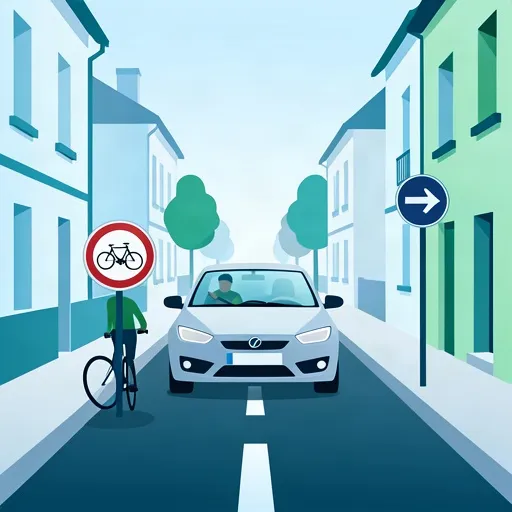
When driving in French urban areas, you will frequently encounter streets where cyclists are legally permitted to travel in the opposite direction of motorized traffic. This guide helps you understand how to share the road safely and provides the necessary knowledge to answer related questions correctly during your theory test. We cover spatial awareness, priority conventions, and the legal status of these shared lanes.
Article content overview
In modern French urban environments, you will frequently encounter traffic configurations designed to encourage sustainable mobility. One such configuration is the double-sens cyclable. Understanding these zones is not only crucial for real-world driving safety but is also a common topic in the French Code de la route theory exam (ETG). These streets are one-way for motorized vehicles but allow cyclists to travel in both directions.
A specific traffic layout where cyclists are legally authorized to travel in the opposite direction to motorized traffic on a street that is otherwise designated as one-way.
To navigate these streets correctly, you must be able to recognize the road signs and markings that designate a two-way cycling lane. These zones are usually indicated by specific signage placed at the entrance of the street, ensuring that drivers are aware they may encounter cyclists heading toward them.
It is essential to stay vigilant when turning into these streets. When you are about to enter or cross a road that features a double-sens cyclable, you must check for cyclists coming from the opposite direction, even if all other traffic is flowing away from you. Failure to scan for these vulnerable road users is a frequent cause of points lost during the practical driving test and a significant safety hazard in urban traffic.
When driving in a street with a double-sens cyclable, you must treat cyclists with the same care as you would on any other road, but with increased attention to the shared space. Since these lanes are often narrow, your spatial awareness is critical to avoid "dooring" incidents or forcing cyclists off the road.
When overtaking a cyclist in a double-sens cyclable zone, you must maintain a safety distance of at least 1 meter in urban areas and 1.5 meters outside of urban areas. If the road is too narrow to provide this lateral clearance safely, you must wait behind the cyclist until conditions allow for a safe maneuver.
In many of these zones, you will see a sas vélo—a specific advanced stop line for bicycles—at intersections. This allows cyclists to position themselves ahead of motorized traffic, increasing their visibility when the light turns green. As a driver, you must stop at the first line and ensure you do not encroach upon the sas vélo, as this space is reserved exclusively for cyclists and micromobility users.
The French theory exam often tests your ability to anticipate the behavior of vulnerable users. A common question scenario involves turning left at an intersection where a double-sens cyclable is present. You might be tempted to focus only on oncoming motorized traffic, but the law requires you to yield to any cyclist traveling in the designated opposite lane.
| Situation | Driver Obligation |
|---|---|
| Entering a one-way street | Check for signs allowing cyclists to ride against the flow. |
| Turning at an intersection | Scan for oncoming cyclists in the marked cycle lane. |
| Overtaking | Maintain a minimum lateral distance of 1 meter. |
| At a traffic light | Stop behind the line and leave the sas vélo clear. |
Double-sens cyclable streets are one-way routes for cars but allow cyclists to travel in both directions, designated by specific signage combinations. Drivers must remain vigilant for cyclists approaching from the opposite direction, maintain mandatory lateral distances of 1 meter in towns and 1.5 meters outside them, and never occupy the sas vélo advanced stop line area at intersections. These shared space configurations prioritize vulnerable road users and are a regular feature of the French theory exam, testing your ability to anticipate cyclist behavior at intersections and during turning maneuvers.
A short set of high-value points that capture the most important ideas from this article.
Double-sens cyclable zones are one-way streets for motorized vehicles where cyclists are legally permitted to travel in both directions
These zones are identified by a B1 one-way sign combined with a M4d2 cyclist exception sign placed underneath
Drivers must always scan for cyclists approaching from the opposite direction when entering, crossing, or turning at these streets
The sas vélo is an exclusive advanced stop line area reserved for cyclists and must never be encroached upon by motorized vehicles
These rules are frequently tested in the French Code de la route theory exam (ETG) with scenarios involving vulnerable road users
When overtaking cyclists in urban areas, maintain a minimum lateral distance of 1 meter; outside urban areas, increase to 1.5 meters
If the road is too narrow to provide safe lateral clearance, you must wait behind the cyclist rather than force a pass
At traffic lights, stop behind the first line and leave the sas vélo completely clear for cyclists
The M4d2 auxiliary sign indicates cyclists may legally travel against the normal flow of traffic
When turning left at an intersection with a double-sens cyclable, you must yield to oncoming cyclists before completing the turn
Assuming no cyclists are present because other motorized traffic flows only one way, leading to failure to check for oncoming riders
Not maintaining the required lateral distance when overtaking cyclists in these narrow shared zones
Encroaching on the sas vélo when stopped at traffic lights, blocking the space reserved for cyclists
Focusing only on oncoming motorized traffic when turning left and overlooking cyclists traveling against the flow
Entering a double-sens cyclable street without first observing the entrance signs for cyclist exceptions
Article content overview
A short set of high-value points that capture the most important ideas from this article.
Double-sens cyclable zones are one-way streets for motorized vehicles where cyclists are legally permitted to travel in both directions
These zones are identified by a B1 one-way sign combined with a M4d2 cyclist exception sign placed underneath
Drivers must always scan for cyclists approaching from the opposite direction when entering, crossing, or turning at these streets
The sas vélo is an exclusive advanced stop line area reserved for cyclists and must never be encroached upon by motorized vehicles
These rules are frequently tested in the French Code de la route theory exam (ETG) with scenarios involving vulnerable road users
When overtaking cyclists in urban areas, maintain a minimum lateral distance of 1 meter; outside urban areas, increase to 1.5 meters
If the road is too narrow to provide safe lateral clearance, you must wait behind the cyclist rather than force a pass
At traffic lights, stop behind the first line and leave the sas vélo completely clear for cyclists
The M4d2 auxiliary sign indicates cyclists may legally travel against the normal flow of traffic
When turning left at an intersection with a double-sens cyclable, you must yield to oncoming cyclists before completing the turn
Assuming no cyclists are present because other motorized traffic flows only one way, leading to failure to check for oncoming riders
Not maintaining the required lateral distance when overtaking cyclists in these narrow shared zones
Encroaching on the sas vélo when stopped at traffic lights, blocking the space reserved for cyclists
Focusing only on oncoming motorized traffic when turning left and overlooking cyclists traveling against the flow
Entering a double-sens cyclable street without first observing the entrance signs for cyclist exceptions
Explore related topics, search based questions, and concepts that learners often look up when studying French Cyclists and Double-Sens Cyclable Rules. These themes reflect real search intent and help you understand how this topic connects to wider driving theory knowledge in France.
Find clear and practical answers to common questions learners often have about French Cyclists and Double-Sens Cyclable Rules. This section helps explain difficult points, remove confusion, and reinforce the key driving theory concepts that matter for learners in France.
It is a one-way street where cyclists are specifically authorized to travel in the opposite direction of other vehicles, typically marked by specific road signs.
You must treat cyclists with the same care as other road users. Always maintain safe distances and be aware that they may be approaching from the opposite direction.
No. Cyclists are only permitted to travel against traffic in one-way streets that have been specifically marked and designated as a double-sens cyclable.
The exam often tests your ability to identify vulnerable road users, respect their priority, and recognize the specific road signs that indicate shared lanes and bicycle zones.
Continue your preparation for the French permis de conduire exam. Dive deeper into specific Code de la route sections, practice scenarios, or review official procedures. Use our comprehensive article collection to master every aspect of driving theory.