
This lesson explores how varying weather conditions impact the handling and stability of mopeds and scooters under German road laws. Building on your knowledge of vehicle control, you will learn essential strategies to adapt your riding style, ensure safety in poor visibility, and pass the weather-related questions on your AM theory exam.
Lesson content overview
Operating a moped or scooter, whether for an AM licence in Germany or elsewhere, demands acute awareness of your surroundings. While the thrill of open-air riding is undeniable, weather conditions can drastically alter road safety and require significant adjustments to your riding style. This lesson provides essential knowledge and practical strategies to navigate the hazards posed by rain, fog, strong winds, and temperature extremes, ensuring you remain in control and reduce accident risks.
Weather phenomena directly impact the interaction between your vehicle, the road, and other road users. These changes affect critical aspects of riding, such as the grip of your tyres, your ability to see and be seen, and the stability of your moped or scooter. By understanding these fundamental interactions, you can proactively adapt your riding behaviour to maintain safety.
Traction is the foundation of vehicle control. It is the friction that allows your tyres to "grip" the road, translating engine power into movement and braking force into deceleration. Ideal traction occurs on dry, clean road surfaces. However, precipitation like rain, the formation of ice, or even environmental factors like spilled oil or wet leaves significantly reduce this vital grip. When traction is compromised, your stopping distances increase, and your ability to steer accurately decreases, making sudden manoeuvres particularly dangerous. Adapting your speed and riding inputs to match the available traction is paramount for safety.
Hydroplaning, often called aquaplaning, is a critical risk on wet roads, especially for lightweight vehicles like mopeds and scooters. It occurs when your tyres encounter more water than they can disperse through their tread patterns. Instead of cutting through the water to maintain contact with the road, the tyre rides on a film of water, effectively floating. When hydroplaning, you lose all ability to steer or brake, making it impossible to control the vehicle until the tyres regain contact with the road. Reducing speed and avoiding large puddles are the primary defences against this dangerous phenomenon.
Your visibility range directly determines how much time you have to react to changing road conditions or unexpected events. Fog, heavy rain, mist, or darkness drastically shorten this range. When you cannot see far ahead, your reaction time is naturally reduced, demanding a slower speed to compensate. If you cannot see a hazard, you cannot react to it in time. Therefore, maintaining an adequate sight distance – the distance you can see clearly ahead – is crucial for making safe decisions, especially concerning speed and following distance.
Mopeds and scooters are lightweight vehicles with a relatively large side profile, making them susceptible to the effects of wind. Strong winds, particularly crosswinds and sudden gusts, can exert significant lateral forces, pushing your vehicle sideways and making it difficult to maintain a straight line. This can lead to instability, especially on exposed roads, bridges, or when emerging from sheltered areas. Riding near large vehicles can also create sudden wind disruptions. Anticipating wind effects and adjusting your speed and grip are key to maintaining stability.
Each type of adverse weather presents unique challenges and requires specific adaptations to your riding strategy. Understanding these nuances is essential for safe operation of your AM licence vehicle.
Rainfall significantly alters road conditions, turning normally grippy surfaces into slippery hazards. The amount and duration of rain directly correlate with the level of risk.
The most effective way to prevent hydroplaning is to reduce your speed. Lower speeds allow your tyres more time to displace water through their treads, maintaining better contact with the road. Avoid riding through large puddles or standing water whenever possible. If you must, approach them slowly and smoothly.
On wet roads, your braking distances will be considerably longer. Apply brakes gently and progressively, using both front and rear brakes, but be cautious with the front brake to avoid skidding. When cornering, reduce your speed significantly before entering the turn and maintain a smooth, steady throttle through the curve, avoiding sudden leaning or steering inputs.
When riding in the rain, pay extra attention to road markings (like zebra crossings or painted arrows) and metal surfaces (manhole covers, tram tracks, gratings), as these become extremely slippery when wet.
Fog is composed of tiny water droplets suspended in the air, scattering light and drastically reducing visibility. This makes it challenging to perceive traffic, road signs, and other hazards in time.
In fog, your primary goal is to see and be seen.
Switch to Low-Beam Headlights: High beams will reflect off the fog droplets, creating glare that reduces your own visibility rather than improving it. Low beams direct light downwards, illuminating the road surface better.
Activate Fog Lights (if equipped): If your moped has front fog lights, turn them on. They are designed to cut through fog more effectively than standard headlights.
Ensure Rear Lights are Visible: Your taillights are crucial for other drivers to see you. Consider activating your hazard warning lights if visibility is severely restricted and you are moving very slowly or are stopped, but only when it does not confuse other traffic.
Strong winds, especially crosswinds, pose a direct threat to the stability of mopeds and scooters.
Crosswinds can push your vehicle sideways, making it difficult to maintain a straight line. This requires constant minor steering corrections and a firm grip on the handlebars. Be particularly wary on exposed sections of road, such as bridges, open fields, or when passing gaps in buildings or tree lines.
Overtaking or being overtaken by large vehicles like trucks or buses can create sudden changes in wind pressure. As you approach a large vehicle, it temporarily blocks the wind. When you clear it, you can be hit by a sudden gust, potentially throwing you off balance. Anticipate this "wind shadow" effect and be prepared for a sudden push when emerging from behind a large vehicle.
Avoid overtaking large vehicles in strong crosswinds, especially on exposed roads. The sudden change in wind pressure can cause you to lose balance.
Combining darkness with rain creates a particularly challenging scenario for visibility. The effect is multiplicative, not merely additive.
At night, raindrops act like tiny prisms, scattering your headlights' beams and creating significant glare, both from your own lights and those of oncoming traffic. The wet road surface also reflects light, making road markings, potholes, and other hazards harder to distinguish.
Temperatures around freezing point (0°C) introduce the severe hazard of ice, which can drastically reduce traction without obvious visual cues.
Ice dramatically reduces tyre grip to almost zero. It is most common in shaded areas, on bridges (which freeze faster than roads), underpasses, and after periods of thaw followed by a freeze.
Never assume a road is dry just because it looks dry when temperatures are near freezing. Black ice can be present and is extremely dangerous.
In Germany, the Straßenverkehrs-Ordnung (StVO) or Road Traffic Regulations, along with common sense and due care, dictates how drivers and riders must behave in various conditions. Ignoring weather-related hazards can lead to serious accidents and legal consequences.
According to German traffic law, riders are always required to adjust their speed to match the prevailing road, traffic, and weather conditions.
The correct use of vehicle lighting is not just a safety recommendation but a legal requirement.
Even experienced riders can make errors in challenging weather. Awareness of common pitfalls can significantly enhance your safety.
Driving at Normal Speed in Heavy Rain:
Using High-Beam Headlights During Heavy Rain or Fog:
Following Too Closely in Fog or Heavy Rain:
Riding Too Fast on Icy Patches (Especially Black Ice):
Attempting to Overtake Large Vehicles in Strong Crosswinds:
Not Using Headlights in Low-Light Conditions During Rain:
Safe riding in adverse weather isn't just about following rules; it's also about understanding how various contexts amplify or mitigate risks.
In adverse weather, visibility is reduced not only for you but also for pedestrians, cyclists, and other moped riders.
Riding a moped or scooter for your AM licence in Germany means being prepared for all conditions. Weather fundamentally transforms the dynamics of riding, impacting your grip, visibility, and vehicle stability. The core principle of safe riding in adverse weather is adaptation. By reducing speed, increasing following distance, using appropriate lighting, and making smooth, deliberate inputs, you can mitigate most risks. Understanding the physics behind these changes and consistently applying these strategies will enable you to navigate challenging conditions safely and confidently. Always remember that your safety, and the safety of others, depends on your ability to adjust your riding to the environment.
Adverse weather fundamentally changes moped and scooter riding dynamics by reducing traction, visibility, and stability. Rain creates slippery road films and hydroplaning risks, while fog and heavy rain shorten your visibility range to the point where speed must be dramatically reduced so you can always stop within what you can see. Strong winds and crosswinds destabilise lightweight vehicles, especially near large vehicles or on exposed roads. Near-freezing temperatures introduce black ice—nearly invisible and extremely dangerous. The core strategy across all conditions is reducing speed, increasing following distance, using low-beam headlights, and making only smooth, gradual inputs to maintain what little traction remains.
A short set of high-value points that capture the most important learning from this lesson.
Traction is the foundation of vehicle control; rain, ice, and oil significantly reduce grip, increasing stopping distances and reducing steering accuracy.
Hydroplaning occurs when tyres cannot displace water, causing complete loss of control until contact is regained—speed reduction is the primary defence.
Fog and rain drastically reduce visibility range, meaning you must slow down so your stopping distance never exceeds your sight distance.
Mopeds and scooters are particularly vulnerable to crosswinds due to their lightweight build and large side profile, requiring firm grip and anticipatory adjustments.
Black ice forms a nearly invisible transparent layer at temperatures around freezing, most commonly on bridges, shaded areas, and after thaw-freeze cycles.
Explore all units and lessons included in this driving theory course.
Light drizzle can be more dangerous than heavy rain because it mixes with road oil and dust to create an extremely slippery film.
In fog or heavy rain, always use low-beam headlights—high beams reflect off water particles and reduce your own visibility.
The half-speed rule for following distance (speed in km/h ÷ 2) should be doubled or tripled in adverse conditions.
Avoid sudden braking, acceleration, or steering inputs on wet or icy surfaces; all inputs must be smooth and gradual to maintain available traction.
Under StVO, you must adjust speed to match prevailing road, traffic, and weather conditions—this is a legal requirement, not merely advice.
Riding at normal speed in heavy rain underestimates the dramatic reduction in tyre grip and significantly increases stopping distances and hydroplaning risk.
Using high-beam headlights in fog or heavy rain causes light to scatter off water droplets, creating glare that worsens visibility for everyone.
Following too closely in fog or heavy rain when visibility is already reduced leaves insufficient time to react if the vehicle ahead brakes suddenly.
Riding too fast over suspected black ice or icy patches leads to immediate and complete loss of control with almost no traction available.
Attempting to overtake large vehicles in strong crosswinds is dangerous because emerging from their wind shadow can cause sudden destabilising gusts.
Lesson content overview
A short set of high-value points that capture the most important learning from this lesson.
Traction is the foundation of vehicle control; rain, ice, and oil significantly reduce grip, increasing stopping distances and reducing steering accuracy.
Hydroplaning occurs when tyres cannot displace water, causing complete loss of control until contact is regained—speed reduction is the primary defence.
Fog and rain drastically reduce visibility range, meaning you must slow down so your stopping distance never exceeds your sight distance.
Mopeds and scooters are particularly vulnerable to crosswinds due to their lightweight build and large side profile, requiring firm grip and anticipatory adjustments.
Black ice forms a nearly invisible transparent layer at temperatures around freezing, most commonly on bridges, shaded areas, and after thaw-freeze cycles.
Explore all units and lessons included in this driving theory course.
Light drizzle can be more dangerous than heavy rain because it mixes with road oil and dust to create an extremely slippery film.
In fog or heavy rain, always use low-beam headlights—high beams reflect off water particles and reduce your own visibility.
The half-speed rule for following distance (speed in km/h ÷ 2) should be doubled or tripled in adverse conditions.
Avoid sudden braking, acceleration, or steering inputs on wet or icy surfaces; all inputs must be smooth and gradual to maintain available traction.
Under StVO, you must adjust speed to match prevailing road, traffic, and weather conditions—this is a legal requirement, not merely advice.
Riding at normal speed in heavy rain underestimates the dramatic reduction in tyre grip and significantly increases stopping distances and hydroplaning risk.
Using high-beam headlights in fog or heavy rain causes light to scatter off water droplets, creating glare that worsens visibility for everyone.
Following too closely in fog or heavy rain when visibility is already reduced leaves insufficient time to react if the vehicle ahead brakes suddenly.
Riding too fast over suspected black ice or icy patches leads to immediate and complete loss of control with almost no traction available.
Attempting to overtake large vehicles in strong crosswinds is dangerous because emerging from their wind shadow can cause sudden destabilising gusts.
Explore search topics learners often look for when studying Weather Impact on Road Conditions and Riding Strategies. These topics reflect common questions about road rules, driving situations, safety guidance, and lesson level theory preparation for learners in Germany.
Browse additional driving theory lessons that cover connected traffic rules, road signs, and common driving situations related to this topic. Improve your understanding of how different rules interact across everyday traffic scenarios.
Explore advanced techniques for handling severe weather like heavy rain, dense fog, and strong winds on German roads. This lesson covers how to maintain control and visibility in challenging conditions, building on basic weather safety principles for the AM licence theory.
This lesson teaches drivers how to safely manage their vehicle in challenging weather. It explains the dangers of aquaplaning in heavy rain, the loss of traction on snow and ice (including 'black ice'), and the severely reduced visibility in fog. You will learn to adjust your speed, increase following distances, and use lights correctly to suit these conditions.
This lesson explores how different weather conditions impact driving safety and vehicle performance. It discusses the risks of hydroplaning in heavy rain, reduced visibility in fog, and loss of traction on snow and ice. Drivers will learn how to adapt their speed, increase following distances, and make smooth control inputs to maintain vehicle stability and prevent skids in these challenging conditions.
This lesson addresses the challenges posed by various weather conditions on heavy vehicle operation. It discusses the effects of crosswinds on stability, reduced traction in rain or ice, and diminished visibility in fog. The content provides guidance on adjusting speed and using vehicle technologies to maintain control.
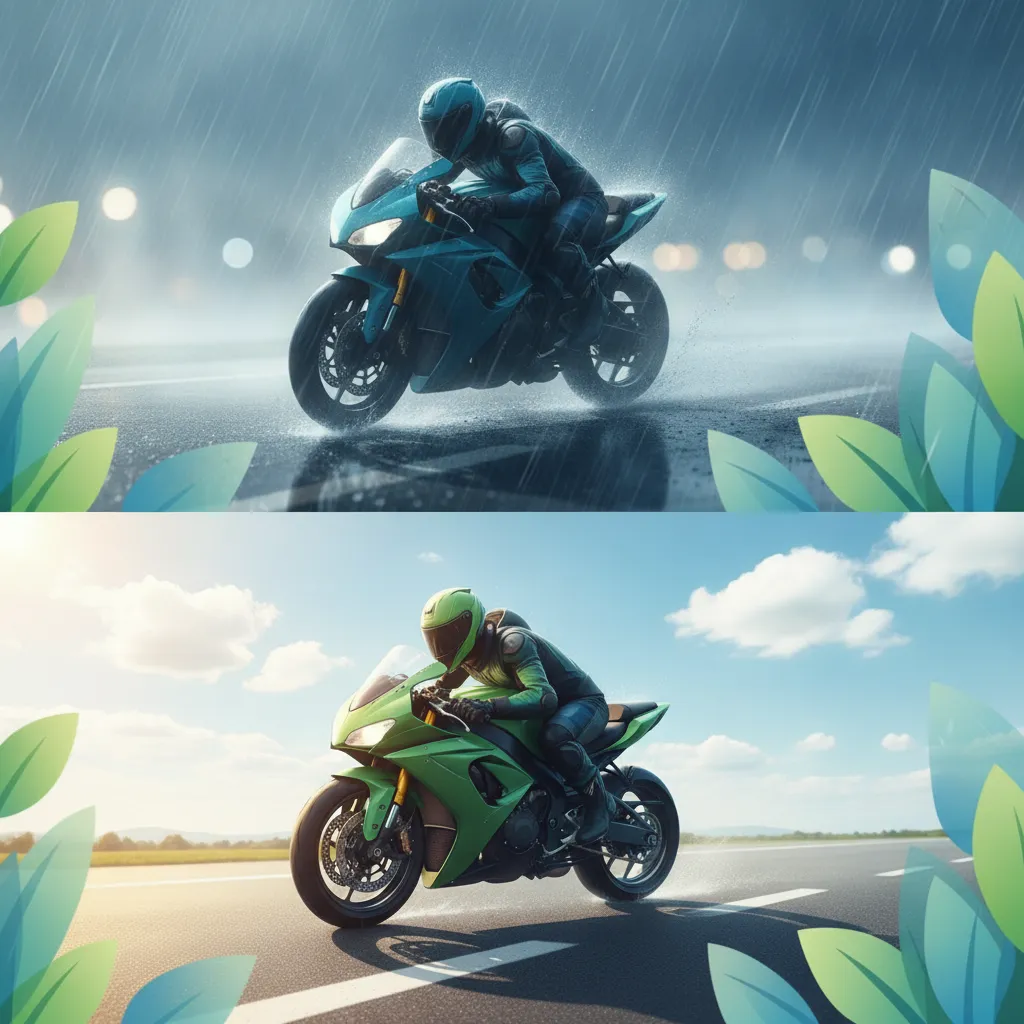
This lesson examines how different weather conditions, such as rain, strong winds, and fog, directly impact motorcycle safety. It explains how wet surfaces reduce tyre grip and increase braking distances, requiring smoother rider inputs. The content also provides strategies for managing reduced visibility and the physical effects of crosswinds on the motorcycle's stability.
Learn how different weather conditions and road surfaces create specific hazards for drivers. This lesson details how rain, ice, and poor road conditions impact vehicle dynamics and braking distances according to German traffic laws.
This lesson explores how different weather conditions impact driving safety and vehicle performance. It discusses the risks of hydroplaning in heavy rain, reduced visibility in fog, and loss of traction on snow and ice. Drivers will learn how to adapt their speed, increase following distances, and make smooth control inputs to maintain vehicle stability and prevent skids in these challenging conditions.
This lesson teaches drivers how to safely manage their vehicle in challenging weather. It explains the dangers of aquaplaning in heavy rain, the loss of traction on snow and ice (including 'black ice'), and the severely reduced visibility in fog. You will learn to adjust your speed, increase following distances, and use lights correctly to suit these conditions.
This lesson examines how different weather conditions, such as rain, strong winds, and fog, directly impact motorcycle safety. It explains how wet surfaces reduce tyre grip and increase braking distances, requiring smoother rider inputs. The content also provides strategies for managing reduced visibility and the physical effects of crosswinds on the motorcycle's stability.
This lesson explores the critical role of visibility in safe driving, covering topics such as sight distance, managing blind spots, and the correct use of mirrors. It provides guidance on how to adjust your driving in conditions of reduced visibility, such as at night, in fog, or during heavy rain, including the proper use of headlights. The importance of the over-the-shoulder check ('Schulterblick') is also a key focus.
This lesson addresses the challenges posed by various weather conditions on heavy vehicle operation. It discusses the effects of crosswinds on stability, reduced traction in rain or ice, and diminished visibility in fog. The content provides guidance on adjusting speed and using vehicle technologies to maintain control.
This lesson introduces the concept of defensive driving ('vorausschauendes Fahren'), a proactive approach focused on anticipating and mitigating potential risks. It teaches techniques for scanning the road ahead, identifying potential hazards early, and managing the space around your vehicle to create a safety buffer. The goal is to develop a mindset that prioritizes safety and collision avoidance above all else.
This lesson focuses on identifying and safely managing various road surface imperfections and hazards. It provides techniques for riding over loose surfaces like gravel, dealing with the low traction of wet leaves or manhole covers, and safely crossing tram tracks. The key is to recognize these hazards early and adjust technique accordingly.
This lesson builds on defensive driving by focusing specifically on hazard perception ('Gefahrenerkennung'). It teaches you how to actively scan the driving environment for potential risks, not just immediate dangers. You will learn to anticipate the likely actions of other road users and identify clues that signal a developing hazardous situation, allowing you to react early and safely.
This lesson focuses on the specific challenges and dangers associated with driving on rural roads ('Landstraßen'). It highlights common hazards such as sharp, blind corners, unmarked junctions, hidden farm entrances, and the presence of slow-moving agricultural vehicles or wildlife. The lesson emphasizes the need for appropriate speed selection and caution when overtaking in these environments.
Find clear answers to common questions learners have about Weather Impact on Road Conditions and Riding Strategies. Learn how the lesson is structured, which driving theory objectives it supports, and how it fits into the overall learning path of units and curriculum progression in Germany. These explanations help you understand key concepts, lesson flow, and exam focused study goals.
When it first begins to rain, water mixes with the oil, grease, and dust accumulated on the road surface. This mixture creates a very slick, oily film that significantly reduces tyre grip for mopeds and scooters until the rain is heavy enough to wash the surface clean.
Strong side winds can push a light AM vehicle out of its lane. You should slow down, maintain a firm grip on the handlebars, and be prepared to steer slightly into the wind to maintain your lane position, especially when passing larger vehicles that block and then release the wind.
No, wet roads require a significantly longer braking distance due to reduced tyre traction. You should always increase your following distance to at least twice what you would maintain on a dry, clear day to allow enough room for emergency stops.
Reduce your speed significantly so that you can stop within your field of vision. Ensure your lights are on, avoid sudden movements, and increase your distance from the vehicle in front so that you have more time to react if they brake unexpectedly.
Begin your targeted revision now. Use our practice search to quickly find specific German driving theory questions. Filter by StVO rules, road signs, or hazard perception to create your focused study plan. Master challenging areas and prepare confidently for your theoretical driving test.