
This lesson explores how diverse weather conditions impact the handling and safety of large passenger vehicles. You will learn to identify specific hazards like hydroplaning and reduced traction to maintain professional safety standards for your D, DE, D1, or D1E licence.
Lesson content overview
Navigating a passenger vehicle, especially in professional transport, demands exceptional skill and awareness. This is particularly true when adverse weather conditions and varying road surfaces challenge vehicle control and driver visibility. This comprehensive lesson explores how rain, fog, snow, and ice impact driving safety and vehicle performance, equipping professional drivers with the knowledge to adapt their techniques and ensure passenger safety.
Weather conditions significantly alter the driving environment, influencing everything from tire grip to a driver's ability to perceive hazards. As a professional driver, understanding these changes is crucial for maintaining control, preventing accidents, and fulfilling your legal duty of care. The core challenge lies in the reduction of friction between tires and the road surface, combined with diminished visibility.
Friction is the force that allows tires to grip the road, enabling steering, acceleration, and braking. When the road surface becomes wet, icy, or contaminated, this friction is significantly reduced. This reduction, known as friction loss, directly translates to increased stopping distances and a higher risk of skidding or losing control, particularly for heavier passenger vehicles.
As a professional driver, your responsibility under German traffic law (§ 1 StVO - Straßenverkehrs-Ordnung) includes adapting your speed and driving behavior to current road surface conditions. Ignoring this can have severe consequences, especially when transporting passengers.
Visibility reduction refers to any decrease in a driver's ability to see the road ahead, surrounding traffic, signage, and potential hazards. This can be caused by fog, heavy rain, falling snow, or even the spray from other vehicles. When visibility is compromised, your reaction time to perceive and process information remains constant, but the effective distance over which you can react shrinks.
This means that if you are driving too fast for the conditions, by the time you see a hazard, you may not have enough distance to stop or maneuver safely. Proper use of vehicle lighting and significant speed adaptation are essential when visibility is poor.
Rain is a common weather condition that quickly transforms a predictable road surface into a hazardous one. The primary risks associated with driving in rain are reduced friction and the potential for hydroplaning.
Hydroplaning, also known as aquaplaning, is a dangerous phenomenon where a layer of water builds up between the tires and the road surface, causing the tires to lose contact with the pavement. When this occurs, the vehicle essentially floats on water, leading to a complete loss of steering, braking, and traction control.
There are two main types of hydroplaning:
Several factors influence the risk of hydroplaning, including:
If your vehicle begins to hydroplane, ease off the accelerator, do not brake sharply, and steer gently in the direction you want the vehicle to go. Wait for the tires to regain contact with the road. Abrupt actions will worsen the situation.
To mitigate the risks of driving in rain and prevent hydroplaning, professional drivers must make several crucial adjustments:
Reduce Speed (Geschwindigkeitsanpassung): This is the most critical step. Lowering your speed gives your tires more time to displace water and reduces the likelihood of dynamic hydroplaning. Remember, the posted speed limit is a maximum under ideal conditions, not a target in adverse weather.
A good rule of thumb for heavy rain is to reduce your speed by at least 20-30 km/h below the dry road limit, or even more if visibility is significantly reduced.
Increase Following Distance (Sicherheitsabstand): On wet roads, braking distances can double. To compensate, significantly increase the gap between your vehicle and the one in front. While a two-second rule might suffice on dry roads, a four-second or even greater gap is advisable in heavy rain. This provides crucial extra time to react to unexpected hazards or sudden braking from other vehicles.
Smooth Control Inputs: Avoid sudden acceleration, hard braking, or abrupt steering maneuvers. Gentle and progressive inputs help maintain traction and prevent skidding.
Use Appropriate Lighting: Turn on your dipped headlights (Abblendlicht) even during daylight hours in rain. This not only helps you see the road but also makes your vehicle more visible to other drivers, particularly in heavy spray. Fog lights (Nebelschlussleuchte) should only be used when visibility is severely reduced, typically below 50 metres, to avoid dazzling other road users.
Fog presents a unique challenge primarily by severely reducing visibility. When driving a passenger vehicle in fog, the immediate concern is often the inability to see other vehicles, pedestrians, cyclists, road signs, and lane markings in time to react safely.
Effective management of fog conditions requires specific lighting strategies and a significant reduction in speed:
Reduce Speed Drastically: Your speed must be low enough to allow you to stop safely within the distance you can see. If you can only see 30 metres ahead, you must be able to stop your vehicle within that distance. For professional passenger vehicles, this often means reducing speed to 30 km/h or even less.
Use Appropriate Lighting:
Never use high beams (Fernlicht) in fog. The intense light reflects off the fog droplets directly back at you, worsening your visibility and creating glare.
Increase Following Distance: Just as in rain, increased following distance is vital. The standard two-second rule is insufficient. Aim for a gap that provides ample reaction time given the limited visibility.
Listen Carefully: In dense fog, your ears can become an important tool. Listen for the sounds of other vehicles you cannot yet see.
Stay in Your Lane and Avoid Overtaking: Resist the urge to overtake slower vehicles. It is extremely dangerous in fog due to unpredictable oncoming traffic and lane visibility. Maintain your lane and avoid drifting. Use the right-hand edge of the road or lane markings as a guide.
Be Prepared for Stops: Be vigilant for sudden stops by vehicles ahead or stationary hazards. Tap your brakes gently early to warn following traffic if you need to slow down significantly.
Driving in snow and ice presents the most challenging conditions due to extreme friction loss. These conditions demand the utmost caution, anticipation, and smooth control.
Professional drivers must adopt a highly defensive and cautious approach when snow and ice are present:
Extreme Speed Adaptation: Reduce your speed to an absolute minimum. In severe conditions, this may mean crawling along at very low speeds, sometimes as low as 10-20 km/h. Your speed should always allow you to stop safely within the visible distance. For large passenger vehicles, inertia plays a significant role, meaning that once a skid starts, it's harder to recover.
Greatly Increased Following Distance: Allow for a much larger following distance than in any other condition. On icy roads, you might need a gap of 10 seconds or more. This allows for vast stopping distances and much longer reaction times.
Smooth and Gentle Control Inputs: This is paramount for preventing skids:
Use Winter Tires (Winterreifen): In Germany, there is a situational winter tire requirement (situative Winterreifenpflicht). This means that during winter conditions (black ice, slick ice, slush, packed snow, fresh snow, hoar frost), you must use tires marked with the Alpine symbol (a snowflake within a three-peaked mountain). All-season tires with the Alpine symbol or M+S marking produced after 2017 are also acceptable. Failure to comply can result in fines and insurance issues.
Clear Vehicle Thoroughly: Before starting your journey, ensure your entire windshield, all windows, mirrors, headlights, taillights, and registration plates are completely free of snow and ice. Driving with an obstructed view is illegal and extremely dangerous.
Anticipate and Look Far Ahead: Scan the road far ahead for potential problem areas like shaded spots, bridges, or areas where snow has accumulated. Early detection gives you more time to react.
Avoid Cruise Control: Never use cruise control on slippery surfaces. If the wheels lose traction, the system might try to accelerate, worsening the skid.
Even with modern safety features like ABS and Electronic Stability Program (ESP), the laws of physics still apply. These systems assist, but they cannot create friction where there is none. Your careful driving remains the primary safety factor.
As a professional driver operating passenger vehicles in Germany, your responsibility to adapt to weather and road conditions is enshrined in law. The most fundamental principle is found in § 1 StVO (Basic Rules of Conduct), which states that anyone participating in traffic must behave in such a way that no other person is harmed, endangered, hindered, or annoyed more than is unavoidable under the circumstances.
This legal duty of care mandates that you:
Failure to comply with these regulations can lead to significant fines (Bußgelder), penalty points (Punkte in Flensburg), and, in severe cases, even criminal charges if an accident occurs due to negligence. For professional drivers, this also impacts your licence and employment.
Driving in adverse weather is rarely a simple, one-size-fits-all situation. Several factors combine to dictate the level of risk and the necessary adaptations:
Driving a professional passenger vehicle in adverse weather conditions demands heightened awareness, refined skills, and a commitment to safety above all else. Understanding the physical principles of friction loss and hydroplaning, coupled with the critical importance of visibility, forms the foundation of safe driving. By consistently adapting your speed, increasing following distances, and applying smooth control inputs, you can significantly reduce the risks associated with rain, fog, snow, and ice. Adhering to legal mandates like the situational winter tire requirement and rules for fog light usage is not just about avoiding penalties; it is about protecting your passengers, yourself, and other road users.
Always remember that human reaction time remains constant, so when conditions reduce your visible stopping distance, your speed must decrease proportionally to maintain safety. Prioritizing anticipation, patience, and gentle driving will ensure a professional and safe journey, regardless of what the weather brings.
This lesson covers how rain, fog, snow, and ice affect vehicle handling and road surface grip for professional drivers. Key hazards include hydroplaning in rain, severe visibility reduction in fog, and extreme friction loss on snow and black ice. Safe driving requires significant speed reduction, greatly increased following distances, and smooth control inputs to maintain traction. German law under § 1 StVO mandates adapting driving behavior to conditions, and specific rules govern fog light usage and winter tire requirements for passenger transport vehicles.
A short set of high-value points that capture the most important learning from this lesson.
Friction loss on wet, icy, or snowy surfaces dramatically increases stopping distances and reduces steering and braking effectiveness
Hydroplaning occurs when water separates tires from the road; reduce speed to prevent it and ease off the accelerator if it happens
Your speed must always allow you to stop safely within your visible stopping distance, regardless of posted limits
Smooth, gradual control inputs are essential in adverse conditions; sudden actions cause skids even with ABS
Heavy passenger vehicles have greater inertia, making them harder to control once a skid begins
Explore all units and lessons included in this driving theory course.
Rear fog light (Nebelschlussleuchte) may only be used when visibility is below 50 metres; switch it off when conditions improve
Winter tires are legally required in Germany during winter conditions including black ice, packed snow, slush, and fresh snow
Black ice commonly forms on bridges, overpasses, and shaded road areas where surfaces cool faster
In heavy rain, reduce speed by at least 20-30 km/h and increase following distance to at least four seconds
Use dipped headlights (Abblendlicht) in rain and fog; never use high beams in fog as light reflects back at you
Driving too fast for conditions and not matching speed to visible stopping distance
Using rear fog lights when visibility exceeds 50 metres, dazzling following drivers
Assuming ABS and traction control can compensate for excessive speed on slippery surfaces
Applying brakes sharply when hydroplaning; this worsens loss of control
Using cruise control on snow or ice, which can cause sudden wheel spin if traction is lost
Lesson content overview
A short set of high-value points that capture the most important learning from this lesson.
Friction loss on wet, icy, or snowy surfaces dramatically increases stopping distances and reduces steering and braking effectiveness
Hydroplaning occurs when water separates tires from the road; reduce speed to prevent it and ease off the accelerator if it happens
Your speed must always allow you to stop safely within your visible stopping distance, regardless of posted limits
Smooth, gradual control inputs are essential in adverse conditions; sudden actions cause skids even with ABS
Heavy passenger vehicles have greater inertia, making them harder to control once a skid begins
Explore all units and lessons included in this driving theory course.
Rear fog light (Nebelschlussleuchte) may only be used when visibility is below 50 metres; switch it off when conditions improve
Winter tires are legally required in Germany during winter conditions including black ice, packed snow, slush, and fresh snow
Black ice commonly forms on bridges, overpasses, and shaded road areas where surfaces cool faster
In heavy rain, reduce speed by at least 20-30 km/h and increase following distance to at least four seconds
Use dipped headlights (Abblendlicht) in rain and fog; never use high beams in fog as light reflects back at you
Driving too fast for conditions and not matching speed to visible stopping distance
Using rear fog lights when visibility exceeds 50 metres, dazzling following drivers
Assuming ABS and traction control can compensate for excessive speed on slippery surfaces
Applying brakes sharply when hydroplaning; this worsens loss of control
Using cruise control on snow or ice, which can cause sudden wheel spin if traction is lost
Explore search topics learners often look for when studying Weather Conditions and Road Surface Effects. These topics reflect common questions about road rules, driving situations, safety guidance, and lesson level theory preparation for learners in Germany.
Browse additional driving theory lessons that cover connected traffic rules, road signs, and common driving situations related to this topic. Improve your understanding of how different rules interact across everyday traffic scenarios.
Explore the specific challenges of driving on German Autobahns during adverse weather. This lesson focuses on adapting to rain, snow, ice, and high winds to maintain control and safety for professional passenger vehicle drivers.

This lesson teaches drivers how to safely manage their vehicle in challenging weather. It explains the dangers of aquaplaning in heavy rain, the loss of traction on snow and ice (including 'black ice'), and the severely reduced visibility in fog. You will learn to adjust your speed, increase following distances, and use lights correctly to suit these conditions.
This lesson addresses the challenges posed by various weather conditions on heavy vehicle operation. It discusses the effects of crosswinds on stability, reduced traction in rain or ice, and diminished visibility in fog. The content provides guidance on adjusting speed and using vehicle technologies to maintain control.
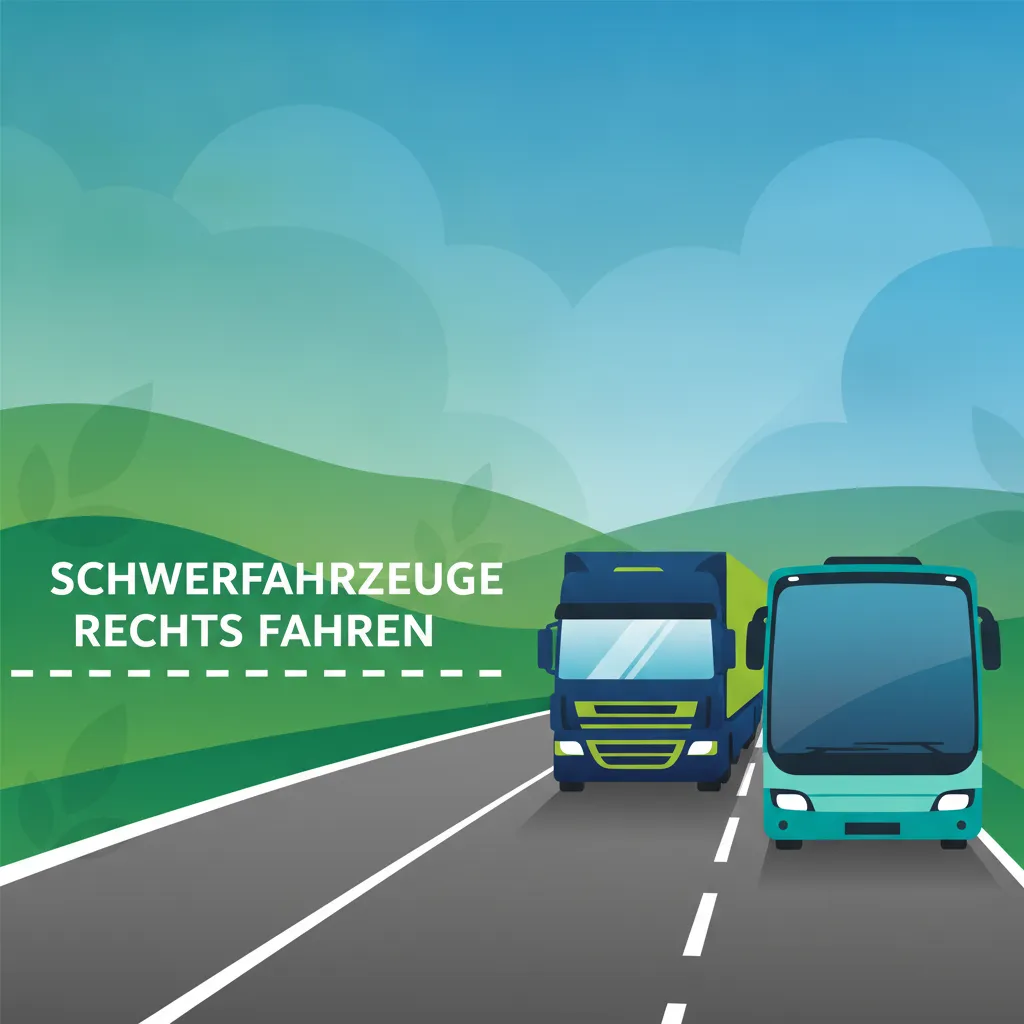
This lesson explains the specific regulations for operating heavy vehicles on Autobahnen, including speed limits, lane discipline, and overtaking rules. It discusses the use of dedicated truck lanes and the importance of maintaining appropriate following distances. The content also covers procedures for merging and exiting high-speed roads safely.
This lesson examines the specific hazards posed by different weather conditions. It explains how rain can lead to hydroplaning and reduced grip, how fog impairs visibility, and how strong winds can affect stability. Riders will learn practical strategies, such as reducing speed and increasing following distance, to mitigate these risks.

This lesson examines how different weather conditions, such as rain, strong winds, and fog, directly impact motorcycle safety. It explains how wet surfaces reduce tyre grip and increase braking distances, requiring smoother rider inputs. The content also provides strategies for managing reduced visibility and the physical effects of crosswinds on the motorcycle's stability.
This lesson provides a complete guide to driving on the German Autobahn. It covers the correct procedure for entering and exiting via acceleration and deceleration lanes, the strict lane discipline rule of keeping right ('Rechtsfahrgebot'), and the principle of overtaking only on the left. It also explains the recommended speed limit and the critical procedure for forming an emergency corridor ('Rettungsgasse') in a traffic jam.
This lesson provides instruction on the rules and best practices for operating a large passenger vehicle on the Autobahn. It covers the principles of strict lane discipline, regulations for minimum speed, and correct procedures for overtaking and merging. The importance of maintaining significantly increased following distances at high speeds and planning for exits well in advance is a key focus.
Understand how to prevent skids and maintain vehicle stability during challenging weather. This lesson details essential techniques for adapting speed, increasing distances, and making smooth control inputs to avoid loss of traction on wet, icy, or foggy roads.
This lesson teaches drivers how to safely manage their vehicle in challenging weather. It explains the dangers of aquaplaning in heavy rain, the loss of traction on snow and ice (including 'black ice'), and the severely reduced visibility in fog. You will learn to adjust your speed, increase following distances, and use lights correctly to suit these conditions.

This lesson examines how various road surfaces and conditions affect tyre grip and traction. It teaches riders to recognize and adapt to hazards like wet patches, loose gravel, or oil spills. The content covers techniques for maintaining control through smooth throttle and brake inputs, preventing traction loss while accelerating, braking, and cornering on compromised surfaces.
This lesson addresses the challenges posed by various weather conditions on heavy vehicle operation. It discusses the effects of crosswinds on stability, reduced traction in rain or ice, and diminished visibility in fog. The content provides guidance on adjusting speed and using vehicle technologies to maintain control.
This lesson examines the specific hazards posed by different weather conditions. It explains how rain can lead to hydroplaning and reduced grip, how fog impairs visibility, and how strong winds can affect stability. Riders will learn practical strategies, such as reducing speed and increasing following distance, to mitigate these risks.
This lesson examines how different weather conditions, such as rain, strong winds, and fog, directly impact motorcycle safety. It explains how wet surfaces reduce tyre grip and increase braking distances, requiring smoother rider inputs. The content also provides strategies for managing reduced visibility and the physical effects of crosswinds on the motorcycle's stability.
This lesson teaches the driving techniques required for smooth operation, which is essential for passenger comfort and vehicle stability. It covers progressive application of the accelerator and brakes to avoid jolts and abrupt movements. The principles of anticipatory driving are also explored, showing how looking ahead and planning maneuvers contributes to a smoother ride, better fuel efficiency, and increased safety.

This lesson delves into the critical control systems of a passenger vehicle: steering, braking, and acceleration. It explains the mechanics of hydraulic and pneumatic brakes and the function of safety aids like ABS and ESP. Learners will understand how to apply smooth acceleration and deceleration techniques to ensure passenger comfort and maintain vehicle stability under various driving conditions.
Find clear answers to common questions learners have about Weather Conditions and Road Surface Effects. Learn how the lesson is structured, which driving theory objectives it supports, and how it fits into the overall learning path of units and curriculum progression in Germany. These explanations help you understand key concepts, lesson flow, and exam focused study goals.
On wet roads, tire adhesion decreases significantly. You must increase your following distance to compensate for the increased braking distance and the risk of hydroplaning, which can occur at higher speeds.
According to German regulations, you must reduce your speed to a maximum of 50 km/h in such conditions. Your speed must always allow you to stop within the distance you can see clearly.
Abrupt movements shift the vehicle's center of gravity suddenly. In large passenger vehicles, this can lead to a loss of traction or skidding, which is harder to correct once it begins.
Yes. A loaded vehicle may have more weight over the drive wheels, increasing traction slightly, but it also has greater momentum, which makes stopping and turning more challenging and potentially hazardous.
Begin your targeted revision now. Use our practice search to quickly find specific German driving theory questions. Filter by StVO rules, road signs, or hazard perception to create your focused study plan. Master challenging areas and prepare confidently for your theoretical driving test.