
This lesson focuses on the critical skills required to share the road safely when riding a moped or scooter in dense, mixed traffic environments. You will learn how to maintain visibility, position your vehicle defensively, and interact correctly with other road users including cyclists and cars to ensure your safety in the German road system.
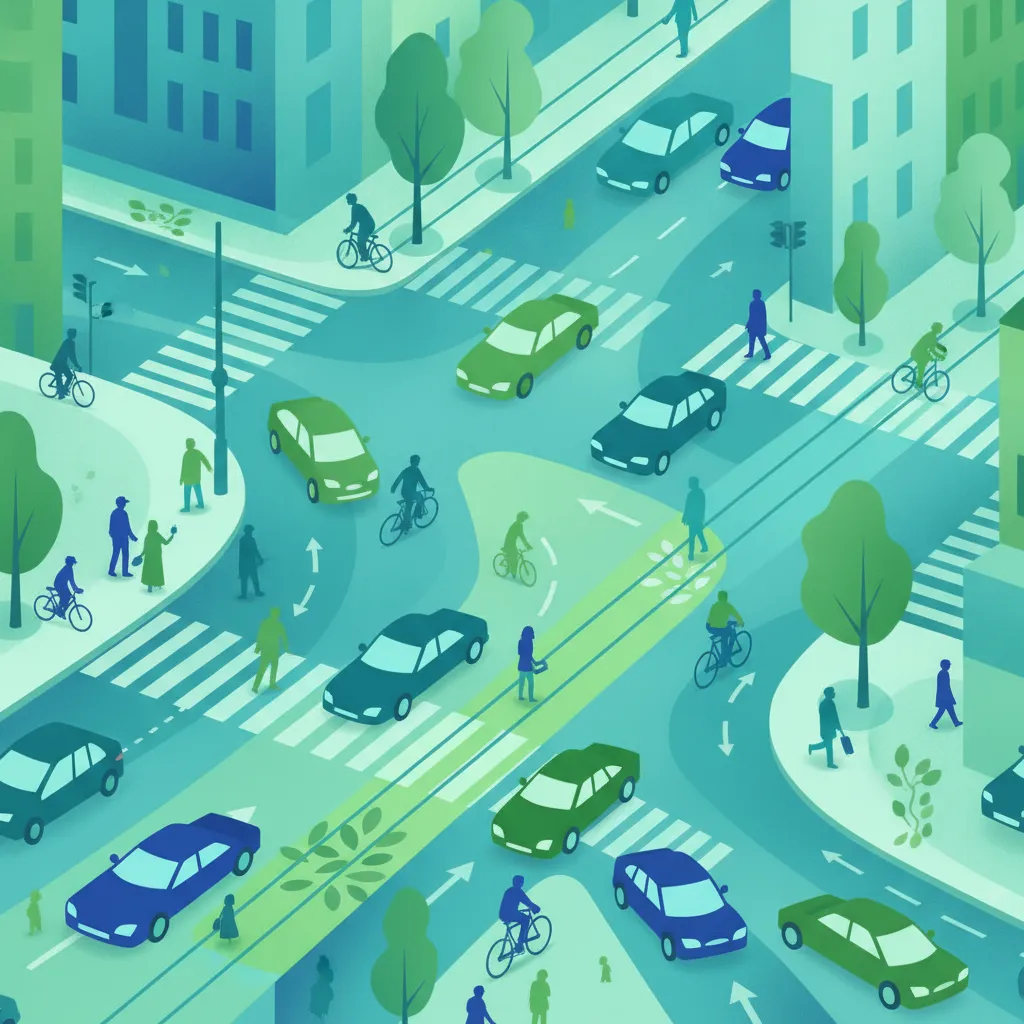
Lesson content overview
Operating a moped, scooter, or light quadricycle with an AM licence in Germany often involves navigating dense, mixed traffic environments. These situations present unique challenges due to the smaller size and different performance characteristics of AM vehicles compared to cars, trucks, and buses. This lesson provides essential strategies for increasing your visibility, positioning yourself defensively, and safely interacting with all road users, particularly cyclists and larger vehicles. Mastering these techniques is crucial for reducing collision risk and ensuring a smooth, safe journey in complex urban and rural settings.
AM vehicles, such as mopeds and scooters, are significantly smaller than most other vehicles on the road. This inherent size difference makes them less visible and more prone to being overlooked by drivers of larger vehicles. In a collision, AM riders are also far more exposed and vulnerable to severe injury. Therefore, a proactive and defensive riding approach is not just recommended, but absolutely essential for personal safety. Your primary goal in mixed traffic is to ensure your presence is always known and anticipated by others, and to protect yourself by maintaining adequate space and avoiding dangerous zones like blind spots.
Successful navigation of mixed traffic relies on several fundamental principles that combine defensive tactics with clear communication and awareness. These principles help AM riders minimize risks and integrate seamlessly with the flow of traffic.
Defensive positioning involves intentionally choosing your lane placement to minimize risk, maximize your visibility, and provide yourself with an escape route if needed. For AM riders, this often means avoiding the edges of the lane where you might be less visible or pushed into hazardous situations. Instead, you should aim for a position that allows other drivers to clearly see you and anticipate your movements. This often involves riding slightly more towards the centre of your lane, rather than hugging the curb, which can place you in blind spots or too close to parked vehicles and opening doors.
Always be seen: Think of your position as a statement to other drivers. If they can clearly see you, they can react to you.
The practice of positioning oneself and using equipment (like lights and reflective gear) to ensure other road users can detect an AM rider from a sufficient distance, reducing the chance of surprise encounters.
Maximizing your visibility goes beyond just proper positioning. It means actively ensuring that other road users can see you from a sufficient distance, reducing the likelihood of unexpected encounters. This is especially vital when integrating with cyclists and larger vehicles. Always use your headlights, even during the day, and consider wearing bright or reflective clothing. Avoid riding directly behind large vehicles for extended periods, as this makes you invisible to their rear-view mirrors. Instead, occupy a position that maintains a clear line of sight between you and other drivers.
A safety margin around your vehicle, both laterally (to the sides) and longitudinally (front and rear), which provides time to react and space for maneuvering in response to sudden actions from other road users.
Maintaining an adequate space cushion, or Abstandspuffer, is crucial in all traffic conditions, but particularly so in dense, mixed traffic where sudden stops or lane changes are common. This means keeping a safe distance from the vehicle ahead, allowing for smooth braking and acceleration without risk of collision. Equally important is lateral distance from vehicles, especially larger ones like trucks and buses, as they require more space for turns and may have significant blind spots. A generous space cushion provides you with precious reaction time and room to maneuver safely.
Cyclists are among the most vulnerable road users, and AM riders share many of these vulnerabilities. Integrating safely with cyclists requires respect, anticipation, and adherence to specific rules. Never assume you have priority over a cyclist, especially when they are traveling straight. Be aware that cyclists may ride side-by-side or swerve to avoid potholes, drains, or debris. When overtaking a cyclist, always maintain a minimum safe distance to ensure their stability and safety.
To effectively apply the core principles, it's important to understand specific concepts related to visibility, positioning, and interaction with other vehicles.
Areas around a vehicle where the driver's direct line of sight or mirror coverage is significantly reduced or completely obstructed, making other vehicles or obstacles invisible.
Blind spots, known in German as "Toter Winkel," are critical zones for AM riders to understand and avoid. These are areas around a vehicle where the driver cannot see you, even with properly adjusted mirrors.
For an AM rider, staying in these zones is extremely dangerous as the driver of the larger vehicle may not be aware of your presence and could change lanes or make a turn, leading to a collision. Always strive to be in the "visible road space" of other drivers. When you pass a larger vehicle, do so quickly and efficiently, minimizing the time you spend in their blind spots.
The portion of the roadway where all road users are within each other's field of vision, allowing for mutual awareness and anticipation of movements.
The visible road space is the opposite of a blind spot: it's where you can see others, and they can see you. As an AM rider, your goal should always be to operate within this zone. This means avoiding positions that might place you out of the common visual field of other drivers. For example, riding too close to the very edge of a lane, especially next to a parked truck or a construction barrier, can make you disappear from the line of sight of drivers approaching from behind or pulling out. Prioritize positions that ensure you are easily detectable by all surrounding traffic.
Lateral positioning refers to your placement across the width of your lane. While some new riders might instinctively hug the curb, believing it offers more safety, this can often be counterproductive. Riding too close to the curb can:
Instead, positioning yourself slightly more towards the center of the lane (or in the wheel track of a car) often provides better visibility, more room to maneuver, and encourages other vehicles to overtake you properly by changing lanes.
When overtaking any vehicle, maintaining a safe distance is paramount. This is particularly true for vulnerable road users like cyclists. The minimum safe distance ensures that the overtaken road user has ample space and is not endangered by your maneuver.
In Germany, when overtaking cyclists, a minimum lateral distance of 1.5 meters must be observed. This distance is critical for the cyclist's safety, allowing them room to maintain balance and react to hazards.
Underestimating the necessary overtaking distance, especially at higher speeds or in windy conditions, can lead to serious accidents. Always plan your overtake, ensure sufficient space, and only execute the maneuver when it is completely safe to do so.
Shared lane usage occurs when different types of road users, such as an AM vehicle and a bicycle, occupy the same lane. This requires dynamic adjustments in speed and positioning from all parties involved.
Safe shared lane usage is about respectful coexistence and understanding the vulnerabilities of other road users.
The Straßenverkehrs-Ordnung (StVO) provides the legal framework for safe conduct on German roads. For AM riders in mixed traffic, several key regulations are particularly relevant.
Rule: Riders must actively avoid staying in the blind spot (Toter Winkel) of large vehicles such as trucks and buses for extended periods.
Explanation: This rule is mandatory and directly addresses the significant risk posed by limited visibility around large vehicles. If you are in a truck's blind spot, the driver cannot see you, making you vulnerable to them changing lanes or turning. When approaching or passing a large vehicle, you should quickly move into a position where you are clearly visible, preferably within their mirrors. If you must be near them in slow-moving traffic, ensure you can see their mirrors, and if you cannot see their face in their mirror, they likely cannot see you.
Rule: When overtaking a cyclist, a minimum lateral distance of 1.5 meters must be observed.
Explanation: This mandatory rule is specifically designed to protect vulnerable cyclists. The 1.5-meter buffer provides sufficient space for the cyclist to maintain balance, avoid road hazards, and prevent them from being caught in a sudden draft from your vehicle. Failing to maintain this distance is a serious violation and can lead to dangerous situations and legal penalties. Always move into an adjacent lane if available, or slow down and wait for a safe opportunity to pass with ample space.
Rule: Riders must maintain a position where they are clearly visible to other road users, especially in mixed traffic.
Explanation: This general rule underlies much of defensive riding. It means you are responsible for ensuring your presence is known. This includes proper lane positioning, using appropriate lighting (headlights on, even during the day), and avoiding situations where you might become obscured. For example, riding too close to the curb near parked cars, or directly behind a large vehicle, can reduce your visibility significantly.
Rule: In dense traffic, maintain a minimum distance from the vehicle ahead, allowing for safe braking and maneuverability.
Explanation: This is often referred to as maintaining a "vestibular distance" or simply a "safe following distance." It is mandatory at all times, regardless of speed. The rationale is to provide you with sufficient reaction time to unexpected stops or sudden actions by the vehicle in front. A common guideline is the "two-second rule" (or three seconds in adverse conditions), where you count two seconds from when the vehicle ahead passes a fixed point until you pass the same point. In very dense, slow-moving traffic, this might be shorter, but you should always be able to stop safely if the vehicle ahead brakes suddenly.
Understanding common pitfalls helps AM riders avoid dangerous situations and legal violations.
Safe riding in mixed traffic isn't static; it requires constant adaptation to changing conditions.
If your AM vehicle is carrying a heavy load (e.g., luggage, a passenger), its performance characteristics will change:
Always adjust your speed, following distance, and maneuver planning to account for the altered dynamics of a heavily loaded vehicle.
Every action and inaction on the road has consequences. Understanding these cause-and-effect relationships reinforces the importance of safe riding practices.
Let's look at how these principles apply in real-world situations.
Setting: You are riding your scooter on a bustling urban street with moderate traffic and clear weather. Ahead of you is a delivery van.
Correct Behavior: You assess the traffic flow and confirm there's enough space to your left. You signal your intention to change lanes, check your mirrors and blind spot, and move to the left lane. You then accelerate to safely pass the van, ensuring you maintain a clear line of sight with the van driver and minimizing the time you spend in the van's side blind spot. Once you've fully passed the van and can see it in your rear-view mirror, you signal and return to the original lane, maintaining a safe forward distance.
Incorrect Behavior: You decide to overtake the van from the right side, believing it's quicker. As you pass, you linger in the van's large side blind spot, making you invisible to the driver. The van driver might then unexpectedly try to move right, or open their door, leading to a collision.
Setting: You are approaching a roundabout in a residential area. As you prepare to enter, you see several cyclists already in the roundabout, traveling straight across your intended path.
Correct Behavior: Recognizing that cyclists have priority when traveling straight, you slow down significantly, prepare to stop, and yield to the cyclists already in the roundabout. You make eye contact with them if possible to confirm their intentions. Only after the cyclists have safely cleared your path do you proceed to enter the roundabout, maintaining a safe distance from any subsequent cyclists.
Incorrect Behavior: You accelerate towards the roundabout, assuming that as an AM vehicle, you can merge ahead of the cyclists. You might cut them off or force them to brake sharply, creating a dangerous situation and violating their right-of-way.
Setting: It's rush hour on a busy city boulevard. Traffic is heavy and it has just started to rain. You are following a large, heavy truck.
Correct Behavior: Given the dense traffic and wet conditions, you significantly increase your following distance behind the truck, well beyond the typical two-second rule. You position your scooter slightly to the left of the truck's rear, ensuring you are visible in its side mirrors. This allows you ample braking distance and keeps you out of the truck's rear blind spot, which is particularly large. You remain vigilant for the truck's brake lights and indicators, anticipating its movements.
Incorrect Behavior: You follow too closely behind the truck, staying within its immediate rear blind spot. This position makes you completely invisible to the truck driver. In the rain, the truck's spray also obscures your vision, and if the truck brakes suddenly, you would have insufficient time and space to react, leading to a potential rear-end collision.
These principles and practices, deeply rooted in the German Straßenverkehrs-Ordnung, form the bedrock of safe and responsible riding for AM licence holders. By integrating them into your daily riding habits, you significantly enhance your safety and contribute to a smoother traffic flow for everyone.
This lesson covers the essential defensive riding strategies for AM licence holders navigating mixed traffic in Germany. AM riders are inherently more vulnerable due to their smaller size, making visibility and positioning critical for safety. Key German traffic regulations require riders to actively avoid blind spots of large vehicles, maintain a minimum 1.5-meter overtaking distance from cyclists, and ensure they remain within the visible road space at all times. The lesson emphasizes maintaining a space cushion both longitudinally and laterally, positioning slightly towards lane centre rather than the curb, and anticipating the actions of other road users rather than simply reacting to them. Practical scenarios demonstrate correct versus incorrect behaviour at roundabouts, when overtaking vehicles, and following heavy trucks in congested conditions.
A short set of high-value points that capture the most important learning from this lesson.
Defensive positioning means riding slightly towards the centre of your lane, not hugging the curb, to stay visible and maintain an escape route.
Blind spots (Toter Winkel) of large vehicles like trucks and buses are extremely dangerous zones where you are completely invisible to the driver.
A minimum lateral distance of 1.5 meters is legally required when overtaking cyclists in Germany.
Always aim to operate within the visible road space (Sichtbarer Fahrbereich) where you can see others and they can see you.
Maintain a space cushion (Abstandspuffer) both ahead and to the sides to allow reaction time and room to maneuver.
Explore all units and lessons included in this driving theory course.
If you cannot see a larger vehicle driver's face in their mirror, they likely cannot see you either.
Never overtake a cyclist from the right side; this is dangerous and usually illegal.
In dense traffic or poor weather, increase your following distance well beyond the standard two-second rule.
Position yourself slightly left of the centre of a lane when following large vehicles to stay in their mirrors.
Vulnerable road users including cyclists have priority when travelling straight, especially at intersections and roundabouts.
Riding too close to the curb believing it offers safety, which actually places you in the blind spots of passing vehicles.
Linger in the blind spot of a bus or truck for extended periods, making you invisible during lane changes or turns.
Overtaking cyclists too closely with less than the required 1.5-meter lateral distance, risking their stability and balance.
Following large vehicles too closely in heavy traffic, reducing your braking distance and visibility to the driver ahead.
Failing to use headlights during daytime, especially when integrating with cyclists and larger vehicles.
Lesson content overview
A short set of high-value points that capture the most important learning from this lesson.
Defensive positioning means riding slightly towards the centre of your lane, not hugging the curb, to stay visible and maintain an escape route.
Blind spots (Toter Winkel) of large vehicles like trucks and buses are extremely dangerous zones where you are completely invisible to the driver.
A minimum lateral distance of 1.5 meters is legally required when overtaking cyclists in Germany.
Always aim to operate within the visible road space (Sichtbarer Fahrbereich) where you can see others and they can see you.
Maintain a space cushion (Abstandspuffer) both ahead and to the sides to allow reaction time and room to maneuver.
Explore all units and lessons included in this driving theory course.
If you cannot see a larger vehicle driver's face in their mirror, they likely cannot see you either.
Never overtake a cyclist from the right side; this is dangerous and usually illegal.
In dense traffic or poor weather, increase your following distance well beyond the standard two-second rule.
Position yourself slightly left of the centre of a lane when following large vehicles to stay in their mirrors.
Vulnerable road users including cyclists have priority when travelling straight, especially at intersections and roundabouts.
Riding too close to the curb believing it offers safety, which actually places you in the blind spots of passing vehicles.
Linger in the blind spot of a bus or truck for extended periods, making you invisible during lane changes or turns.
Overtaking cyclists too closely with less than the required 1.5-meter lateral distance, risking their stability and balance.
Following large vehicles too closely in heavy traffic, reducing your braking distance and visibility to the driver ahead.
Failing to use headlights during daytime, especially when integrating with cyclists and larger vehicles.
Explore search topics learners often look for when studying Mixed Traffic Scenarios and Integration with Cars and Bicycles. These topics reflect common questions about road rules, driving situations, safety guidance, and lesson level theory preparation for learners in Germany.
Browse additional driving theory lessons that cover connected traffic rules, road signs, and common driving situations related to this topic. Improve your understanding of how different rules interact across everyday traffic scenarios.
Learn advanced strategies for visibility and defensive positioning when sharing German roads with cars and bicycles. This lesson covers nuances of interacting with larger vehicles and vulnerable road users for your AM licence theory.
This lesson addresses the critical skill of safely interacting with other road users, particularly vulnerable ones like pedestrians and cyclists. It covers rules for yielding at crosswalks, maintaining a safe passing distance, and being aware of the limited visibility of a moped to car drivers. The focus is on fostering a defensive and cooperative mindset in mixed traffic.
This lesson teaches riders how to develop strong visual perception skills for the road. It covers systematic scanning patterns, the correct use of mirrors, and the critical importance of performing a head check to cover blind spots. Understanding the larger blind spots of trucks and buses is also a key safety component.

This lesson focuses on strategic road positioning to enhance safety and visibility. It explains where to ride within a lane under different circumstances, such as approaching intersections or riding alongside parked cars. A key skill covered is anticipating the potential actions of other drivers, cyclists, and pedestrians.
This lesson focuses on maintaining a safe buffer around the vehicle in traffic. It explains the 'two-second rule' as a simple method for ensuring adequate following distance and discusses how to adjust this for adverse conditions. A key focus is on developing hazard anticipation skills through continuous scanning and risk assessment.
This lesson teaches riders how to interact safely and predictably with pedestrians, cyclists, and public transport vehicles. It highlights the importance of yielding at designated crossings, maintaining a safe passing distance, and anticipating the movements of buses and trams. The content emphasizes using eye contact and clear signaling to foster safe and respectful interactions with all road users.
This lesson focuses on the interaction between heavy vehicles and vulnerable road users at crossings, particularly when turning right. It covers the need for heightened vigilance, the importance of properly using mirrors, and correct signaling to alert others. The content highlights legal responsibilities and safe distance requirements to prevent accidents.
This lesson focuses on strategies to enhance a rider's visibility to others, a key aspect of motorcycle safety. It explains how high-visibility gear with neon colors and retroreflective materials functions to make the rider more conspicuous during both day and night. The content covers different types of reflective accessories and their proper placement to maximize effectiveness in traffic.
This lesson provides specific guidance on how to safely share the road with pedestrians and cyclists, who are among the most vulnerable road users. It covers the rules of conduct at zebra crossings, traffic lights for pedestrians, and designated cycle lanes. The content emphasizes the importance of vigilance, yielding right-of-way, and maintaining a safe distance to prevent accidents in urban and rural environments.

This lesson focuses on how motorcyclists can clearly communicate their intentions to other road users to prevent misunderstandings and collisions. It covers the correct use of indicators, brake lights, and standardized hand signals for turning and stopping. The importance of making eye contact with other drivers to confirm they have seen you is also a key topic for enhancing safety.

This lesson focuses on the importance of strategic road positioning for enhancing safety and visibility. Learners explore different lane positions and understand when to use them to see, be seen, and create a safety buffer. The content emphasizes maintaining a long visual focus down the road to anticipate hazards and avoid target fixation, particularly when cornering.
Enhance your understanding of how to be seen and interact safely with cars, buses, and cyclists in mixed German traffic. This lesson focuses on techniques to avoid blind spots and maintain awareness for AM licence holders.
This lesson addresses the critical skill of safely interacting with other road users, particularly vulnerable ones like pedestrians and cyclists. It covers rules for yielding at crosswalks, maintaining a safe passing distance, and being aware of the limited visibility of a moped to car drivers. The focus is on fostering a defensive and cooperative mindset in mixed traffic.
This lesson teaches riders how to interact safely and predictably with pedestrians, cyclists, and public transport vehicles. It highlights the importance of yielding at designated crossings, maintaining a safe passing distance, and anticipating the movements of buses and trams. The content emphasizes using eye contact and clear signaling to foster safe and respectful interactions with all road users.
This lesson focuses on how motorcyclists can clearly communicate their intentions to other road users to prevent misunderstandings and collisions. It covers the correct use of indicators, brake lights, and standardized hand signals for turning and stopping. The importance of making eye contact with other drivers to confirm they have seen you is also a key topic for enhancing safety.
This lesson teaches riders how to develop strong visual perception skills for the road. It covers systematic scanning patterns, the correct use of mirrors, and the critical importance of performing a head check to cover blind spots. Understanding the larger blind spots of trucks and buses is also a key safety component.
This lesson focuses on strategic road positioning to enhance safety and visibility. It explains where to ride within a lane under different circumstances, such as approaching intersections or riding alongside parked cars. A key skill covered is anticipating the potential actions of other drivers, cyclists, and pedestrians.
This lesson provides specific guidance on how to safely share the road with pedestrians and cyclists, who are among the most vulnerable road users. It covers the rules of conduct at zebra crossings, traffic lights for pedestrians, and designated cycle lanes. The content emphasizes the importance of vigilance, yielding right-of-way, and maintaining a safe distance to prevent accidents in urban and rural environments.
This lesson focuses on the importance of strategic road positioning for enhancing safety and visibility. Learners explore different lane positions and understand when to use them to see, be seen, and create a safety buffer. The content emphasizes maintaining a long visual focus down the road to anticipate hazards and avoid target fixation, particularly when cornering.
This lesson covers the correct and safe way to interact with cyclists. It explains the different types of bicycle infrastructure, such as dedicated cycle paths and advisory bike lanes on the road. Key topics include maintaining the legally required minimum passing distance, checking for cyclists before turning right, and being aware of the risk of 'dooring' when parked.
This lesson focuses on strategies to enhance a rider's visibility to others, a key aspect of motorcycle safety. It explains how high-visibility gear with neon colors and retroreflective materials functions to make the rider more conspicuous during both day and night. The content covers different types of reflective accessories and their proper placement to maximize effectiveness in traffic.
This lesson focuses on maintaining a safe buffer around the vehicle in traffic. It explains the 'two-second rule' as a simple method for ensuring adequate following distance and discusses how to adjust this for adverse conditions. A key focus is on developing hazard anticipation skills through continuous scanning and risk assessment.
Find clear answers to common questions learners have about Mixed Traffic Scenarios and Integration with Cars and Bicycles. Learn how the lesson is structured, which driving theory objectives it supports, and how it fits into the overall learning path of units and curriculum progression in Germany. These explanations help you understand key concepts, lesson flow, and exam focused study goals.
Because moped and scooter riders are smaller and less visible than cars, correct lane positioning helps you stay in the driver's field of vision. It prevents dangerous close-passes and ensures you are not trapped in a driver's blind spot during turns.
Always maintain a safe distance and never crowd a cyclist at the stop line. Be aware that they might pull away quickly, and ensure you remain visible without obstructing their path or entering their potential turning space.
The biggest risk is the blind spot. If you cannot see the driver's mirrors, they cannot see you. Never pull up alongside a large vehicle that is waiting to turn right, as you could be crushed if the driver does not see you.
Yes, the theory test frequently uses video-based questions to assess your hazard perception. You will often see scenarios where you must react to cars, bicycles, and pedestrians in busy, shared spaces.
Begin your targeted revision now. Use our practice search to quickly find specific German driving theory questions. Filter by StVO rules, road signs, or hazard perception to create your focused study plan. Master challenging areas and prepare confidently for your theoretical driving test.