
This lesson details the critical technical interaction between towing vehicles and trailers, focusing on braking systems and electrical connectivity. Mastering these concepts is essential for ensuring roadworthiness and safe operation of heavy vehicle combinations in accordance with German traffic regulations.

Lesson content overview
Operating heavy vehicle combinations, such as trucks with trailers or semi-trailers, demands a profound understanding of their integrated braking systems. This lesson delves into the various braking technologies employed in trailers, their critical electrical connections, and how they seamlessly interact with the towing vehicle. Mastering these concepts is fundamental for ensuring safe stopping distances, maintaining vehicle stability, and complying with stringent German road safety regulations. Improper setup or faulty components can lead to dangerous situations, including increased stopping distances, loss of control, and serious accidents.
The primary role of a trailer's braking system is to contribute significantly to the overall braking effort of the combined vehicle. By distributing the braking load, it reduces the strain on the towing vehicle's brakes, prevents overheating, and ensures more balanced and stable deceleration. Furthermore, precise coordination between the towing vehicle and the trailer is vital to prevent adverse effects like trailer sway, jackknifing, or excessive brake lag, which can severely compromise safety on the road. The electrical system, meanwhile, ensures that other road users are accurately informed of your intentions through functional lighting and signals.
For drivers seeking their German Heavy Vehicle Driving License in categories C1, C1E, C, and CE, a thorough grasp of these integrated systems is not just theoretical knowledge but a practical necessity for daily operations.
When a heavy vehicle combination brakes, the total kinetic energy of the entire system must be dissipated. If only the towing vehicle's brakes were to handle this, they would quickly overheat and become ineffective, a phenomenon known as brake fade. Trailer brakes are designed to share this immense braking load, ensuring that each component of the combination contributes to a controlled and efficient stop. This load distribution is crucial for:
Trailers employ different braking technologies depending on their size, weight, and intended use. The German legal framework for heavy vehicles dictates specific requirements for these systems to ensure maximum safety.
Compressed air brakes are the most common and robust braking system found on heavy trailers and semi-trailers in Germany, particularly those requiring a German Heavy Vehicle Driving License (C, CE categories). These systems use compressed air generated by the towing vehicle's compressor to activate the trailer's brake chambers.
The towing vehicle supplies compressed air to the trailer via dedicated air lines. When the driver applies the service brake, a signal is sent through the control lines, which modulates the air pressure in the trailer's brake chambers. This pressure then forces diaphragms or pistons to actuate the brake shoes or pads against the brake drums or discs.
A critical safety feature of air brake systems is their fail-safe design. Many heavy trailers are equipped with spring-applied brakes (Federspeicherbremsen) that engage automatically if the air pressure in the system drops below a safe operating level or if the air supply line disconnects. This ensures that the trailer will always come to a stop, even in the event of a system failure. This mechanism is vital for parking and emergency braking.
Electric brakes are typically found on lighter to medium-weight trailers, such as those that might be towed by vehicles requiring a C1 or C1E license. They rely on an electrical signal from the towing vehicle to activate the trailer's brakes.
When the driver applies the brake pedal in the towing vehicle, an electrical signal is sent to the trailer's brakes via a dedicated wiring harness. This signal energizes electromagnets within the trailer's brake assemblies, which then pull a lever or cam to engage the brake shoes or pads. The strength of the electrical current determines the braking force.
Hydraulic brakes are less common on heavy commercial trailers and are primarily found on very light trailers or some specialized agricultural equipment. They operate by connecting directly to the towing vehicle's hydraulic brake circuit.
When the towing vehicle's brakes are applied, the hydraulic pressure from its master cylinder is transmitted through a hose to the trailer's hydraulic brake cylinders, engaging the trailer brakes. While simple, this system is generally not suitable for the substantial loads and braking demands of heavy vehicles due to limitations in pressure and fluid capacity.
A brake controller is an essential electronic device installed in the towing vehicle. Its purpose is to regulate the amount and timing of braking force applied to the trailer's brakes, ensuring a smooth and coordinated stop. This device is particularly crucial for trailers equipped with electric or certain types of air brakes, preventing harsh braking or dangerous brake lag.
The controller's primary role is to ensure that the trailer decelerates in harmony with the towing vehicle. Without it, the trailer could either push the tow vehicle (if its brakes are too weak or slow) or pull back excessively, causing instability and discomfort.
There are two main categories of brake controllers, each with distinct operational characteristics:
Proportional controllers are the most advanced and recommended type for heavy towing. They include an internal sensor that detects the deceleration rate of the towing vehicle. Based on this, they automatically apply a corresponding, proportional amount of braking force to the trailer.
Advantages:
Weight-activated controllers, often referred to as manual controllers, require the driver to manually set the braking force level for the trailer. This setting is typically based on the estimated weight of the trailer and its cargo.
Advantages:
Disadvantages:
For heavy vehicle combinations (C1, C1E, C, CE categories), a properly functioning proportional brake controller is highly recommended for optimal safety and control, especially when navigating diverse road conditions or carrying variable loads.
Beyond braking force, the electrical connection between the towing vehicle and the trailer is paramount for road safety. It powers all necessary lighting and signaling devices on the trailer, ensuring visibility and communication with other road users, as mandated by German traffic law, specifically § 32 StVZO (Straßenverkehrs-Zulassungs-Ordnung – Road Traffic Licensing Regulations).
The electrical connection typically involves a multi-pin connector (e.g., 7-pin, 13-pin, or 15-pin, depending on the trailer's complexity and age) that links the trailer's lights and sometimes its braking system components to the towing vehicle. The standard wiring scheme ensures that functions like tail lights, brake lights, turn signals, and reverse lights operate in synchronisation.
It is crucial that the trailer's lighting system operates on a dedicated electrical circuit, separate from the towing vehicle's main lighting system. This prevents overloading the vehicle's electrical system, which could lead to blown fuses, system failures, or even fires. Modern heavy vehicles are designed with specific outputs for trailer lighting to manage this.
Before every journey, especially with a combined vehicle, a thorough inspection of all trailer lights and signals is mandatory. This quick check ensures:
Visually inspect the electrical connector for dirt, corrosion, or damage before coupling.
After coupling, turn on the towing vehicle's ignition and engage the headlights (or tail lights). Verify the trailer's tail lights are on.
Activate the left turn signal. Confirm the left turn signal on the trailer flashes correctly. Repeat for the right turn signal.
Ask a helper to observe the rear of the trailer as you depress the brake pedal. Verify both brake lights illuminate.
Engage reverse gear (if applicable). Verify the reverse lights on the trailer illuminate.
If the trailer has a rear fog light, activate it and verify its function.
Brake lag is the slight, but potentially critical, time delay between the moment the driver applies the towing vehicle's brakes and the moment the trailer's brakes fully engage. While seemingly minor, excessive brake lag can severely impact vehicle stability and increase overall stopping distances, especially in emergency situations.
Brake lag can stem from various sources within the braking system:
When the towing vehicle brakes significantly before the trailer, several dangerous scenarios can unfold:
Several measures can be taken to mitigate brake lag:
An Antilock Braking System (ABS) designed specifically for trailers (Trailer ABS) is a crucial safety feature for modern heavy vehicle combinations. It prevents the trailer wheels from locking up during aggressive or emergency braking, thereby maintaining steering control and stability.
Trailer ABS works in conjunction with the towing vehicle's ABS, typically communicating through a dedicated electrical connection (often via the ISO 7638 connector for heavier vehicles).
When a driver brakes hard, especially on slippery surfaces, wheels can lock up. A locked wheel provides very little directional control and can lead to skidding, loss of stability, and increased stopping distances. Trailer ABS prevents this by:
For Trailer ABS to function correctly, it requires proper integration and compatibility with the towing vehicle's ABS and brake controller. The electrical connection must support the necessary data exchange for synchronized operation. Drivers must ensure that any trailer they operate has a compatible and functional ABS system if required by law or specified for the load.
In Germany, the operation of heavy vehicle combinations is subject to strict regulations, primarily outlined in the Straßenverkehrs-Zulassungs-Ordnung (StVZO). These regulations ensure that all components, especially those related to braking and lighting, meet specific safety standards.
According to § 32 StVZO, all trailers must be equipped with functional brake lights, turn signals, and other mandatory lighting devices, and these must be correctly connected and synchronized with the towing vehicle at all times.
Like all motor vehicles in Germany, trailers are subject to regular technical inspections (Hauptuntersuchung or HU), commonly known as TÜV. During these inspections, the braking system, including its components, functionality, and electrical connections, is thoroughly checked to ensure compliance with StVZO. For commercial vehicles and heavy trailers, these inspections are often more frequent and rigorous.
Despite robust systems, drivers of heavy vehicle combinations can encounter various issues related to trailer brakes and electrical connections. Awareness of these common problems is key to proactive safety.
Unlit Trailer Brake Lights:
Incorrect Wiring of Turn Signals:
Excessive Brake Lag:
Overloading the Trailer's Braking System:
Neglecting to Check ABS Functionality:
The effective operation of trailer braking and electrical systems is highly dependent on various external and internal factors. Professional drivers must adapt their approach to these conditions.
Understanding the theory is one thing; applying it in real-world scenarios is another. Here are practical examples that illustrate the importance of correctly functioning trailer brake and electrical systems.
You are driving a heavy vehicle combination (category CE) down a long, winding mountain road in Germany with a fully loaded semi-trailer equipped with air brakes and a proportional brake controller. As you begin the descent, you engage the engine brake and gently apply the service brake. The proportional controller senses the deceleration and automatically commands the trailer's air brakes to engage smoothly, distributing the braking load evenly. This prevents the towing vehicle's brakes from overheating and maintains optimal speed, allowing you to safely navigate the turns without trailer sway.
You are travelling on the German Autobahn when traffic ahead suddenly brakes sharply. You react quickly, applying maximum brake pressure. Your heavy vehicle combination has Trailer ABS. As your towing vehicle's ABS activates, the trailer's ABS also engages, preventing its wheels from locking up despite the wet surface. This allows you to maintain directional control and steer the combination safely, avoiding a collision, even during the emergency stop. Without Trailer ABS, the trailer's wheels might have locked, causing it to skid sideways and potentially jackknife.
Before starting your urban delivery route with a truck and drawbar trailer, you perform a mandatory pre-journey inspection. You notice that the trailer's left turn signal is not illuminating when activated from the towing vehicle. Recognizing this as a serious legal and safety issue (§ 32 StVZO), you immediately trace the fault to a corroded contact pin in the electrical coupling. You clean the pin, re-test the lights, and confirm all signals are now functioning correctly before departing, ensuring other drivers and pedestrians are aware of your turning intentions in the busy city environment.
The effective integration of trailer brake systems and their electrical connections is paramount for the safe and efficient operation of heavy vehicle combinations. This lesson has highlighted:
Proficient drivers of heavy vehicles must not only understand these systems theoretically but also diligently inspect and maintain them to prevent accidents, ensure compliance, and guarantee safety on every journey.
Trailer braking systems are essential for safe heavy vehicle combinations, with air brakes dominating commercial transport due to their robustness and fail-safe spring-applied mechanism. Electronic brake controllers—particularly proportional types—regulate and synchronise braking force between the towing vehicle and trailer, minimising the dangerous delay known as brake lag. Electrical connections via standardised multi-pin connectors must comply with German StVZO § 32, ensuring all lights and signals function correctly before every journey. Trailer ABS provides critical stability control by preventing wheel lock-up during emergency braking, especially on varying or slippery surfaces. Drivers must understand load limits, brake lag effects, and the differences between proportional and manual controllers to maintain safety and legal compliance.
A short set of high-value points that capture the most important learning from this lesson.
Trailer brakes share the braking load with the towing vehicle, preventing brake fade and ensuring stable deceleration of the combination.
Air brakes (Druckluftbremsen) are standard on heavy commercial trailers and include fail-safe spring-applied brakes that engage automatically if air pressure drops.
Proportional brake controllers automatically adjust trailer braking force based on the towing vehicle's deceleration rate, providing smooth and coordinated stops.
All trailer lighting and signaling must be correctly connected and functional per StVZO § 32, verified before every journey.
Trailer ABS prevents wheel lock-up during braking, maintaining directional stability and steering control on slippery surfaces.
Explore all units and lessons included in this driving theory course.
Spring-applied brakes (Federspeicherbremsen) are held off by air pressure and automatically engage by spring force if pressure is lost—serving as a fail-safe and parking brake.
Brake lag is the critical delay between applying the towing vehicle's brakes and full trailer brake engagement, caused by air travel time, signal transmission, or mechanical clearances.
The electrical coupling (multi-pin connector) must power tail lights, brake lights, turn signals, reverse lights, hazard warnings, and fog lights in synchronisation with the towing vehicle.
Proportional controllers are preferred for heavy combinations because they automatically adapt to load and road conditions; manual controllers require the driver to adjust settings for each scenario.
Overloading the trailer or improper load distribution can cause brake overheating, brake fade, and dangerously long stopping distances.
Assuming the trailer brakes are engaged simultaneously with the towing vehicle—ignoring brake lag, which can cause dangerous trailer sway or push.
Using a manual weight-activated brake controller without adjusting the force setting when load conditions change, leading to harsh braking or wheel lock-up.
Continuing to drive with non-functional trailer lights, which violates StVZO § 32 and creates serious rear-end collision risks for following traffic.
Overloading the trailer beyond its permissible maximum mass (zulässige Gesamtmasse), overtaxing its braking system and causing premature wear or brake fade.
Ignoring ABS warning lights or failing to verify trailer ABS compatibility, which can lead to loss of stability during emergency braking on wet or slippery roads.
Lesson content overview
A short set of high-value points that capture the most important learning from this lesson.
Trailer brakes share the braking load with the towing vehicle, preventing brake fade and ensuring stable deceleration of the combination.
Air brakes (Druckluftbremsen) are standard on heavy commercial trailers and include fail-safe spring-applied brakes that engage automatically if air pressure drops.
Proportional brake controllers automatically adjust trailer braking force based on the towing vehicle's deceleration rate, providing smooth and coordinated stops.
All trailer lighting and signaling must be correctly connected and functional per StVZO § 32, verified before every journey.
Trailer ABS prevents wheel lock-up during braking, maintaining directional stability and steering control on slippery surfaces.
Explore all units and lessons included in this driving theory course.
Spring-applied brakes (Federspeicherbremsen) are held off by air pressure and automatically engage by spring force if pressure is lost—serving as a fail-safe and parking brake.
Brake lag is the critical delay between applying the towing vehicle's brakes and full trailer brake engagement, caused by air travel time, signal transmission, or mechanical clearances.
The electrical coupling (multi-pin connector) must power tail lights, brake lights, turn signals, reverse lights, hazard warnings, and fog lights in synchronisation with the towing vehicle.
Proportional controllers are preferred for heavy combinations because they automatically adapt to load and road conditions; manual controllers require the driver to adjust settings for each scenario.
Overloading the trailer or improper load distribution can cause brake overheating, brake fade, and dangerously long stopping distances.
Assuming the trailer brakes are engaged simultaneously with the towing vehicle—ignoring brake lag, which can cause dangerous trailer sway or push.
Using a manual weight-activated brake controller without adjusting the force setting when load conditions change, leading to harsh braking or wheel lock-up.
Continuing to drive with non-functional trailer lights, which violates StVZO § 32 and creates serious rear-end collision risks for following traffic.
Overloading the trailer beyond its permissible maximum mass (zulässige Gesamtmasse), overtaxing its braking system and causing premature wear or brake fade.
Ignoring ABS warning lights or failing to verify trailer ABS compatibility, which can lead to loss of stability during emergency braking on wet or slippery roads.
Explore search topics learners often look for when studying Trailer Brake Systems and Electrical Connections. These topics reflect common questions about road rules, driving situations, safety guidance, and lesson level theory preparation for learners in Germany.
Browse additional driving theory lessons that cover connected traffic rules, road signs, and common driving situations related to this topic. Improve your understanding of how different rules interact across everyday traffic scenarios.
Learn about the critical trailer brake systems and electrical connections for German C-category driving theory. Understand air brakes, electric brakes, ABS, and proper wiring for roadworthiness and safe towing.
This lesson introduces the various braking systems in heavy vehicles, including service brakes, air brakes, and retarders. It explains the functional principles of each system, such as how compressed air is used and the role of retarders in reducing service brake wear. The content also covers the importance of dual-circuit systems and fail-safe mechanisms.
This lesson explains the function of a vehicle's braking system and the technology designed to enhance its effectiveness. It describes how the Anti-lock Braking System (ABS) prevents wheels from locking up during hard braking, allowing the driver to maintain steering control. The role of the Electronic Stability Program (ESP) in preventing skids is also covered.

This lesson introduces the various types of trailers, including rigid trailers, low-loaders, and refrigerated units. It explains the different coupling devices, such as fifth wheel couplings and drawbars, and the importance of ensuring compatibility. The content also covers the function of safety latches and kingpin systems.

This lesson examines the phenomena of brake delay (lag) and brake fade, particularly during prolonged braking on steep gradients. It discusses how brake temperature rises, leading to reduced friction and potential brake failure. The content also covers strategies for preventing overheating, such as using retarders and proper speed management.

This lesson provides specialized instruction for drivers of D1E and DE category vehicles, which involve towing a trailer. It covers the physics of vehicle combinations, including the effects of the articulation point on turning and reversing. Learners will understand principles of split braking systems, proper load distribution to prevent trailer sway, and the additional safety checks required before operating such a combination.
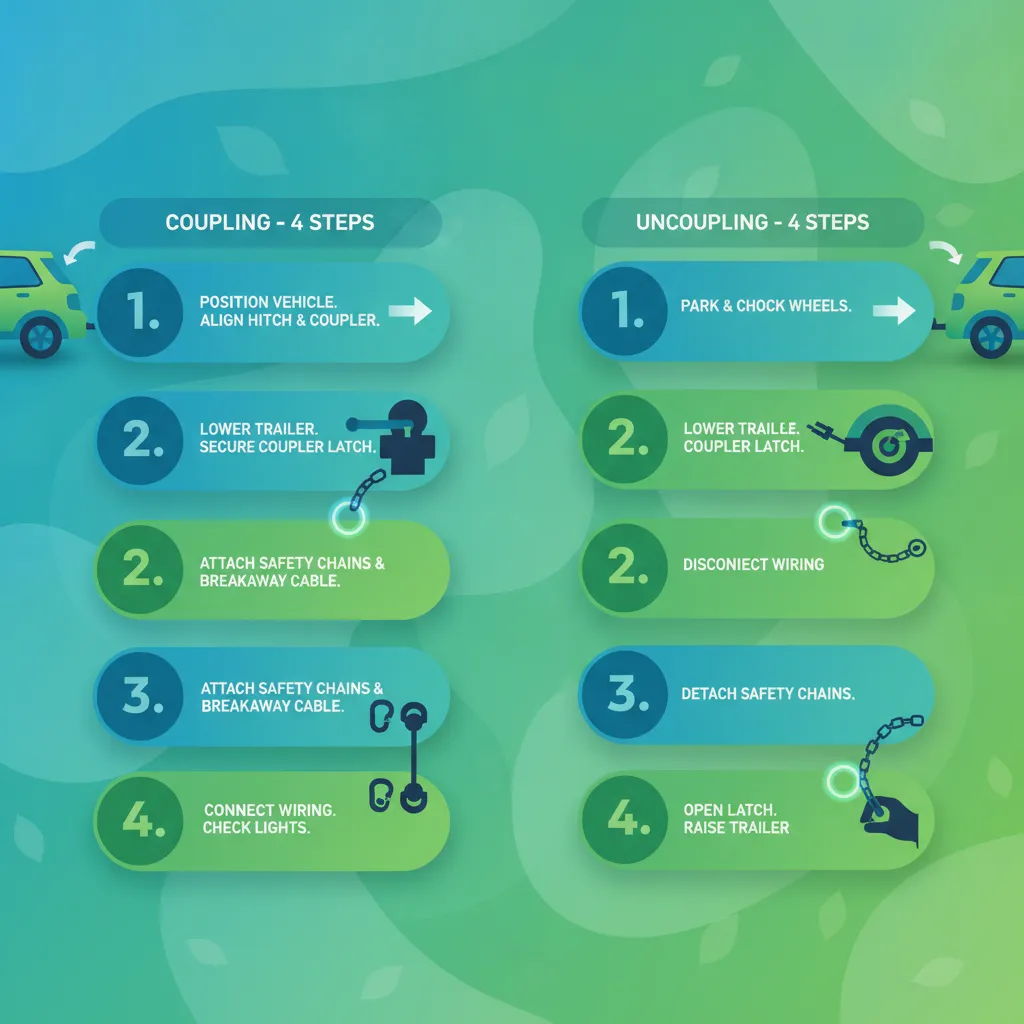
This lesson outlines the standard procedure for coupling and uncoupling trailers, emphasizing safety checks such as verifying the lock, hand brake, and brake connections. It discusses the importance of wheel chocks and correct alignment of the tow vehicle. The content includes a visual inspection checklist to ensure a secure connection.

This lesson delves into the critical control systems of a passenger vehicle: steering, braking, and acceleration. It explains the mechanics of hydraulic and pneumatic brakes and the function of safety aids like ABS and ESP. Learners will understand how to apply smooth acceleration and deceleration techniques to ensure passenger comfort and maintain vehicle stability under various driving conditions.

This lesson focuses on the risks of jackknifing and trailer swing, particularly during braking and on downhill descents. It provides recommendations for safe speed management, proper braking techniques, and maintaining vehicle stability. The content also addresses safe reversing practices and the importance of monitoring blind spots during maneuvers.

This lesson provides a method for calculating the braking distance of loaded vehicles, considering factors such as speed, load, and road conditions. It explains the formula for total stopping distance, including reaction time and braking distance components. The content highlights the importance of maintaining adequate safety margins for emergency braking.
This lesson explains the specific rules and limitations for towing trailers with a Category B license in Germany. It details how to calculate the permissible total weight of the car and trailer combination. The lesson also covers the practical aspects of safely coupling a trailer, checking its lights, and the changes in vehicle handling that drivers must adapt to when towing.
Explore the theory behind coupling and uncoupling trailers, understanding articulation dynamics, off-tracking, and how combinations behave on the road. Essential knowledge for German heavy vehicle theory tests.
This lesson outlines the standard procedure for coupling and uncoupling trailers, emphasizing safety checks such as verifying the lock, hand brake, and brake connections. It discusses the importance of wheel chocks and correct alignment of the tow vehicle. The content includes a visual inspection checklist to ensure a secure connection.

This lesson explains the dynamics of articulation between the tractor and trailer, focusing on the pivot point and its effect on the turning radius. It covers the phenomenon of off-tracking, where the trailer wheels follow a tighter path than the towing vehicle. The content also addresses the risks associated with trailer swing-out during cornering.
This lesson focuses on the risks of jackknifing and trailer swing, particularly during braking and on downhill descents. It provides recommendations for safe speed management, proper braking techniques, and maintaining vehicle stability. The content also addresses safe reversing practices and the importance of monitoring blind spots during maneuvers.
This lesson introduces the various types of trailers, including rigid trailers, low-loaders, and refrigerated units. It explains the different coupling devices, such as fifth wheel couplings and drawbars, and the importance of ensuring compatibility. The content also covers the function of safety latches and kingpin systems.
This lesson provides specialized instruction for drivers of D1E and DE category vehicles, which involve towing a trailer. It covers the physics of vehicle combinations, including the effects of the articulation point on turning and reversing. Learners will understand principles of split braking systems, proper load distribution to prevent trailer sway, and the additional safety checks required before operating such a combination.

This lesson provides a detailed overview of the German licence categories C1, C1E, C, and CE, explaining the specific vehicle weight limits associated with each class. It clarifies the legal definitions that differentiate rigid trucks from vehicle combinations. You will also learn about the required driver qualifications and the theoretical knowledge necessary for each category.
This lesson explains the specific rules and limitations for towing trailers with a Category B license in Germany. It details how to calculate the permissible total weight of the car and trailer combination. The lesson also covers the practical aspects of safely coupling a trailer, checking its lights, and the changes in vehicle handling that drivers must adapt to when towing.

This lesson examines the risks associated with load shifting during braking and cornering maneuvers. It explains how inertia and weight transfer can cause cargo to move, potentially leading to instability or loss of control. The content emphasizes the importance of proper load securing to mitigate these risks and maintain vehicle stability.

This lesson addresses the challenges of maneuvering heavy vehicles in confined spaces such as loading bays and narrow streets. It provides strategies for planning the maneuver, accounting for vehicle dimensions, turning radius, and blind spots. The content emphasizes slow, controlled movements and the need for high situational awareness.

This lesson covers the dimensional limits for heavy vehicles, focusing on height, width, and length restrictions. It explains how to interpret clearance signage for bridges, tunnels, and overhead obstacles, and discusses the implications for route planning. The content also addresses the importance of understanding turning radii and swept paths to avoid collisions.
Find clear answers to common questions learners have about Trailer Brake Systems and Electrical Connections. Learn how the lesson is structured, which driving theory objectives it supports, and how it fits into the overall learning path of units and curriculum progression in Germany. These explanations help you understand key concepts, lesson flow, and exam focused study goals.
The brake controller manages the distribution of braking force between the towing vehicle and the trailer. It ensures that the trailer brakes engage in synchronization with the truck, which is vital for maintaining stability and preventing jackknifing during emergency stops.
Trailer ABS prevents the trailer wheels from locking up during hard braking, which allows the driver to maintain steering control and directional stability. Without it, a trailer can easily skid sideways, causing the entire combination to become unstable.
Always ensure the plug is firmly seated and free from corrosion, dirt, or moisture. Damaged wires or poor contact can lead to intermittent brake light or signal failures, which are major safety hazards and will result in an immediate failure during a police inspection or practical test.
Brake lag is the slight delay between pressing the pedal and the actual application of the brakes on the trailer. Understanding this lag is crucial for maintaining safe following distances, as you must anticipate that the full stopping power of a heavy combination is not instantaneous.
Begin your targeted revision now. Use our practice search to quickly find specific German driving theory questions. Filter by StVO rules, road signs, or hazard perception to create your focused study plan. Master challenging areas and prepare confidently for your theoretical driving test.