
This lesson provides a critical guide to understanding the physical dimensions, clearance requirements, and operating limits of heavy goods vehicles. It is a foundational part of your training for categories C1, C1E, C, and CE, ensuring you are prepared to plan routes safely and avoid hazards related to vehicle size.

Lesson content overview
Operating a heavy vehicle on German roads requires a comprehensive understanding of its physical dimensions and the clearance limitations of the infrastructure. This lesson, part of your German Heavy Vehicle Driving License Theory – C1, C1E, C, CE course, is crucial for preventing accidents, avoiding damage to your vehicle and road infrastructure, and ensuring compliance with strict legal regulations. Mastering these concepts allows you to plan safe routes, maneuver effectively, and operate responsibly.
Properly assessing your vehicle's height, width, and length, alongside interpreting road signage, is fundamental. Misjudging these elements can lead to severe consequences, from minor damage to catastrophic collisions with bridges, tunnels, or other obstacles. We will explore the legal maximums, the critical importance of clearance signs, and the dynamics of vehicle turning behavior.
German road traffic regulations impose strict dimensional limits on heavy vehicles to ensure the safety and integrity of the road network and its users. These limits vary based on the vehicle type, whether it's a single unit or a combination (tractor with trailer/semi-trailer). Drivers must be fully aware of their vehicle's exact dimensions and understand how these compare to the legal maximums. Exceeding these limits without proper authorization is a serious offense.
The maximum permissible height for heavy vehicles in Germany, including any load, is generally 4.00 metres. This standard applies across most of the European road network and is a critical figure for all heavy vehicle drivers. Infrastructure such as bridges, tunnels, and overhead gantries are designed with this limit in mind.
However, it is vital to remember that individual structures may have lower actual clearances, which will be explicitly indicated by clearance signage. Drivers must never assume universal 4.00-metre clearance and must always check for posted signs. Snow accumulation on the road surface, especially in winter, can also temporarily reduce the effective clearance height beneath structures.
The standard maximum permissible width for heavy vehicles, including any load, is generally 2.55 metres. For refrigerated vehicles with walls thicker than 45 mm, a slightly increased width of 2.60 metres may be permitted. These limits are in place to ensure that vehicles can safely share road lanes, pass each other, and navigate through tunnels, underpasses, and urban environments without encroaching on adjacent lanes or sidewalks.
When driving, it is essential to consider the actual width of your vehicle and its load. Side mirrors can extend beyond the vehicle's body, and careful calculation is needed, especially in narrow passages or when passing other vehicles. Special attention must be paid to width restrictions posted on signs, particularly in urban areas or on roads designed for lighter traffic.
Length restrictions are more complex as they depend significantly on the vehicle configuration. For a single motor vehicle (e.g., a rigid truck), the maximum length is 12.00 metres. This limit ensures maneuverability, especially in urban settings and during turns.
For vehicle combinations, the limits are different:
Understanding these length limits is crucial for route planning, especially when navigating roundabouts, tight corners, or junctions where sufficient space is required to complete a turn without obstructing other traffic or hitting infrastructure.
Clearance signage provides critical information about the physical limits of the road ahead. Ignoring these signs can lead to severe accidents, significant infrastructure damage, and legal penalties. Drivers of heavy vehicles must be vigilant and precisely interpret these warnings.
Vertical clearance signs, identifiable by their red circle, white background, and black numerals indicating a height measurement (e.g., "4.0 m"), prohibit vehicles taller than the specified limit from passing. These signs are typically placed before bridges, tunnels, underpasses, or any overhead obstruction.
Drivers must always compare their vehicle's actual height (including any load) with the posted clearance. It is a mandatory rule that if your vehicle's height exceeds the indicated clearance, you must choose an alternative route. Attempting to pass is illegal and highly dangerous.
Always factor in a safety margin. Snow, ice, or uneven road surfaces can reduce effective clearance. Be conservative with your height assessment, especially if the posted limit is close to your vehicle's actual height.
Horizontal clearance signs, similar in appearance to height signs but showing a width measurement (e.g., "2.5 m"), indicate the maximum width allowed for vehicles to pass. These are typically found in narrow passages, archways, or certain lanes. While less common for general road widths, they are critical in specific restrictive environments.
These signs are particularly relevant when navigating construction zones, old town centers, or temporary lane reductions where the available width is constrained. Drivers must consider their vehicle's full width, including mirrors and any protruding load, against the posted limit.
Before embarking on any journey, especially with a new vehicle or an unusual load, it is imperative to know your vehicle's exact dimensions. This includes:
Relying on manufacturer specifications alone might not be sufficient if modifications or specialized loads are involved. Physical measurement is the most reliable method.
Heavy vehicles, due to their size and configuration, have significantly different turning characteristics compared to passenger cars. Understanding the concepts of turning radius and swept path is essential for safe maneuvering, especially in confined spaces, at junctions, or within urban areas.
The turning radius refers to the smallest circular path a vehicle can make. For heavy vehicles, two main radii are important:
Heavy vehicle drivers must be aware that the turning radius is substantial, requiring ample space for turns. Attempting to turn in too small a radius can lead to collisions with curbs, road furniture, or other vehicles. The longer the wheelbase or the overall length of a combination, the larger the turning radius required.
The swept path is the total area covered by a vehicle from its outermost points (front, rear, and sides) during a turning maneuver. This includes not only the wheels but also the entire body of the vehicle, particularly the rear overhang of rigid trucks and the trailer's swing-out in combinations.
A critical aspect of the swept path is rear swing-out (or cut-in). When a long vehicle turns, the rear portion of the vehicle or trailer can swing significantly outwards or cut inwards relative to the front wheels.
Failing to account for the swept path is a common cause of accidents, such as hitting streetlights, traffic signs, other vehicles, or even pedestrians during turns. This emphasizes the need for wide turns, careful mirror usage, and potentially stopping traffic to ensure a clear path.
In urban environments, heavy vehicle drivers frequently encounter situations where turning radii and swept paths become critical. Roundabouts, narrow street corners, and loading docks demand precise maneuvering. Drivers must:
Effective route planning is not just about finding the shortest path; for heavy vehicle drivers, it's about finding the safest and most compliant path that accommodates the vehicle's dimensions. Ignoring this step can lead to significant delays, damages, and legal repercussions.
The primary goal of route planning related to dimensions is to avoid encountering structures with insufficient clearance. This means identifying and circumventing:
Modern navigation technology has greatly improved this process, but drivers must understand the underlying principles and verify information.
Standard consumer GPS devices are often inadequate for heavy vehicles as they do not factor in height, width, length, or weight restrictions. Professional heavy vehicle navigation systems are specifically designed to:
Even with specialized systems, drivers should exercise caution. Maps may not always be up-to-date, especially concerning temporary restrictions or construction. Cross-referencing with official road maps, local knowledge, and on-site signage is always recommended.
Before every journey, especially into unfamiliar territory, drivers should conduct a thorough pre-trip check and risk assessment:
Adherence to dimensional limits and clearance rules is enshrined in German traffic law (Straßenverkehrs-Ordnung - StVO) and other relevant regulations. Non-compliance is not merely unsafe; it carries significant legal consequences.
Drivers are legally obligated to operate vehicles that comply with the maximum dimensions specified for their vehicle class in Germany. Furthermore, all posted clearance signs are mandatory and must be obeyed without exception.
Violations can lead to:
Sometimes, transport needs dictate that a vehicle or its load must exceed standard dimensional limits (e.g., transporting large machinery). In such cases, special permits (Ausnahmegenehmigungen) are required. These permits are issued by the relevant authorities (e.g., Straßenverkehrsbehörde) and specify:
Operating an oversized vehicle without a valid permit, or deviating from the permit's conditions, constitutes a serious legal offense with severe penalties.
The risks associated with not adhering to vehicle dimensions and clearance requirements are manifold and can be severe. Understanding these potential outcomes reinforces the importance of diligence.
Beyond the basic rules, several conditional factors require heavy vehicle drivers to adapt their approach to dimensions and clearance.
The nature of the load can significantly impact a vehicle's effective dimensions:
The greater dimensions and swept path of heavy vehicles pose a particular risk to vulnerable road users (pedestrians, cyclists, motorcyclists).
When turning in urban areas, always assume pedestrians or cyclists might be present, even if not immediately visible. Use your mirrors, look around, and proceed slowly and deliberately.
This lesson covers the legal dimensional limits for heavy vehicles in Germany and their practical application for safe driving. Key limits include 4.00m height, 2.55m width, and specific lengths up to 18.75m for combinations. Understanding clearance signage (signs 265 and 264) is mandatory for avoiding collisions with bridges and tunnels. The concepts of turning radius and swept path, including rear swing-out and cut-in, are critical for maneuvering safely, particularly in urban environments. Effective route planning requires specialized navigation systems and pre-trip verification of vehicle dimensions against posted restrictions.
A short set of high-value points that capture the most important learning from this lesson.
Heavy vehicles in Germany are legally limited to 4.00m height, 2.55m width (2.60m for refrigerated), 12.00m single length, 16.50m articulated, and 18.75m drawbar combinations.
Road sign 265 restricts vehicles exceeding the stated height; sign 264 restricts vehicles exceeding stated width—both must be strictly obeyed or alternative routes taken.
The swept path is the total area a vehicle occupies during a turn, including rear swing-out (opposite to turn direction) and rear cut-in (tighter path of rear wheels), requiring extra space and mirror monitoring.
Standard GPS systems do not account for vehicle dimensions; specialized heavy vehicle navigation with manual dimension input is essential for route planning.
Drivers must physically verify vehicle dimensions before each trip, including mirrors and load, not relying solely on manufacturer specifications.
Explore all units and lessons included in this driving theory course.
Maximum height is 4.00m but individual structures may have lower clearances always check posted signs.
Snow or ice on road surfaces can reduce effective clearance height beneath structures.
Rear cut-in means the trailer's rear wheels follow a tighter path than the front wheels during turns, especially in articulated vehicles.
Special permits (Ausnahmegenehmigungen) are required for any transport exceeding standard dimensional limits.
Violations can result in fines, Flensburg points, driving bans, and full liability for infrastructure damage.
Assuming a 4.00m vehicle height guarantee will clear all structures without checking individual clearance signs.
Not accounting for rear cut-in when turning right, causing the trailer to swing into the curb or adjacent lane.
Using standard consumer GPS instead of specialized heavy vehicle navigation that factors in dimensions.
Neglecting to measure actual vehicle width including extended side mirrors and any load overhang.
Attempting turns in tight urban areas without positioning the vehicle wide enough to accommodate the swept path.
Lesson content overview
A short set of high-value points that capture the most important learning from this lesson.
Heavy vehicles in Germany are legally limited to 4.00m height, 2.55m width (2.60m for refrigerated), 12.00m single length, 16.50m articulated, and 18.75m drawbar combinations.
Road sign 265 restricts vehicles exceeding the stated height; sign 264 restricts vehicles exceeding stated width—both must be strictly obeyed or alternative routes taken.
The swept path is the total area a vehicle occupies during a turn, including rear swing-out (opposite to turn direction) and rear cut-in (tighter path of rear wheels), requiring extra space and mirror monitoring.
Standard GPS systems do not account for vehicle dimensions; specialized heavy vehicle navigation with manual dimension input is essential for route planning.
Drivers must physically verify vehicle dimensions before each trip, including mirrors and load, not relying solely on manufacturer specifications.
Explore all units and lessons included in this driving theory course.
Maximum height is 4.00m but individual structures may have lower clearances always check posted signs.
Snow or ice on road surfaces can reduce effective clearance height beneath structures.
Rear cut-in means the trailer's rear wheels follow a tighter path than the front wheels during turns, especially in articulated vehicles.
Special permits (Ausnahmegenehmigungen) are required for any transport exceeding standard dimensional limits.
Violations can result in fines, Flensburg points, driving bans, and full liability for infrastructure damage.
Assuming a 4.00m vehicle height guarantee will clear all structures without checking individual clearance signs.
Not accounting for rear cut-in when turning right, causing the trailer to swing into the curb or adjacent lane.
Using standard consumer GPS instead of specialized heavy vehicle navigation that factors in dimensions.
Neglecting to measure actual vehicle width including extended side mirrors and any load overhang.
Attempting turns in tight urban areas without positioning the vehicle wide enough to accommodate the swept path.
Explore search topics learners often look for when studying Vehicle Dimensions and Clearance Requirements. These topics reflect common questions about road rules, driving situations, safety guidance, and lesson level theory preparation for learners in Germany.
Browse additional driving theory lessons that cover connected traffic rules, road signs, and common driving situations related to this topic. Improve your understanding of how different rules interact across everyday traffic scenarios.
Learn how to plan routes for heavy vehicles, specifically considering vehicle dimensions, clearance requirements for bridges and tunnels, and German road law. This lesson explores practical applications of dimension limits in route selection.
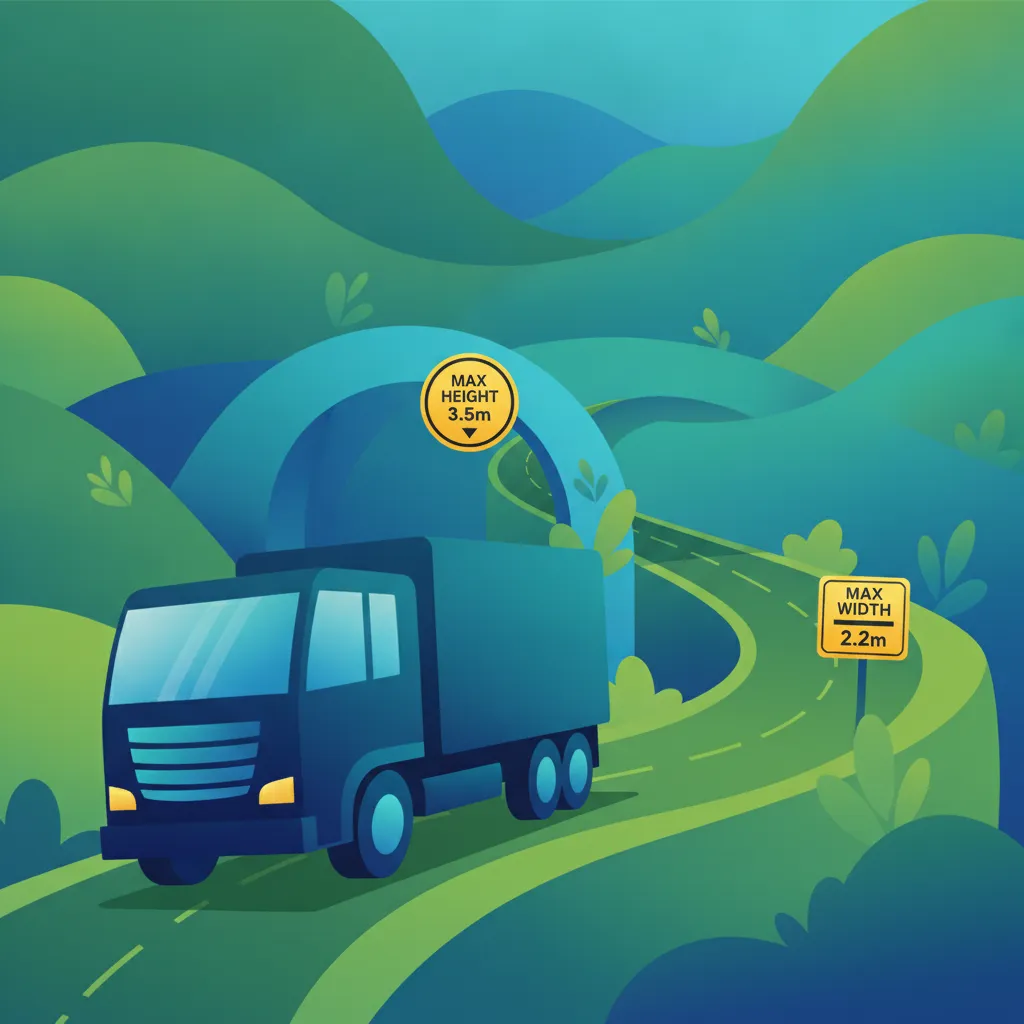
This lesson focuses on the importance of thorough route planning for heavy vehicles, taking into account dimensional and weight limits. It discusses how to use mapping tools and road signage to identify bridges, tunnels, and roads with restrictions. The content also covers how to plan alternative routes to avoid impassable areas.
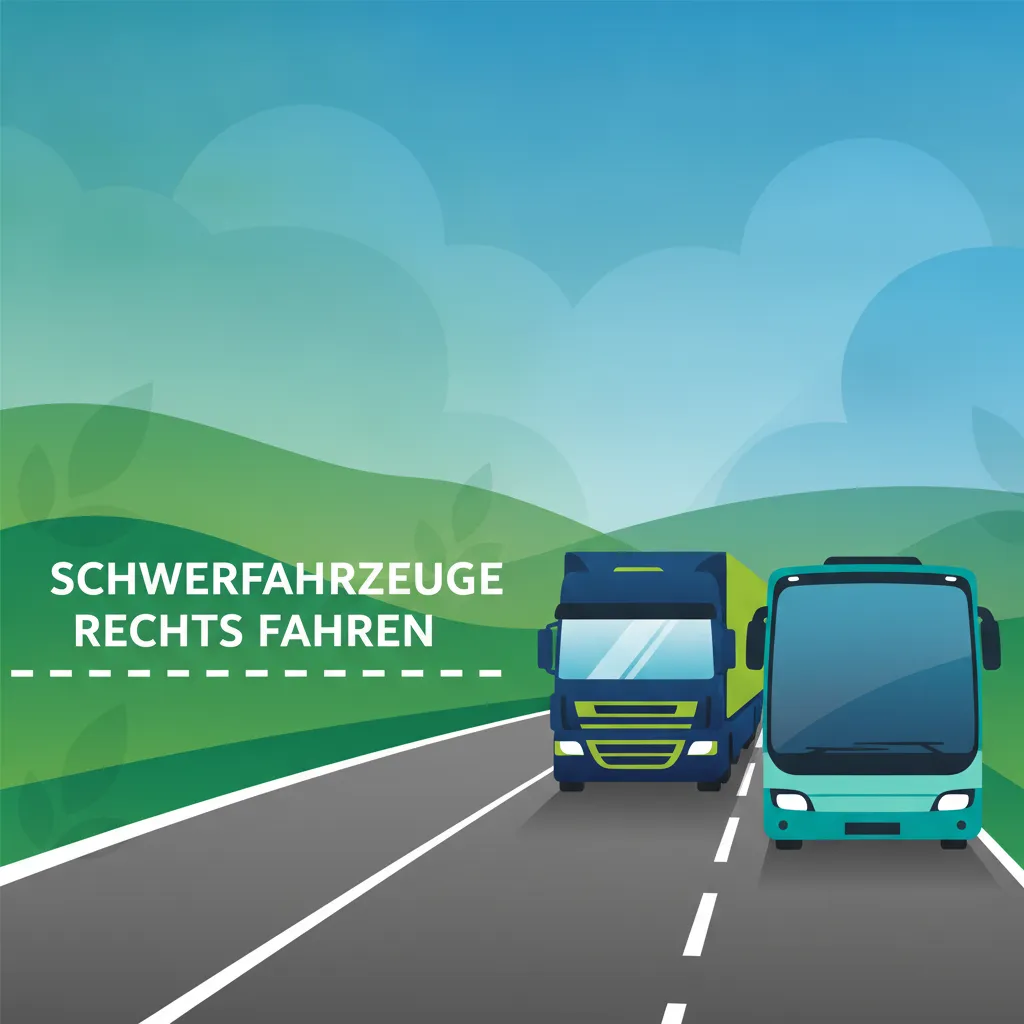
This lesson explains the specific regulations for operating heavy vehicles on Autobahnen, including speed limits, lane discipline, and overtaking rules. It discusses the use of dedicated truck lanes and the importance of maintaining appropriate following distances. The content also covers procedures for merging and exiting high-speed roads safely.
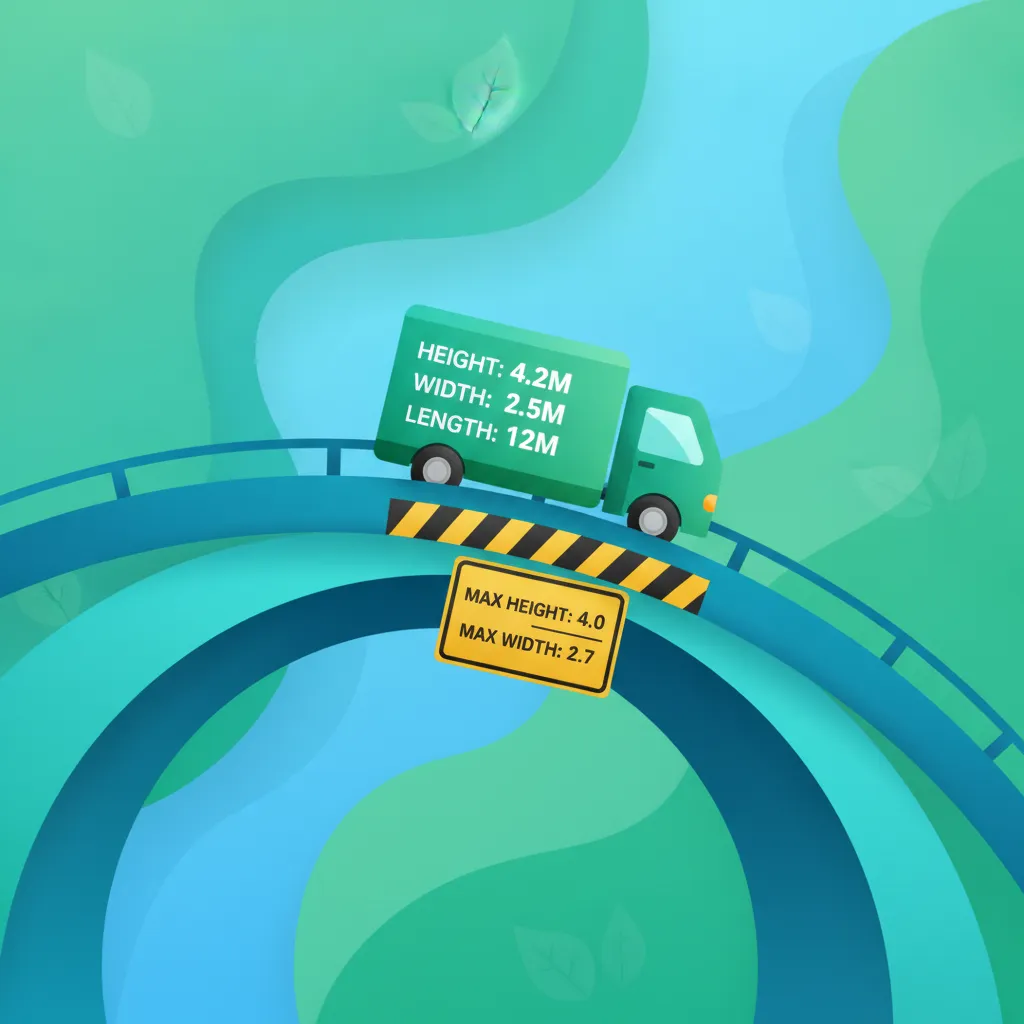
This lesson examines the specific height, width, and length constraints that affect heavy vehicle operation, including bridge and tunnel clearances. It discusses how to interpret and comply with traffic signs indicating dimensional limits and the consequences of violating these restrictions. The content also covers practical strategies for route planning to avoid restricted areas.
This lesson covers the principles of effective route planning and the practical skills for navigating different types of junctions. It provides guidance on using navigation aids and understanding the specific challenges large vehicles face at roundabouts and complex intersections. Emphasis is placed on correct lane selection and positioning well in advance of a turn to execute the maneuver safely and without impeding other traffic.

This lesson focuses on the logistical and safety aspects of planning long-distance passenger services. It covers the legal requirements for driving hours and rest periods, which are monitored by a tachograph. Learners will understand the importance of proactive fatigue management, scheduling regular breaks, and planning routes that include appropriate rest stops to ensure both driver alertness and passenger comfort throughout the journey.

This lesson examines the direct impact of a passenger vehicle's dimensions on its operation. It explains key concepts such as turning radius, swept path, and rear overhang, which are crucial for safe maneuvering in confined areas. Learners will understand how to account for these characteristics when positioning the vehicle in a lane, making turns, and navigating challenging urban environments to avoid collisions.

This lesson addresses the challenges of maneuvering heavy vehicles in confined spaces such as loading bays and narrow streets. It provides strategies for planning the maneuver, accounting for vehicle dimensions, turning radius, and blind spots. The content emphasizes slow, controlled movements and the need for high situational awareness.

This lesson focuses on the safe passage of heavy vehicles through tunnels and over bridges, with an emphasis on clearance checks. It explains how to interpret height restriction signs and assess whether the vehicle's load complies with limits. The content also covers appropriate speed control and emergency procedures specific to these structures.

This lesson examines the dynamics of delivery traffic within urban areas and industrial estates, focusing on right-of-way rules and loading zone usage. It discusses the importance of adhering to delivery windows and managing traffic flow to minimize congestion. The content also highlights the challenges of navigating narrow aisles and loading docks.
Explore the critical concepts of turning radii and swept paths for heavy vehicles. This lesson explains how to safely navigate turns, avoid collisions, and understand the physics of maneuvering large trucks in various traffic situations.

This lesson examines the concepts of turning radius and swept path, explaining how a heavy vehicle's size influences the space required for a turn. It highlights the importance of maintaining proper lane positioning to accommodate the vehicle's dimensions. The content provides guidance on planning maneuvers and accounting for off-tracking during cornering.
This lesson examines the direct impact of a passenger vehicle's dimensions on its operation. It explains key concepts such as turning radius, swept path, and rear overhang, which are crucial for safe maneuvering in confined areas. Learners will understand how to account for these characteristics when positioning the vehicle in a lane, making turns, and navigating challenging urban environments to avoid collisions.

This lesson provides a step-by-step guide to executing turns safely at intersections and other locations. It details the full observation sequence (mirrors, signal, blind spot check) required before initiating a turn. The lesson covers correct lane positioning for both left and right turns and explains the rules for performing U-turns or three-point turns where permitted.

This lesson teaches the fundamental techniques for safely turning a large passenger vehicle. It explains the concepts of turning radius, swept path, and off-tracking, where the rear wheels follow a tighter path than the front wheels. Learners will understand how to position the vehicle correctly before a turn and manage their speed to navigate corners without encroaching on other lanes or hitting curbs.

This lesson details the correct procedure for executing left turns, right turns, and U-turns. It emphasizes the importance of proper signaling, correct lane positioning before the turn, and managing speed throughout the maneuver. The content also covers fundamental cornering techniques to maintain stability and control.
This lesson addresses the challenges of maneuvering heavy vehicles in confined spaces such as loading bays and narrow streets. It provides strategies for planning the maneuver, accounting for vehicle dimensions, turning radius, and blind spots. The content emphasizes slow, controlled movements and the need for high situational awareness.

This lesson focuses on the interaction between heavy vehicles and vulnerable road users at crossings, particularly when turning right. It covers the need for heightened vigilance, the importance of properly using mirrors, and correct signaling to alert others. The content highlights legal responsibilities and safe distance requirements to prevent accidents.
This lesson covers safe reversing techniques for both rigid trucks and articulated combinations, emphasizing the use of mirrors and cameras. It discusses the risks of jackknifing during reversal and the importance of speed control and safety checks. The content outlines best practices for planning a safe reversing path, potentially with a guide person.

This lesson focuses on the right-of-way rules that heavy vehicles must follow when interacting with cyclists and pedestrians, particularly at intersections and crossings. It emphasizes the need for trucks to yield appropriately and maintain safe distances. The content also covers the interpretation of traffic signs governing priority in urban areas.
This lesson explains the specific regulations for operating heavy vehicles on Autobahnen, including speed limits, lane discipline, and overtaking rules. It discusses the use of dedicated truck lanes and the importance of maintaining appropriate following distances. The content also covers procedures for merging and exiting high-speed roads safely.
Find clear answers to common questions learners have about Vehicle Dimensions and Clearance Requirements. Learn how the lesson is structured, which driving theory objectives it supports, and how it fits into the overall learning path of units and curriculum progression in Germany. These explanations help you understand key concepts, lesson flow, and exam focused study goals.
Generally, the maximum height for heavy vehicles is 4 meters. However, always verify current regulations and check for specific signage on your intended route, as many bridges have lower limits.
Heavy vehicles do not turn like passenger cars; the rear wheels track inside the front wheels' path. Knowing this is vital to avoid striking curbs, pedestrians, or street furniture during turns.
No, you should never rely on exact measurements. It is professional practice to allow for a safety margin due to road surface variations, vehicle suspension movement, or potential inaccuracies in sign marking.
Improperly secured loads or heavy items on the roof can increase the effective height or width of your vehicle. Always perform a pre-drive check to confirm your actual dimensions after loading.
Begin your targeted revision now. Use our practice search to quickly find specific German driving theory questions. Filter by StVO rules, road signs, or hazard perception to create your focused study plan. Master challenging areas and prepare confidently for your theoretical driving test.