
This lesson explores how inertial forces impact heavy vehicles, specifically focusing on the dangers of unsecured cargo during braking and cornering maneuvers. You will learn how to maintain vehicle stability and why load shifting is a critical safety issue for professional drivers operating under German regulations.

Lesson content overview
Operating heavy vehicles, such as those covered by the German Heavy Vehicle Driving License Theory for categories C1, C1E, C, and CE, demands a comprehensive understanding of vehicle dynamics, especially concerning cargo. One of the most critical aspects of safe heavy vehicle operation is managing the risks associated with load shifting during dynamic manoeuvres like braking and cornering. This lesson delves into why cargo moves, the dangers it poses, and how proper load securing is paramount for preventing accidents and ensuring overall road safety.
Load shifting refers to the movement of cargo within a vehicle's cargo space relative to its chassis during driving. This phenomenon is governed by fundamental physics principles, primarily inertia and weight transfer, which significantly influence how a vehicle responds to driver inputs and external forces. Understanding these principles is crucial for predicting and preventing dangerous situations caused by unsecured loads.
In the context of vehicle operation, inertia explains why unsecured cargo becomes a hazard. When a heavy vehicle brakes suddenly, the vehicle itself decelerates, but the cargo, due to its inertia, tends to continue moving forward at the original speed. Similarly, during a sharp turn, the vehicle changes direction, but the cargo's inertia causes it to resist this change and attempt to continue in a straight line, pushing outwards against the vehicle's side.
If not adequately restrained, this inertial force can cause cargo to slide, tip, or even spill out of the vehicle. The consequences can range from minor damage to the cargo and vehicle to severe accidents involving loss of control, rollovers, or collisions with other road users.
Weight transfer is a dynamic process that constantly redistributes the load bearing down on each axle and wheel as a vehicle moves.
Unsecured cargo exacerbates weight transfer. If cargo slides forward during braking, it further increases the load on the front axle and simultaneously reduces the load on the rear axle, potentially leading to a dangerous loss of rear-wheel traction and steering stability. During cornering, lateral cargo movement adds to the lateral weight transfer, intensifying the forces acting to destabilize the vehicle.
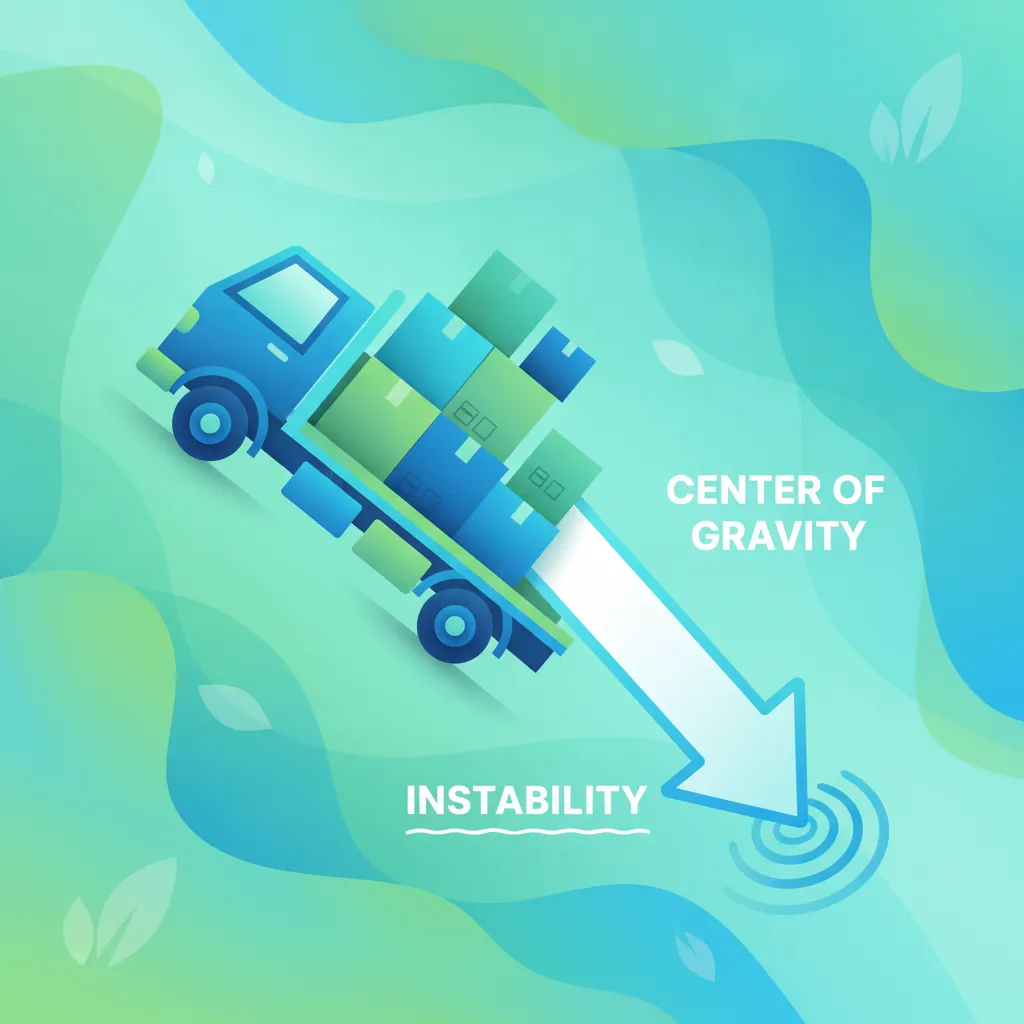
The centre of gravity (CG) is the hypothetical point where the entire weight of the vehicle and its cargo is concentrated. The position of the CG is a crucial determinant of vehicle stability. A higher CG increases the risk of rollover, while an off-centre CG can lead to unpredictable handling.
While a vehicle's static weight distribution is determined by how it is loaded when stationary, dynamic forces constantly alter this distribution. When cargo shifts, it effectively moves the vehicle's CG. This dynamic shift can be far more dangerous than the static CG. For example, if a heavy load slides forward during braking, the CG moves forward and downward, potentially causing the rear of the vehicle to become dangerously light. If a load shifts laterally during a turn, the CG moves towards the outside of the turn, significantly increasing the rollover risk. Maintaining a stable, predictable CG through proper load securing is therefore fundamental to safe heavy vehicle operation.
The failure to properly secure cargo can lead to a cascade of dangerous events, compromising vehicle stability, increasing accident risk, and endangering the driver and other road users.
During braking, especially emergency braking, unsecured loads will tend to surge forward. This longitudinal shift has several severe consequences:
Cornering introduces lateral forces that cause unsecured cargo to shift sideways. The implications of this lateral shift are equally hazardous:
The centre of gravity (CG) is the single most important factor determining a vehicle's stability. For heavy vehicles, improper loading can drastically alter the CG:
Any shift in the CG, whether longitudinal or lateral, compromises the vehicle's predictability and stability, demanding greater skill and caution from the driver to prevent an incident.
Rollover is one of the most dangerous types of accidents involving heavy vehicles, often resulting in severe injuries, fatalities, and extensive property damage. Load shifting is a primary contributor to rollover risk.
Beyond direct instability, load shifting critically impairs a vehicle's fundamental control capabilities:
The primary goal of load securing is to prevent any movement of cargo relative to the vehicle, thereby maintaining the vehicle's intended centre of gravity and stability throughout the journey. This requires a combination of techniques and appropriate equipment.
Effective load securing must counteract forces in all directions:
Restraints are flexible devices used to hold cargo in place by applying tension.
It is critical to use enough restraints with adequate strength for the weight and type of cargo, ensuring they are correctly tensioned and attached to certified anchoring points. Using only one strap for a heavy load is almost always insufficient.
Blocking involves creating rigid barriers to prevent cargo movement.
Restraints are only as strong as their anchoring points. Heavy vehicles are equipped with certified lashing points, often complying with standards like DIN EN 12640. Drivers must:
In Germany, the legal framework for road traffic, particularly the Straßenverkehrs-Ordnung (StVO), mandates strict adherence to load securing principles. These regulations are designed to protect all road users from the dangers posed by shifting or falling cargo.
According to German road traffic law, particularly § 95 and § 96 of the StVO, drivers and vehicle owners are legally responsible for ensuring that loads are properly secured. Key aspects include:
The rationale behind these regulations is clear: to prevent cargo from becoming a hazard to vehicle stability, other road users, and the environment. Non-compliance can lead to severe penalties, including fines, points on the driver's license, and even criminal charges in the event of an accident.
Proper load securing means using methods and equipment that are appropriate for the type, weight, and dimensions of the cargo, and the vehicle in question. This involves:
Despite clear regulations and established best practices, load shifting incidents still occur due to common errors and misunderstandings.
A frequent mistake is the belief that load securing is less critical for short journeys or at low speeds. This is incorrect. Even at moderate speeds, sudden braking to avoid a pedestrian or an unexpected sharp turn can generate significant inertial forces, causing unsecured cargo to shift dramatically. The legal requirement for securing loads applies to all journeys, regardless of distance or anticipated speed.
Several external factors can exacerbate the risks of load shifting, making proper securing even more critical.
Wet or icy road surfaces significantly reduce the friction between tyres and the road, as well as between the cargo and the load bed (if not using anti-slip mats).
On high-speed roads like the German Autobahnen, the forces generated during even slight braking or lane changes are much greater than at lower speeds.
The condition of the vehicle itself plays a role in how it handles dynamic forces:
Sudden braking or evasive manoeuvres are often required to avoid vulnerable road users such as pedestrians, cyclists, or motorcyclists. In such situations, the added complication of shifting cargo can turn a potentially avoidable incident into a severe accident, as the driver loses crucial control over the vehicle.
Understanding the risks of load shifting during braking and cornering is fundamental for all heavy vehicle drivers in Germany, particularly for those pursuing categories C1, C1E, C, and CE. The principles of inertia, weight transfer, and the dynamic centre of gravity are not just theoretical concepts; they are daily realities that dictate a vehicle's behaviour on the road.
Proper load securing, through a combination of appropriate restraints, blocking, and careful load placement, is not merely a legal obligation under the StVO, but a critical safety measure. It directly prevents dangerous shifts in the vehicle's centre of gravity, maintains stable weight distribution, preserves braking efficiency, and ultimately, helps avoid loss of control and potential rollovers. By diligently applying these principles, professional drivers contribute significantly to their own safety and the safety of everyone on the road.
This lesson explains how inertia and weight transfer cause cargo to shift during braking and cornering, moving the vehicle's centre of gravity and compromising stability. During braking, unsecured loads surge forward reducing rear traction and increasing stopping distances; during cornering, lateral cargo movement raises and shifts the centre of gravity toward the outside of the turn, dramatically increasing rollover risk. Proper load securing through a combination of restraints (straps, chains), blocking (bulkheads, chocks, dunnage), and correct load placement (low and centrally) is both a legal requirement under German StVO and essential for preventing loss of control, rollovers, and accidents involving other road users.
A short set of high-value points that capture the most important learning from this lesson.
Inertia causes unsecured cargo to continue moving forward during braking and sideways during cornering, independent of vehicle direction.
Load shifting moves the vehicle's centre of gravity, which is the primary factor determining rollover risk and stability.
During braking, weight transfers forward increasing front axle load while reducing rear axle load, potentially causing rear-wheel skidding.
During cornering, lateral weight transfer combined with cargo movement toward the outside of the turn creates a lever effect that dramatically increases rollover susceptibility.
Proper load securing must counteract forces in all directions: forward, rearward, lateral, and vertical.
Explore all units and lessons included in this driving theory course.
Heavy cargo must always be placed as low and centrally as possible to minimize centre of gravity elevation.
Vehicle side walls (especially on curtain-siders) are designed for weather protection, not for withstanding heavy load forces.
Using a single strap or chain for heavy loads is almost always insufficient; multiple securing points with adequate lashing capacity are required.
Load securing requirements apply to all journeys regardless of distance or anticipated speed.
Drivers and vehicle owners share legal responsibility for proper load securing under German StVO regulations.
Assuming load securing is less critical on short journeys or at low speeds, when even moderate braking can generate sufficient force to shift unsecured cargo.
Relying solely on vehicle side walls or container walls to block heavy loads, which are not designed to withstand significant lateral forces.
Using insufficient or incorrectly tensioned restraints, including loose, twisted, or improperly routed straps that reduce effectiveness.
Placing heavy items high in the cargo space, which raises the centre of gravity and significantly increases rollover risk.
Neglecting anti-slip mats and not filling gaps between cargo, which reduces the efficiency of mechanical securing methods.
Lesson content overview
A short set of high-value points that capture the most important learning from this lesson.
Inertia causes unsecured cargo to continue moving forward during braking and sideways during cornering, independent of vehicle direction.
Load shifting moves the vehicle's centre of gravity, which is the primary factor determining rollover risk and stability.
During braking, weight transfers forward increasing front axle load while reducing rear axle load, potentially causing rear-wheel skidding.
During cornering, lateral weight transfer combined with cargo movement toward the outside of the turn creates a lever effect that dramatically increases rollover susceptibility.
Proper load securing must counteract forces in all directions: forward, rearward, lateral, and vertical.
Explore all units and lessons included in this driving theory course.
Heavy cargo must always be placed as low and centrally as possible to minimize centre of gravity elevation.
Vehicle side walls (especially on curtain-siders) are designed for weather protection, not for withstanding heavy load forces.
Using a single strap or chain for heavy loads is almost always insufficient; multiple securing points with adequate lashing capacity are required.
Load securing requirements apply to all journeys regardless of distance or anticipated speed.
Drivers and vehicle owners share legal responsibility for proper load securing under German StVO regulations.
Assuming load securing is less critical on short journeys or at low speeds, when even moderate braking can generate sufficient force to shift unsecured cargo.
Relying solely on vehicle side walls or container walls to block heavy loads, which are not designed to withstand significant lateral forces.
Using insufficient or incorrectly tensioned restraints, including loose, twisted, or improperly routed straps that reduce effectiveness.
Placing heavy items high in the cargo space, which raises the centre of gravity and significantly increases rollover risk.
Neglecting anti-slip mats and not filling gaps between cargo, which reduces the efficiency of mechanical securing methods.
Explore search topics learners often look for when studying Risks of Load Shifting during Braking and Cornering. These topics reflect common questions about road rules, driving situations, safety guidance, and lesson level theory preparation for learners in Germany.
Browse additional driving theory lessons that cover connected traffic rules, road signs, and common driving situations related to this topic. Improve your understanding of how different rules interact across everyday traffic scenarios.
Explore the physics behind load shifting in German heavy vehicles. Understand how inertia and weight transfer during braking and cornering impact vehicle stability, directly relating to C class license theory. Learn about the forces that cause instability and loss of control.

This lesson focuses on the critical relationship between load distribution, the center of gravity, and vehicle stability. It explains how the placement of passengers and luggage can raise the center of gravity, increasing the risk of rollover during turns or sudden maneuvers. Learners will understand how to manage loading within legal weight limits to maintain optimal handling, braking performance, and overall safety.
This lesson introduces the principles of load distribution and the impact of the centre of gravity on vehicle stability. It explains how cargo placement influences axle loads and the overall balance of the vehicle. The content emphasizes the importance of maintaining a low centre of gravity to reduce rollover risk.

This lesson focuses on vehicle stability and the risks of rollover, particularly for vehicles with a high centre of gravity. It discusses how load placement, speed, and cornering affect rollover risk. The content outlines countermeasures such as speed reduction, load lowering, and the use of anti-roll devices.

This lesson explains the dynamics of articulation between the tractor and trailer, focusing on the pivot point and its effect on the turning radius. It covers the phenomenon of off-tracking, where the trailer wheels follow a tighter path than the towing vehicle. The content also addresses the risks associated with trailer swing-out during cornering.

This lesson examines the concepts of turning radius and swept path, explaining how a heavy vehicle's size influences the space required for a turn. It highlights the importance of maintaining proper lane positioning to accommodate the vehicle's dimensions. The content provides guidance on planning maneuvers and accounting for off-tracking during cornering.

This lesson contrasts the dynamic and operational characteristics of heavy vehicles with those of passenger cars. It explains how greater mass and inertia influence braking distance, turning radius, and vehicle stability. The content also addresses visibility challenges, the impact of load on handling, and the necessity for different driving strategies.

This lesson focuses on the risks of jackknifing and trailer swing, particularly during braking and on downhill descents. It provides recommendations for safe speed management, proper braking techniques, and maintaining vehicle stability. The content also addresses safe reversing practices and the importance of monitoring blind spots during maneuvers.

This lesson provides a method for calculating the braking distance of loaded vehicles, considering factors such as speed, load, and road conditions. It explains the formula for total stopping distance, including reaction time and braking distance components. The content highlights the importance of maintaining adequate safety margins for emergency braking.
Understand the severe consequences of inadequate load securing for German heavy vehicle drivers. This lesson covers the legal implications and risks of cargo shifting during braking and cornering, crucial for C and CE license theory exams.

This lesson explains the legal and safety requirements for transporting goods and cargo. It covers the importance of proper load distribution to maintain vehicle stability and the methods for securely fastening items to prevent them from shifting or falling. The regulations concerning maximum vehicle weight, roof loads, and the correct marking of loads that overhang the vehicle are also detailed.

This lesson outlines the legal requirements for load securing according to German traffic law (StVO) and other relevant regulations. It details the obligations for cargo safety, inspection, and documentation. The content also explains the penalties for non-compliance, emphasizing adherence to legal standards to ensure safety.

This lesson covers the various methods and equipment used to secure loads, including friction, blocking, and lashing techniques. It describes the proper use of tie-down straps, cargo nets, load bars, and other securing devices. The content also explains how to achieve sufficient tension and use secure fastening points.

This lesson examines best practices for loading and unloading heavy vehicles at delivery points, including proper vehicle positioning and coordination with ground personnel. It emphasizes the importance of verifying load stability during unloading to prevent accidents. The content also discusses time-window management and safety protocols for loading docks.

This lesson focuses on the distribution of loads across axle groups and the legal limits for axle loads. It explains the importance of correct weight distribution to avoid axle overloading, which can lead to road damage and safety hazards. The content also covers methods for measuring axle loads and the legal requirements for maintaining proper axle load limits.
This lesson introduces the principles of load distribution and the impact of the centre of gravity on vehicle stability. It explains how cargo placement influences axle loads and the overall balance of the vehicle. The content emphasizes the importance of maintaining a low centre of gravity to reduce rollover risk.
Find clear answers to common questions learners have about Risks of Load Shifting during Braking and Cornering. Learn how the lesson is structured, which driving theory objectives it supports, and how it fits into the overall learning path of units and curriculum progression in Germany. These explanations help you understand key concepts, lesson flow, and exam focused study goals.
A high centre of gravity significantly increases the risk of rollover when cornering. As the load shifts, the vehicle's balance changes, making it harder to steer or stop, which is a frequent topic in the C/CE theory exam.
During braking, kinetic energy causes unsecured or poorly secured cargo to shift towards the front of the vehicle. This forward movement can damage the cab or alter the braking distribution, leading to a loss of control.
No, vehicle combinations with trailers or semitrailers are more susceptible to load-related instability during cornering due to articulation dynamics. Understanding these forces is crucial for safely maneuvering combinations in urban and motorway traffic.
A shifting load creates unpredictable handling, often causing the vehicle to pull or swing in the direction of the shift. This can lead to jackknifing or unexpected lane departure, posing a major risk to other road users.
Begin your targeted revision now. Use our practice search to quickly find specific German driving theory questions. Filter by StVO rules, road signs, or hazard perception to create your focused study plan. Master challenging areas and prepare confidently for your theoretical driving test.