
This lesson details the legal requirements and practical safety protocols for towing trailers under a German Class B license. You will learn how to calculate permissible weights and master the essential skills for coupling and driving with a trailer, ensuring you are fully prepared for related questions on your theoretical exam.
Lesson content overview
Operating a vehicle that is towing a trailer introduces a new layer of complexity and responsibility for any driver. This lesson, part of the German Driving License Theory – Comprehensive Category B Course, extensively covers the specific rules, weight limits, and safety considerations you must understand when towing a trailer with a Category B driving license in Germany. Adhering to these regulations is crucial not only for legal compliance but, more importantly, for ensuring the safety of yourself, your passengers, and other road users.
Driving with a trailer affects many aspects of vehicle operation, including acceleration, braking, maneuverability, and stability. Understanding these changes and adapting your driving style accordingly is paramount. This chapter will guide you through everything from calculating permissible total weights to safely coupling a trailer and adjusting to new driving dynamics.
In Germany, your driving license category dictates the maximum permissible weight of the vehicle and trailer combination you are allowed to operate. It is vital to know the specific limitations of your license before embarking on any towing activity. Misunderstanding these limits is a common cause of violations and dangerous situations.
The standard Category B driving license, which most new drivers obtain, allows for specific towing capabilities. With a Class B license, you are generally permitted to tow light trailers.
With a Class B license, you can tow:
This means that if your towing vehicle has a maximum permissible mass (M_ZG) of, for example, 2,000 kg, you could legally tow a trailer weighing up to 1,500 kg (2,000 kg + 1,500 kg = 3,500 kg total). It is essential to check the specific figures for both your vehicle and the trailer, which can be found in their respective registration documents (Fahrzeugschein or Zulassungsbescheinigung Teil I).
For drivers who need to tow slightly heavier combinations than allowed by a standard Class B license, but do not require the full BE category, the B96 qualification offers a practical solution. This is an extension to the Class B license and does not involve a separate practical driving test in the same way Class BE does, but typically requires specific training.
The B96 qualification extends the Class B towing limit, allowing the maximum permissible total mass of the towing vehicle and trailer combination to be up to 4,250 kg.
This qualification is particularly useful for those who occasionally need to tow larger caravans, boat trailers, or horse trailers that exceed the 3,500 kg combined limit but still fall within the 4,250 kg threshold. For instance, if your car has an M_ZG of 2,500 kg, with a B96 qualification you could tow a trailer with an M_AT of up to 1,750 kg (2,500 kg + 1,750 kg = 4,250 kg total).
For the heaviest trailer combinations, a Class BE driving license is required. This category significantly expands the permissible towing capacity and necessitates a separate practical driving test to demonstrate competence in handling such large combinations.
The Class BE license allows a maximum permissible mass for the trailer (M_AT) of up to 3,500 kg. The towing vehicle can also have a maximum permissible mass (M_ZG) of up to 3,500 kg. This means the combined maximum permissible total mass of the vehicle and trailer can be up to 7,000 kg.
This license is typically needed for large commercial trailers, very large caravans, or heavy plant machinery transport. The training for a BE license focuses heavily on advanced maneuvering techniques, complex coupling procedures, and safely handling significant mass and inertia. It is crucial to remember that merely having the license is not enough; practical experience and careful planning are always necessary.
A fundamental concept in safe and legal towing is understanding and calculating the maximum permissible total mass (Gesamtmasse) of your vehicle and trailer combination. This calculation ensures you do not overload your setup, which could compromise safety and lead to legal penalties.
Before you tow, it is essential to understand the following terms:
To determine if your planned towing operation is legal and safe with your current license:
Never exceed the smallest of these limits: your license class limit, your vehicle's specified towing capacity, or the trailer's maximum permissible mass. Always check the specific towing capacity for your vehicle model, which can usually be found in its manual or registration documents (O.1 and O.2 for braked and unbraked trailer mass).
Properly connecting and disconnecting a trailer to your towing vehicle is a critical safety step. A secure connection prevents the trailer from detaching unexpectedly, which could lead to severe accidents.
Position the Towing Vehicle: Carefully reverse your towing vehicle until the tow hitch ball is directly aligned under the trailer's coupling head. Take your time and use mirrors or a helper if available.
Attach the Coupling Head: Lower the trailer coupling head onto the tow hitch ball. Ensure it engages correctly and locks into place with an audible click. Many coupling heads have a visible indicator (e.g., green mark) that confirms a secure connection.
Connect the Safety Chain (Sicherungskette): Attach the safety chain or breakaway cable to the designated eyelet on the towing vehicle. This chain acts as a backup should the primary coupling fail. Ensure it is taut enough not to drag on the ground but long enough to allow for turns without restricting movement.
Connect the Electrical Plug: Insert the trailer's electrical plug into the vehicle's socket. This connection powers the trailer's lights and indicators. Make sure it is firmly seated.
Raise the Jockey Wheel: Fully raise the trailer's jockey wheel and secure it in its highest position to prevent it from lowering accidentally during transit.
Perform a Light Check (Beleuchtungskontrolle): Before moving, test all trailer lights: brake lights, turn signals (left and right), tail lights, and hazard lights. Ask a helper to confirm functionality or use reflective surfaces.
Final Visual Inspection: Walk around the entire setup. Check for any loose connections, obstructions, or issues with tire pressure on both the vehicle and trailer.
Decoupling generally reverses the coupling steps:
Towing a trailer significantly alters the dynamics of your vehicle. Ignoring these changes can lead to dangerous situations and loss of control. Successful trailer towing requires a conscious adjustment to your driving style.
The added weight and length of a trailer impact several aspects of vehicle handling:
Due to the significantly increased mass, both your braking distance (the distance traveled after applying brakes) and your total stopping distance (including reaction time) will be longer when towing.
Braking Distance is the distance a vehicle travels from the moment the brakes are applied until it comes to a complete stop. Stopping Distance is the total distance required to stop, which includes the driver's reaction time (perception, decision, and reaction) plus the braking distance.
A general rule of thumb for reaction time is about one second. During this second, traveling at 50 km/h, your vehicle covers approximately 14 meters. When towing, your braking distance will be considerably longer. Therefore, you must:
In Germany, special speed limits apply when towing a trailer, regardless of the posted general speed limit for solo vehicles. These restrictions are in place to account for the altered handling characteristics and increased stopping distances.
When towing a trailer with a combination under Class B (total weight ≤ 3,500 kg):
Even if a 100 km/h permit is issued for your combination, always prioritize safety. In adverse weather, heavy traffic, or on challenging roads, reduce your speed well below the maximum limit.
The way you load your trailer and, to a lesser extent, your towing vehicle, profoundly affects the stability and safety of the entire combination. Improper loading is a leading cause of trailer sway and loss of control.
Understanding and adhering to the rules when towing a trailer is paramount. Here are common mistakes and violations, along with the correct behavior to ensure safety and legality.
Exceeding Total Weight Limits:
Improper Light Checks:
Insufficient Safety Chain Attachment:
Speeding While Towing:
Improper Load Distribution:
Ignoring Increased Stopping Distances:
The rules and best practices for towing must be adapted to various driving conditions and situations. What is safe on a clear, dry day may become extremely hazardous in different circumstances.
Weather Conditions:
Road Type and Terrain:
Vehicle State and Maintenance:
Vulnerable Road Users:
The rules and regulations surrounding towing are not arbitrary; they are rooted in the fundamental principles of physics and designed to mitigate risk. Understanding the "why" behind the rules can help you internalize safe driving practices.
By respecting these physical realities, you can drive with greater awareness and make safer decisions when towing a trailer.
This lesson covers the legal and practical aspects of towing trailers with a German Class B license, explaining the three-tier license system (B, B96, BE) with their respective weight limits. It details the correct step-by-step procedure for safely coupling and uncoupling a trailer, emphasizing safety chain attachment and light checks. The content explains how towing changes vehicle handling, particularly increasing braking distances and reducing stability, and why proper load distribution with a low center of gravity is critical. Special German speed limits for towing (80 km/h on motorways) and common violations such as exceeding weight limits, improper coupling, and incorrect load distribution are clearly identified to help learners avoid dangerous mistakes in both the exam and real-world driving.
A short set of high-value points that capture the most important learning from this lesson.
Class B license permits towing a trailer up to 750 kg, or a heavier trailer provided the combined maximum permissible mass does not exceed 3,500 kg.
Safe coupling requires correct alignment, audible locking confirmation, safety chain attachment to the designated eyelet, and a full light check before departure.
Towing significantly increases braking distance and reduces acceleration, requiring drivers to anticipate hazards much earlier and maintain at least double the normal following distance.
Heavier items must be placed low and centrally over the trailer axle to maintain a low center of gravity and prevent dangerous sway.
Special speed limits apply when towing: maximum 80 km/h on Autobahnen regardless of the general limit, with 100 km/h only permitted under specific technical conditions.
Explore all units and lessons included in this driving theory course.
B license: combined total ≤ 3,500 kg; B96: combined total ≤ 4,250 kg; BE: trailer ≤ 3,500 kg, combined ≤ 7,000 kg.
Safety chain (Sicherungskette) must be attached to the designated eyelet on the towing vehicle, not wrapped around the tow bar.
Nose weight (Stützlast) must fall within the permissible range specified for your vehicle and hitch to prevent instability.
On motorways with a standard Class B combination, the towing speed limit is always 80 km/h, regardless of posted limits.
The coupling head should show a visible indicator (e.g., green mark) confirming a secure, locked connection before driving.
Exceeding combined weight limits by underestimating the actual loaded mass of vehicle and trailer, leading to illegal operation and compromised safety.
Driving without verifying trailer lights are fully functional, reducing visibility to other road users and increasing collision risk.
Attaching the safety chain incorrectly, such as too loosely, dragging on the ground, or not to the designated attachment point, rendering it ineffective if the hitch fails.
Not adjusting driving behavior for increased mass, including insufficient following distance and failure to account for longer braking distances.
Loading heavy items too high or too far to the rear of the trailer, raising the center of gravity and creating dangerous conditions for trailer sway.
Lesson content overview
A short set of high-value points that capture the most important learning from this lesson.
Class B license permits towing a trailer up to 750 kg, or a heavier trailer provided the combined maximum permissible mass does not exceed 3,500 kg.
Safe coupling requires correct alignment, audible locking confirmation, safety chain attachment to the designated eyelet, and a full light check before departure.
Towing significantly increases braking distance and reduces acceleration, requiring drivers to anticipate hazards much earlier and maintain at least double the normal following distance.
Heavier items must be placed low and centrally over the trailer axle to maintain a low center of gravity and prevent dangerous sway.
Special speed limits apply when towing: maximum 80 km/h on Autobahnen regardless of the general limit, with 100 km/h only permitted under specific technical conditions.
Explore all units and lessons included in this driving theory course.
B license: combined total ≤ 3,500 kg; B96: combined total ≤ 4,250 kg; BE: trailer ≤ 3,500 kg, combined ≤ 7,000 kg.
Safety chain (Sicherungskette) must be attached to the designated eyelet on the towing vehicle, not wrapped around the tow bar.
Nose weight (Stützlast) must fall within the permissible range specified for your vehicle and hitch to prevent instability.
On motorways with a standard Class B combination, the towing speed limit is always 80 km/h, regardless of posted limits.
The coupling head should show a visible indicator (e.g., green mark) confirming a secure, locked connection before driving.
Exceeding combined weight limits by underestimating the actual loaded mass of vehicle and trailer, leading to illegal operation and compromised safety.
Driving without verifying trailer lights are fully functional, reducing visibility to other road users and increasing collision risk.
Attaching the safety chain incorrectly, such as too loosely, dragging on the ground, or not to the designated attachment point, rendering it ineffective if the hitch fails.
Not adjusting driving behavior for increased mass, including insufficient following distance and failure to account for longer braking distances.
Loading heavy items too high or too far to the rear of the trailer, raising the center of gravity and creating dangerous conditions for trailer sway.
Explore search topics learners often look for when studying Towing, Trailers and Limits for Class B. These topics reflect common questions about road rules, driving situations, safety guidance, and lesson level theory preparation for learners in Germany.
Browse additional driving theory lessons that cover connected traffic rules, road signs, and common driving situations related to this topic. Improve your understanding of how different rules interact across everyday traffic scenarios.
Understand the specific German regulations for towing trailers with a Category B license. This lesson details permissible weight calculations, safe coupling procedures, and essential driving adjustments needed when a trailer is attached, crucial for safe road use and passing the theory exam.
This lesson defines the specific vehicle types covered by the German Category B license, focusing on passenger cars and light commercial vehicles. It details the regulations concerning maximum permissible gross vehicle weight and the legal limits for towing trailers. You will learn to identify which vehicles fall under this category according to German and EU standards to ensure full compliance.
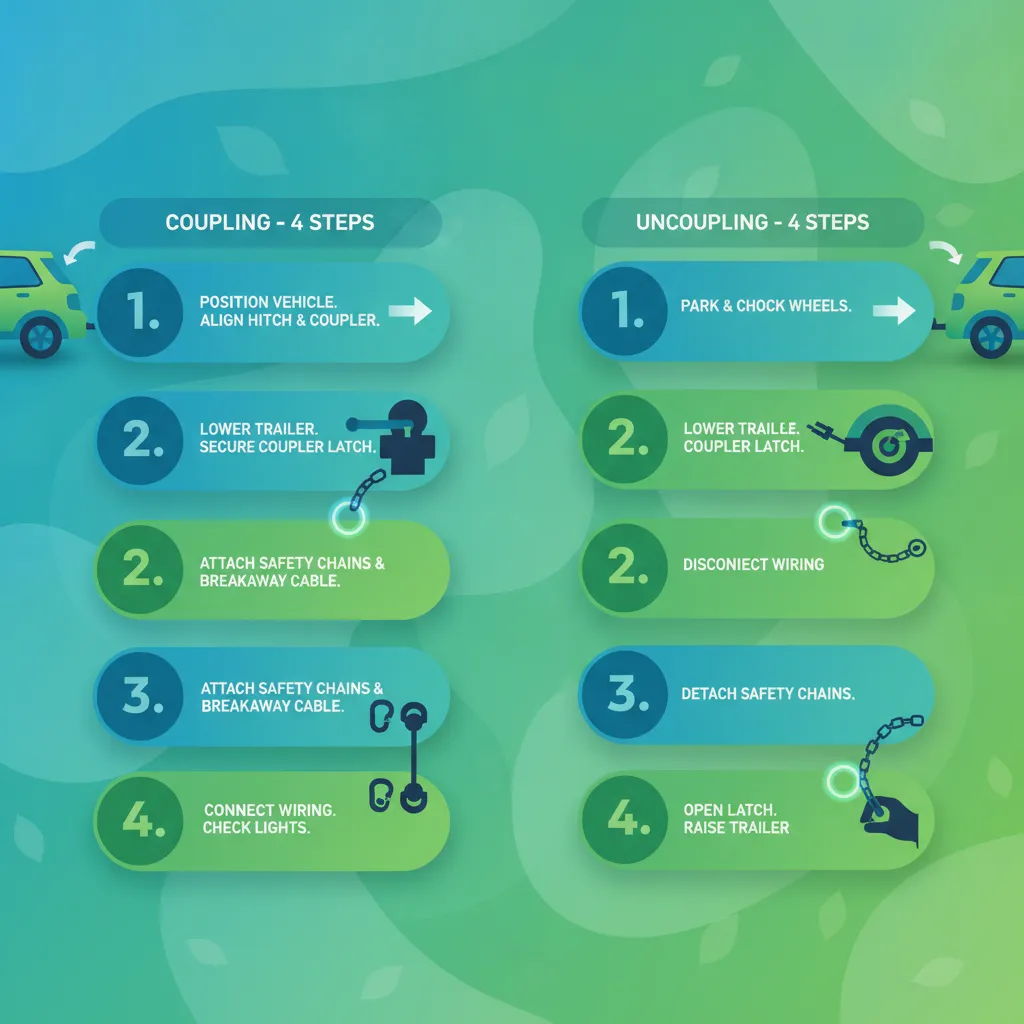
This lesson outlines the standard procedure for coupling and uncoupling trailers, emphasizing safety checks such as verifying the lock, hand brake, and brake connections. It discusses the importance of wheel chocks and correct alignment of the tow vehicle. The content includes a visual inspection checklist to ensure a secure connection.

This lesson introduces the various types of trailers, including rigid trailers, low-loaders, and refrigerated units. It explains the different coupling devices, such as fifth wheel couplings and drawbars, and the importance of ensuring compatibility. The content also covers the function of safety latches and kingpin systems.

This lesson explains the legal and safety requirements for transporting goods and cargo. It covers the importance of proper load distribution to maintain vehicle stability and the methods for securely fastening items to prevent them from shifting or falling. The regulations concerning maximum vehicle weight, roof loads, and the correct marking of loads that overhang the vehicle are also detailed.
This lesson explains the specific regulations for operating heavy vehicles on Autobahnen, including speed limits, lane discipline, and overtaking rules. It discusses the use of dedicated truck lanes and the importance of maintaining appropriate following distances. The content also covers procedures for merging and exiting high-speed roads safely.

This lesson provides specialized instruction for drivers of D1E and DE category vehicles, which involve towing a trailer. It covers the physics of vehicle combinations, including the effects of the articulation point on turning and reversing. Learners will understand principles of split braking systems, proper load distribution to prevent trailer sway, and the additional safety checks required before operating such a combination.

This lesson covers the dimensional limits for heavy vehicles, focusing on height, width, and length restrictions. It explains how to interpret clearance signage for bridges, tunnels, and overhead obstacles, and discusses the implications for route planning. The content also addresses the importance of understanding turning radii and swept paths to avoid collisions.

This lesson covers the various braking systems used on trailers, including air and electric brakes, and their integration with the towing vehicle. It explains the role of the brake controller, electrical connections for brake lights, and how braking force is distributed. The content also addresses considerations such as brake lag and trailer ABS functionality.
This lesson covers the general permissions and limitations that come with holding a German Category B driving license. It clarifies the conditions for license eligibility, including medical fitness and mandatory vehicle insurance coverage. The content also addresses potential restrictions, the process for obtaining special permits, and the circumstances that can lead to a temporary or permanent driving ban.
This lesson focuses on the distribution of loads across axle groups and the legal limits for axle loads. It explains the importance of correct weight distribution to avoid axle overloading, which can lead to road damage and safety hazards. The content also covers methods for measuring axle loads and the legal requirements for maintaining proper axle load limits.
Learn about the rules for combined vehicle weights, safe cargo securing, and passenger limits in Germany. This lesson covers essential theory for understanding vehicle capabilities and legal requirements beyond basic towing, preparing drivers for diverse load situations.
This lesson explains the legal and safety requirements for transporting goods and cargo. It covers the importance of proper load distribution to maintain vehicle stability and the methods for securely fastening items to prevent them from shifting or falling. The regulations concerning maximum vehicle weight, roof loads, and the correct marking of loads that overhang the vehicle are also detailed.

This lesson outlines the legal requirements for load securing according to German traffic law (StVO) and other relevant regulations. It details the obligations for cargo safety, inspection, and documentation. The content also explains the penalties for non-compliance, emphasizing adherence to legal standards to ensure safety.
This lesson focuses on the distribution of loads across axle groups and the legal limits for axle loads. It explains the importance of correct weight distribution to avoid axle overloading, which can lead to road damage and safety hazards. The content also covers methods for measuring axle loads and the legal requirements for maintaining proper axle load limits.

This lesson covers the various methods and equipment used to secure loads, including friction, blocking, and lashing techniques. It describes the proper use of tie-down straps, cargo nets, load bars, and other securing devices. The content also explains how to achieve sufficient tension and use secure fastening points.
This lesson covers the dimensional limits for heavy vehicles, focusing on height, width, and length restrictions. It explains how to interpret clearance signage for bridges, tunnels, and overhead obstacles, and discusses the implications for route planning. The content also addresses the importance of understanding turning radii and swept paths to avoid collisions.

This lesson explains the concepts of permissible total mass and actual mass, as well as the risks and legal consequences of overloading. It discusses how exceeding mass limits can lead to fines, increased stopping distances, and a higher risk of instability. Additionally, the content highlights the impact of overloading on vehicle wear and legal liabilities.
This lesson explains the specific regulations for operating heavy vehicles on Autobahnen, including speed limits, lane discipline, and overtaking rules. It discusses the use of dedicated truck lanes and the importance of maintaining appropriate following distances. The content also covers procedures for merging and exiting high-speed roads safely.
This lesson introduces the principles of load distribution and the impact of the centre of gravity on vehicle stability. It explains how cargo placement influences axle loads and the overall balance of the vehicle. The content emphasizes the importance of maintaining a low centre of gravity to reduce rollover risk.
This lesson defines the specific vehicle types covered by the German Category B license, focusing on passenger cars and light commercial vehicles. It details the regulations concerning maximum permissible gross vehicle weight and the legal limits for towing trailers. You will learn to identify which vehicles fall under this category according to German and EU standards to ensure full compliance.
This lesson teaches how to calculate the payload and gross combination mass (GCM) for vehicle combinations. It explains the difference between vehicle mass and payload, and introduces the concept of tongue load and its impact on handling and braking. The content provides practical examples and calculation formulas for determining permissible loads for safe operation.
Find clear answers to common questions learners have about Towing, Trailers and Limits for Class B. Learn how the lesson is structured, which driving theory objectives it supports, and how it fits into the overall learning path of units and curriculum progression in Germany. These explanations help you understand key concepts, lesson flow, and exam focused study goals.
No, your Class B license has specific weight limitations. You can generally drive a car with a trailer up to 750 kg, or a heavier trailer if the total permissible weight of the combination does not exceed 3,500 kg, depending on specific vehicle registration documents.
The exact towing capacity for your specific vehicle is listed in the Part I of your vehicle registration document (Zulassungsbescheinigung Teil I). Always check this document before attaching any trailer to ensure you remain within legal limits.
When towing a trailer, your vehicle combination is significantly longer and wider than a standard car. You have larger blind spots, and your ability to maneuver is reduced, making a thorough shoulder check (Schulterblick) essential for lane changes and turning.
Yes, all trailer lighting, including turn signals and brake lights, must function perfectly and be synchronized with your car. Before moving, you must perform a full check to ensure all signals are visible to other road users.
Begin your targeted revision now. Use our practice search to quickly find specific German driving theory questions. Filter by StVO rules, road signs, or hazard perception to create your focused study plan. Master challenging areas and prepare confidently for your theoretical driving test.