
This lesson teaches you how to interpret supplementary signs (Zusatzzeichen) that appear below primary traffic signs in Germany. Understanding these signs is crucial, as they provide the vital context needed to correctly follow rules regarding timing, distance, and vehicle exceptions. This knowledge is essential for both your theoretical exam and safe, legal driving on German roads.
Lesson content overview
Welcome to this comprehensive lesson on supplementary signs, known in German as Zusatzzeichen. As part of your German Driving License Theory – Comprehensive Category B Course, mastering the interpretation of these crucial traffic elements is indispensable for safe and lawful driving on German roads. Supplementary signs refine or modify the instructions given by primary traffic signs, adding essential details such as time restrictions, distance limits, or vehicle-specific regulations.
Properly understanding these signs ensures you comprehend the full context of a traffic regulation, allowing you to react appropriately to nuanced road rules. This lesson will equip you with the knowledge to accurately interpret these combined messages, which is fundamental for both your theoretical exam and your everyday driving practice.
Supplementary signs, or Zusatzzeichen, are small, rectangular signs typically placed directly below a main traffic sign. Their primary function is to provide additional, specific information that clarifies, restricts, or extends the meaning of the main sign. They never stand alone but always form a single, integrated instruction with the primary sign they accompany.
For instance, a standard speed limit sign might be accompanied by a supplementary sign indicating that the limit applies only during certain hours or to specific vehicle types. Without the supplementary sign, the primary sign's meaning would be too general, potentially leading to confusion or over-regulation. By adding these details, traffic authorities can implement precise and flexible regulations tailored to specific situations, road sections, or times of day. Understanding these combined signals is critical for correctly navigating traffic and complying with the Straßenverkehrs-Ordnung (StVO), Germany's road traffic regulations.
Interpreting supplementary signs involves understanding a few key principles that govern how they interact with main traffic signs. These principles ensure consistency and clarity in traffic regulation, providing a logical framework for drivers.
The most fundamental principle of supplementary signs is that they are inseparable from the main sign they accompany. Together, they form a single, unified instruction. Drivers must always interpret the pair as a whole, rather than the main sign and the supplementary sign independently.
This approach prevents clutter on signs and allows for detailed regulation without overwhelming drivers with too much information at once. For drivers, this means recognizing that the entire unit dictates the required action or restriction. Ignoring the supplementary sign effectively means misinterpreting the entire regulation, which can lead to violations or unsafe situations.
Supplementary signs serve to narrow the scope of the main sign's instruction. They specify the exact conditions under which the main sign applies, whether these conditions relate to time, distance, vehicle type, or specific situations. This principle ensures that traffic regulations are applied precisely where and when they are needed, avoiding unnecessary restrictions.
For example, a No Parking sign might have a supplementary sign indicating that parking is prohibited only on certain days. This specificity prevents vehicles from being unnecessarily restricted outside those particular times, optimizing the use of public space while maintaining traffic flow. Drivers must be highly attentive to these specific conditions to ensure compliance.
When a supplementary sign modifies a main sign, its specific instruction takes precedence over the generic instruction of the main sign under the specified conditions. This means that if there is a conflict or a more detailed condition provided by the supplementary sign, that detailed condition is the one that must be followed.
This principle is vital because it establishes a clear hierarchy of rules: the general rule of the main sign is superseded by the specific conditions introduced by the supplementary sign. Failing to adhere to the supplementary instruction, even if the main sign generally permits an action under other circumstances, constitutes a traffic violation. It ensures that the specific intent of the regulation is always paramount.
Supplementary signs come in various forms, each designed to convey specific modifying information. Recognizing these categories and their typical appearances is crucial for any driver.
Time restriction supplementary signs indicate the exact periods during which the accompanying main sign's instruction is active. These are very common in urban areas and residential zones where regulations might vary based on time of day or day of the week to manage traffic flow, noise, or parking availability.
Subcategories:
07:00 – 19:00). This means the main sign's rule is enforced only within these hours.Mo-Fr for Monday to Friday, Sa for Saturday, So for Sunday). Sometimes, specific dates or date ranges might be used for temporary events.Practical Meaning: If a 30 km/h speed limit sign is accompanied by Mo-Fr 07:00 – 19:00, the 30 km/h limit applies only during those weekdays and hours. Outside these times, the general speed limit for that road (e.g., 50 km/h in urban areas) would apply, unless another sign dictates otherwise.
Always check if time restrictions refer to specific days of the week, weekdays, or weekends. German abbreviations are standard: Mo (Montag), Di (Dienstag), Mi (Mittwoch), Do (Donnerstag), Fr (Freitag), Sa (Samstag), So (Sonntag).
Distance limit supplementary signs specify the length of the road section over which the main sign's instruction remains valid, starting from the point of the sign. These are often used for temporary speed limits, construction zones, or no-parking zones that cover a defined stretch of road.
Subcategories:
200 m). This means the regulation applies for the next 200 meters.>>) to indicate a continuing restriction.Practical Meaning: A No Parking sign (Regulatory Sign 283) with a supplementary sign displaying 50 m means that parking is prohibited for the next 50 meters immediately following the sign. Once you have passed that distance, the prohibition no longer applies, unless another sign is present.
Do not assume a restriction applies indefinitely without a specific "end of restriction" sign (Regulatory Sign 278, 279) if a distance limit supplementary sign is present. Always look for the next sign or revert to default rules after the indicated distance.
These supplementary signs indicate that the main sign's instruction applies only to certain categories or types of vehicles. This allows for differentiated traffic management, ensuring rules are tailored to vehicle capabilities, safety requirements, or road conditions.
Subcategories:
trucks (LKW), buses (Omnibus), motorcycles (Motorrad), or passenger cars (PKW).7.5 t) indicates the maximum permissible total weight of a vehicle for the restriction to apply. Vehicles exceeding this weight must comply.10 m) indicates the maximum permissible length for a vehicle.Practical Meaning: A No Overtaking sign (Regulatory Sign 276) combined with a supplementary truck icon means that only trucks are prohibited from overtaking. Passenger cars, motorcycles, and other non-truck vehicles are still permitted to overtake, provided other general rules allow it.
Be aware of combined symbols. Sometimes a supplementary sign may show an XX t (weight limit) and a truck symbol, meaning the restriction applies to trucks above that weight.
Beyond time, distance, and vehicle type, supplementary signs can impose other specific behavioral or usage restrictions. These signs are critical for managing traffic flow, ensuring safety at junctions, or protecting specific road users.
Subcategories:
No right turn) in conjunction with a main sign (e.g., a Priority Road sign).Bus Lane markings often accompanied by supplementary signs for time restrictions).Except bicycles (Ausgenommen Fahrräder) or Except pedestrians (Ausgenommen Fußgänger).Practical Meaning: A No Entry sign (Regulatory Sign 267) with a supplementary sign showing except public transport (Linienverkehr frei) means that only public transport vehicles are allowed to enter, while all other vehicles are prohibited.
Provisional or temporary supplementary signs indicate that the main sign's instruction is only for a limited period, often due to construction work, special events, or road maintenance. These signs are crucial for adapting to dynamic road conditions.
Practical Meaning: A Speed Limit 60 km/h sign (Regulatory Sign 274) with a supplementary sign stating Baustelle (Construction site) means that the reduced speed limit is only active within the construction zone. Once you leave the construction area, the normal speed limit for that road section resumes, unless another sign indicates otherwise.
Temporary signs are usually marked by their color (yellow background) or explicit text like Temporary or Baustelle. They demand strict adherence for safety reasons, especially when road workers are present.
All supplementary signs, by their nature, are legally binding when combined with a primary traffic sign. Ignoring a supplementary sign is equivalent to ignoring the primary sign itself, as they form an indivisible regulatory unit. This carries the same legal weight as violating any other traffic regulation under the StVO.
Failure to correctly interpret and obey supplementary signs can lead to various legal consequences, depending on the severity of the violation:
While supplementary signs provide clear instructions, several contextual factors can influence how drivers should approach them, enhancing overall road safety.
Adverse weather conditions, such as heavy rain, fog, or snow, can significantly reduce visibility and make road conditions more treacherous. Even if a supplementary sign does not explicitly indicate a reduced speed for bad weather, drivers should exercise increased caution. For example, if a temporary speed limit in a construction zone has a supplementary sign indicating Bei Nässe (in wet conditions), the lower speed limit only applies when the road is wet. Regardless, drivers should always adjust their speed to conditions, even when a supplementary sign might seem to "release" a restriction.
When driving in adverse weather, always prioritize safety. Reduce your speed and increase your following distance, even if the signs permit higher speeds. Your responsibility extends beyond merely following the letter of the law.
Drivers of larger or heavier vehicles, such as trucks, buses, or vehicles towing trailers, must pay extra attention to vehicle-specific supplementary signs. These restrictions are often in place for good reason, such as:
Passenger car drivers, while not always directly affected by vehicle-specific restrictions for trucks, should be aware of them to anticipate truck behavior and maintain safe distances.
In areas where supplementary signs introduce restrictions related to pedestrians, cyclists, or school zones, extra vigilance is paramount. For instance, a time-restricted speed limit around a school (e.g., 07:00 – 08:00 and 12:00 – 16:00 on weekdays) highlights periods of high pedestrian activity. Even outside these times, drivers should remain aware of potential vulnerable road users. Similarly, if a supplementary sign exempts cyclists from a No Entry rule, drivers must be prepared for cyclists to emerge from that direction, especially when turning.
Let's look at some real-world examples to solidify your understanding of supplementary signs in the context of the German Driving License Theory – Comprehensive Category B Course.
Setting: A quiet residential street in a town.
Traffic Regulation: A 30 km/h speed limit sign (Regulatory Sign 274) has a supplementary sign indicating Mo-Fr 07:00 – 19:00.
Your Action:
Setting: A winding rural road with poor visibility in sections.
Traffic Regulation: A No Overtaking sign (Regulatory Sign 276) is accompanied by a supplementary sign reading 800 m.
Your Action: You are prohibited from overtaking any other motor vehicles for the next 800 meters from the point where the sign is erected. After precisely 800 meters, the overtaking ban ceases to apply, and you may overtake if it is otherwise safe and permitted by general traffic rules.
Reasoning: This restriction might be in place due to a specific hazardous stretch of road, such as a series of sharp bends or a hidden dip, for a defined distance.
Setting: An approach road to a historic city center with narrow streets.
Traffic Regulation: A No Entry sign (Regulatory Sign 267) is shown with a supplementary sign depicting a truck icon and the text 3.5 t.
Your Action:
truck with a permissible total mass exceeding 3.5 tonnes, you are prohibited from entering this street.passenger car (Category B) or a truck up to 3.5 tonnes, you are permitted to enter.
Reasoning: This restriction aims to protect the infrastructure of old towns, reduce congestion, and enhance safety in areas unsuitable for heavy goods vehicles.Setting: A section of the Autobahn undergoing roadworks.
Traffic Regulation: A Speed Limit 100 km/h sign (Regulatory Sign 274) is paired with a supplementary sign showing a construction worker symbol (or text Baustelle).
Your Action: You must reduce your speed to a maximum of 100 km/h as long as you are within the designated construction zone. Once you pass the End of All Restrictions sign (Regulatory Sign 278) or leave the construction area, the general Autobahn speed recommendation (Richtgeschwindigkeit) of 130 km/h or a new explicit speed limit applies.
Reasoning: Construction zones present increased hazards due to reduced lane width, uneven surfaces, temporary barriers, and the presence of workers. Temporary speed limits are vital for safety.
Understanding supplementary signs is more than just recognizing a few symbols; it's about grasping the nuanced language of German traffic regulation. These Zusatzzeichen are indispensable for interpreting the full context of traffic rules, ensuring that your driving complies with specific conditions regarding time, distance, vehicle type, or temporary situations.
Always remember these core takeaways:
Zusatzzeichen is a violation of traffic law, with potential fines and safety risks.By integrating this knowledge into your driving practice, you will not only be well-prepared for your German Category B driving license theory exam but also become a safer, more informed, and compliant driver on German roads.
German supplementary signs (Zusatzzeichen) are rectangular plates placed below primary traffic signs that modify, restrict, or extend the main sign's meaning. They must always be read together as one unified instruction under three key principles: the Integration Principle (they form a single rule), the Specificity Principle (they narrow conditions), and the Precedence Principle (their specific conditions override the general main sign rule). The four main types are time restrictions (limiting rules to specific hours or days), distance limits (specifying how far a rule applies), vehicle-specific restrictions (applying only to certain vehicle types or weights), and behavioral restrictions (such as turning or lane restrictions). Ignoring these signs carries the same legal consequences as ignoring the primary sign, with potential fines, penalty points in Flensburg, or driving bans for serious violations.
A short set of high-value points that capture the most important learning from this lesson.
Supplementary signs (Zusatzzeichen) and the main sign they accompany form one inseparable, unified instruction that must always be interpreted together.
The three governing principles are: Integration (combined instruction), Specificity (narrowing conditions), and Precedence (specific overrides general).
Time restriction signs limit rule applicability to specific hours or days (e.g., Mo-Fr 07:00-19:00); outside those times the default rules apply.
Distance limit signs specify how far a regulation extends from the sign; after that distance, the restriction ends unless another sign continues it.
Vehicle-specific supplementary signs bind only the vehicle types depicted, while other vehicles follow the unmodified main sign rule.
Explore all units and lessons included in this driving theory course.
Time abbreviations: Mo=Montag, Di=Dienstag, Mi=Mittwoch, Do=Donnerstag, Fr=Freitag, Sa=Samstag, So=Sonntag.
Weight limits (e.g., 3.5 t) mean the restriction applies to vehicles exceeding that weight.
Temporary or construction zone signs (Baustelle) are typically yellow and require strict adherence for safety.
The specific condition of a supplementary sign always overrides the general rule of the main sign.
Prohibition signs like Halteverbot (no stopping), Überholverbot (no overtaking), and Verbot der Einfahrt (no entry) are modified by their supplementary signs.
Assuming a speed limit or parking restriction applies indefinitely without checking for time or distance supplementary signs.
Believing all vehicles must follow a vehicle-specific restriction when it only applies to the depicted vehicle type.
Ignoring temporary supplementary signs in construction zones, thinking the permanent sign's rule takes precedence.
Failing to look for an 'end of restriction' sign (Regulatory Sign 278) after passing a distance-limited regulation.
Interpreting the main sign and supplementary sign as separate, independent instructions rather than one combined rule.
Lesson content overview
A short set of high-value points that capture the most important learning from this lesson.
Supplementary signs (Zusatzzeichen) and the main sign they accompany form one inseparable, unified instruction that must always be interpreted together.
The three governing principles are: Integration (combined instruction), Specificity (narrowing conditions), and Precedence (specific overrides general).
Time restriction signs limit rule applicability to specific hours or days (e.g., Mo-Fr 07:00-19:00); outside those times the default rules apply.
Distance limit signs specify how far a regulation extends from the sign; after that distance, the restriction ends unless another sign continues it.
Vehicle-specific supplementary signs bind only the vehicle types depicted, while other vehicles follow the unmodified main sign rule.
Explore all units and lessons included in this driving theory course.
Time abbreviations: Mo=Montag, Di=Dienstag, Mi=Mittwoch, Do=Donnerstag, Fr=Freitag, Sa=Samstag, So=Sonntag.
Weight limits (e.g., 3.5 t) mean the restriction applies to vehicles exceeding that weight.
Temporary or construction zone signs (Baustelle) are typically yellow and require strict adherence for safety.
The specific condition of a supplementary sign always overrides the general rule of the main sign.
Prohibition signs like Halteverbot (no stopping), Überholverbot (no overtaking), and Verbot der Einfahrt (no entry) are modified by their supplementary signs.
Assuming a speed limit or parking restriction applies indefinitely without checking for time or distance supplementary signs.
Believing all vehicles must follow a vehicle-specific restriction when it only applies to the depicted vehicle type.
Ignoring temporary supplementary signs in construction zones, thinking the permanent sign's rule takes precedence.
Failing to look for an 'end of restriction' sign (Regulatory Sign 278) after passing a distance-limited regulation.
Interpreting the main sign and supplementary sign as separate, independent instructions rather than one combined rule.
Explore search topics learners often look for when studying Supplementary Signs. These topics reflect common questions about road rules, driving situations, safety guidance, and lesson level theory preparation for learners in Germany.
Browse additional driving theory lessons that cover connected traffic rules, road signs, and common driving situations related to this topic. Improve your understanding of how different rules interact across everyday traffic scenarios.
Learn how German supplementary signs ('Zusatzzeichen') provide crucial context to main traffic regulations. Understand their impact on restrictions, exceptions, and distances, essential for accurate interpretation of StVO rules.

This lesson explains the function of informational signs, which provide helpful guidance for navigation and services. You will learn how to read directional signs on all types of roads, including the Autobahn, and understand distance markers to upcoming cities and exits. The lesson also covers the symbols for services such as fuel stations, restaurants, and tourist attractions.

This lesson provides a thorough explanation of traffic light systems ('Lichtzeichenanlagen') used in Germany. It details the meaning of red, amber, and green lights and the correct response to each phase of the signal sequence. The lesson also covers special signals, such as the green arrow for turning right on red, pedestrian and cyclist signals, and the authority of signals given by a police officer, which override all other signs.
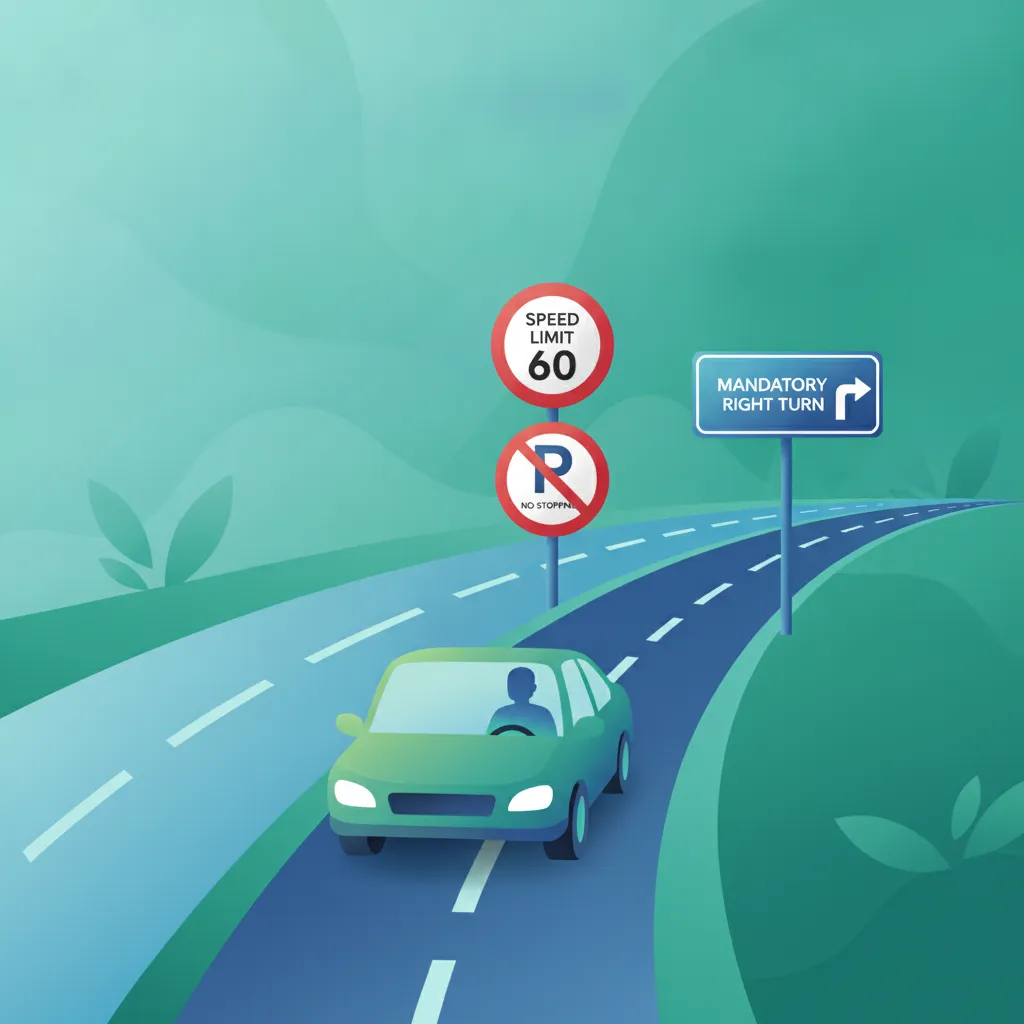
This lesson covers regulatory signs, which are legally enforceable and command specific actions from drivers. You will learn the meaning of critical signs such as the stop sign, yield sign, no-entry signs, and various parking and stopping prohibitions. The content also explains signs that establish speed limits, one-way streets, and restricted areas like environmental or pedestrian zones.

This lesson explains the various types of road markings and their significance for guiding traffic and ensuring safety. It covers the difference between solid and broken lines for lane separation and overtaking rules, the function of stop lines at intersections, and the markings for pedestrian crosswalks. You will also learn to interpret directional arrows, bicycle lane markings, and other symbols painted on the road.

This lesson explains the function and meaning of traffic light signals, including standard cycles, flashing lights, and arrows. It also details how to interpret and obey hand signals given by police officers, which override all other signs and signals. Understanding these instructions is crucial for navigating controlled junctions and emergency situations.

This lesson focuses on warning signs, which are designed to alert drivers to potential dangers or unusual conditions on the road ahead. You will learn to identify signs indicating sharp bends, upcoming intersections, railway crossings, road works, and risks like slippery surfaces or wildlife. Recognizing these signs allows you to anticipate hazards and adjust your driving proactively.
This lesson familiarizes drivers with the various special traffic signals and signs that apply exclusively to buses and other public transport vehicles. It covers the interpretation of bus-only signals (often showing bars or letters), flashing priority indicators, and lane-use control signs. Correctly understanding these signals is crucial for legal compliance and for taking advantage of public transport priority measures in urban areas.
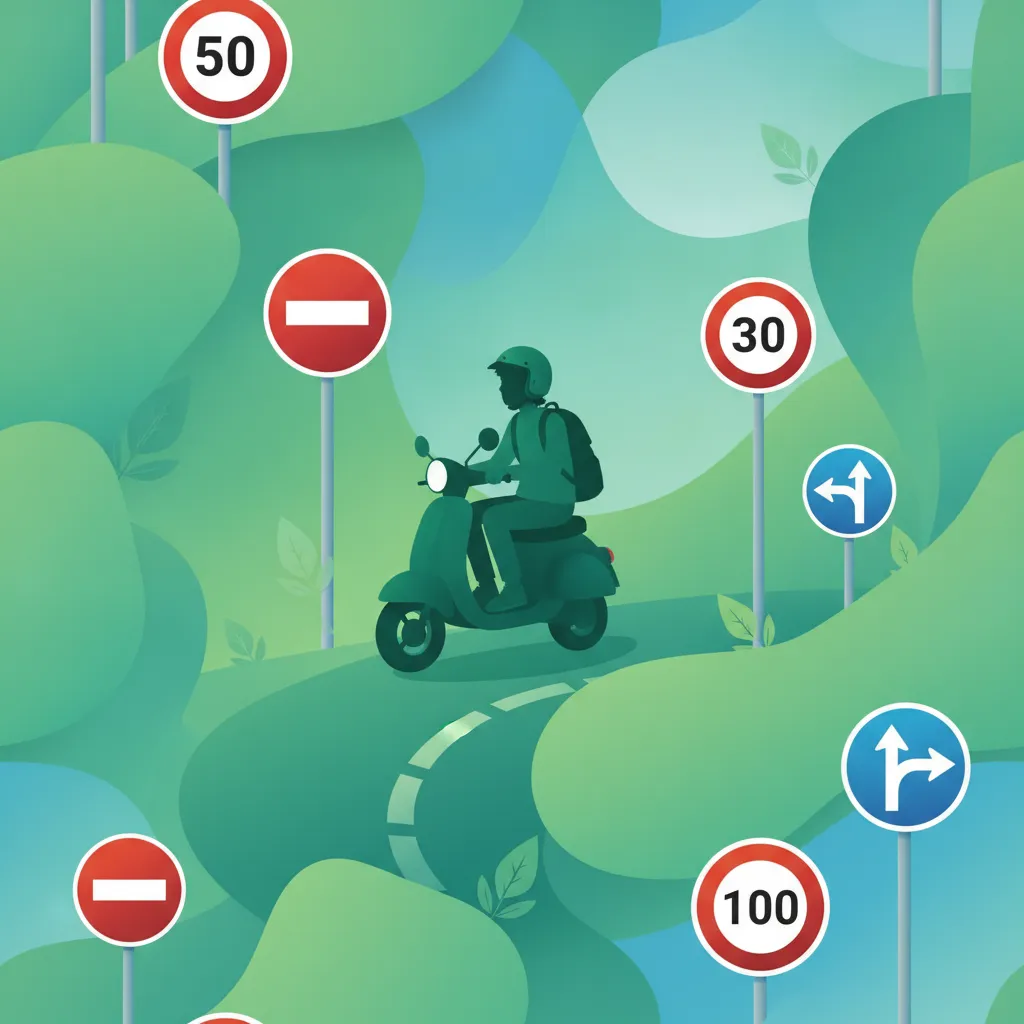
This lesson introduces the various categories of German road signs, focusing on their meaning and application for AM riders. It covers regulatory signs like speed limits, warning signs for hazards, and informational signs for guidance. Learners will be ableto identify signs by their shape, color, and symbols, ensuring correct interpretation while riding.
This lesson focuses on interpreting various road markings, from lane lines and directional arrows to stop lines and pedestrian crossings. It explains the rules associated with solid versus broken lines and how to navigate temporary markings found in construction zones. Correctly reading these markings is vital for proper lane discipline and safety.

Effective communication is critical for road safety, and this lesson details the correct use of a vehicle's signaling devices. It explains when and how to use turn signals (indicators), hazard warning lights, the horn, and headlight flashes to clearly communicate your intentions to other road users. Proper signaling helps prevent misunderstandings and is a key component of defensive and cooperative driving.
Explore how main traffic signs and supplementary signs combine to create specific traffic regulations in Germany. This lesson clarifies how different sign types work together to convey complete traffic instructions and avoid misunderstandings.
This lesson explains the function of informational signs, which provide helpful guidance for navigation and services. You will learn how to read directional signs on all types of roads, including the Autobahn, and understand distance markers to upcoming cities and exits. The lesson also covers the symbols for services such as fuel stations, restaurants, and tourist attractions.
This lesson provides a thorough explanation of traffic light systems ('Lichtzeichenanlagen') used in Germany. It details the meaning of red, amber, and green lights and the correct response to each phase of the signal sequence. The lesson also covers special signals, such as the green arrow for turning right on red, pedestrian and cyclist signals, and the authority of signals given by a police officer, which override all other signs.
This lesson covers regulatory signs, which are legally enforceable and command specific actions from drivers. You will learn the meaning of critical signs such as the stop sign, yield sign, no-entry signs, and various parking and stopping prohibitions. The content also explains signs that establish speed limits, one-way streets, and restricted areas like environmental or pedestrian zones.
This lesson explains the function and meaning of traffic light signals, including standard cycles, flashing lights, and arrows. It also details how to interpret and obey hand signals given by police officers, which override all other signs and signals. Understanding these instructions is crucial for navigating controlled junctions and emergency situations.
This lesson focuses on warning signs, which are designed to alert drivers to potential dangers or unusual conditions on the road ahead. You will learn to identify signs indicating sharp bends, upcoming intersections, railway crossings, road works, and risks like slippery surfaces or wildlife. Recognizing these signs allows you to anticipate hazards and adjust your driving proactively.
This lesson explains the various types of road markings and their significance for guiding traffic and ensuring safety. It covers the difference between solid and broken lines for lane separation and overtaking rules, the function of stop lines at intersections, and the markings for pedestrian crosswalks. You will also learn to interpret directional arrows, bicycle lane markings, and other symbols painted on the road.
Effective communication is critical for road safety, and this lesson details the correct use of a vehicle's signaling devices. It explains when and how to use turn signals (indicators), hazard warning lights, the horn, and headlight flashes to clearly communicate your intentions to other road users. Proper signaling helps prevent misunderstandings and is a key component of defensive and cooperative driving.
This lesson familiarizes drivers with the various special traffic signals and signs that apply exclusively to buses and other public transport vehicles. It covers the interpretation of bus-only signals (often showing bars or letters), flashing priority indicators, and lane-use control signs. Correctly understanding these signals is crucial for legal compliance and for taking advantage of public transport priority measures in urban areas.

This lesson provides comprehensive guidance on using vehicle signals to communicate with other road users. It covers the correct timing and use of turn indicators, the application of hand signals when necessary, and the proper use of hazard lights. Effective signaling is presented as a cornerstone of predictable and safe driving.
This lesson introduces the various categories of German road signs, focusing on their meaning and application for AM riders. It covers regulatory signs like speed limits, warning signs for hazards, and informational signs for guidance. Learners will be ableto identify signs by their shape, color, and symbols, ensuring correct interpretation while riding.
Find clear answers to common questions learners have about Supplementary Signs. Learn how the lesson is structured, which driving theory objectives it supports, and how it fits into the overall learning path of units and curriculum progression in Germany. These explanations help you understand key concepts, lesson flow, and exam focused study goals.
Yes, they are designed to modify, restrict, or clarify the primary sign directly above. If there are multiple supplementary signs, you must consider all of them together to determine the full scope of the regulation.
Look for the supplementary sign showing clock times (e.g., 8-18h). If no supplementary sign is present, the restriction generally applies 24/7. Always check if there is an additional plate indicating days of the week, such as Monday to Saturday.
These signs indicate that the regulation (such as a parking ban or access restriction) does not apply to vehicles displaying a valid resident parking permit. You must always check if your vehicle qualifies for the exemption indicated on the plate.
This indicates that the danger or regulation warned about by the primary sign will begin in 100 meters. It helps you prepare your speed and positioning in advance.
Begin your targeted revision now. Use our practice search to quickly find specific German driving theory questions. Filter by StVO rules, road signs, or hazard perception to create your focused study plan. Master challenging areas and prepare confidently for your theoretical driving test.