
Driving through areas with active construction or maintenance requires heightened vigilance and strict adherence to temporary traffic rules. This guide helps you understand your responsibilities as a driver when approaching infrastructure projects, such as bridge repairs, and explains how to interpret temporary signage to ensure the safety of workers and fellow road users.
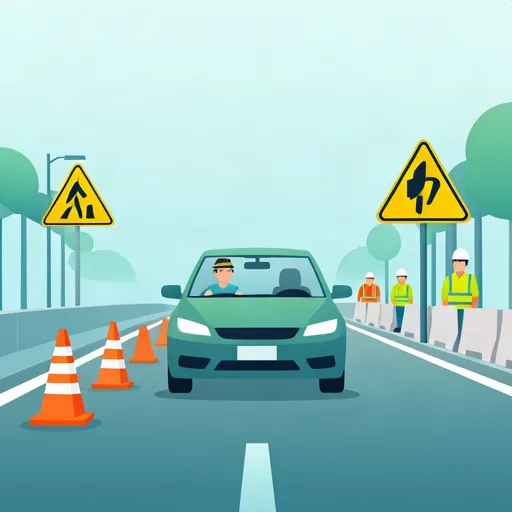
Article content overview
Navigating Swedish roadworks requires understanding that temporary signage legally overrides permanent infrastructure, with yellow signs signaling construction zones and temporary speed reductions that must be obeyed regardless of visible activity. The safest-choice principle applies to theory exam questions, meaning you should always prioritize reduced speed, increased following distance, and avoiding risky maneuvers like overtaking. Bridge maintenance zones present unique challenges including narrowed lanes, one-way traffic controls, and limited shoulder space requiring heightened attention to signal lights and staff instructions. Swedish terminology such as Vägarbete (roadworks), Blixtlåsprincipen (zipper merging), and Hastighetsbegränsning (speed limit) may appear on both the road and the theory exam.
A short set of high-value points that capture the most important ideas from this article.
Temporary traffic signs always override permanent signs in Swedish roadwork zones, regardless of whether workers are visible
The primary safety priority in construction zones is protecting road workers who operate in physically exposed environments
Temporary speed limits are legally enforceable even when no construction activity is currently visible
Swedish theory exam questions about roadworks follow a consistent safest-choice principle prioritizing reduced speed and avoidance of risky maneuvers
Narrowed lanes and reduced shoulder space require maintaining a central lane position and avoiding unnecessary lateral movements
Temporary signs are typically yellow with red borders or entirely yellow in color
If a temporary sign shows a lower speed limit than the permanent sign, the temporary limit is the only legal one to follow
Blixtlåsprincipen (zipper principle) applies to alternating lane merging in congested areas
Vägarbete (roadworks) signs warn of construction zones and require immediate speed adjustment
Stop signs at construction zones remain in effect until a sign officially cancels the temporary restriction
Assuming permanent speed limits still apply when temporary signs are present
Attempting to overtake other vehicles within construction zones, which is rarely permitted and often dangerous due to uneven surfaces or sudden lane shifts
Failing to increase following distance when approaching and traveling through roadwork areas
Not scanning far enough ahead for yellow warning signs indicating upcoming construction zones
Ignoring instructions from flaggers or ground staff at bridge construction sites where one-way traffic may be in effect
Article content overview
A short set of high-value points that capture the most important ideas from this article.
Temporary traffic signs always override permanent signs in Swedish roadwork zones, regardless of whether workers are visible
The primary safety priority in construction zones is protecting road workers who operate in physically exposed environments
Temporary speed limits are legally enforceable even when no construction activity is currently visible
Swedish theory exam questions about roadworks follow a consistent safest-choice principle prioritizing reduced speed and avoidance of risky maneuvers
Narrowed lanes and reduced shoulder space require maintaining a central lane position and avoiding unnecessary lateral movements
Temporary signs are typically yellow with red borders or entirely yellow in color
If a temporary sign shows a lower speed limit than the permanent sign, the temporary limit is the only legal one to follow
Blixtlåsprincipen (zipper principle) applies to alternating lane merging in congested areas
Vägarbete (roadworks) signs warn of construction zones and require immediate speed adjustment
Stop signs at construction zones remain in effect until a sign officially cancels the temporary restriction
Assuming permanent speed limits still apply when temporary signs are present
Attempting to overtake other vehicles within construction zones, which is rarely permitted and often dangerous due to uneven surfaces or sudden lane shifts
Failing to increase following distance when approaching and traveling through roadwork areas
Not scanning far enough ahead for yellow warning signs indicating upcoming construction zones
Ignoring instructions from flaggers or ground staff at bridge construction sites where one-way traffic may be in effect
Explore related topics, search based questions, and concepts that learners often look up when studying Safe Driving Through Swedish Roadworks. These themes reflect real search intent and help you understand how this topic connects to wider driving theory knowledge in Sweden.
Find clear and practical answers to common questions learners often have about Safe Driving Through Swedish Roadworks. This section helps explain difficult points, remove confusion, and reinforce the key driving theory concepts that matter for learners in Sweden.
You must always prioritize temporary signs over permanent ones, as they reflect the current safety requirements for that specific stretch of road. Adjust your speed and follow lane markings strictly to ensure the safety of road workers.
Bridge construction zones often involve narrow lanes, heavy machinery, and shifting traffic patterns. Increased vigilance helps you react to sudden stops or workers near the roadway, which is a common focus in Swedish theory exams.
Yes, temporary speed limits set by authorities like Trafikverket are mandatory. They are designed to protect workers and manage traffic flow in restricted areas, and failing to adhere to them is a serious traffic violation.
Continue your learning journey by exploring more detailed articles and guides. Clarify specific traffic rules, understand complex road signs, or review safe driving practices. Our extensive content library supports your Swedish driving license theory preparation.