
Navigating a railway level crossing requires constant vigilance and an understanding of the immense braking distance required by trains. This guide explains how to properly assess crossing environments, adapt your speed, and ensure you never enter a crossing if there is a risk of being trapped on the tracks. Mastering these procedures is a mandatory component of your Swedish driving theory preparation and a fundamental skill for real-world road safety.
Article content overview
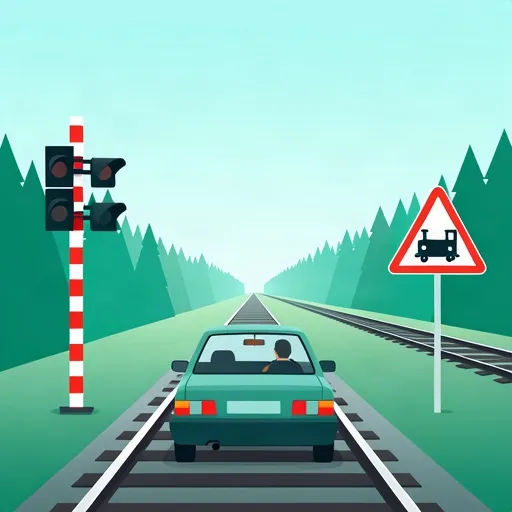
Navigating railway level crossings in Sweden requires understanding that trains cannot stop quickly and that drivers bear sole responsibility for preventing collisions. Guarded crossings (A32) have gates and signals but may fail, while unguarded crossings (A33) demand extra vigilance and speed adaptation based on visibility. Key procedures include slowing in advance, checking both directions, confirming you cannot be trapped on the tracks, and never entering when signals or gates are active. The Swedish theory exam frequently tests the misconception about white flashing lights, which indicate only that the system is active, not that the track is safe.
A short set of high-value points that capture the most important ideas from this article.
Trains can require up to 1,000 meters to brake, making it physically impossible for them to avoid collisions, so the entire safety burden falls on road vehicle drivers.
You must always visually confirm that the track is clear before crossing, even at guarded crossings with working signals and gates.
Never enter a railway crossing if there is any risk of being forced to stop within the crossing area due to traffic congestion ahead.
White flashing lights at a crossing indicate the signal system is active, not that the track is clear; you must still verify no train is approaching.
Spårspring refers to unauthorized access to railway tracks by pedestrians or cyclists, which creates additional hazards at crossings that drivers should anticipate.
A32 signals a railway crossing equipped with automatic gates: obey them but remain prepared for system failure.
A33 signals an unguarded crossing: adapt your speed based on visibility and creep forward to check both directions along the tracks.
Red flashing lights, active sound signals, or moving gates create a strict legal prohibition against entering the crossing.
Trafikverket is the Swedish Transport Administration responsible for road and rail infrastructure and safety standards.
If a gate is lowering or lights are flashing, even if you believe you can beat it, attempting to cross is one of the most dangerous actions a driver can take at a crossing.
Assuming that because the signal system at a guarded crossing is active, the crossing is necessarily safe without your own visual confirmation.
Mistaking white flashing lights for permission to proceed; these lights only indicate the signal equipment is working, not that the track is clear.
Entering a crossing without checking if traffic ahead might cause you to stop on the tracks.
Believing unguarded crossings are less dangerous and requiring less attention than guarded crossings.
Failing to slow down in advance and maintain full vehicle control when approaching any railway crossing.
Article content overview
A short set of high-value points that capture the most important ideas from this article.
Trains can require up to 1,000 meters to brake, making it physically impossible for them to avoid collisions, so the entire safety burden falls on road vehicle drivers.
You must always visually confirm that the track is clear before crossing, even at guarded crossings with working signals and gates.
Never enter a railway crossing if there is any risk of being forced to stop within the crossing area due to traffic congestion ahead.
White flashing lights at a crossing indicate the signal system is active, not that the track is clear; you must still verify no train is approaching.
Spårspring refers to unauthorized access to railway tracks by pedestrians or cyclists, which creates additional hazards at crossings that drivers should anticipate.
A32 signals a railway crossing equipped with automatic gates: obey them but remain prepared for system failure.
A33 signals an unguarded crossing: adapt your speed based on visibility and creep forward to check both directions along the tracks.
Red flashing lights, active sound signals, or moving gates create a strict legal prohibition against entering the crossing.
Trafikverket is the Swedish Transport Administration responsible for road and rail infrastructure and safety standards.
If a gate is lowering or lights are flashing, even if you believe you can beat it, attempting to cross is one of the most dangerous actions a driver can take at a crossing.
Assuming that because the signal system at a guarded crossing is active, the crossing is necessarily safe without your own visual confirmation.
Mistaking white flashing lights for permission to proceed; these lights only indicate the signal equipment is working, not that the track is clear.
Entering a crossing without checking if traffic ahead might cause you to stop on the tracks.
Believing unguarded crossings are less dangerous and requiring less attention than guarded crossings.
Failing to slow down in advance and maintain full vehicle control when approaching any railway crossing.
Explore related topics, search based questions, and concepts that learners often look up when studying Safe Railway Crossing Procedures. These themes reflect real search intent and help you understand how this topic connects to wider driving theory knowledge in Sweden.
Find clear and practical answers to common questions learners often have about Safe Railway Crossing Procedures. This section helps explain difficult points, remove confusion, and reinforce the key driving theory concepts that matter for learners in Sweden.
Yes, as a driver, you hold full responsibility for safety at a level crossing. Even if there are lights, bells, or gates, you must remain vigilant because technical failures can occur.
You must adapt your speed based on your sightlines and be fully prepared to stop before the tracks if a train is approaching. Never cross unless you are certain the way is clear in both directions.
No, you must never enter a level crossing if there is any risk of having to stop on the tracks due to traffic congestion or queueing vehicles ahead.
No, white lights are only there to help you identify the crossing. They do not grant permission to cross, and you must still verify that no train is approaching before proceeding.
Continue your learning journey by exploring more detailed articles and guides. Clarify specific traffic rules, understand complex road signs, or review safe driving practices. Our extensive content library supports your Swedish driving license theory preparation.