
When traveling on Swedish roads, you will frequently encounter infrastructure projects managed by Trafikverket that require temporary traffic alterations. This guide breaks down the legal obligations for drivers in construction zones, the function of TMA-bil safety vehicles, and why temporary directions must always take precedence. Mastering these concepts will help you prepare for the safety-focused questions on your Swedish driving licence theory exam.
Article content overview
When driving on Swedish roads, encountering road construction is an inevitable part of the experience. Whether it is a long-term infrastructure project like the "Dubbelspår Hallsberg–Degerön" or a short-term repair, Trafikverket—the Swedish Transport Administration—implements temporary traffic management measures to ensure the safety of both drivers and road workers. As a learner driver, understanding how to interpret these changes is not only a requirement for safe driving but also a frequent focus of the Swedish driving theory exam.
In Sweden, the law is clear regarding your obligations when approaching a work zone. Temporary road signs and signals are specifically designed to override permanent signage when conditions on the road change. If you see a temporary yellow sign indicating a speed limit or a diversion, you must obey that sign, even if it contradicts the permanent signage that you are accustomed to seeing on that stretch of road.
Failure to follow these instructions is a common trap on the theory exam. Remember that temporary measures, such as narrowing lanes or shifting traffic to the opposite side of a dual carriageway, are implemented based on rigorous safety assessments. Ignoring these directions puts construction personnel at risk and significantly increases the probability of traffic incidents.
You may occasionally encounter a complete road closure rather than a partial lane restriction. While this can be inconvenient, Trafikverket often opts for full closures to enhance efficiency and worker safety. By removing through-traffic entirely, construction teams can utilize heavy machinery across the full width of the roadway, which often leads to a shorter project duration. In the long run, this minimizes the total time that residents and commuters face disruptions, even if the short-term impact is more noticeable.
Infrastructure maintenance often requires complex adjustments to the traffic flow, such as guiding vehicles into a single lane using physical barriers. When you approach such a zone, you must prioritize patience and clear communication with other road users. Maintaining a steady speed and avoiding unnecessary lane changes is essential for keeping traffic moving smoothly without causing phantom traffic jams.
Temporary road changes often affect pedestrians and cyclists the most. During projects like the construction of new cycle paths, you may find that traditional crossings are relocated or temporarily closed. It is your responsibility to remain vigilant for these vulnerable road users, who may be forced to navigate less familiar paths due to the construction. Always assume that visibility is reduced in these areas and maintain a speed that allows for a quick stop if a pedestrian steps into the road.
This article covers how Trafikverket implements temporary traffic management for road works in Sweden, emphasizing that drivers must always obey temporary yellow signs over permanent ones. Key concepts include the role of TMA-bil safety vehicles, the safety procedures for passing through work zones (slowing early, increasing following distance, following lane markings, obeying controllers, and avoiding overtaking), and the heightened responsibility toward vulnerable road users like pedestrians and cyclists. Understanding these principles is essential for both safe driving and success on the Swedish driving theory exam.
A short set of high-value points that capture the most important ideas from this article.
Temporary yellow signs and signals always take precedence over permanent road signs when road conditions change.
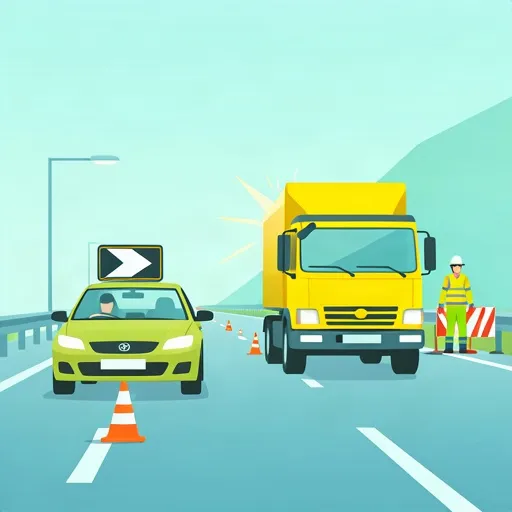
TMA-bil vehicles are equipped with crash cushions and arrow boards to protect workers and guide traffic through work zones.
Full road closures are often implemented to speed up construction and reduce total disruption time for commuters.
Drivers must increase their safety distance when approaching and passing through work zones.
Pedestrians and cyclists are especially vulnerable during road works and may need to use unfamiliar routes.
Temporary signs override permanent ones—always follow the yellow signs even if they contradict the signage you normally expect.
TMA-bil (Truck Mounted Attenuator) vehicles with flashing yellow lights require immediate speed reduction.
Never overtake inside a work zone unless clearly marked as permitted, as lanes are often narrowed for safety.
Skyddsavstånd (safety distance) must be increased when passing road works.
If a traffic controller gives hand signals, their instructions take priority over both temporary and permanent signs.
Assuming permanent speed limits still apply when temporary signs indicate different restrictions.
Failing to slow down early enough when approaching the first warning signs for a work zone.
Attempting to overtake other vehicles inside a construction zone where lanes are narrower than usual.
Not maintaining an adequate following distance, reducing reaction time in dynamic traffic situations.
Ignoring or misinterpreting hand signals from traffic controllers directing vehicles through a work zone.
Article content overview
A short set of high-value points that capture the most important ideas from this article.
Temporary yellow signs and signals always take precedence over permanent road signs when road conditions change.
TMA-bil vehicles are equipped with crash cushions and arrow boards to protect workers and guide traffic through work zones.
Full road closures are often implemented to speed up construction and reduce total disruption time for commuters.
Drivers must increase their safety distance when approaching and passing through work zones.
Pedestrians and cyclists are especially vulnerable during road works and may need to use unfamiliar routes.
Temporary signs override permanent ones—always follow the yellow signs even if they contradict the signage you normally expect.
TMA-bil (Truck Mounted Attenuator) vehicles with flashing yellow lights require immediate speed reduction.
Never overtake inside a work zone unless clearly marked as permitted, as lanes are often narrowed for safety.
Skyddsavstånd (safety distance) must be increased when passing road works.
If a traffic controller gives hand signals, their instructions take priority over both temporary and permanent signs.
Assuming permanent speed limits still apply when temporary signs indicate different restrictions.
Failing to slow down early enough when approaching the first warning signs for a work zone.
Attempting to overtake other vehicles inside a construction zone where lanes are narrower than usual.
Not maintaining an adequate following distance, reducing reaction time in dynamic traffic situations.
Ignoring or misinterpreting hand signals from traffic controllers directing vehicles through a work zone.
Explore related topics, search based questions, and concepts that learners often look up when studying Temporary Road Works and Management. These themes reflect real search intent and help you understand how this topic connects to wider driving theory knowledge in Sweden.
Find clear and practical answers to common questions learners often have about Temporary Road Works and Management. This section helps explain difficult points, remove confusion, and reinforce the key driving theory concepts that matter for learners in Sweden.
Authorities may choose complete closure to maximize safety for road workers and improve efficiency. This often results in a shorter overall project timeline compared to maintaining partial traffic flow with temporary bypasses.
A TMA (Traffic Management Area) vehicle is a specialized truck equipped with crash cushions and warning lights. It acts as a protective barrier for road workers and alerts oncoming traffic to construction activity or hazards.
In accordance with the Swedish Traffic Act, you must always follow temporary directions and signs at a work zone, even if they contradict permanent road signs or markings.
Continue your learning journey by exploring more detailed articles and guides. Clarify specific traffic rules, understand complex road signs, or review safe driving practices. Our extensive content library supports your Swedish driving license theory preparation.