This lesson synthesizes all your training into a proactive framework for safe motorcycling across France. You will learn to apply continuous risk assessment and defensive positioning, building on the mechanical and legal knowledge from earlier units to master the art of predicting hazards before they develop.

Lesson content overview
Operating a motorcycle on French roads requires more than just mechanical control; it demands a highly refined cognitive approach to safety. Because motorcyclists do not have the protective steel passenger compartment of a car, active hazard mitigation is your primary defense.
This final lesson of the French Motorcycle Theory Course (Category A, A1, A2) integrates all previously learned concepts—such as lane positioning, motorcycle control, and traffic rules—into a single, cohesive methodology: defensive riding and continuous risk assessment.
In France, the motorcycle theoretical exam (Épreuve Théorique Moto or ETM) places significant emphasis on your ability to analyze complex road situations, anticipate the errors of other road users, and adjust your riding dynamically. By adopting the proactive strategies detailed in this chapter, you will build the lifelong habits necessary to navigate French urban centers, rural departmental roads (routes départementales), and high-speed motorways (autoroutes) safely.
Defensive riding is a proactive mental model centered on anticipating potential hazards and mitigating them before they escalate into active conflicts. Rather than simply reacting to emergencies as they occur, a defensive rider actively scans the environment to ensure that dangerous situations never develop in the first place.
Continuous risk assessment is the operational engine of defensive riding. It is an ongoing, real-time evaluation of:
By constantly synthesizing these three elements, you can make minor, proactive adjustments to your speed and lateral position. This systematic approach drastically reduces your reliance on emergency braking or sudden, high-risk evasive maneuvers.
The foundation of all defensive riding is where and how you direct your eyes. A "high-mileage" visual lead means maintaining a forward visual focus that extends as far down the road as possible. Your gaze should look ahead to the point where your motorcycle will be in 15 to 20 seconds.
To implement this technique effectively, you must understand the three zones of visual focus:
This is your strategic planning zone. On a straight motorway or rural road, this means looking several hundred metres ahead to detect slow-moving traffic, changing road layouts, exit signs, or upcoming curves. Looking far ahead allows your brain to calculate a smooth path of travel and gives you ample time to adjust your speed before reaching a hazard.
This is your tactical adjustment zone. Here, you monitor interactions with other road users, identify vehicles preparing to turn, analyze road curvature, and look for signs of changing road grip, such as damp patches or gravel.
This is your immediate reaction zone. While you must be aware of obstacles directly in front of your front tyre—such as potholes, diesel spills, or debris—you must avoid "target fixation" on this area. Looking exclusively at the asphalt immediately in front of your fender limits your reaction window and makes smooth cornering and stable braking impossible.
The Trap of Target Fixation: Your motorcycle naturally travels where your eyes are pointing. If you stare directly at a pothole or a guardrail during a curve, you will likely steer straight into it. Always look through the turn or past the hazard to where you want the motorcycle to go.
While maintaining a high-mileage visual lead, you must actively scan your entire environment using a systematic visual pattern. Continuous scanning prevents tunnel vision, which often occurs at high speeds or under stress.
A safe scanning routine involves a continuous loop:
In France, a physical head check—known as the contrôle direct—is a legally mandated and graded component of motorcycle riding. Your mirrors have inherent blind spots (angles morts). You must turn your head to check your blind spot before:
The safest assumption a motorcyclist can make is that other road users do not see them. Due to their narrow profile, motorcycles are easily hidden by larger vehicles, structural pillars of cars, or roadside infrastructure. Furthermore, car drivers suffer from "motion-induced blindness" and "looked-but-failed-to-see" errors, where they look in the direction of a motorcycle but their brains fail to register it because they are visually searching for larger objects like cars or trucks.
To counter this danger, you must adopt proactive measures to maximize your visibility and prepare for the worst-case scenario:
The physical characteristics of an object (such as color, luminance, and contrast) that make it stand out from its background and easily catch a road user's attention. For motorcyclists, conspicuity is enhanced by retro-reflective gear and daytime running lights.
Speed management is not merely about obeying posted speed limits; it is about adjusting your velocity so that your stopping sight distance is always shorter than your active line of sight. You must be able to come to a complete, controlled stop within the distance of clear road you can see ahead of you.
Proactive speed adjustment means reducing your speed before a hazard becomes immediate.
Slow down before entering a curve, while the motorcycle is still upright. This preserves your tires' lateral grip for the corner itself, rather than using up precious traction on emergency trail-braking while leaned over.
Slightly reduce your speed and hover your fingers over the front brake lever (known as "covering the brakes") when approaching intersections, pedestrian crossings, or lines of stopped vehicles. This reduces your physical reaction time by up to half a second, which can save several metres of stopping distance.
On wet roads, tire grip is halved. You must reduce your speed and double your following distance to compensate for the increased risk of skidding and the longer stopping distances required on wet asphalt.
Your position within your lane is your most effective tool for managing space, optimizing visibility, and protecting yourself from lateral hazards. French lanes are wide enough to offer three primary riding tracks: the left third, the center, and the right third.
To maintain control over your safety, you must manage three types of space:
Anticipating risk requires you to read the subtle clues provided by other road users and the environment. By interpreting these cues, you can predict hazardous behaviors before they occur:
The French Code de la route codifies several safety rules designed to protect motorcyclists and other vulnerable road users. Strict adherence to these laws is not only mandatory for passing your ETM exam but is also vital for your survival.
Under French law (Article R416-17 of the Code de la route), all riders of motorized two-wheelers must ride with their low-beam headlights (feux de croisement) switched on at all times, both day and night.
Article R412-12 of the Code de la route dictates that when two vehicles are traveling in the same direction, the driver behind must maintain a safe distance. Under normal dry conditions, this distance must correspond to a travel time of at least two seconds.
Before any change of speed, lateral lane position, or direction, you must signal your intent and verify that the maneuver is safe.
While motorcyclists are encouraged to choose the safest position within their lane dynamically, they must remain within their designated lane boundaries.
You must adhere to the national speed limits under the Code de la route, which dynamically change based on weather and your license status (e.g., probationary license holders / jeunes conducteurs face lower speed limits on motorways and dual-carriageways).
Understanding the most common errors made by riders helps you avoid making them yourself. The table below outlines critical violations of defensive riding principles, why they are dangerous, and how to correct them.
| Violation / Error | Why It Is Dangerous | Correct Defensive Behavior |
|---|---|---|
| Riding too close to the right lane edge | Reduces your visibility to oncoming traffic, exposes you to road debris, and encourages cars to squeeze past you in your lane. | Ride in the left or middle third of the lane depending on traffic, asserting your right to the full lane space. |
| Failing to scan at high speeds | High speeds cause natural tunnel vision. Neglecting mirror checks means you may miss high-speed vehicles approaching from behind. | Actively force your eyes to scan your mirrors every 5 to 10 seconds, even on straight motorways. |
| Relying solely on bright clothing | Hi-vis clothing does not make you visible if you are hidden in a blind spot or if a driver pulls out blindly. | Combine hi-vis gear with defensive lane positioning, and always ride under the assumption that you are invisible. |
| Maintaining speed in wet curves | Excess speed on wet curves quickly overloads the reduced lateral traction of your tires, causing a low-side slide. | Reduce your speed in a straight line before entering the curve, maintaining a smooth, upright posture. |
| Relying on automatic headlights | Automatic sensors may not trigger during midday fog, heavy rain, or light dust storms, leaving you invisible from behind. | Manually switch your low-beam headlights on as soon as atmospheric conditions degrade. |
| Lingering in blind spots | Heavy trucks and buses have massive blind zones (angles morts) where a motorcycle is completely invisible. | Pass large vehicles quickly and safely, or drop back to ensure you remain visible in their physical side mirrors. |
| Failing to signal in dense traffic | Unpredictable lane changes cause sudden braking reactions from other drivers, leading to rear-end collisions. | Always signal your intent at least three seconds before changing lanes or merging. |
| Failing to adjust speed for hazards | Spotting a hazard (like a pedestrian near the curb) but maintaining speed increases your reaction distance if they step out. | Proactively ease off the throttle and cover your brakes the moment you spot any potential conflict. |
| Short-range visual lead in traffic | Looking only at the rear bumper of the car directly in front prevents you from seeing brake lights further ahead. | Look through the windows of the car ahead or adjust your lane position to see past its sides to monitor traffic flow. |
Defensive riding is not a static set of rules; it is an adaptable strategy that must change according to your surroundings.
Understanding the direct physical and psychological consequences of your actions on the road is key to passing the ETM and staying safe.
To master defensive riding and successfully pass the French motorcycle theory exam:
Explore all units and lessons included in this driving theory course.
Lesson content overview
Explore all units and lessons included in this driving theory course.
Explore search topics learners often look for when studying Defensive Riding Strategies and Continuous Risk Assessment. These topics reflect common questions about road rules, driving situations, safety guidance, and lesson level theory preparation for learners in France.
Browse additional driving theory lessons that cover connected traffic rules, road signs, and common driving situations related to this topic. Improve your understanding of how different rules interact across everyday traffic scenarios.
Learn how to apply defensive riding principles when navigating complex urban centers. This guide covers managing congestion, filtering safely, and navigating busy intersections according to French traffic laws and local road safety standards for motorcycle riders.

This lesson teaches riders how to approach and cross both controlled and uncontrolled intersections in urban settings. You will practice the 'scanning cycle' technique to identify cross-traffic hazards and manage your defensive line of sight around physical obstructions. The lesson also highlights the critical importance of early signaling and positioning to ensure that turning passenger cars do not violate your safety zone.
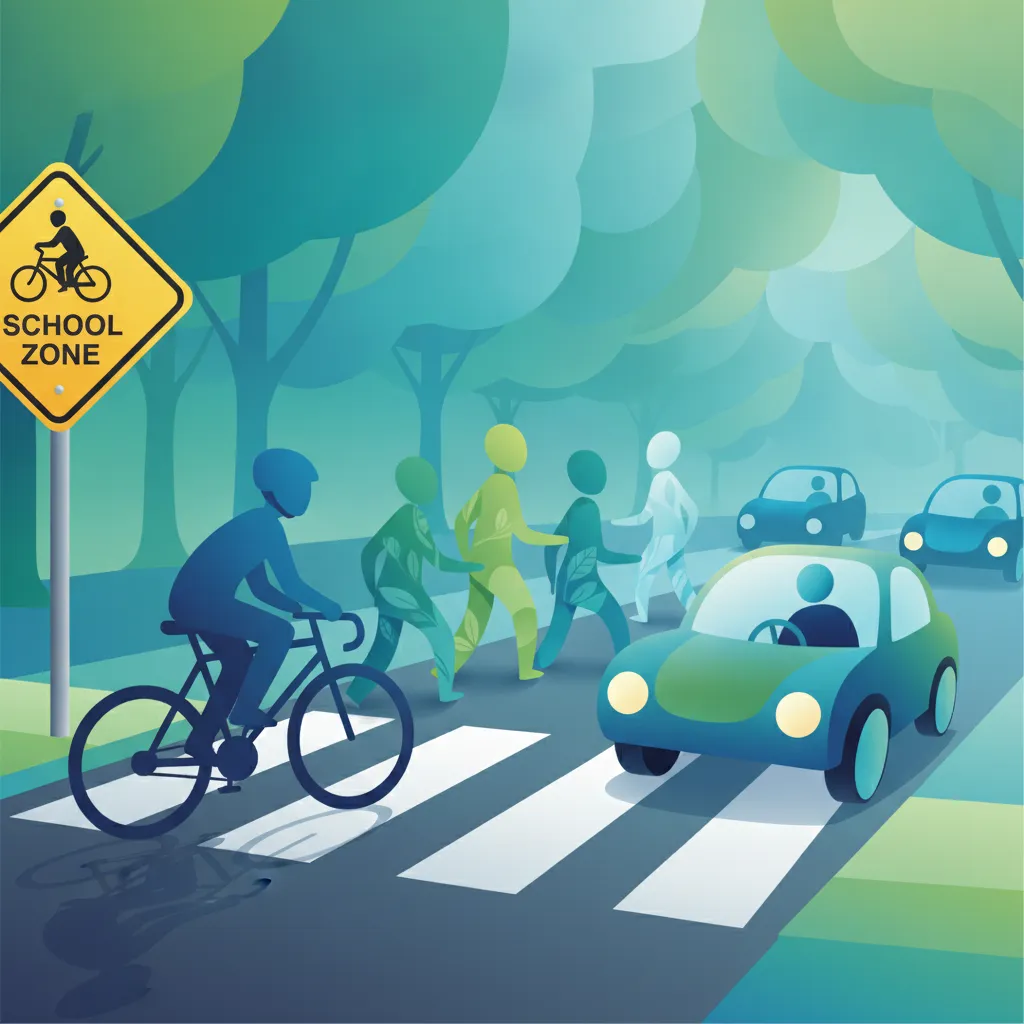
This lesson focuses on the legal requirement to yield to pedestrians on or about to step onto zebra crossings, a major focus of French road safety. You will learn how to approach school zones and pedestrian islands with heightened vigilance and reduced speed. Additionally, the lesson explores shared urban spaces, explaining how to maintain safe lateral distances when overtaking cyclists or personal electric scooters.

This lesson provides practical strategies for managing the physical demands of slow, heavily congested city traffic. You will learn how to maintain excellent low-speed balance through correct body posture, rear brake modulation, and smooth clutch control. It also emphasizes the importance of preserving an adequate safety buffer when stopping behind other vehicles, allowing an immediate escape route if you face a rear-end threat.

This lesson covers the operational logic of traffic light signals in France, emphasizing the legal implications of the red, amber, and green cycles. You will study how to safely manage the amber phase to avoid rear-end collisions from vehicles behind while maintaining control. Additionally, you will discover the unique challenge of electromagnetic induction loops, which sometimes fail to detect lightweight motorcycles at quiet intersections.

This lesson clarifies the legal boundaries of urban infrastructure, highlighting the strict ban on riding motorcycles within bus lanes or cycle paths. You will study French regulations concerning traffic flow, including where and when experimental lane filtering is permitted between lines of stationary cars. Understanding these boundaries ensures you can keep moving through congested areas without risking heavy fines or dangerous collisions.

Learners will learn the critical steps for safely approaching and traversing intersections, emphasizing speed reduction, priority assessment, and adherence to right-of-way rules, including priorité à droite. The lesson covers recognizing stop lines, interpreting road markings, and maintaining a safe distance from other vehicles. By mastering these practices, AM riders can confidently navigate intersections while minimizing collision risk.
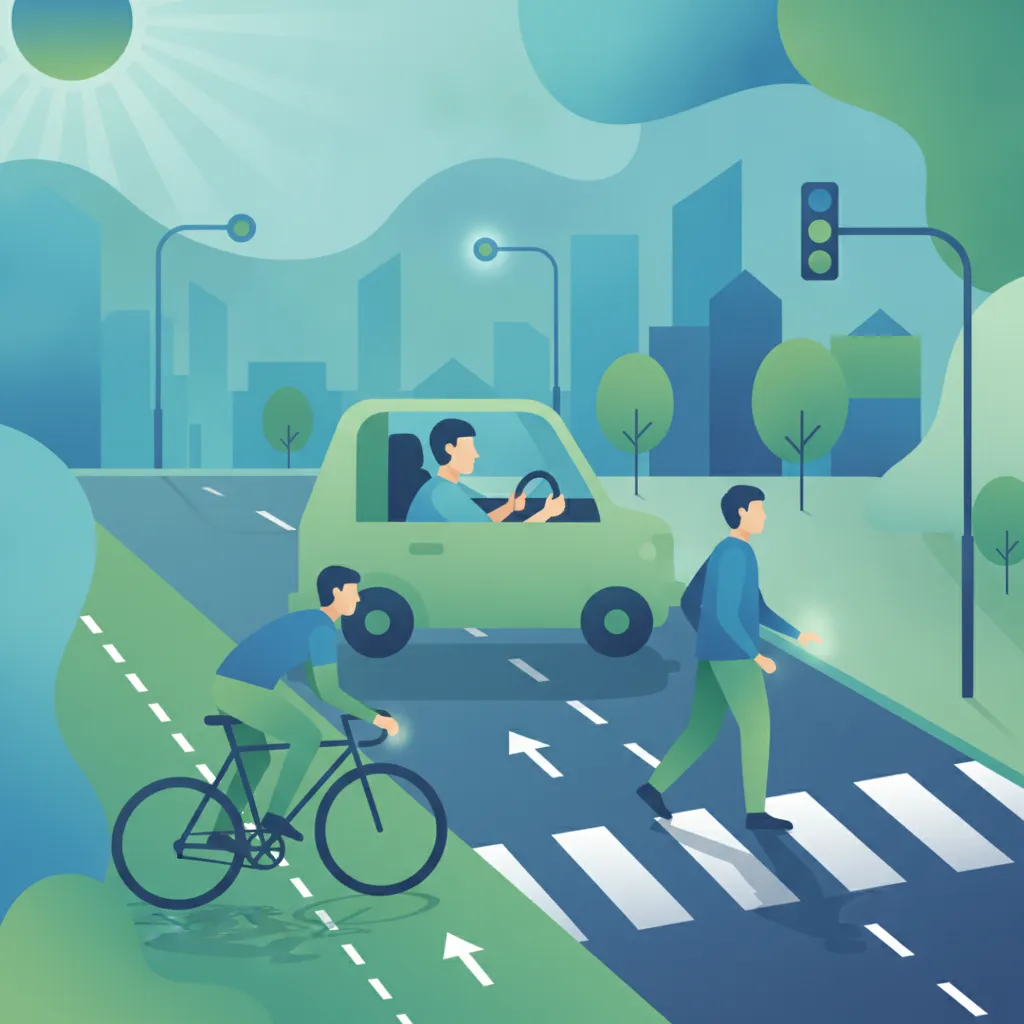
This lesson examines the specific challenges and responsibilities goods vehicle drivers face when interacting with pedestrians and cyclists in urban environments. Learners will understand right-of-way rules, the importance of yielding at pedestrian crossings, and safe turning practices that protect cyclists. The content emphasizes heightened driver vigilance, especially when navigating bike lanes and crowded sidewalks.
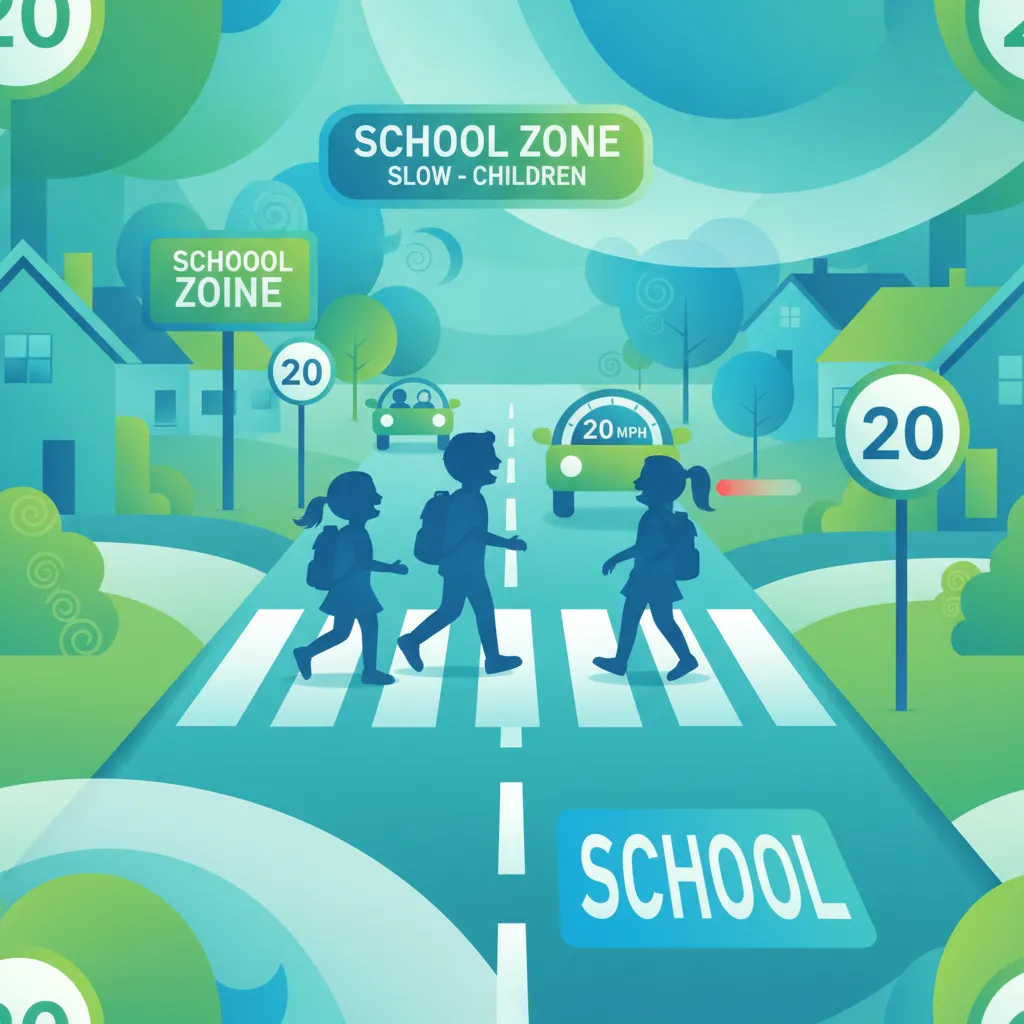
French municipalities utilize distinct low-speed configurations to foster pedestrian safety in residential and educational neighborhoods. This lesson details speed restrictions in 'zone 30', pedestrian-only districts, and shared 'zones de rencontre' where speed is capped at 20 km/h. You will learn how priority hierarchies shift in these zones, giving pedestrians legal priority to use the entire roadway.
This lesson focuses on the skills required to safely enter, navigate, and exit roundabouts, a common feature in French urban environments. Learners will understand the need to yield to circulating traffic, select the appropriate lane upon entry, and signal intentions when exiting. By mastering these techniques, AM riders can safely integrate into roundabout traffic flow and reduce conflicts with other road users.

This lesson analyzes the various traffic challenges unique to operating large passenger vehicles in historic and modern French urban areas. Drivers will learn to manage narrow street layouts, double-parked delivery trucks, and high-density multi-lane roundabouts safely. The lesson emphasizes defensive driving strategies, route adjustments, and maintaining mental focus under severe schedule and time pressures.
Understand how to continuously assess road risks related to weather, road surfaces, and low-light visibility. This theory overview explains how rain, gravel, and night conditions impact motorcycle handling and safety while adhering to French Code de la route requirements.

This lesson focuses on adapting your riding behavior to sudden environmental shifts, such as heavy fog or strong crosswinds on exposed bridges. You will learn specific technical adjustments, including leaning slightly into crosswinds and widening your safety margins during low-visibility fog. The lesson also highlights how seasonal temperature drops affect your tires' ability to warm up and achieve reliable, safe levels of road adhesion.

Learners will explore techniques for maintaining control and safety while riding in rain, focusing on reduced braking efficiency, hydroplaning prevention, and visibility challenges. The lesson emphasizes appropriate speed reduction, tire condition checks, and the use of rain gear to enhance rider comfort and protection. By mastering these adaptations, riders can navigate wet French conditions with confidence.

This lesson addresses the unique hazards of riding a motorcycle in wet conditions, emphasizing the danger of aquaplaning. You will learn how water pooling on the asphalt can cause tires to lose direct contact with the road, leading to a complete loss of steering control. The lesson offers practical advice on reducing your speed, using smooth throttle and brake inputs, and ensuring your tires have adequate tread depth to clear water.

This lesson addresses the distinct safety considerations for riding during daylight hours versus nighttime, covering topics such as managing glare from the sun and ensuring adequate lighting after dark. Learners will learn strategies to maintain visibility, stay alert, and adapt riding techniques to varying light conditions, including the use of reflective gear. Emphasis is placed on proactive planning to mitigate risks associated with reduced visibility, thereby fostering safe riding practices.

This lesson teaches riders how to negotiate loose surfaces such as gravel, sand, and poorly maintained urban asphalt without dropping the motorcycle. You will study correct body positioning, focusing on keeping your weight centered and your grip relaxed on the handlebars. The lesson also highlights why smooth, constant throttle delivery and avoiding abrupt front braking are essential to prevent the front wheel from washing out.

Adverse weather reduces tyre traction and limits visibility, dramatically raising the risk of multi-car accidents on highways. This lesson details speed reductions required during rainfall, techniques for avoiding aquaplaning, and demisting windshields for visibility. You will learn how to maintain extra stopping distance on snow-covered roads and the correct headlight adjustments to make during fog.

This lesson examines how different road surfaces affect tire grip and vehicle stability. Learners will explore strategies for maintaining traction on wet surfaces, gravel, and irregular roadways, including appropriate lean angles and smooth throttle control under French road conditions. Understanding these principles helps riders avoid slip incidents and preserve control during cornering and braking.
This lesson focuses on the skill of adjusting speed according to real-time road conditions, visibility, and traffic density. Learners will learn to assess factors such as weather, road surface quality, and pedestrian activity to determine a safe riding speed under French regulatory expectations. By mastering adaptive speed control, riders can enhance safety and reduce the likelihood of accidents caused by inappropriate speed.

Learners will develop the ability to anticipate potential hazards on the road, enhancing reaction times and defensive riding strategies. The lesson emphasizes constant scanning, early identification of threats such as sudden stops, pedestrian crossings, or unexpected lane changes, and appropriate response measures. By cultivating proactive risk assessment, AM riders can significantly reduce accident likelihood.
This lesson covers the mechanical and physical adaptations required to drive a passenger coach in rain, heavy fog, snow, and crosswinds. Drivers will learn to recognize signs of aquaplaning and understand the dramatic traction loss associated with wet or icy roads. It also details French winter equipment regulations (Loi Montagne) requiring snow tires or chains in designated mountainous regions.
Find clear answers to common questions learners have about Defensive Riding Strategies and Continuous Risk Assessment. Learn how the lesson is structured, which driving theory objectives it supports, and how it fits into the overall learning path of units and curriculum progression in France. These explanations help you understand key concepts, lesson flow, and exam focused study goals.
The exam tests your ability to anticipate danger rather than just following signs. Demonstrating an understanding of defensive positioning and proactive hazard scanning is key to scoring highly on perception-based questions.
A high-mileage visual lead means scanning far down the road rather than just at the vehicle ahead. It gives you more time to react to braking, changing lights, or lane shifts, which is a critical safety habit for motorcyclists.
Always adjust your visual scanning frequency based on the environment. In urban areas, you should focus on potential lateral conflicts like intersections or pedestrians, while on motorways, your focus should be further ahead to manage high-speed spacing.
No, defensive riding means adjusting your speed to the conditions to ensure you have a safety buffer. It is about being prepared to react safely, which sometimes means slowing down but often means simply being in the right lane position for maximum visibility.
Ready to focus your study? Use the practice search to find exactly the French driving theory questions you need for the Code de la route and permis de conduire ETG. Refine your knowledge on specific topics or challenging rules to boost your confidence and exam readiness.