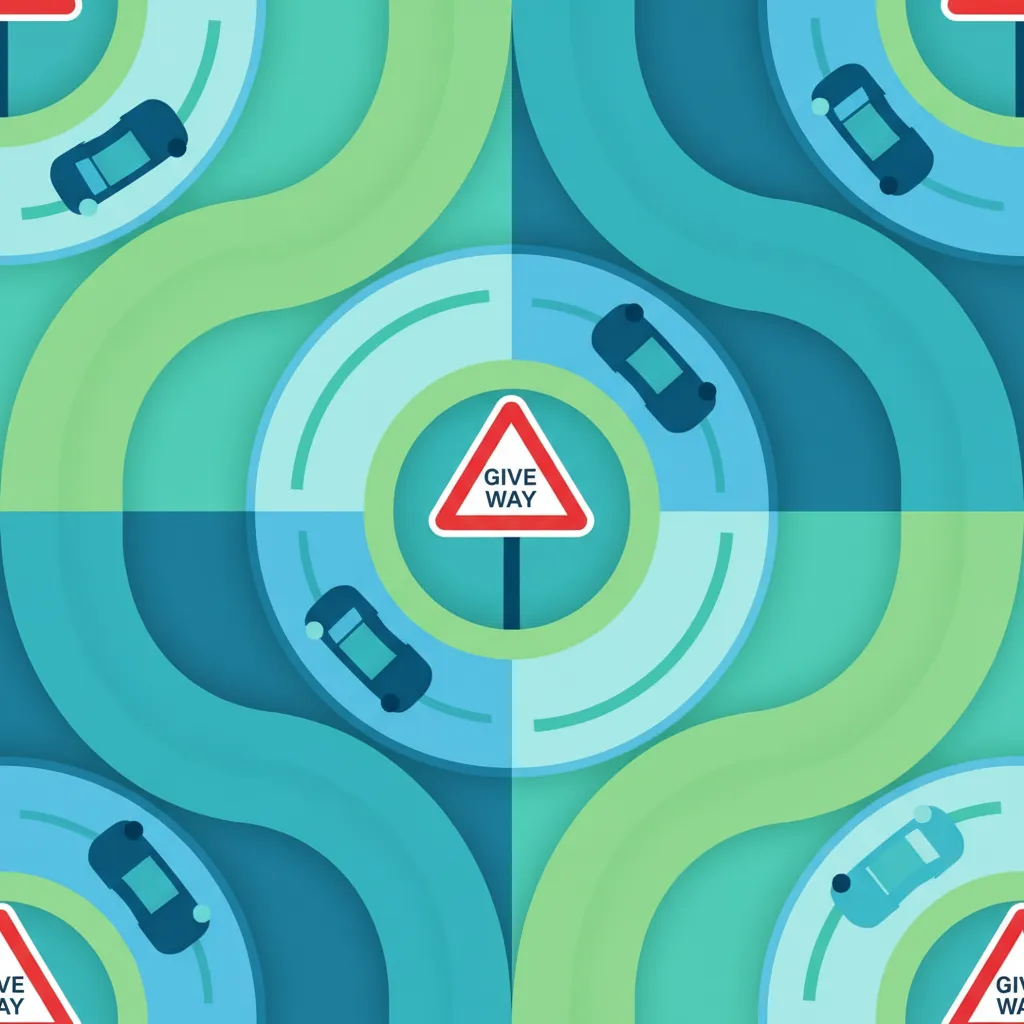
Roundabouts, or 'rondo' in Polish, are designed to improve traffic flow and safety, but they operate under specific priority rules. In Poland, these rules are typically indicated by road signs and markings, most commonly requiring drivers to yield to traffic already within the roundabout. Knowing these rules ensures you can safely enter, navigate, and exit these circular intersections.
Theory topic content overview
Read the full theory topic guide for Roundabout Priority with structured, easy-to-scan content built for learners in Poland. This detailed section explains the exact rule, meaning, traffic context, comparison points, and exam logic behind this Polish driving theory topic so you can study faster, understand the concept more clearly, and avoid common interpretation mistakes on the theory test.
Roundabouts, known as rondo in Polish, are critical junctions designed to enhance traffic flow and safety. However, they are a frequent source of confusion for learner drivers in Poland, particularly regarding priority rules. Mastering roundabout priority rules in Poland is not only essential for safe driving but also a common focus in the Polish driving theory exam.
At its core, roundabout priority dictates which vehicle has the right to proceed first at various points within a circular intersection. In Poland, the general principle is that traffic already circulating within the rondo typically has priority over vehicles entering it. This is a crucial distinction from the default "right-hand priority" rule at unmarked intersections.
Understanding who has pierwszeństwo (priority) at a rondo is paramount for several reasons:
ustąp pierwszeństwa).Prawo o ruchu drogowym: Adhering to Polish traffic law is a fundamental responsibility of every driver.The vast majority of roundabouts in Poland operate under a specific, clearly signed priority system.
In Poland, if you see the A-7 Ustąp pierwszeństwa (Give Way) sign combined with the C-12 Ruch okrężny (Roundabout) sign at the entrance to a rondo, vehicles already circulating within the roundabout have priority. This means you must yield to any traffic approaching from your left that is already inside the roundabout before entering.
A-7 Ustąp pierwszeństwa: This triangular warning sign indicates you must yield to traffic on the intersecting road or, in this case, to traffic already on the roundabout.C-12 Ruch okrężny: This blue circular mandatory sign indicates a roundabout and that traffic must travel in the direction of the arrows.Together, these signs unequivocally establish that incoming traffic must give way.
rondo and on your approach.A-7 and C-12 signs. If present (which they almost always are in Poland), be prepared to yield.rondo that would be forced to slow down or change their path by your entry, you must stop or slow down and wait for a safe gap.Once you are inside the rondo and the priority has been established by the A-7 sign at entry points, you generally have priority over vehicles trying to enter.
rondo unless you intend to take the very first exit immediately.While most Polish roundabouts follow the A-7/C-12 rule, there are some variations:
rondo is not signed with A-7 Ustąp pierwszeństwa at its entries, the general right-hand priority rule (zasada prawej ręki) applies. This means vehicles entering from your right would have priority. However, such roundabouts are uncommon and often temporary or in very low-traffic areas. The exam focuses almost exclusively on signed roundabouts.rondo, it often has priority regardless of other signs, especially when entering or leaving a roundabout or when turning. Always be vigilant for trams.A common area of confusion for Polish learners is distinguishing between general right-hand priority and signed roundabout priority.
Roundabout Priority (Signed with A-7/C-12) vs. General Right-Hand Priority:
Rondo: Vehicles inside the roundabout have priority. Drivers entering must ustąp pierwszeństwa. This is the prevailing rule in Poland.A-7 (which is very rare). Always assume signed priority.A-7 Ustąp pierwszeństwa vs. B-20 STOP at Roundabouts:
A-7 Ustąp pierwszeństwa: Requires you to yield, which means you must be prepared to stop if necessary, but you don't have to stop if the path is clear and safe.B-20 STOP: Requires you to come to a complete stop, even if the roundabout appears clear, before proceeding safely. This sign is less common at roundabout entries but can appear at complex junctions.Standard Single-Lane Rondo: You are approaching a rondo in a smaller Polish town. You see the A-7 Ustąp pierwszeństwa and C-12 Ruch okrężny signs. A car is currently circulating on your left, approaching your entry.
Multi-Lane Rondo (e.g., in a city like Warsaw or Kraków): You want to take the third exit (straight ahead) on a two-lane rondo. You've followed signs indicating the inner lane for "straight/left" turns.
Roundabout with a Tram Crossing: You are entering a rondo and a tram line crosses your path. A tram is approaching the roundabout from your right.
Learners in Poland often make these errors regarding rondo priority:
zasada prawej ręki (right-hand priority rule) to a roundabout clearly marked with A-7 and C-12. Remember, the signs override the general rule.rondo without adequately checking for or yielding to vehicles already inside. This forces other drivers to react, creating a hazard.When approaching any rondo in Poland, your primary focus must be on observing road signs. The A-7 Ustąp pierwszeństwa sign, almost always paired with C-12 Ruch okrężny, is your most important cue. It dictates that you must yield to traffic already in the roundabout.
Always:
By consistently applying these rules, you will navigate rondo safely and confidently, both in your daily driving and in your Polish driving theory exam.
In Poland, roundabouts (rondo) operate under clear priority rules where vehicles already circulating have priority over those entering. The A-7 Give Way sign combined with the C-12 Roundabout sign at entries establishes this rule, requiring drivers to yield. When entering, approach with caution, scan for circulating traffic from your left, and yield if necessary. Once inside, you have priority over entering vehicles. When exiting, activate your right indicator after passing the exit before your intended one. Multi-lane roundabouts require proper lane selection before entering based on your planned exit, and signaling is essential for safe maneuvering. Always observe road signs as your primary cue, and remember that trams have special priority rules at roundabouts.
A short set of high-value points that capture the most important ideas from this theory explanation.
Vehicles already circulating within a roundabout have priority over those entering it in Poland
The A-7 Give Way sign combined with the C-12 Roundabout sign establishes the yield rule at entries
Approach roundabouts with caution, slow down in advance, and scan for circulating traffic
Use your right indicator when passing the exit before your intended exit to signal your exit intention
At multi-lane roundabouts, select the appropriate lane before entering based on your intended exit
A-7 Ustąp pierwszeństwa means yield to circulating traffic; B-20 STOP requires a complete stop
Right-hand priority (zasada prawej ręki) does NOT apply at signed roundabouts marked with A-7 and C-12
On multi-lane roundabouts, the outer lane is typically used for first exits and the inner lane for continuing or later exits
You do not signal when entering a roundabout unless taking the very first exit immediately
Trams have special priority at roundabouts in Poland and always take precedence over other traffic
Assuming right-hand priority applies to roundabouts with A-7 and C-12 signs when circulating vehicles actually have priority
Failing to adequately check for and yield to vehicles already inside the roundabout before entering
Not signaling or signaling too late when exiting, which confuses other drivers and pedestrians
Choosing the wrong lane upon entering a multi-lane roundabout, leading to dangerous late lane changes
Excessive hesitation when a clear gap exists, impeding traffic flow for vehicles behind
Start with a short, direct summary of Roundabout Priority before reading the full explanation below.
In Poland, the general rule for roundabouts is that vehicles already circulating within the roundabout have priority over vehicles entering it. This is usually enforced by the 'Ustąp pierwszeństwa' (A-7 Give Way) sign and the 'Ruch okrężny' (C-12 Roundabout) sign at the entry points. Always approach with caution, observe traffic, and be prepared to yield before entering.
Review the most important terms, rule signals, and traffic concepts linked to Roundabout Priority.
Explore related theory topic pages connected to Roundabout Priority and continue with the next useful rule explanation.
See the common search queries learners use when trying to understand Roundabout Priority in Poland.

Continue your preparation by exploring specific Polish driving theory topics in detail. Review each section to reinforce your understanding of traffic rules, road signs, and safe driving practices. Our comprehensive explanations are structured to support your learning journey and help you confidently approach the official driving licence theory exam.
Polish Driving Theory TopicsTheory topic content overview
A short set of high-value points that capture the most important ideas from this theory explanation.
Vehicles already circulating within a roundabout have priority over those entering it in Poland
The A-7 Give Way sign combined with the C-12 Roundabout sign establishes the yield rule at entries
Approach roundabouts with caution, slow down in advance, and scan for circulating traffic
Use your right indicator when passing the exit before your intended exit to signal your exit intention
At multi-lane roundabouts, select the appropriate lane before entering based on your intended exit
A-7 Ustąp pierwszeństwa means yield to circulating traffic; B-20 STOP requires a complete stop
Right-hand priority (zasada prawej ręki) does NOT apply at signed roundabouts marked with A-7 and C-12
On multi-lane roundabouts, the outer lane is typically used for first exits and the inner lane for continuing or later exits
You do not signal when entering a roundabout unless taking the very first exit immediately
Trams have special priority at roundabouts in Poland and always take precedence over other traffic
Assuming right-hand priority applies to roundabouts with A-7 and C-12 signs when circulating vehicles actually have priority
Failing to adequately check for and yield to vehicles already inside the roundabout before entering
Not signaling or signaling too late when exiting, which confuses other drivers and pedestrians
Choosing the wrong lane upon entering a multi-lane roundabout, leading to dangerous late lane changes
Excessive hesitation when a clear gap exists, impeding traffic flow for vehicles behind
Start with a short, direct summary of Roundabout Priority before reading the full explanation below.
In Poland, the general rule for roundabouts is that vehicles already circulating within the roundabout have priority over vehicles entering it. This is usually enforced by the 'Ustąp pierwszeństwa' (A-7 Give Way) sign and the 'Ruch okrężny' (C-12 Roundabout) sign at the entry points. Always approach with caution, observe traffic, and be prepared to yield before entering.
Review the most important terms, rule signals, and traffic concepts linked to Roundabout Priority.
Explore related theory topic pages connected to Roundabout Priority and continue with the next useful rule explanation.
See the common search queries learners use when trying to understand Roundabout Priority in Poland.
Continue your preparation by exploring specific Polish driving theory topics in detail. Review each section to reinforce your understanding of traffic rules, road signs, and safe driving practices. Our comprehensive explanations are structured to support your learning journey and help you confidently approach the official driving licence theory exam.
Polish Driving Theory TopicsUse this exam-focused revision tip to understand how Roundabout Priority is likely to appear in theory questions for learners in Poland. This section helps you identify the most testable part of the rule, avoid common traps, and remember the concept more effectively during Polish driving theory exam preparation.
A common exam trap involves roundabouts where the 'Ustąp pierwszeństwa' (A-7) sign is crucial. Remember: if you see this sign at the entrance, you MUST yield to all traffic already circulating in the roundabout. Do not assume 'right before left' unless there are absolutely no priority signs present.
Read direct answers to the most common learner questions about Roundabout Priority in Poland. This FAQ focuses on rule confusion, practical meaning, comparison with similar concepts, and the exact uncertainties that appear most often in Polish driving theory revision and exam preparation.
The fundamental rule in Poland is that vehicles already on the roundabout have priority over those attempting to enter, unless otherwise indicated by signs or signals.
You will typically see the 'Ruch okrężny' (C-12 Roundabout) sign combined with the 'Ustąp pierwszeństwa' (A-7 Give Way) sign at the entry points of most roundabouts, mandating that entering traffic yields.
Generally, yes, if the entrance is marked with the 'Ustąp pierwszeństwa' (A-7) sign. However, always check for specific signage, as some older or signalized roundabouts may have different rules.
You typically do not signal when entering the roundabout unless turning immediately right. You must signal right when you intend to exit the roundabout, giving sufficient notice to other drivers.
For multi-lane roundabouts, choose your lane based on your intended exit. Generally, the right lane is for early exits (first or second exit), and inner lanes are for later exits. Always check road markings and signs.
While less common, some older or unmarked roundabouts might operate under the 'right before left' rule if no specific priority signs are present. However, modern roundabouts almost universally require yielding to circulating traffic.
At pedestrian crossings at roundabout exits or entries, drivers must yield to pedestrians who are on or about to enter the crossing, just like at any other intersection.
Build custom practice sessions tailored precisely to your needs. Focus on areas requiring improvement, review specific Polish road signs, or master complex traffic rules to ensure full preparation for your official driving license exam.