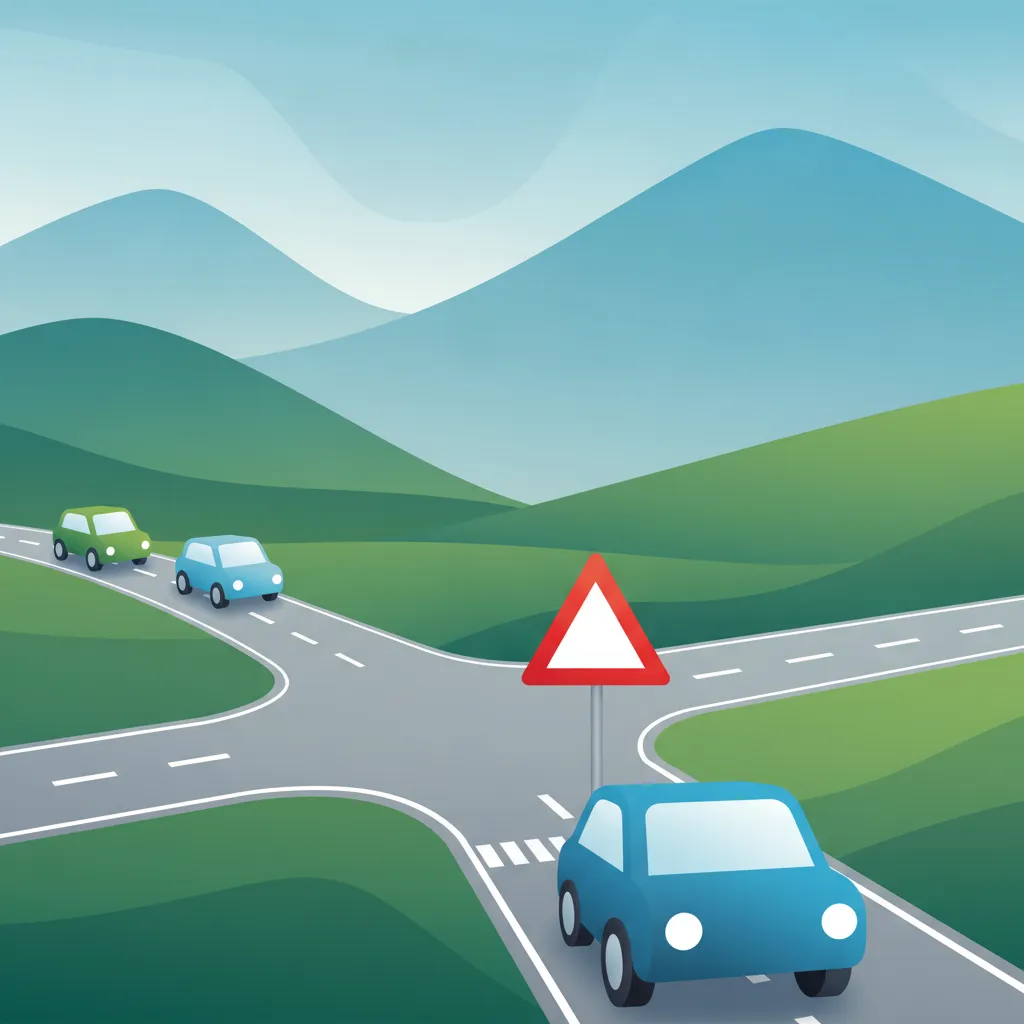
The Give Way sign (official Swiss Signal 3.01: Vortritt gewähren, céder le passage, dare precedenza) is a fundamental instruction for managing priority at intersections. Unlike a Stop sign, it does not always require a complete stop, but demands careful observation to ensure you yield to all traffic on the priority road. Mastering this rule is essential for safe driving and passing your Swiss theory exam.
Theory topic content overview
Read the full theory topic guide for Give Way Sign Rules with structured, easy-to-scan content built for learners in Switzerland. This detailed section explains the exact rule, meaning, traffic context, comparison points, and exam logic behind this Swiss driving theory topic so you can study faster, understand the concept more clearly, and avoid common interpretation mistakes on the theory test.
The Give Way sign (official Swiss Signal 3.01), known locally as Vortritt gewähren (German), céder le passage (French), or dare precedenza (Italian), is a triangular traffic sign with a red border and a white inverted triangle. Its presence is a fundamental instruction in Swiss traffic law, indicating that you, as the driver, must yield priority to traffic on the intersecting road or from a specific direction before proceeding.
Unlike some other priority rules, the Give Way sign is an explicit command requiring drivers to actively assess and respond to the traffic situation, ensuring the smooth and safe flow of priority traffic. Mastering this rule is not just about avoiding collisions; it's about understanding the hierarchy of the Swiss road network and contributing to efficient traffic movement.
In Switzerland, where road networks are often intricate and traffic can be dense, especially in urban and tourist areas, clear priority rules are paramount. The Give Way sign serves several critical functions:
Signal 3.01 are a cornerstone of the Swiss driving theory exam. They test your judgment, observation skills, and understanding of priority rules (Vortrittsregeln), particularly your ability to identify when a complete stop is necessary versus when you can proceed safely without stopping.When you encounter a Give Way sign in Swiss traffic, your actions must be deliberate and measured:
Signal 3.01, reduce your speed and begin to assess the intersection (Strassenverzweigung). Identify which road has priority and from which directions traffic might approach.Several factors can influence how you apply the Give Way rule:
One of the most common points of confusion for learners in Switzerland is the difference between the Give Way sign (Signal 3.01) and the Stop sign (Signal 3.02). While both command you to yield, the key difference lies in the mandatory stop:
Vortritt gewähren): You must yield to priority traffic. You are required to slow down and be prepared to stop. You may proceed without stopping if the priority road is absolutely clear and your movement will not disrupt any priority traffic. There is no specific stop line; you stop where you have clear visibility without obstructing.Stop): You must come to a complete and mandatory stop before the stop line, or if there is no line, at the intersection's edge where you have the best view of priority traffic. You then proceed only when the priority road is clear and safe, just as with a Give Way sign. The full stop is non-negotiable, regardless of whether traffic is visible or not.In short: A Stop sign always demands a full stop. A Give Way sign demands a full stop only if necessary to yield. Both demand you do not impede priority traffic.
The Give Way sign (Vortritt gewähren) is a constant reminder that driving is a cooperative act. In Switzerland, respecting priority rules is fundamental to road safety and efficient traffic flow. Always approach Signal 3.01 with an active mindset: Observe, Judge, and Act only when certain you will not impede priority traffic. When in doubt, always err on the side of caution and yield. Your ability to correctly interpret and apply this rule demonstrates maturity and competence, essential qualities for passing your Swiss driving theory exam and for safe driving throughout your career.
Start with a short, direct summary of Give Way Sign Rules before reading the full explanation below.
The Give Way sign instructs drivers to yield to traffic on the intersecting road. In Switzerland, this means you must slow down and be prepared to stop, proceeding only when the priority road is clear and your entry will not force other drivers to brake or swerve. It is crucial for maintaining a smooth traffic flow and preventing dangerous situations at junctions where you do not have right-of-way.
Review the most important terms, rule signals, and traffic concepts linked to Give Way Sign Rules.
Explore related theory topic pages connected to Give Way Sign Rules and continue with the next useful rule explanation.
See the common search queries learners use when trying to understand Give Way Sign Rules in Switzerland.

Continue your preparation by exploring specific Swiss traffic rules, road signs, and essential driving concepts. Strengthen your knowledge of official legislation and practical application to ensure complete readiness for your driving licence theory examination.
Explore Swiss Driving Theory TopicsTheory topic content overview
Start with a short, direct summary of Give Way Sign Rules before reading the full explanation below.
The Give Way sign instructs drivers to yield to traffic on the intersecting road. In Switzerland, this means you must slow down and be prepared to stop, proceeding only when the priority road is clear and your entry will not force other drivers to brake or swerve. It is crucial for maintaining a smooth traffic flow and preventing dangerous situations at junctions where you do not have right-of-way.
Review the most important terms, rule signals, and traffic concepts linked to Give Way Sign Rules.
Explore related theory topic pages connected to Give Way Sign Rules and continue with the next useful rule explanation.
See the common search queries learners use when trying to understand Give Way Sign Rules in Switzerland.
Continue your preparation by exploring specific Swiss traffic rules, road signs, and essential driving concepts. Strengthen your knowledge of official legislation and practical application to ensure complete readiness for your driving licence theory examination.
Explore Swiss Driving Theory TopicsUse this exam-focused revision tip to understand how Give Way Sign Rules is likely to appear in theory questions for learners in Switzerland. This section helps you identify the most testable part of the rule, avoid common traps, and remember the concept more effectively during Swiss driving theory exam preparation.
In Swiss driving theory exams, scenarios involving Give Way signs often test your ability to assess traffic flow and potential hazards. Pay close attention to the speed and distance of approaching priority vehicles. Remember, if you cause a priority vehicle to alter its speed or direction, you have failed to yield correctly.
Read direct answers to the most common learner questions about Give Way Sign Rules in Switzerland. This FAQ focuses on rule confusion, practical meaning, comparison with similar concepts, and the exact uncertainties that appear most often in Swiss driving theory revision and exam preparation.
The Give Way sign (Signal 3.01 in Switzerland) instructs you to yield to all traffic on the intersecting road. This means you must allow other vehicles to pass before you proceed, ensuring you do not obstruct or endanger them.
No, unlike a Stop sign, a complete stop is not always mandatory. You must slow down, observe the traffic, and be prepared to stop. If the road is clearly free of priority traffic, you may proceed without stopping, but only if it's safe to do so.
A Give Way sign requires you to yield to priority traffic, stopping only if necessary. A Stop sign (Signal 3.02) requires you to come to a complete halt before the stop line, even if the road appears clear, before observing traffic and proceeding.
When approaching a Give Way sign, reduce your speed, check for traffic from both directions on the priority road, and be ready to brake. Only enter the intersection when it is safe and you will not force any priority vehicles to slow down or change course.
Learners often mistake 'yield' for 'always stop,' fail to adequately check for traffic, or misjudge the speed of approaching priority vehicles. The exam emphasizes correct observation and the ability to proceed safely without disruption.
Yes, when you have a Give Way sign, you must also yield to pedestrians and cyclists crossing your path on the priority road or in areas where they have right-of-way, such as pedestrian crossings that are part of the priority route.
Pinpoint specific Swiss traffic rules, road signs, or driving situations you need to master. Use the practice search to start a focused revision session now and build confidence for your official driving theory exam.