
Giving way means allowing other road users to proceed first to ensure a smooth and safe flow of traffic. In Switzerland, specific rules and signs govern when and where you must yield. This page clarifies these essential "Vortrittsregeln" to help you navigate intersections, roundabouts, and pedestrian crossings correctly and confidently.
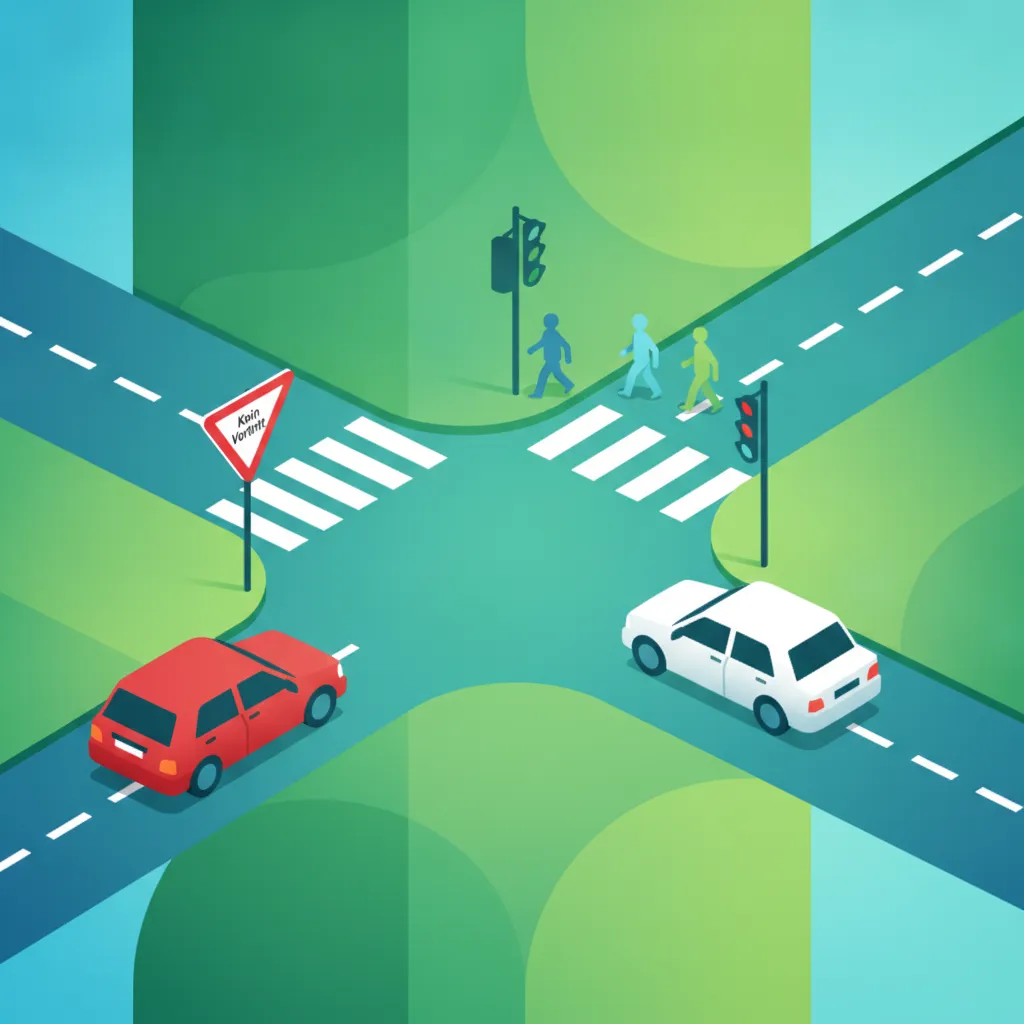
Theory topic content overview
Read the full theory topic guide for Swiss Give Way Rules (Vortritt) with structured, easy-to-scan content built for learners in Switzerland. This detailed section explains the exact rule, meaning, traffic context, comparison points, and exam logic behind this Swiss driving theory topic so you can study faster, understand the concept more clearly, and avoid common interpretation mistakes on the theory test.
Giving way, or Vortritt gewähren in Switzerland, means allowing another road user to proceed first at a junction or conflict point. It's a fundamental principle of safe driving designed to prevent collisions and ensure a smooth, predictable flow of traffic. When you give way, you must adjust your speed, and be prepared to slow down or even stop completely, to ensure that the road user with priority can continue without obstruction or danger.
Understanding these Vortrittsregeln (priority rules) is not just about avoiding fines; it's about anticipating the actions of others and making safe, timely decisions. This is especially crucial in Switzerland's diverse road environments, from busy urban intersections to quiet alpine village roads.
Mastering give way rules is non-negotiable for anyone driving in Switzerland. Here's why:
Vortritt rules directly reduces the risk of collisions.Strassenverkehrsgesetz SVG and Verkehrsregelnverordnung VRV) strictly governs priority. Violations can lead to significant penalties.Rechtsvortritt and interpreting signs like Kein Vortritt, are frequently featured in the official Swiss driving theory test. A solid grasp is vital for passing.Vortritt is a key indicator of a competent driver.When you approach a potential conflict point in Swiss traffic, you must determine who has Vortritt by following a clear hierarchy:
Stop or Kein Vortritt (Yield) and road markings such as stop lines or yield lines dictate priority.Allgemeine Regeln): If no signals or signs are present, general rules apply, most notably Rechtsvortritt (right-hand priority).Let's break down the most common give way situations you'll encounter in Switzerland:
Rechtsvortritt (Right-Hand Priority)This is a cornerstone of Swiss traffic law and a common point of confusion for learners.
Rechtsvortritt applies at uncontrolled intersections where there are no traffic lights, no traffic signs indicating priority, and no road markings dictating otherwise. In this scenario, vehicles approaching from your right have priority.Rechtsvortritt applies, even if your road seems more significant. Always assume Rechtsvortritt unless a sign or signal explicitly states otherwise.Kein Vortritt (Yield) Sign (Signal 3.02)Wartelinie (yield line - dashed white line) on the road.Stop Sign (Signal 3.01)Haltelinie (stop line – solid white line) or, if no line is present, at a point where you have a clear view of the intersecting road. Even if the road is completely clear, you must stop. Only proceed when it is safe to do so, giving way to all traffic on the priority road.Fussgängerstreifen. As a driver, you must give way to pedestrians who are already on the crossing or who clearly indicate their intention to cross.Kein Vortritt signs at each entry point.Autobahn or Autostrasse via an acceleration lane, you must adjust your speed to match the flow of traffic and give way to vehicles already on the main carriageway. Use your indicators and merge when it is safe and clear.Signal 3.09: Dem Gegenverkehr Vortritt lassen (Give way to oncoming traffic) means you must yield. Signal 3.10: Vortritt vor dem Gegenverkehr (Priority over oncoming traffic) means you have priority.Trams (trams) generally have priority. Additionally, buses often have priority when moving off from a bus stop, especially if they indicate their intention to pull out.To excel in the Swiss driving theory exam and drive safely, clarify these points:
Rechtsvortritt vs. "Main Road" Fallacy: Never assume the wider or straighter road has priority without explicit signs or signals. Rechtsvortritt is the default at uncontrolled junctions in Switzerland.Stop vs. Kein Vortritt (Yield): A Stop sign demands a complete halt, regardless of traffic. A Kein Vortritt sign requires you to be prepared to stop and only stop if traffic requires it.Vortrittsregeln.Vortritt. The rules of the road dictate priority.Rechtsvortritt applies unless signs dictate otherwise). If flashing amber, lights are regulating traffic with caution, but you still need to look for signs or apply Rechtsvortritt if none are present.Lieferwagen (delivery van) approaches from your right.
Rechtsvortritt applies. You must slow down and allow the Lieferwagen to proceed first.Kein Vortritt sign at the entrance.
Fussgängerstreifen in a residential area. A pedestrian is standing at the curb, looking in your direction.
Learners often struggle with these aspects of Vortrittsregeln:
Rechtsvortritt: This is the most common error, often due to assuming a "main road" has priority without signs.Stop signs: Rolling through a Stop sign is a serious offence, even if the road appears clear.Kein Vortritt with Stop or not noticing a priority sign at all.To confidently apply give way rules in Switzerland, adopt this mental checklist at every potential conflict point:
Stop or Kein Vortritt signs, or Vortrittstrasse (priority road) signs? (Override general rules).Rechtsvortritt? If none of the above, is there a vehicle approaching from your right? (Give way to your right).Always be ready to slow down or stop, and drive defensively. Prioritise safety above all else, even if you technically have priority, if another road user makes a mistake. This proactive approach to Vortritt is key to safe and successful driving in Switzerland.
Swiss give-way rules (Vortrittsregeln) establish a clear priority hierarchy where police instructions override all else, followed by traffic signals, then traffic signs, and finally general rules including the fundamental Rechtsvortritt principle. At uncontrolled intersections, vehicles approaching from your right always have priority regardless of road appearance, making it essential to check right before proceeding. The Stop sign requires a mandatory complete halt, while the Kein Vortritt (Yield) sign requires you to be prepared to stop and only halt if traffic is present. Roundabouts require yielding to circulating traffic from the left, and pedestrians at marked crossings have strong priority rights that drivers must always respect.
A short set of high-value points that capture the most important ideas from this theory explanation.
In Switzerland, priority is determined by a strict hierarchy: police instructions override all else, followed by traffic signals, then traffic signs, and finally general rules
Rechtsvortritt (right-hand priority) applies at ALL uncontrolled intersections regardless of road width or appearance, unless signs explicitly state otherwise
A Stop sign requires a mandatory complete halt, while a Kein Vortritt (Yield) sign only requires stopping if traffic is actually approaching
Vehicles already inside a roundabout always have priority over those attempting to enter
Pedestrians at marked Fussgängerstreifen have strong priority rights that drivers must respect
The Rechtsvortritt rule applies at uncontrolled intersections where no signs, signals, or markings indicate otherwise—never assume a wider road has priority
Stop sign demands a full halt behind the stop line; Kein Vortritt allows proceeding without stopping if the road is clear
At roundabouts, always give way to circulating traffic from your left and signal your exit when passing the exit before yours
When traffic lights are off or showing flashing amber, treat the intersection as uncontrolled and apply Rechtsvortritt
Public transport vehicles (trams and buses pulling out) have priority in built-up areas
Assuming a wider or straighter-looking road has automatic priority without checking for signs—this violates Rechtsvortritt
Rolling through a Stop sign instead of making a complete halt, even when the road appears clear
Confusing Kein Vortritt and Stop signs, leading to either unnecessary stops or failure to yield properly
Failing to anticipate pedestrians at crossings who may be about to step onto the Fussgängerstreifen
Hesitating at uncontrolled intersections due to uncertainty about Rechtsvortritt, disrupting traffic flow
Start with a short, direct summary of Swiss Give Way Rules (Vortritt) before reading the full explanation below.
Giving way in Switzerland means allowing other vehicles or pedestrians to proceed before you, to avoid conflict and maintain safety. This is mandatory at specific intersections, based on traffic signs (like 'Kein Vortritt' or 'Stop'), traffic signals, and the fundamental 'Rechtsvortritt' (right-hand priority) rule at uncontrolled junctions. Always be prepared to slow down or stop to ensure a clear path for those with priority.
Review the most important terms, rule signals, and traffic concepts linked to Swiss Give Way Rules (Vortritt).
Explore related theory topic pages connected to Swiss Give Way Rules (Vortritt) and continue with the next useful rule explanation.
See the common search queries learners use when trying to understand Swiss Give Way Rules (Vortritt) in Switzerland.

Continue your preparation by exploring specific Swiss traffic rules, road signs, and essential driving concepts. Strengthen your knowledge of official legislation and practical application to ensure complete readiness for your driving licence theory examination.
Explore Swiss Driving Theory TopicsTheory topic content overview
A short set of high-value points that capture the most important ideas from this theory explanation.
In Switzerland, priority is determined by a strict hierarchy: police instructions override all else, followed by traffic signals, then traffic signs, and finally general rules
Rechtsvortritt (right-hand priority) applies at ALL uncontrolled intersections regardless of road width or appearance, unless signs explicitly state otherwise
A Stop sign requires a mandatory complete halt, while a Kein Vortritt (Yield) sign only requires stopping if traffic is actually approaching
Vehicles already inside a roundabout always have priority over those attempting to enter
Pedestrians at marked Fussgängerstreifen have strong priority rights that drivers must respect
The Rechtsvortritt rule applies at uncontrolled intersections where no signs, signals, or markings indicate otherwise—never assume a wider road has priority
Stop sign demands a full halt behind the stop line; Kein Vortritt allows proceeding without stopping if the road is clear
At roundabouts, always give way to circulating traffic from your left and signal your exit when passing the exit before yours
When traffic lights are off or showing flashing amber, treat the intersection as uncontrolled and apply Rechtsvortritt
Public transport vehicles (trams and buses pulling out) have priority in built-up areas
Assuming a wider or straighter-looking road has automatic priority without checking for signs—this violates Rechtsvortritt
Rolling through a Stop sign instead of making a complete halt, even when the road appears clear
Confusing Kein Vortritt and Stop signs, leading to either unnecessary stops or failure to yield properly
Failing to anticipate pedestrians at crossings who may be about to step onto the Fussgängerstreifen
Hesitating at uncontrolled intersections due to uncertainty about Rechtsvortritt, disrupting traffic flow
Start with a short, direct summary of Swiss Give Way Rules (Vortritt) before reading the full explanation below.
Giving way in Switzerland means allowing other vehicles or pedestrians to proceed before you, to avoid conflict and maintain safety. This is mandatory at specific intersections, based on traffic signs (like 'Kein Vortritt' or 'Stop'), traffic signals, and the fundamental 'Rechtsvortritt' (right-hand priority) rule at uncontrolled junctions. Always be prepared to slow down or stop to ensure a clear path for those with priority.
Review the most important terms, rule signals, and traffic concepts linked to Swiss Give Way Rules (Vortritt).
Explore related theory topic pages connected to Swiss Give Way Rules (Vortritt) and continue with the next useful rule explanation.
See the common search queries learners use when trying to understand Swiss Give Way Rules (Vortritt) in Switzerland.
Continue your preparation by exploring specific Swiss traffic rules, road signs, and essential driving concepts. Strengthen your knowledge of official legislation and practical application to ensure complete readiness for your driving licence theory examination.
Explore Swiss Driving Theory TopicsUse this exam-focused revision tip to understand how Swiss Give Way Rules (Vortritt) is likely to appear in theory questions for learners in Switzerland. This section helps you identify the most testable part of the rule, avoid common traps, and remember the concept more effectively during Swiss driving theory exam preparation.
The Swiss driving theory exam frequently tests 'Rechtsvortritt' at uncontrolled intersections. Remember that this applies even if one road looks 'main' or wider, unless signs dictate otherwise. Also, clearly distinguish between a 'Stop' sign requiring a full halt, and a 'Kein Vortritt' sign, where a stop is only necessary if traffic is approaching.
Read direct answers to the most common learner questions about Swiss Give Way Rules (Vortritt) in Switzerland. This FAQ focuses on rule confusion, practical meaning, comparison with similar concepts, and the exact uncertainties that appear most often in Swiss driving theory revision and exam preparation.
Giving way (Vortritt lassen) means you must allow other road users to proceed before you, to prevent conflicts and ensure a safe, orderly traffic flow. You must be prepared to slow down or stop.
You must give way at intersections indicated by 'Kein Vortritt' or 'Stop' signs, to traffic from the right at uncontrolled intersections ('Rechtsvortritt'), to pedestrians at marked crossings, and when merging onto a main road.
The 'Rechtsvortritt' (right-hand priority) rule states that at intersections without any signs, signals, or road markings, traffic approaching from your right has priority. This is a fundamental Swiss rule.
A 'Stop' sign (Signal 3.01) requires you to come to a complete halt before the intersection and yield to all traffic on the intersecting road. A 'Kein Vortritt' sign (Signal 3.02) requires you to yield to priority traffic, but you only need to stop if necessary to do so safely.
Pedestrians generally have priority at marked pedestrian crossings (Zebrastreifen) in Switzerland. However, drivers must still ensure pedestrians intend to cross and can do so safely, and pedestrians should not step out unexpectedly.
In Switzerland, traffic already circulating within a roundabout always has priority. You must give way to traffic already in the roundabout before entering, unless otherwise indicated by specific signs or signals.
Failing to give way correctly can lead to dangerous situations, traffic accidents, and significant penalties under Swiss traffic law, including fines and potential license consequences. It's also a common reason for failing the theory and practical driving exams.
Yes, in many urban situations, you must give way to public transport vehicles (like trams or buses) when they indicate they are pulling away from a stop or changing lanes. Always be aware of their signals and intentions.
Pinpoint specific Swiss traffic rules, road signs, or driving situations you need to master. Use the practice search to start a focused revision session now and build confidence for your official driving theory exam.