
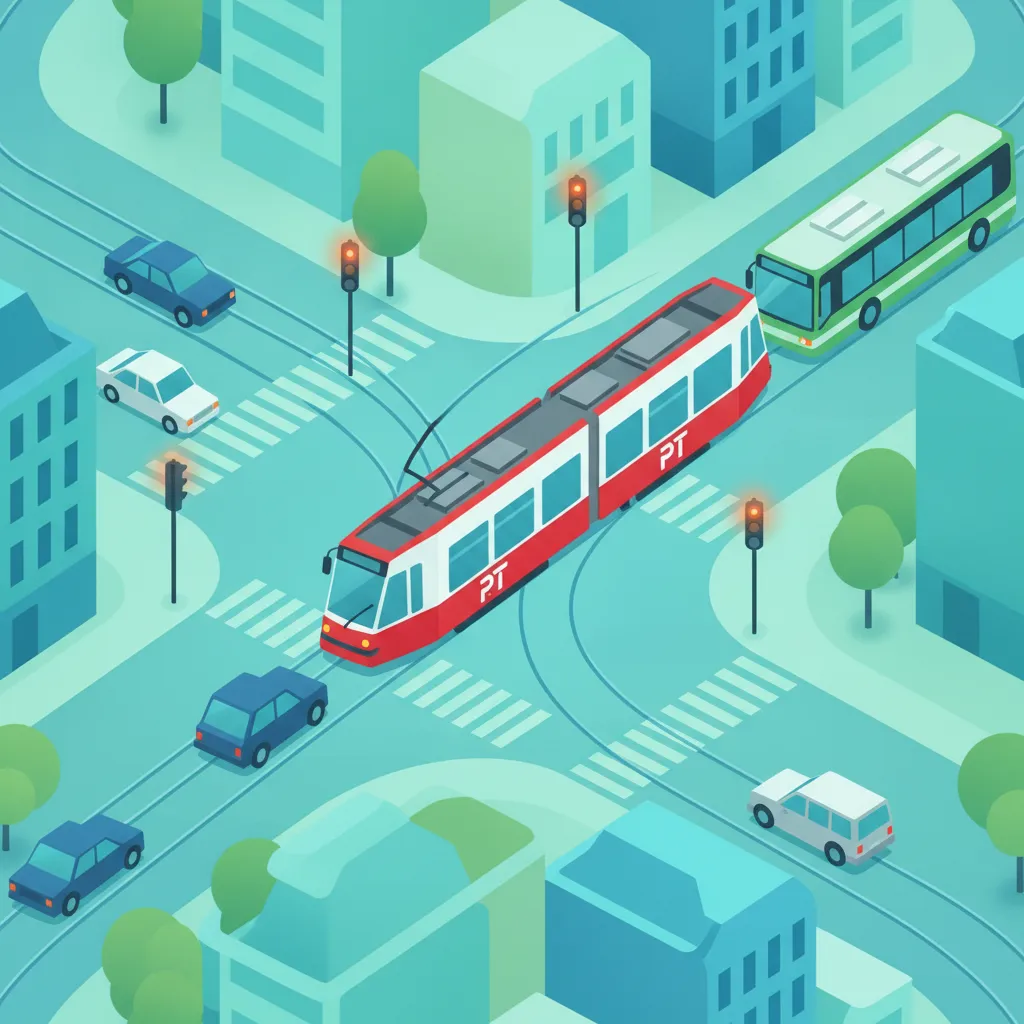
In Switzerland's urban environments, trams and certain public transport vehicles often have special priority. This is due to their fixed routes, size, and limited ability to maneuver or stop quickly. Knowing when and how to yield to them is essential for preventing accidents, maintaining traffic flow, and passing your Swiss driving theory exam.
Theory topic content overview
Read the full theory topic guide for Tram & Public Transport Priority with structured, easy-to-scan content built for learners in Switzerland. This detailed section explains the exact rule, meaning, traffic context, comparison points, and exam logic behind this Swiss driving theory topic so you can study faster, understand the concept more clearly, and avoid common interpretation mistakes on the theory test.
In Switzerland's dynamic urban landscapes, trams and certain public transport vehicles operate with a distinct set of priority rules, known locally as Vortritt. Understanding these rules is fundamental for safe driving, maintaining efficient traffic flow, and successfully navigating your Swiss driving theory exam. The core principle behind this special priority stems from the physical limitations of these vehicles.
At its heart, Swiss tram priority means that a tram, which runs on fixed tracks and cannot deviate, generally has the right of way over other road users. This is not merely a courtesy; it's a legal requirement based on the practical inability of trams to swerve or stop quickly to avoid collisions. Their considerable mass and momentum also demand longer braking distances.
Similarly, specific rules grant priority to other public transport vehicles, notably buses, under particular circumstances. These rules ensure that essential public services can operate efficiently and safely within busy city environments.
The importance of these Vortritt rules in Switzerland cannot be overstated:
The application of priority rules varies slightly between trams and other public transport vehicles:
Trams generally have priority in almost all situations, overriding many common Vortritt rules, such as "right before left" (rechts-vor-links).
For buses and trolleybuses, the priority rule is more specific:
innerorts), if a bus or trolleybus signals its intention to depart from a clearly marked stop by using its indicator, other vehicles in the lane of travel must yield and allow it to pull out. This helps public transport maintain schedules.Several factors underscore these priority rules:
To avoid errors, distinguish these rules:
Vortritt: Standard Swiss priority rules (rechts-vor-links, main road priority, traffic signs) often do not apply to trams. A tram's fixed path typically overrides these.Fussgängerstreifen). Always look left and right for trams before crossing tracks, even on a zebra crossing.Consider these common situations:
rechts-vor-links. However, a tram is approaching from your left. Despite the "right before left" rule, you must yield to the tram. The tram always has Vortritt.Many learners struggle with these specific rules:
Rechts-vor-links applies to trams: This is a frequent error. Trams almost always have priority regardless of the direction they are coming from.Fussgängerstreifen.innerorts is a violation and can cause disruption.In Switzerland, the Road Traffic Rules Ordinance (VRV) outlines these specific priority provisions. The concept of Vortritt for fixed-track vehicles like Strassenbahnen (trams) is deeply embedded in Swiss traffic law and practical driving. Urban centers are designed around these networks, making driver awareness paramount. The consistent message from Swiss traffic authorities, such as ASTRA and local transport operators like VBZ (Zurich), is that "The tram always has priority."
Specific road markings like "Achtung Tram" (Attention Tram), seen in cities like Zurich, serve as additional warnings, particularly near school routes or complex crossings, reinforcing the tram's unwavering right of way.
The golden rule for Swiss tram and public transport priority is simple: Trams cannot adapt, so you must. Always be vigilant for trams, especially in urban environments and at intersections or pedestrian crossings. When you see a tram, assume it has priority unless explicitly directed otherwise by active traffic signals. For buses, pay close attention to their indicators when they are at marked stops innerorts. Your flexibility and readiness to yield are essential for safety, smooth traffic flow, and mastering the Swiss theory exam.
Swiss tram and public transport priority rules give trams special Vortritt status due to their fixed tracks and inability to maneuver. Unlike standard vehicles, trams override rechts-vor-links rules and do not yield to pedestrians at marked crossings, a critical distinction for exam success and road safety. Buses have priority only when signaling departure from marked stops within urban areas. Drivers must always yield to trams when turning across tracks and remain vigilant at intersections where tram lines cross, particularly in cities like Zurich, Geneva, and Bern.
A short set of high-value points that capture the most important ideas from this theory explanation.
Trams have priority because they run on fixed tracks and cannot deviate, making them unable to swerve or stop quickly to avoid collisions
At intersections, trams generally override standard priority rules including right-before-left unless traffic lights or police direct otherwise
Unlike other vehicles, trams do NOT yield to pedestrians at marked crossings (Fussgängerstreifen) in Switzerland
Buses only have special priority when signaling departure from a marked stop within built-up areas (innerorts)
When turning across tram tracks, you must always yield to approaching trams regardless of your position or signaling
Trams always have Vortritt unless actively directed otherwise by traffic signals or police
Pedestrian crossings: trams are the exception to the rule—always look both ways for trams before crossing tracks
Bus special priority applies only at marked stops in urban areas when the bus signals departure
Trams require significantly longer braking distances due to their mass and momentum
Emergency vehicles override all tram and public transport priority rules
Assuming rechts-vor-links applies to trams—it does not; trams almost always have priority regardless of direction
Forgetting that trams do not stop for pedestrians at Fussgängerstreifen, leading to dangerous situations
Underestimating tram speed and braking distance and attempting to 'dash' across tracks
Failing to notice or respect a bus's indicator when it departs from a marked stop in a built-up area
Not checking blind spots for trams, which can appear quickly when changing lanes near tracks
Start with a short, direct summary of Tram & Public Transport Priority before reading the full explanation below.
Trams in Switzerland generally have priority because they run on fixed tracks and cannot deviate, requiring other road users to adapt. Similarly, certain public transport vehicles, especially buses departing from marked stops, may also have priority. Always be prepared to yield to trams at intersections and to buses signaling their departure from a stop, as misunderstanding these rules is a common cause of incidents and theory test errors.
Review the most important terms, rule signals, and traffic concepts linked to Tram & Public Transport Priority.
Explore related theory topic pages connected to Tram & Public Transport Priority and continue with the next useful rule explanation.
See the common search queries learners use when trying to understand Tram & Public Transport Priority in Switzerland.

Continue your preparation by exploring specific Swiss traffic rules, road signs, and essential driving concepts. Strengthen your knowledge of official legislation and practical application to ensure complete readiness for your driving licence theory examination.
Explore Swiss Driving Theory TopicsTheory topic content overview
A short set of high-value points that capture the most important ideas from this theory explanation.
Trams have priority because they run on fixed tracks and cannot deviate, making them unable to swerve or stop quickly to avoid collisions
At intersections, trams generally override standard priority rules including right-before-left unless traffic lights or police direct otherwise
Unlike other vehicles, trams do NOT yield to pedestrians at marked crossings (Fussgängerstreifen) in Switzerland
Buses only have special priority when signaling departure from a marked stop within built-up areas (innerorts)
When turning across tram tracks, you must always yield to approaching trams regardless of your position or signaling
Trams always have Vortritt unless actively directed otherwise by traffic signals or police
Pedestrian crossings: trams are the exception to the rule—always look both ways for trams before crossing tracks
Bus special priority applies only at marked stops in urban areas when the bus signals departure
Trams require significantly longer braking distances due to their mass and momentum
Emergency vehicles override all tram and public transport priority rules
Assuming rechts-vor-links applies to trams—it does not; trams almost always have priority regardless of direction
Forgetting that trams do not stop for pedestrians at Fussgängerstreifen, leading to dangerous situations
Underestimating tram speed and braking distance and attempting to 'dash' across tracks
Failing to notice or respect a bus's indicator when it departs from a marked stop in a built-up area
Not checking blind spots for trams, which can appear quickly when changing lanes near tracks
Start with a short, direct summary of Tram & Public Transport Priority before reading the full explanation below.
Trams in Switzerland generally have priority because they run on fixed tracks and cannot deviate, requiring other road users to adapt. Similarly, certain public transport vehicles, especially buses departing from marked stops, may also have priority. Always be prepared to yield to trams at intersections and to buses signaling their departure from a stop, as misunderstanding these rules is a common cause of incidents and theory test errors.
Review the most important terms, rule signals, and traffic concepts linked to Tram & Public Transport Priority.
Explore related theory topic pages connected to Tram & Public Transport Priority and continue with the next useful rule explanation.
See the common search queries learners use when trying to understand Tram & Public Transport Priority in Switzerland.
Continue your preparation by exploring specific Swiss traffic rules, road signs, and essential driving concepts. Strengthen your knowledge of official legislation and practical application to ensure complete readiness for your driving licence theory examination.
Explore Swiss Driving Theory TopicsUse this exam-focused revision tip to understand how Tram & Public Transport Priority is likely to appear in theory questions for learners in Switzerland. This section helps you identify the most testable part of the rule, avoid common traps, and remember the concept more effectively during Swiss driving theory exam preparation.
Remember that while standard right-of-way rules apply to most vehicles, trams often override these due to their fixed path. For the Swiss theory test, pay close attention to questions involving trams at intersections or pedestrian crossings, as this is where learners most commonly make mistakes by applying general priority rules incorrectly.
Read direct answers to the most common learner questions about Tram & Public Transport Priority in Switzerland. This FAQ focuses on rule confusion, practical meaning, comparison with similar concepts, and the exact uncertainties that appear most often in Swiss driving theory revision and exam preparation.
In most situations, trams have priority due to their inability to swerve. However, they must yield to emergency vehicles and, when driving on a minor road, to vehicles on a major road.
Vortritt Tram is the German term for 'tram priority' or 'right of way for trams' in Swiss traffic. It refers to the rule that other road users must typically yield to trams.
No, generally buses (and trolleybuses) follow the same priority rules as other motor vehicles. However, a bus signaling its departure from a marked stop within a built-up area may have priority, requiring other drivers to wait.
Even at a pedestrian crossing (Fussgängerstreifen), pedestrians must yield to trams. Always look left and right before crossing tram tracks, as trams have priority over pedestrians in these situations.
Trams are given special priority because they operate on fixed tracks, making them unable to deviate or stop as quickly as other vehicles. This rule enhances safety and helps maintain the smooth flow of public transport.
If a tram approaches an intersection, you must generally yield to it, even if you might normally have right of way under standard priority rules. Trams cannot stop or maneuver easily.
If a tram is stopped at a designated stop, you may overtake it cautiously if there is sufficient space and no passengers are boarding or alighting. Be extremely careful of pedestrians.
Yes, in some Swiss cities like Zurich, there are 'Achtung Tram' (Attention Tram) markings on the road, especially near pedestrian crossings on school routes, to remind road users of tram priority.
Pinpoint specific Swiss traffic rules, road signs, or driving situations you need to master. Use the practice search to start a focused revision session now and build confidence for your official driving theory exam.