
This lesson guides you through the legal requirements and professional standards for conducting heavy-goods vehicle deliveries within urban areas. It builds upon your understanding of traffic rules and vehicle operation, focusing specifically on compliance and safety in sensitive city environments.

Lesson content overview
As a professional driver of heavy goods vehicles (HGVs) in categories C, C1, C1E, or CE, operating within urban environments demands a heightened level of awareness and adherence to specific legal obligations. City deliveries involve complex interactions with a diverse range of road users, often in restricted spaces and under time constraints. Compliance with these regulations is not merely about avoiding fines; it is fundamental to ensuring the safety of pedestrians, cyclists, and other motorists, maintaining public order, and upholding the reputation of professional drivers and logistics companies. This lesson delves into the critical legal duties you must observe when making deliveries in Austrian cities, building upon foundational knowledge from previous lessons on load securing and urban traffic navigation.
The legal framework governing urban HGV deliveries is designed to mitigate potential risks and disturbances inherent in operating large vehicles in densely populated areas. These obligations are rooted in fundamental principles of safety, public order, and professional diligence. By understanding the rationale behind these rules, drivers can better anticipate challenges and make informed decisions on the road.
Urban areas present unique challenges for heavy goods vehicles. Narrow streets, high traffic volumes, and a significant presence of vulnerable road users like pedestrians and cyclists require precise maneuvering and responsible conduct. Regulations for city deliveries are crucial for several reasons. They prevent traffic congestion, reduce noise pollution, and minimize the risk of accidents during loading and unloading procedures. Non-compliance can lead to substantial fines, the temporary or permanent loss of operating permits, and damage to public trust. For drivers preparing for their Austrian heavy-goods vehicle theory exam, mastering these aspects is essential for safe and legal operation on Austria's roads.
The legal obligations you face during urban deliveries stem from three core rationales. Firstly, safety is paramount; rules prevent hazards caused by unsecured loads, improper vehicle positioning, or erratic stopping in traffic. Secondly, public order is maintained by reducing excessive noise, unnecessary congestion, and obstruction of pedestrian pathways. Lastly, professional responsibility reinforces the expectation that commercial drivers exercise a higher degree of diligence and care when operating in densely populated areas. These rationales collectively ensure that essential deliveries can be performed efficiently while minimizing negative impacts on urban life.
One of the most critical aspects of urban logistics is the strict observance of designated delivery time windows. These windows are legally prescribed intervals during which loading or unloading activities are permitted at a specific location, typically a loading zone or a business address.
The legally defined period during which loading or unloading operations are permitted at a specific urban location, as set by municipal ordinances.
Delivery time windows are established by municipal authorities to manage traffic flow, reduce congestion during peak hours, and minimize disturbance in residential or commercial areas. These windows can vary significantly between locations, ranging from fixed daily intervals (e.g., 7:00 AM – 9:00 AM) to more flexible or even exception-based schedules for specific types of deliveries. As a driver, you must plan your routes meticulously to ensure arrival and commencement of unloading within these precise timeframes. Arriving too early may require you to wait until the window opens, potentially causing further delays or disruption, while late arrivals can incur penalties. Understanding and respecting these windows is a key component of effective city delivery management.
Violating delivery time windows can lead to various negative outcomes, ranging from immediate financial penalties to more significant operational disruptions. Municipal statutes often specify fines for beginning a delivery outside the allowed window, irrespective of whether you are early or late. Beyond fines, such violations can contribute to traffic congestion, particularly if you are forced to wait in an inappropriate location, or if your late arrival coincides with peak traffic hours. Repeated non-compliance could lead to more severe consequences, such as restrictions on your ability to deliver to certain areas or even jeopardize your company's operating permits. It is crucial to remember that a brief wait outside the window is generally not permitted if it involves occupying a public space designated for active use. Therefore, precise route planning and punctuality are paramount.
Noise pollution from heavy vehicles and unloading operations can be a significant nuisance, particularly in urban residential and mixed-use areas. Legal obligations require drivers to actively manage and reduce their vehicle's noise emissions.
Austrian "Umwelt- und Emissionsvorschriften" (environmental and emission regulations) dictate permissible decibel levels for vehicles, and municipal ordinances can impose even stricter local limits, especially for areas near hospitals, schools, or residential zones. These regulations cover engine noise, horn usage, and the sound generated by unloading equipment such as hydraulic lifts or forklifts. The intent is to protect public health and quality of life from excessive noise. Professional drivers are expected to be aware of these limits and adjust their practices accordingly. For instance, horn usage is generally restricted to immediate safety alerts, not for expressing impatience or general warnings. Similarly, unnecessary engine revving during standstill periods should be avoided.
To comply with noise regulations and maintain good public relations, drivers should adopt specific practices during urban deliveries. When arriving at a loading zone, avoid prolonged idling or unnecessary engine revving. If using hydraulic lifts or other noisy equipment, operate them smoothly and efficiently to minimize noise duration. In sensitive areas, consider alternative unloading methods if feasible, or schedule deliveries during less disruptive hours, if allowed. Horn usage should be brief and only for genuine safety warnings, such as alerting a pedestrian who is unaware of your vehicle's movement. By implementing these practices, drivers contribute to a more harmonious urban environment and reduce the likelihood of noise complaints and potential fines.
When maneuvering in quiet urban areas, try to perform necessary movements (like backing up) in one smooth, continuous action rather than multiple short bursts, which can generate more noise.
The moment an HGV stops for unloading is critical for safety. Proper procedures for securing both the vehicle and its load are legally mandated to prevent accidents, injuries, and property damage. This builds directly on the principles of load securing covered in previous lessons.
Before any doors, curtains, or loading equipment are opened, the heavy goods vehicle must be brought to a complete and stable stop. This involves several critical steps:
Bring the vehicle to a full and complete stop within the designated loading area.
Engage the parking brake firmly to prevent any unintended movement of the vehicle.
Activate the hazard warning lights to signal your stationary presence to other road users, especially in busy urban environments.
On slopes or uneven ground, consider using wheel chocks for additional security, especially if the vehicle is heavily laden.
These actions are mandatory and crucial. A vehicle that is not fully secured can roll unexpectedly, causing severe accidents or blocking traffic. Ignoring the activation of hazard lights can also reduce your vehicle's visibility, increasing the risk of rear-end collisions, particularly in low light or adverse weather conditions.
Beyond securing the vehicle itself, verifying the stability of the cargo before opening any doors or curtains is equally important. Throughout the journey, even with proper load securing (as discussed in Lesson 5), cargo can shift due to vibrations, braking, or cornering. Before you initiate unloading, you must perform a quick visual inspection to confirm that the load is still stable and will not fall or shift outwards when the doors are opened.
The unintended movement of cargo within a vehicle, which can alter its center of gravity, potentially leading to instability or cargo falling out when doors are opened.
Austrian regulations require that vehicle doors or curtains may only be opened when the vehicle is stationary and the load is adequately secured to prevent accidental movement or spillage onto public roads. This proactive check prevents accidents where goods could fall onto pedestrians, cyclists, or other vehicles, causing injury or obstruction. Failure to do so can result in serious legal liability and fines, emphasizing the importance of your professional responsibility.
The way you position your heavy goods vehicle in an urban loading zone has significant implications for traffic flow, public safety, and legal compliance. It is imperative to park correctly to avoid fines and potential hazards.
Urban delivery zones and loading areas are specifically designed and marked to accommodate commercial vehicles for loading and unloading. These areas may include on-street loading zones, curbside loading bays, or off-street depot unloading points. You must align your vehicle precisely within the marked lines of these zones. Parking partially in a loading zone while the rest of the vehicle extends into a travel lane, a bike lane, or onto a sidewalk is a common violation that can lead to significant fines and traffic disruption. Proper positioning ensures that the vehicle is safely off the main flow of traffic and that there is adequate space for the unloading process to occur without creating additional hazards.
A critical aspect of correct positioning is ensuring that your HGV does not obstruct pedestrian pathways or dedicated bike lanes. Sidewalks and bike lanes are reserved for their respective users, and any encroachment by a delivery vehicle can pose a serious safety risk. Pedestrians may be forced into the street, and cyclists might have to swerve into traffic, increasing the likelihood of collisions. Even during the unloading process, you must ensure that vehicle doors, ramps, or the cargo itself do not block these vital pathways. Municipal ordinances strictly penalize such obstructions to maintain continuous and safe passage for all urban users. Awareness of blind spots (as covered in Lesson 7) and careful maneuvering are essential to achieve this.
While not always explicitly codified as a traffic regulation, effective communication with site personnel is a critical professional standard and a vital safety measure during urban deliveries.
Before commencing any unloading activities, it is crucial to establish contact with the recipient or the site manager. This pre-unloading coordination ensures that the loading dock or designated unloading area is clear, ready, and safe for your operation. Site personnel can provide crucial information about any site-specific hazards, special handling requirements for the goods, or the presence of other vehicles or people in the vicinity. Initiating unloading without this confirmation can lead to significant safety risks, such as accidentally striking equipment or personnel, or causing delays if the receiving party is not prepared.
Communication protocols can vary but generally involve contacting the site via phone, radio, or clear visual signals upon arrival. For instance, a driver might call the warehouse manager to confirm the dock is clear and receive a signal to open the rear doors. This process ensures a smooth and safe handover of goods and minimizes misunderstandings. In situations involving complex deliveries or hazardous materials, this communication becomes even more critical, ensuring that all safety procedures are in place before any cargo movement begins. This proactive approach is a hallmark of professional driving and minimizes operational risks in dynamic urban environments.
Familiarity with common violations can help heavy goods vehicle drivers proactively avoid them. These transgressions often stem from oversight, impatience, or a lack of understanding of local regulations.
Urban delivery regulations, while strict, often require drivers to adapt their procedures based on prevailing conditions. Factors such as weather, lighting, road type, vehicle state, and the presence of vulnerable road users all influence how you must apply your legal obligations.
Understanding the cause-and-effect relationships tied to legal obligations in urban deliveries highlights why compliance is so critical. Every action a driver takes has direct consequences for safety, traffic management, and their legal standing.
These relationships underscore that compliant driving during urban deliveries is not just about following rules; it's about making deliberate choices that prioritize safety, minimize disruption, and uphold professional standards.
These scenarios illustrate common situations and highlight the correct and incorrect approaches to legal obligations during urban deliveries.
This lesson covers the legal obligations for C category drivers performing urban deliveries in Austria, focusing on time window compliance, noise control, and vehicle security procedures. Key requirements include engaging the parking brake and activating hazard lights before unloading, verifying load stability before opening doors, and maintaining strict adherence to designated delivery windows to avoid fines and traffic disruption. The lesson also addresses pedestrian and cyclist safety, proper loading zone positioning, and effective communication with site personnel, all of which are essential for both exam success and professional practice in Austrian urban logistics.
A short set of high-value points that capture the most important learning from this lesson.
Delivery time windows are legally binding in Austrian cities, and unloading may only begin within the prescribed municipal interval
Before opening any vehicle doors, the HGV must be fully stopped, parking brake engaged, hazard lights activated, and load stability verified
Noise ordinances restrict engine idling, horn usage, and equipment noise in urban areas, especially near hospitals, schools, and residential zones
Loading zones must be occupied precisely within marked lines; blocking sidewalks, bike lanes, or traffic lanes is a serious violation
Pre-unloading communication with site personnel is essential for coordinating safe handover and preventing accidents
Explore all units and lessons included in this driving theory course.
Parking brake engagement and hazard light activation are mandatory the moment the vehicle stops for unloading
Load shift can occur during transport, so always perform a visual stability check before opening curtains or doors
Horn usage is restricted to immediate safety alerts only; prolonged or impatient honking violates noise regulations
Vehicles occupying loading zones after unloading is complete risk fines and blocking other deliveries
Adverse weather, low light, slopes, and heavily laden vehicles all require extra precautionary measures beyond standard procedures
Beginning unloading before the official delivery time window opens, even if the vehicle is correctly parked
Failing to activate hazard lights when stationary in busy urban environments, reducing visibility for other road users
Blocking pedestrian pathways or bike lanes by parking partially outside the marked loading zone lines
Using the horn repeatedly or unnecessarily in noise-sensitive residential or mixed-use areas
Opening vehicle doors before confirming the vehicle is fully stationary and the parking brake is firmly engaged
Lesson content overview
A short set of high-value points that capture the most important learning from this lesson.
Delivery time windows are legally binding in Austrian cities, and unloading may only begin within the prescribed municipal interval
Before opening any vehicle doors, the HGV must be fully stopped, parking brake engaged, hazard lights activated, and load stability verified
Noise ordinances restrict engine idling, horn usage, and equipment noise in urban areas, especially near hospitals, schools, and residential zones
Loading zones must be occupied precisely within marked lines; blocking sidewalks, bike lanes, or traffic lanes is a serious violation
Pre-unloading communication with site personnel is essential for coordinating safe handover and preventing accidents
Explore all units and lessons included in this driving theory course.
Parking brake engagement and hazard light activation are mandatory the moment the vehicle stops for unloading
Load shift can occur during transport, so always perform a visual stability check before opening curtains or doors
Horn usage is restricted to immediate safety alerts only; prolonged or impatient honking violates noise regulations
Vehicles occupying loading zones after unloading is complete risk fines and blocking other deliveries
Adverse weather, low light, slopes, and heavily laden vehicles all require extra precautionary measures beyond standard procedures
Beginning unloading before the official delivery time window opens, even if the vehicle is correctly parked
Failing to activate hazard lights when stationary in busy urban environments, reducing visibility for other road users
Blocking pedestrian pathways or bike lanes by parking partially outside the marked loading zone lines
Using the horn repeatedly or unnecessarily in noise-sensitive residential or mixed-use areas
Opening vehicle doors before confirming the vehicle is fully stationary and the parking brake is firmly engaged
Explore search topics learners often look for when studying Legal Obligations During Urban Deliveries. These topics reflect common questions about road rules, driving situations, safety guidance, and lesson level theory preparation for learners in Austria.
Browse additional driving theory lessons that cover connected traffic rules, road signs, and common driving situations related to this topic. Improve your understanding of how different rules interact across everyday traffic scenarios.
Understand Austrian regulations for heavy goods vehicles during urban deliveries, focusing on noise reduction requirements and legal access rules for loading zones. Essential for C category drivers navigating city logistics.

This lesson explains the regulations governing the use of designated delivery and loading zones in urban areas. It covers topics such as time restrictions, the potential need for permits, and the correct way to position the vehicle to minimize traffic disruption. Adhering to these rules is essential for efficient and legal urban logistics.

This lesson addresses the challenge of manoeuvring a large vehicle through streets not designed for its size. It covers how to assess vertical and horizontal clearances, plan the vehicle's path through tight turns, and heed all restrictive signage. Careful planning and slow, precise control are essential for success.

This lesson details the general traffic rules applicable to heavy goods vehicles on Austrian roads, highlighting differences from passenger car regulations. It covers key topics such as right-of-way at intersections, specific rules for overtaking, maintaining proper lane discipline, and adhering to designated speed limits. Understanding these rules is critical for safe integration into mixed traffic.

This lesson focuses on the legal restrictions concerning a heavy vehicle's dimensions, including maximum height, width, and length. It teaches drivers how to interpret road signs and supplemental plates that indicate these limits. This knowledge is crucial for route planning, especially when navigating under bridges, through tunnels, and on restricted roads.
This lesson explains the system of penalties and enforcement for heavy vehicle operations in Austria. It covers the fines and penalty points associated with common traffic violations, such as overloading or insecure loads. Learners will understand the role of authorities in conducting roadside checks and inspections to ensure regulatory compliance.

This lesson explains the specific definitions and limitations of the C1, C1E, C, and CE heavy-goods vehicle licence categories in Austria. It details the permissible vehicle mass, axle configurations, and rules for trailer combinations associated with each category. Understanding these distinctions is fundamental for ensuring legal compliance and selecting the correct licence for specific vehicle configurations.

This lesson focuses on the specific challenges and safety protocols for operating a heavy vehicle on a construction site. It covers how to communicate with flaggers and site supervisors, navigate around other heavy machinery, and be aware of ground-level personnel. A high level of caution and clear communication is required in these dynamic environments.
This lesson focuses on the specific Austrian road signs and supplemental plates that apply to heavy goods vehicles. It explains how to interpret signage indicating weight limits, height and width restrictions, lane usage rules, and other critical regulatory information. Correctly understanding these signs is essential for legal compliance and safe navigation on Austria's roads.

This lesson details the essential legal and administrative requirements for operating an AM vehicle in Austria. It covers the processes for vehicle registration, the obligation for licence plates, and the necessity of third-party liability insurance. Furthermore, it explains the importance of regular technical inspections to ensure the vehicle remains roadworthy and compliant with national standards.
This lesson covers the legal requirements for regular maintenance and periodic roadworthiness certification (known as the 'Pickerl' or TÜV inspection) in Austria. It explains the importance of adhering to manufacturer-recommended service intervals. Maintaining a certified, roadworthy vehicle is a core legal responsibility for any operator or driver.
Learn the legal requirements for parking heavy goods vehicles in urban loading zones in Austria. This lesson covers avoiding obstruction of pedestrian and bike pathways, crucial for C and CE license holders.
This lesson explains the regulations governing the use of designated delivery and loading zones in urban areas. It covers topics such as time restrictions, the potential need for permits, and the correct way to position the vehicle to minimize traffic disruption. Adhering to these rules is essential for efficient and legal urban logistics.
This lesson details the general traffic rules applicable to heavy goods vehicles on Austrian roads, highlighting differences from passenger car regulations. It covers key topics such as right-of-way at intersections, specific rules for overtaking, maintaining proper lane discipline, and adhering to designated speed limits. Understanding these rules is critical for safe integration into mixed traffic.
This lesson explains the system of penalties and enforcement for heavy vehicle operations in Austria. It covers the fines and penalty points associated with common traffic violations, such as overloading or insecure loads. Learners will understand the role of authorities in conducting roadside checks and inspections to ensure regulatory compliance.
This lesson addresses the challenge of manoeuvring a large vehicle through streets not designed for its size. It covers how to assess vertical and horizontal clearances, plan the vehicle's path through tight turns, and heed all restrictive signage. Careful planning and slow, precise control are essential for success.
This lesson focuses on the legal restrictions concerning a heavy vehicle's dimensions, including maximum height, width, and length. It teaches drivers how to interpret road signs and supplemental plates that indicate these limits. This knowledge is crucial for route planning, especially when navigating under bridges, through tunnels, and on restricted roads.

This lesson covers the practical aspects of planning a route for a heavy goods vehicle. It explains how to use maps and specialized GPS systems to identify and avoid roads with height, weight, or other restrictions. Proactive route planning is essential for ensuring an efficient, legal, and safe journey.

This lesson details the legal ramifications of operating an overloaded heavy vehicle in Austria, which include significant fines and penalty points. It also emphasizes the severe safety risks, such as compromised braking performance and increased mechanical stress on the vehicle. Understanding these consequences reinforces the importance of strict adherence to weight limits.
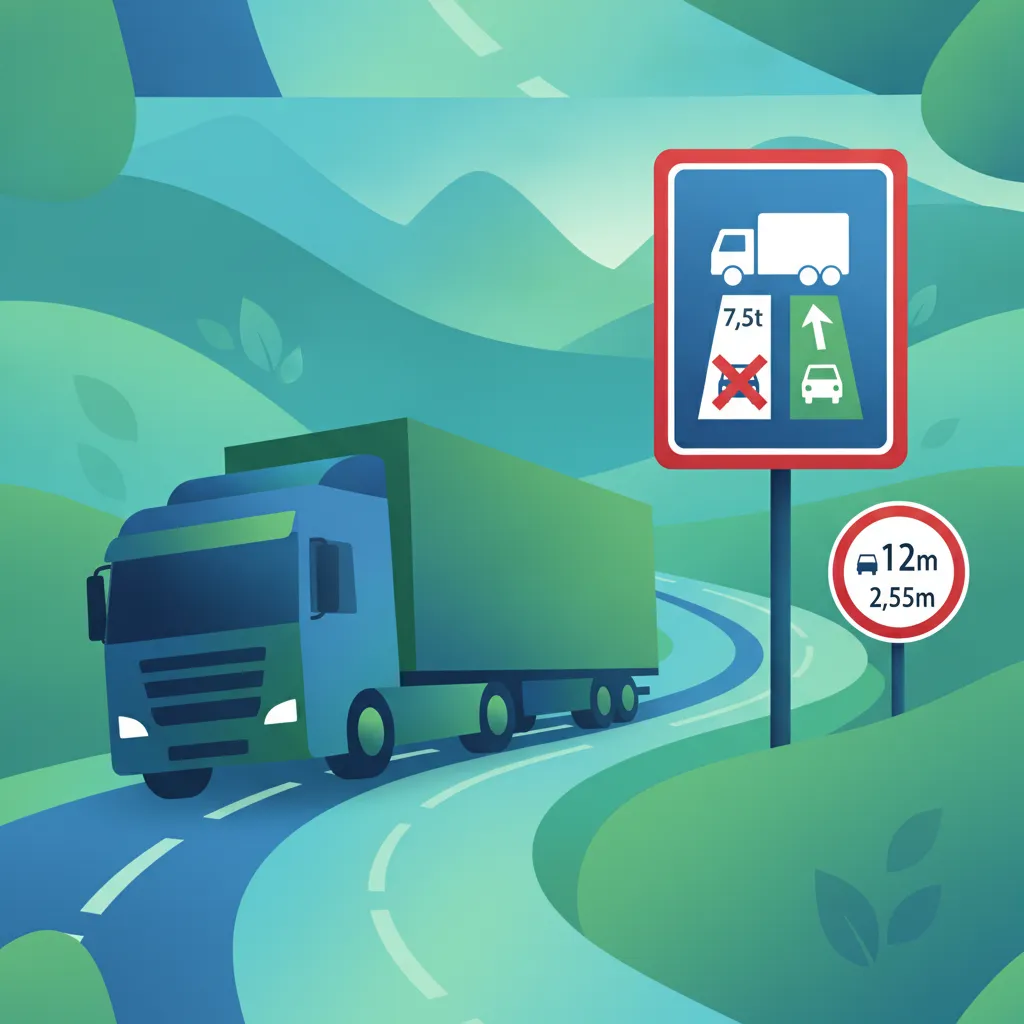
This lesson focuses on the specific Austrian road signs and supplemental plates that apply to heavy goods vehicles. It explains how to interpret signage indicating weight limits, height and width restrictions, lane usage rules, and other critical regulatory information. Correctly understanding these signs is essential for legal compliance and safe navigation on Austria's roads.

This lesson details the regulations for heavy goods vehicles on Austria's high-speed road network. It covers the specific speed limits, rules on lane usage (e.g., when overtaking is permitted), and procedures for entering and exiting the motorway. Adherence to these rules is crucial for safety in a fast-paced environment.

This lesson consolidates the legal restrictions on the maximum dimensions and weight for different vehicle combinations in Austria. It covers how to read signs indicating these limits and the importance of compliance for route planning. Adhering to these regulations is essential for legal operation and avoiding fines.
Find clear answers to common questions learners have about Legal Obligations During Urban Deliveries. Learn how the lesson is structured, which driving theory objectives it supports, and how it fits into the overall learning path of units and curriculum progression in Austria. These explanations help you understand key concepts, lesson flow, and exam focused study goals.
Drivers must minimize noise during loading and unloading, especially during early morning or late evening hours. Avoid unnecessary engine idling and slamming of vehicle doors, as municipal ordinances often strictly regulate noise levels in residential areas.
Always check for supplementary signs indicating delivery access windows or specific vehicle weight exemptions. You must strictly adhere to the posted time limits; failure to do so results in heavy fines and potential loss of delivery access privileges.
Yes. Even during short stops, you must ensure that the remaining cargo is secured to prevent shifting or accidents. Your responsibility as a driver includes maintaining safety both during transit and while the vehicle is stationary at the delivery point.
Use designated loading zones whenever possible, avoid blocking pedestrian paths, and always check your mirrors and cameras for vulnerable road users before maneuvering. Your legal obligation extends to ensuring safe access for all road users around your delivery site.
Refine your study plan by searching for specific Austrian driving theory practice sets. Pinpoint questions related to particular road rules, signs, or challenge levels, and begin practicing immediately to reinforce your knowledge and excel in your official exam with confidence. Get started with focused revision today.