
This lesson details the essential maintenance and inspection requirements for heavy goods vehicles in Austria. You will learn the legal significance of the periodic roadworthiness inspection and how to manage manufacturer-recommended service intervals, ensuring your vehicle remains compliant with safety standards.

Lesson content overview
Operating a heavy goods vehicle (HGV) on public roads carries significant responsibilities, not least of which is ensuring the vehicle's impeccable mechanical condition and adherence to strict legal standards. This comprehensive lesson delves into the critical aspects of regular vehicle maintenance schedules and the mandatory periodic roadworthiness certification, commonly known in Austria as the "Pickerl" or TÜV inspection. For professional drivers and operators within the Austrian driving license theory course for heavy goods vehicles (C, C1, C1E, CE), understanding these requirements is paramount for safety, legal compliance, and efficient operation.
The integrity and operational safety of heavy goods vehicles directly impact the safety of all road users. Due to their size, weight, and the nature of their cargo, mechanical failures in HGVs can have catastrophic consequences. Regular maintenance prevents component failures, ensures optimal performance, and reduces emissions, thereby contributing to both road safety and environmental protection. Austria, like many other European countries, enforces rigorous standards through legally mandated service intervals and periodic inspections to uphold these safety benchmarks.
A certified roadworthy vehicle means it has been verified to meet specific technical standards, including those related to braking systems, steering, lighting, tires, chassis, and exhaust emissions. For HGV drivers, this isn't just a recommendation but a core legal and ethical responsibility that safeguards lives and livelihoods.
Service intervals are the manufacturer-specified periods, typically expressed in terms of mileage (kilometers) or time (months/years), after which a vehicle must undergo routine maintenance. Adhering to these intervals is not merely a suggestion for optimal performance; it is a fundamental aspect of maintaining a heavy goods vehicle's roadworthiness and is indirectly enforceable under Austrian road traffic law.
Vehicle manufacturers spend considerable resources determining the optimal maintenance schedule for their heavy vehicles. These schedules are designed to ensure that components are inspected, lubricated, adjusted, or replaced before wear and tear lead to critical failure. Ignoring these recommendations can accelerate component degradation, reduce vehicle lifespan, increase operational costs, and, crucially, lead to the vehicle failing its mandatory roadworthiness inspection.
While service intervals themselves are primarily manufacturer recommendations, Austrian law, particularly the Strassenverkehrsordnung (StVO), implicitly requires that vehicles be kept in a condition that allows them to pass roadworthiness inspections. A vehicle consistently operating outside its recommended service intervals is highly likely to develop defects that would render it unroadworthy, leading to fines and prohibitions from road use. The Austrian standard ÖNORM B 3310 provides further guidance on maintenance specifications for heavy vehicles, aligning industry practices with safety requirements.
Scheduled maintenance for heavy goods vehicles is comprehensive, covering a wide array of systems and components. These services are often categorized into minor and major checks, performed at different intervals.
Engine System: Regular oil and filter changes (oil, fuel, air filters) are vital for engine longevity and efficiency. Checking the coolant level and condition is also critical, especially for heavy-duty engines operating under stress.
Braking System: Brake fluid replacement, inspection of brake pads, discs, drums, air reservoirs, and brake lines are paramount. Given the weight of HGVs, brake system integrity is a top safety priority.
Tyres and Wheels: Beyond visual inspection, regular checks include tyre pressure, tread depth, and condition (for cuts, bulges). Wheel alignment and balancing also contribute to safety and fuel efficiency.
Steering and Suspension: Inspection of steering linkages, shock absorbers, air springs, and other suspension components ensures precise handling and vehicle stability, crucial for loaded HGVs.
Lighting and Electrical Systems: All lights, indicators, reflectors, and electrical connections must be in perfect working order. Battery health and charging system performance are also checked.
Exhaust and Emission Control: Systems like Diesel Particulate Filters (DPF) and Selective Catalytic Reduction (SCR) with AdBlue require periodic checks and servicing to ensure compliance with environmental standards.
For HGV operators, accurately tracking service intervals requires meticulous record-keeping. Most modern heavy vehicles feature onboard computer systems that monitor mileage and operating hours, often displaying warnings when a service is due. However, these electronic reminders must be cross-referenced with physical records and a proactive maintenance schedule.
Always refer to the specific owner's manual for each heavy goods vehicle in your fleet. Manufacturers may have unique service requirements based on engine type, transmission, and intended use.
It is crucial to understand that service intervals are typically "whichever comes first." For example, if an oil change is recommended every 15,000 km or 12 months, the service must be performed as soon as either limit is reached, even if the other has not. For vehicles that cover fewer kilometers but are older, the time-based interval often dictates service.
In Austria, the periodic roadworthiness inspection is a legal requirement ensuring that every vehicle on public roads meets minimum safety and environmental standards. This inspection is commonly known as the "Pickerl" (a local term for the sticker affixed to the windshield) or colloquially referred to as the TÜV inspection, though it can be performed by various authorized inspection bodies.
The Pickerl is an official certification that confirms a vehicle's compliance with the technical regulations outlined in the Austrian Strassenverkehrsordnung (StVO), particularly § 57. Its primary purpose is to enhance road safety by identifying and mandating the repair of defects that could compromise the vehicle's safe operation or harm the environment. For heavy goods vehicles, the inspection is exceptionally thorough due to the significant risks associated with their operation.
The legally required sticker affixed to a vehicle's windshield in Austria, certifying that it has successfully passed the mandatory periodic roadworthiness inspection and complies with safety and emission standards.
Operating a heavy goods vehicle without a valid Pickerl is a serious administrative offense, carrying potential fines and immediate prohibitions from road use. The presence of a valid Pickerl signifies that at the time of its last inspection, the vehicle was deemed safe and compliant.
The Pickerl inspection for heavy goods vehicles is a comprehensive process conducted by authorized workshops or testing centers. It covers an extensive list of safety-critical components and systems.
Braking System: Thorough checks of service brakes, parking brake, and auxiliary braking systems (e.g., retarders, engine brakes) for efficiency, balance, and wear. This includes air pressure systems for air brakes.
Steering System: Examination of steering play, linkages, power steering components, and overall responsiveness.
Visibility: Inspection of windshield, windows, mirrors, wipers, and washers for proper function and condition.
Lights and Reflectors: Verification that all external lights (headlights, tail lights, brake lights, indicators, fog lights), reflectors, and their associated electrical systems are operational and correctly aligned.
Axles, Wheels, Tyres, and Suspension: Checks for play in wheel bearings, condition of springs, shock absorbers, and chassis. Tyres are inspected for correct size, load index, speed rating, tread depth, and signs of damage or uneven wear.
Chassis and Bodywork: Examination for structural integrity, corrosion, and secure mounting of all components.
Environmental Impact: Emission testing (e.g., diesel smoke opacity test, AdBlue system check) and verification of exhaust system integrity.
Additional Equipment: Checks on safety devices, coupling mechanisms for trailers, and any specialized equipment relevant to the vehicle type.
If the vehicle passes, a new Pickerl sticker is affixed to the windshield, displaying the month and year of the next due inspection. If defects are found, they must be rectified, and the vehicle re-inspected before a valid Pickerl can be issued.
The inspection intervals for heavy goods vehicles in Austria are generally stricter than for passenger cars, reflecting the higher safety demands.
A roadworthiness certification sticker that is current and legally displayed on the vehicle, indicating it has passed its required inspection within the prescribed timeframe.
For most heavy goods vehicles (categories C, C1, C1E, CE, and their associated trailers), the general rule is:
It is the responsibility of the vehicle owner and operator to ensure that the Pickerl is renewed before its expiry date. There is often a grace period (e.g., a few months before and after the due date) during which the inspection can be carried out, but operating beyond the strict expiry date without a valid Pickerl is a violation.
Beyond merely performing services and inspections, the meticulous documentation of these activities is a legal obligation under Austrian law and a critical practice for responsible HGV operation. Maintenance records serve as verifiable proof of compliance and are indispensable for effective fleet management.
For heavy goods vehicles, maintenance records are more than just paperwork; they are a direct reflection of an operator's commitment to safety and compliance.
The Strassenverkehrsordnung (StVO) § 57 (3) explicitly states that maintenance records must be kept and be available for inspection by authorities.
Informal notes or verbal confirmations from a workshop are not sufficient proof. Always insist on official, detailed documentation for all maintenance and repairs.
These records should be maintained for the entire operational life of the vehicle and be readily accessible upon request by law enforcement or regulatory bodies.
The legal framework surrounding vehicle roadworthiness in Austria is stringent, designed to ensure maximum safety on public roads. Both vehicle owners and drivers bear significant responsibilities, and non-compliance carries serious consequences.
The primary legal basis for roadworthiness certification and maintenance is the Austrian Strassenverkehrsordnung (StVO), specifically §§ 57 and 58.
These regulations ensure a continuous cycle of inspection and maintenance, aiming to keep all vehicles in safe operating condition.
Failure to comply with roadworthiness regulations can lead to severe penalties for both the driver and the vehicle owner.
In specific circumstances, a provisional operation permit may be issued. This is typically for a vehicle that has failed its Pickerl inspection but needs to be driven directly to a workshop for repairs or to a re-inspection site. These permits are strictly time-limited and often come with conditions (e.g., maximum speed, specific route). They are not a substitute for a valid Pickerl and must be accompanied by appropriate documentation.
Heavy goods vehicles operate in diverse and challenging environments, and these contextual factors must influence maintenance strategies and inspection preparedness.
The unique challenges of Alpine routes in Austria (steep ascents, long descents, tight turns) demand an even higher level of vehicle preparedness.
These factors emphasize that while general service intervals provide a baseline, proactive and condition-based maintenance is often necessary for HGVs operating under demanding conditions.
Even with clear regulations, certain misunderstandings and oversights frequently lead to non-compliance or safety issues. Recognizing these can help drivers and operators avoid common pitfalls.
Common Pitfall: Operating beyond the Pickerl inspection deadline. This is a direct violation, regardless of the vehicle's apparent condition. Best Practice: Schedule inspections well in advance of the expiry date, allowing time for potential repairs.
Common Pitfall: Obscuring the Pickerl sticker (e.g., with sunshades, decals). Best Practice: Ensure the Pickerl is always clearly visible on the inside of the windshield, typically in the upper right corner from the driver's perspective.
Common Pitfall: Incomplete or missing maintenance records. Best Practice: Maintain a comprehensive logbook and retain all official invoices and reports, making them readily available in the vehicle or digitally accessible.
Common Pitfall: Delaying maintenance after a warning light appears. Best Practice: Address warning lights immediately. Many issues, especially those related to brakes or engine, can quickly escalate from minor to critical.
Common Pitfall: Assuming a service receipt alone satisfies legal roadworthiness. Best Practice: Understand that only the official Pickerl sticker confirms legal roadworthiness. A service is a prerequisite, not the certification itself.
The legal framework of service intervals and roadworthiness certification is built upon fundamental principles of physics, engineering, and risk management. Mechanical components inevitably degrade over time due to friction, heat, and load. Regular servicing aims to counteract this wear, preventing minor issues from escalating into dangerous failures.
Mandatory inspections provide an external, objective verification that a heavy vehicle meets safety criteria, acting as a crucial safeguard against human oversight or economic pressures that might tempt operators to delay essential maintenance. This system contributes significantly to overall road safety, reduces the likelihood of breakdowns and accidents, and fosters public confidence in the safe operation of commercial traffic. For HGV drivers, integrating this knowledge with comprehensive pre-trip inspections and an understanding of specific vehicle systems (like brakes and tires) forms a holistic approach to responsible and safe driving.
This lesson covers the mandatory maintenance and inspection requirements for heavy goods vehicles in Austria, focusing on the legal roadworthiness certification process known as the 'Pickerl' or TÜV inspection. It explains that service intervals (time or mileage, whichever comes first) are manufacturer recommendations that indirectly become legal obligations under Austrian traffic law. The content details comprehensive maintenance tasks including brakes, tyres, steering, and emission systems, while emphasizing the requirement for meticulous record-keeping under StVO § 57(3). HGV inspections occur annually after an initial three-year period, with severe penalties including fines and prohibition from road use for non-compliance. For Alpine driving conditions common in Austria, the lesson highlights that heavy loads, steep terrain, and extreme weather accelerate component wear, requiring proactive condition-based maintenance beyond standard intervals.
A short set of high-value points that capture the most important learning from this lesson.
The 'Pickerl' (roadworthiness sticker) is a legal certification confirming an HGV meets Austrian safety and emission standards, required for all public road operation.
Service intervals are manufacturer-specified mileage or time limits ('whichever comes first') that maintain roadworthiness and prevent inspection failures.
HGV roadworthiness inspections in Austria occur annually after the first three-year period, with stricter standards than passenger vehicles.
Comprehensive maintenance records (service logbooks, invoices, inspection reports) are a legal obligation under StVO § 57(3) and must be available for roadside inspection.
Contextual factors like Alpine terrain and extreme weather can accelerate component wear, requiring proactive condition-based maintenance beyond standard intervals.
Explore all units and lessons included in this driving theory course.
StVO § 57 mandates periodic roadworthiness inspections for HGVs—annual after the initial three-year period.
The Pickerl must be visibly affixed to the windshield; obscuring it is a violation even if the inspection is valid.
Service receipts alone do NOT substitute for a valid Pickerl—only the official inspection certification confirms legal roadworthiness.
In Austria, maintenance records must be kept for the vehicle's entire operational life and be readily available to authorities.
A provisional operation permit allows limited road use after inspection failure, but only for transport to repairs or re-inspection.
Assuming a recently serviced vehicle is automatically roadworthy—only the Pickerl sticker confirms legal compliance.
Missing the inspection deadline assuming the vehicle 'seems fine'; expired Pickerl is a direct violation regardless of apparent condition.
Using informal workshop notes instead of official documentation; invoices and inspection reports are required legal proof.
Treating service intervals as flexible suggestions rather than mandatory requirements that prevent unroadworthy conditions.
Ignoring warning lights immediately, believing minor defects cannot escalate—brake or engine issues can become critical rapidly.
Lesson content overview
A short set of high-value points that capture the most important learning from this lesson.
The 'Pickerl' (roadworthiness sticker) is a legal certification confirming an HGV meets Austrian safety and emission standards, required for all public road operation.
Service intervals are manufacturer-specified mileage or time limits ('whichever comes first') that maintain roadworthiness and prevent inspection failures.
HGV roadworthiness inspections in Austria occur annually after the first three-year period, with stricter standards than passenger vehicles.
Comprehensive maintenance records (service logbooks, invoices, inspection reports) are a legal obligation under StVO § 57(3) and must be available for roadside inspection.
Contextual factors like Alpine terrain and extreme weather can accelerate component wear, requiring proactive condition-based maintenance beyond standard intervals.
Explore all units and lessons included in this driving theory course.
StVO § 57 mandates periodic roadworthiness inspections for HGVs—annual after the initial three-year period.
The Pickerl must be visibly affixed to the windshield; obscuring it is a violation even if the inspection is valid.
Service receipts alone do NOT substitute for a valid Pickerl—only the official inspection certification confirms legal roadworthiness.
In Austria, maintenance records must be kept for the vehicle's entire operational life and be readily available to authorities.
A provisional operation permit allows limited road use after inspection failure, but only for transport to repairs or re-inspection.
Assuming a recently serviced vehicle is automatically roadworthy—only the Pickerl sticker confirms legal compliance.
Missing the inspection deadline assuming the vehicle 'seems fine'; expired Pickerl is a direct violation regardless of apparent condition.
Using informal workshop notes instead of official documentation; invoices and inspection reports are required legal proof.
Treating service intervals as flexible suggestions rather than mandatory requirements that prevent unroadworthy conditions.
Ignoring warning lights immediately, believing minor defects cannot escalate—brake or engine issues can become critical rapidly.
Explore search topics learners often look for when studying Service Intervals and Roadworthiness Certification. These topics reflect common questions about road rules, driving situations, safety guidance, and lesson level theory preparation for learners in Austria.
Browse additional driving theory lessons that cover connected traffic rules, road signs, and common driving situations related to this topic. Improve your understanding of how different rules interact across everyday traffic scenarios.
Understand the mandatory roadworthiness inspection process in Austria, commonly known as the Pickerl or TÜV inspection for HGVs. Learn about inspection checkpoints, validity, and legal requirements to ensure your vehicle is compliant.
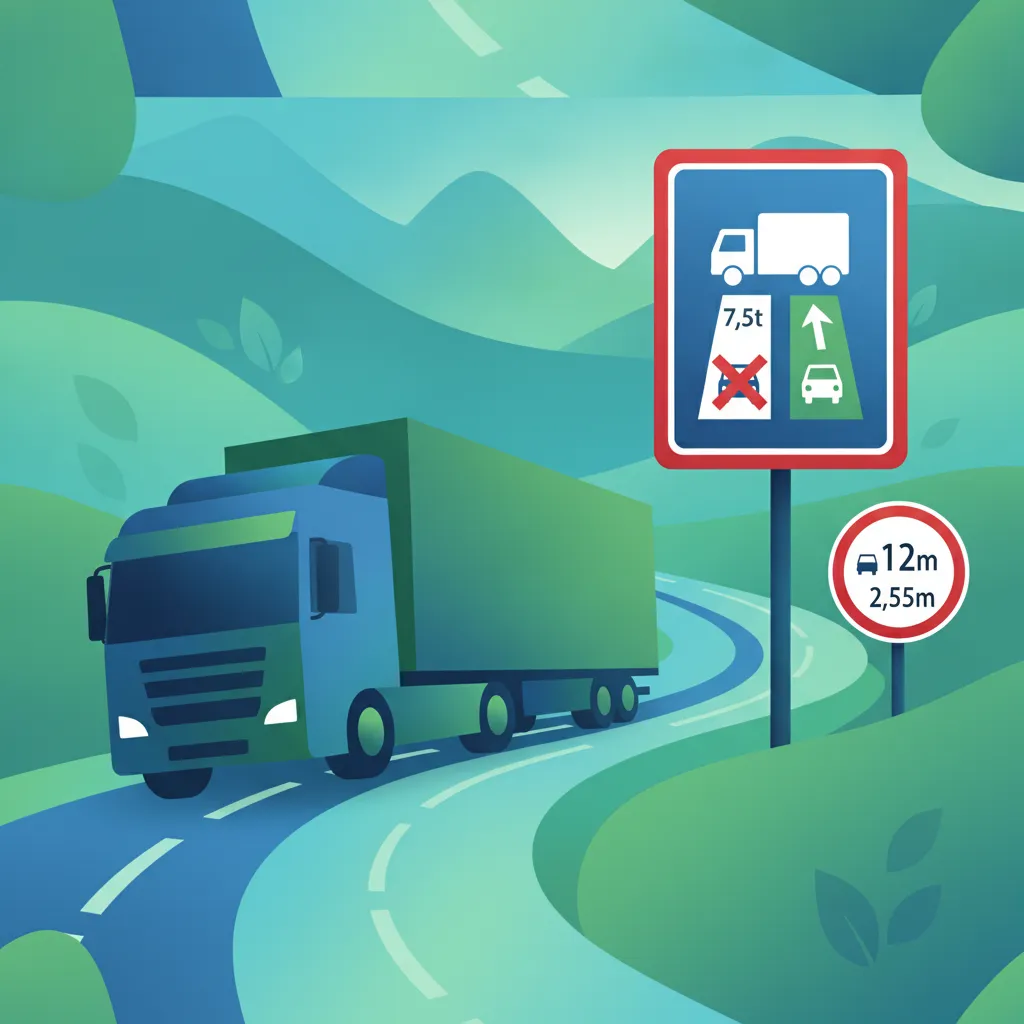
This lesson focuses on the specific Austrian road signs and supplemental plates that apply to heavy goods vehicles. It explains how to interpret signage indicating weight limits, height and width restrictions, lane usage rules, and other critical regulatory information. Correctly understanding these signs is essential for legal compliance and safe navigation on Austria's roads.

This lesson teaches the systematic procedure for conducting a thorough pre-trip walk-around inspection. It provides a checklist of critical components to examine, including tyres, lights, braking systems, and load security. Performing this daily check is a legal requirement and a fundamental practice for preventing mechanical failures and ensuring safety.

This lesson emphasizes the need to inspect all load-securing equipment as part of the daily pre-trip check. It teaches drivers how to look for signs of wear, damage, or malfunction in straps, chains, ratchets, and other devices. Verifying the integrity of this equipment is essential before every journey to ensure the load remains secure.

This lesson provides an overview of the legal framework governing heavy vehicle drivers in Austria. It details the potential penalties for violations, including fines, penalty points, and the risk of licence suspension. A clear understanding of these consequences reinforces the importance of compliant and responsible driving.

This lesson details the general traffic rules applicable to heavy goods vehicles on Austrian roads, highlighting differences from passenger car regulations. It covers key topics such as right-of-way at intersections, specific rules for overtaking, maintaining proper lane discipline, and adhering to designated speed limits. Understanding these rules is critical for safe integration into mixed traffic.
This lesson explains the system of penalties and enforcement for heavy vehicle operations in Austria. It covers the fines and penalty points associated with common traffic violations, such as overloading or insecure loads. Learners will understand the role of authorities in conducting roadside checks and inspections to ensure regulatory compliance.

This lesson focuses on the legal restrictions concerning a heavy vehicle's dimensions, including maximum height, width, and length. It teaches drivers how to interpret road signs and supplemental plates that indicate these limits. This knowledge is crucial for route planning, especially when navigating under bridges, through tunnels, and on restricted roads.

This lesson covers the various lighting and reflector systems required on heavy goods vehicles in Austria. It explains the function and legal requirements for headlights, taillights, brake lights, indicators, and reflective markings. Ensuring all lighting systems are operational is essential for visibility and communicating intentions to other road users.

This lesson covers the practical aspects of planning a route for a heavy goods vehicle. It explains how to use maps and specialized GPS systems to identify and avoid roads with height, weight, or other restrictions. Proactive route planning is essential for ensuring an efficient, legal, and safe journey.

This lesson explains the specific definitions and limitations of the C1, C1E, C, and CE heavy-goods vehicle licence categories in Austria. It details the permissible vehicle mass, axle configurations, and rules for trailer combinations associated with each category. Understanding these distinctions is fundamental for ensuring legal compliance and selecting the correct licence for specific vehicle configurations.
Explore the legal framework surrounding mandatory service intervals and roadworthiness certification for heavy goods vehicles in Austria. Understand your duties as an operator and the penalties for non-compliance.
This lesson explains the system of penalties and enforcement for heavy vehicle operations in Austria. It covers the fines and penalty points associated with common traffic violations, such as overloading or insecure loads. Learners will understand the role of authorities in conducting roadside checks and inspections to ensure regulatory compliance.
This lesson provides an overview of the legal framework governing heavy vehicle drivers in Austria. It details the potential penalties for violations, including fines, penalty points, and the risk of licence suspension. A clear understanding of these consequences reinforces the importance of compliant and responsible driving.

This lesson outlines the significant legal responsibilities placed on heavy-vehicle drivers under Austrian law, emphasizing a strong duty of care and professional conduct. It covers the obligation to perform thorough pre-trip inspections, comply with all load and weight regulations, and uphold safety standards to protect all road users. Adherence to these principles is crucial for professional and safe operation.
This lesson teaches the systematic procedure for conducting a thorough pre-trip walk-around inspection. It provides a checklist of critical components to examine, including tyres, lights, braking systems, and load security. Performing this daily check is a legal requirement and a fundamental practice for preventing mechanical failures and ensuring safety.

This lesson details the legal ramifications of operating an overloaded heavy vehicle in Austria, which include significant fines and penalty points. It also emphasizes the severe safety risks, such as compromised braking performance and increased mechanical stress on the vehicle. Understanding these consequences reinforces the importance of strict adherence to weight limits.
This lesson focuses on the legal restrictions concerning a heavy vehicle's dimensions, including maximum height, width, and length. It teaches drivers how to interpret road signs and supplemental plates that indicate these limits. This knowledge is crucial for route planning, especially when navigating under bridges, through tunnels, and on restricted roads.

This lesson consolidates the legal restrictions on the maximum dimensions and weight for different vehicle combinations in Austria. It covers how to read signs indicating these limits and the importance of compliance for route planning. Adhering to these regulations is essential for legal operation and avoiding fines.
This lesson details the essential legal and administrative requirements for operating an AM vehicle in Austria. It covers the processes for vehicle registration, the obligation for licence plates, and the necessity of third-party liability insurance. Furthermore, it explains the importance of regular technical inspections to ensure the vehicle remains roadworthy and compliant with national standards.
Find clear answers to common questions learners have about Service Intervals and Roadworthiness Certification. Learn how the lesson is structured, which driving theory objectives it supports, and how it fits into the overall learning path of units and curriculum progression in Austria. These explanations help you understand key concepts, lesson flow, and exam focused study goals.
The Pickerl is the common term for the mandatory periodic technical inspection in Austria. For heavy goods vehicles, this inspection ensures that the vehicle meets all safety and environmental standards required for operation on public roads.
While manufacturer service intervals are recommendations for vehicle longevity, they are critical for maintaining roadworthiness. If a vehicle failure caused by neglect leads to an accident or unsafe condition, the driver and operator face significant legal penalties.
Yes, professional drivers of heavy goods vehicles must ensure that valid inspection documentation and vehicle registration details are always present, as these will be checked during traffic enforcement stops.
Operating a vehicle that is not roadworthy can lead to fines, points on your licence, or even the immediate suspension of the vehicle's registration, which directly impacts your professional ability to operate heavy goods vehicles.
Refine your study plan by searching for specific Austrian driving theory practice sets. Pinpoint questions related to particular road rules, signs, or challenge levels, and begin practicing immediately to reinforce your knowledge and excel in your official exam with confidence. Get started with focused revision today.