
This lesson prepares you to navigate Austria's diverse road conditions, focusing on the unique challenges posed by adverse weather and night-time visibility. It builds on your foundational knowledge of speed limits and defensive driving to ensure you can make safe, legal decisions in complex environments. Mastering these rules is critical both for passing your Category B theory exam and for your future safety on the road.
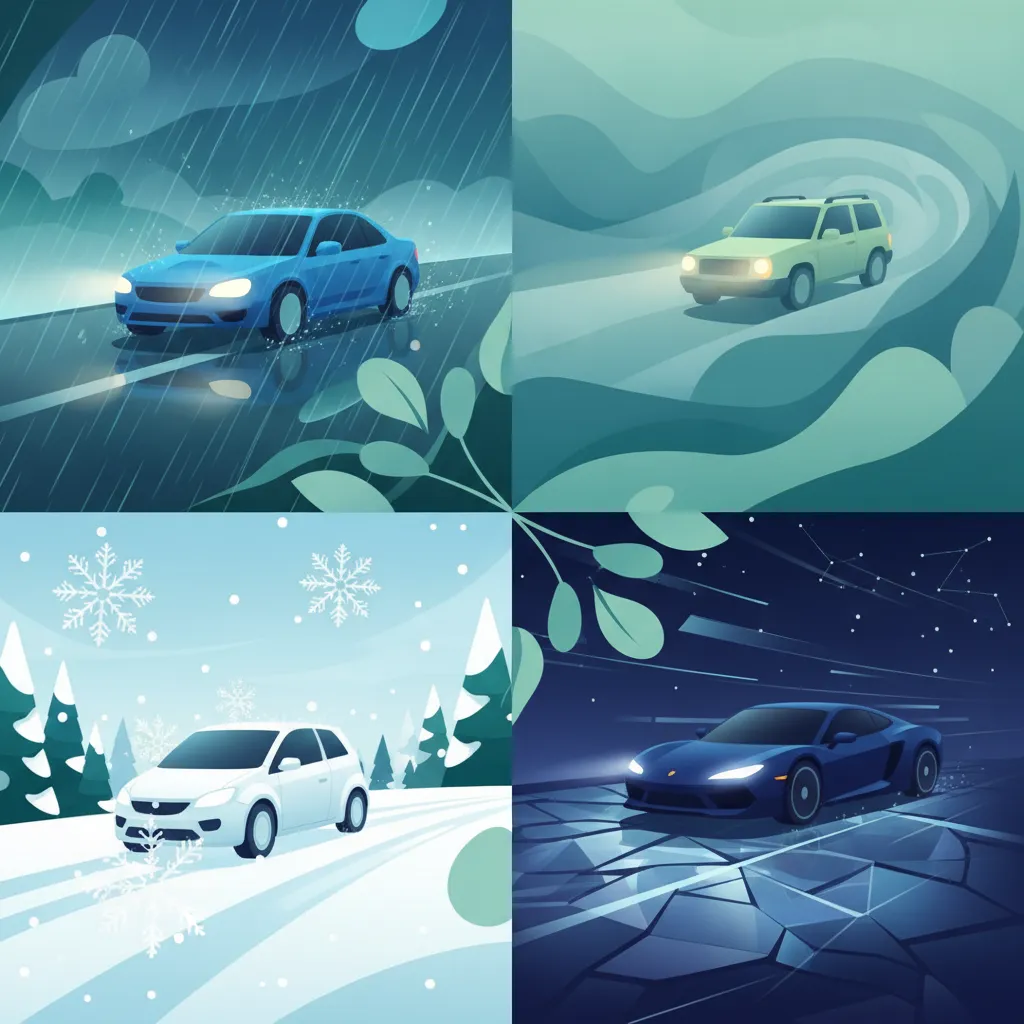
Lesson content overview
Driving on Austrian roads demands adaptability and skill, particularly when faced with adverse weather and reduced visibility. This lesson, part of your Austrian Driving License B Theory Course, will equip you with the essential knowledge and strategies to navigate challenging conditions safely and confidently. Understanding how rain, fog, snow, ice, and darkness affect your vehicle's performance and your perception is crucial for preventing accidents and adhering to Austrian traffic laws (StVO).
Adverse weather conditions profoundly impact vehicle control, road friction, and driver visibility. These changes necessitate a fundamental shift in driving behavior to maintain safety. Ignoring these factors is a major cause of road accidents.
Road friction, quantified by the friction coefficient (µ), is the primary force that allows your tires to grip the road, enabling acceleration, braking, and steering. Different road surfaces and weather conditions drastically alter this coefficient:
When friction is reduced, your tires have less grip, leading to longer stopping distances and a higher risk of skidding. Therefore, drivers must always adjust their speed and driving style to match the prevailing road surface friction. Vehicle systems like Anti-lock Braking System (ABS) and Traction Control (TC) help manage grip but cannot defy the laws of physics or fully compensate for driver error on low-friction surfaces.
Beyond friction, several other critical concepts dictate safe driving in challenging conditions:
The dangerous phenomenon where a vehicle's tires lose contact with the road surface due to a layer of water building up beneath them. This results in a complete loss of steering and braking control.
Hydroplaning typically occurs at higher speeds in standing water when tires cannot displace enough water. It can happen even with good tire tread.
The maximum distance at which a driver can clearly perceive objects, road markings, signs, and other road users.
Reduced visibility, common in fog, heavy rain, or at night, directly impacts a driver's ability to react to hazards. Your speed must always allow you to stop within your visible range. If you cannot see far ahead, you must drive slower.
The time elapsed between a driver perceiving a hazard and initiating an action, such as applying the brakes.
Under normal conditions, an average reaction time is about 1 to 1.5 seconds. However, factors like fatigue, distractions, or reduced visibility can lengthen this time, further increasing the total stopping distance.
The total distance a vehicle travels from the moment a driver perceives a hazard until the vehicle comes to a complete stop. It is the sum of the reaction distance (distance traveled during reaction time) and the braking distance (distance traveled while braking).
The stopping distance is directly influenced by speed, reaction time, and critically, the road's friction coefficient. On wet or icy roads, the braking distance can increase dramatically, requiring much greater following distances.
Rain is a common weather condition that significantly increases driving risks. Understanding these risks and employing appropriate techniques is vital for safe travel.
When rain falls, it mixes with oil and dust on the road surface, creating a slippery film that reduces tire grip. In heavy downpours, water can accumulate, forming puddles or standing water. This poses a significant risk of hydroplaning.
Hydroplaning occurs when your tires encounter more water than they can effectively disperse. Instead of cutting through the water, the tires ride on top of it, losing contact with the road. When hydroplaning, you will experience a sudden loss of steering and braking control. The steering wheel might feel light, and the engine speed could increase without an increase in road speed. This can happen very quickly, especially at higher speeds.
Several factors contribute to hydroplaning:
Do not mistake ABS as a hydroplaning prevention system. While ABS helps maintain steering control during braking on slippery surfaces, it cannot prevent hydroplaning if the tires lose contact with the road altogether.
To safely navigate wet conditions and minimize the risk of hydroplaning:
Fog presents a unique challenge, reducing visibility dramatically and distorting depth perception. Safe driving in foggy conditions requires precise control over lighting and speed.
Fog is essentially a cloud at ground level, formed by suspended water droplets that scatter light and reduce visibility. Its intensity can vary:
Driving in fog makes it difficult to judge distances, speed of other vehicles, and the curvature of the road. Your perception-reaction time can also increase due to the visual strain.
Proper lighting is critical in fog, not just to see but also to be seen.
If you are using your rear fog light, consider if your speed is safe. If visibility is below 50 metres, you should be driving very slowly, well below typical speed limits.
In fog, your speed must be adjusted so that you can stop within the distance you can clearly see ahead. This means if your visibility range is only 50 metres, your stopping distance must be less than 50 metres. This often requires driving at significantly reduced speeds, sometimes as low as 30-40 km/h even on open roads.
Always increase your following distance in fog. The "2-second rule" is insufficient; aim for a much larger gap, at least 4 seconds, or even more in dense fog. This provides crucial extra time to react to suddenly appearing obstacles or vehicles. Listen carefully for traffic you cannot see, and roll down your window slightly to hear better.
Snow and ice represent some of the most challenging conditions for drivers, drastically reducing traction and increasing the risk of skidding and loss of control.
Understanding the different types of frozen precipitation and their impact is key:
Be especially vigilant for black ice on bridges, overpasses, and shaded sections of the road when temperatures are around freezing. These areas often freeze first and remain icy longer.
In Austria, specific regulations govern the use of winter tires to enhance safety during cold weather.
Driving on snow and ice requires extreme caution and a gentle touch:
Night driving introduces different challenges, primarily related to reduced visibility and the effects of artificial light sources.
At night, your vision is naturally reduced. It becomes harder to:
Proper use of your vehicle's lighting systems is paramount at night.
Adhering to specific Austrian traffic regulations (StVO) is not only a legal obligation but also a fundamental aspect of safe driving in challenging conditions.
This section of the Austrian Road Traffic Regulations (Straßenverkehrsordnung) specifies rules for vehicle lighting, including mandatory use of dipped beam headlights and conditions for high beam and fog lights.
The Austrian StVO §12(2)(4b) explicitly mandates the use of winter tires under specific conditions:
Even experienced drivers can make mistakes in adverse conditions. Being aware of common pitfalls and employing proactive strategies is key to safety.
Here are common errors and how to avoid them:
Driving in adverse conditions also requires considering the specific environment and your vehicle's state:
This lesson covers the physics of road friction and how rain, fog, snow, and ice each reduce traction differently, requiring specific speed and technique adjustments. It details Austrian lighting regulations (StVO §61), including when to use dipped beam, high beam, front fog lights, and rear fog lights, with precise visibility thresholds. The content explains winter tire obligations from November 1 to April 15, the dangers of black ice, and practical strategies for maintaining control in low-traction situations. Safe driving requires matching speed to visible stopping distance, maintaining increased following distances, and using lights correctly—rules that are both legal requirements and critical for road safety in Austria's diverse driving conditions.
A short set of high-value points that capture the most important learning from this lesson.
Road friction drops dramatically in adverse conditions: dry asphalt µ 0.7–0.8, wet roads µ 0.5–0.6, snow µ 0.2–0.3, and ice as low as µ 0.1, directly increasing stopping distances.
Hydroplaning occurs when tires lose road contact on standing water—reduce speed and avoid sudden inputs; ABS cannot prevent hydroplaning.
In fog, always use dipped beam; front fog lights when visibility drops below 100 m, rear fog lights only when visibility is below 50 m.
Austrian winter tire regulations (StVO §12(2)(4b)) require compliant winter tires from November 1 to April 15 when winter conditions prevail, with minimum 4 mm tread for radial tires.
Your speed must always allow you to stop within your visible range—this is a legal requirement under StVO, not merely a recommendation.
Explore all units and lessons included in this driving theory course.
Black ice forms first on bridges, overpasses, and shaded areas; it appears as wet road but creates near-zero traction.
High beam headlights are prohibited within 150 m of oncoming or following vehicles; switch to dipped beam well in advance.
Following distance should be at least doubled in rain and extended to 4–5 seconds on snow and ice, as braking distances increase substantially.
Front fog lights must be switched off when visibility exceeds 100 m or another vehicle is within 150 m to avoid causing glare.
Snow chains may be mandatory on alpine routes (sign B33) and must be fitted to the driving wheels on completely snow-covered roads only.
Using high beam headlights in fog, which reflects light back and severely reduces visibility instead of improving it.
Tailgating in rain, fog, or ice, underestimating how dramatically stopping distances increase on low-friction surfaces.
Leaving rear fog lights on after visibility improves beyond 50 m, causing dangerous glare for following drivers.
Assuming posted speed limits apply in severe weather; StVO requires you to reduce speed to what is safe for actual conditions.
Using sudden braking or sharp steering on wet or icy roads, which easily causes skids even with ABS equipped.
Lesson content overview
A short set of high-value points that capture the most important learning from this lesson.
Road friction drops dramatically in adverse conditions: dry asphalt µ 0.7–0.8, wet roads µ 0.5–0.6, snow µ 0.2–0.3, and ice as low as µ 0.1, directly increasing stopping distances.
Hydroplaning occurs when tires lose road contact on standing water—reduce speed and avoid sudden inputs; ABS cannot prevent hydroplaning.
In fog, always use dipped beam; front fog lights when visibility drops below 100 m, rear fog lights only when visibility is below 50 m.
Austrian winter tire regulations (StVO §12(2)(4b)) require compliant winter tires from November 1 to April 15 when winter conditions prevail, with minimum 4 mm tread for radial tires.
Your speed must always allow you to stop within your visible range—this is a legal requirement under StVO, not merely a recommendation.
Explore all units and lessons included in this driving theory course.
Black ice forms first on bridges, overpasses, and shaded areas; it appears as wet road but creates near-zero traction.
High beam headlights are prohibited within 150 m of oncoming or following vehicles; switch to dipped beam well in advance.
Following distance should be at least doubled in rain and extended to 4–5 seconds on snow and ice, as braking distances increase substantially.
Front fog lights must be switched off when visibility exceeds 100 m or another vehicle is within 150 m to avoid causing glare.
Snow chains may be mandatory on alpine routes (sign B33) and must be fitted to the driving wheels on completely snow-covered roads only.
Using high beam headlights in fog, which reflects light back and severely reduces visibility instead of improving it.
Tailgating in rain, fog, or ice, underestimating how dramatically stopping distances increase on low-friction surfaces.
Leaving rear fog lights on after visibility improves beyond 50 m, causing dangerous glare for following drivers.
Assuming posted speed limits apply in severe weather; StVO requires you to reduce speed to what is safe for actual conditions.
Using sudden braking or sharp steering on wet or icy roads, which easily causes skids even with ABS equipped.
Explore search topics learners often look for when studying Weather Conditions: Rain, Fog, Snow, Ice, and Night Driving. These topics reflect common questions about road rules, driving situations, safety guidance, and lesson level theory preparation for learners in Austria.
Browse additional driving theory lessons that cover connected traffic rules, road signs, and common driving situations related to this topic. Improve your understanding of how different rules interact across everyday traffic scenarios.
Understand Austrian traffic regulations (StVO) for driving in adverse weather conditions like rain, fog, snow, and ice. Learn essential rules for speed, lighting, and visibility to ensure road safety and pass your theory test.
This lesson addresses the critical skill of adapting driving behavior to conditions of reduced visibility, such as fog, heavy rain, snow, or darkness. It explains the principle of driving only as fast as you can see, ensuring your stopping distance is within your visibility range. The content covers the correct use of headlights and fog lights and emphasizes why speed reduction is essential for maintaining safety when your ability to perceive hazards is compromised.
This lesson covers the proper and legal use of a vehicle's entire lighting system to see and be seen. It explains the regulations for using headlights, including daytime running lights, and the specific conditions under which fog lights and high beams are permitted. Correct use of turn signals and brake lights is also emphasized as essential for communicating intentions to other drivers and ensuring safety in all visibility conditions.

This lesson focuses on adapting driving techniques for hazardous weather conditions. It details the legal requirements for winter tires and the proper use of snow chains in Austria. Additionally, it covers safe driving practices in low visibility conditions like fog, such as reducing speed and using appropriate lights.
Adverse weather demands a significant adjustment in driving technique. This lesson explains the dangers of aquaplaning in heavy rain, the need for drastically reduced speed in fog, and how to anticipate and correct for the effects of strong crosswinds on a high-sided vehicle. It reinforces the importance of increasing following distances and using appropriate lighting to see and be seen.

This lesson focuses on strategies for riding safely in conditions of poor visibility, such as rain, fog, and low sun glare. It explains how to use lights effectively, increase following distances, and moderate speed to maintain control. The content also addresses braking techniques on wet surfaces to prevent skidding and hydroplaning.
This lesson examines how adverse weather directly affects motorcycle safety. It explains how water on the road reduces tyre grip, increasing braking distances and the risk of aquaplaning. Strategies for riding in fog, dealing with reduced visibility from road spray, and identifying potential ice patches are covered to help riders manage weather-related risks.
Winter driving in Austria presents a serious challenge that requires specific equipment and skills. This lesson covers how to drive on snow and ice, emphasizing smooth, gentle control inputs to maintain traction. It provides a practical overview of when and how to correctly fit snow chains ('Schneeketten') to the drive wheels, a legal requirement on many alpine roads.
This lesson covers the various lighting and reflector systems required on heavy goods vehicles in Austria. It explains the function and legal requirements for headlights, taillights, brake lights, indicators, and reflective markings. Ensuring all lighting systems are operational is essential for visibility and communicating intentions to other road users.
This lesson focuses on the specialized skills required for navigating alpine roads safely. It covers techniques for managing steep gradients, such as using a lower gear for engine braking on descents, and how to safely negotiate hairpin turns. The content stresses the importance of being prepared for rapid weather changes and understanding the effects of altitude on both the driver and the vehicle's performance.

Rural Austrian roads present unique challenges, including lack of markings, tight spaces, and slow-moving agricultural vehicles. This lesson teaches how to read the road ahead, anticipate hazards around blind bends, and use passing places effectively when meeting other large vehicles. It emphasizes adjusting speed to suit the limited visibility and variable road conditions.
Learn to identify and manage critical driving hazards such as black ice and hydroplaning. This lesson covers Austrian winter tire regulations and essential techniques for safe driving on snow and ice.
This lesson focuses on adapting driving techniques for hazardous weather conditions. It details the legal requirements for winter tires and the proper use of snow chains in Austria. Additionally, it covers safe driving practices in low visibility conditions like fog, such as reducing speed and using appropriate lights.
This lesson details the critical role tyres play in vehicle safety, focusing on Austrian regulations for seasonal use. Learners will understand the mandatory period for winter tyres, the legal minimum for tread depth, and the importance of maintaining correct tyre pressure for optimal grip and fuel efficiency. The content explains how tyre condition directly affects braking distance and the risk of aquaplaning, making it a key safety component.
This lesson examines how adverse weather directly affects motorcycle safety. It explains how water on the road reduces tyre grip, increasing braking distances and the risk of aquaplaning. Strategies for riding in fog, dealing with reduced visibility from road spray, and identifying potential ice patches are covered to help riders manage weather-related risks.
This lesson covers the significant risks associated with riding in winter conditions, particularly snow and ice. It teaches riders how to identify areas where black ice is likely to form and the techniques for gentle acceleration, braking, and steering to maintain traction. The importance of appropriate tires and other winter equipment is also highlighted.
This lesson provides practical information on the use of winter equipment for AM vehicles. It explains the legal requirements for winter tires and snow chains in Austria under specific conditions. The content includes guidance on how to correctly install and remove snow chains to ensure they are effective and safe.
This lesson explores the critical relationship between tire grip and different road surfaces. It provides strategies for identifying and navigating hazards such as wet leaves, gravel, and potential black ice. The importance of maintaining correct tire pressure and monitoring tread wear for optimal traction is also emphasized.
Winter driving in Austria presents a serious challenge that requires specific equipment and skills. This lesson covers how to drive on snow and ice, emphasizing smooth, gentle control inputs to maintain traction. It provides a practical overview of when and how to correctly fit snow chains ('Schneeketten') to the drive wheels, a legal requirement on many alpine roads.
This lesson provides guidance on tailoring riding practices to the season. For colder months, it emphasizes the importance of layered clothing and awareness of icy patches, especially in shaded areas. For spring, it highlights hazards like leftover road salt and gravel from winter maintenance, as well as slippery wet leaves, requiring heightened caution.
This lesson addresses the critical skill of adapting driving behavior to conditions of reduced visibility, such as fog, heavy rain, snow, or darkness. It explains the principle of driving only as fast as you can see, ensuring your stopping distance is within your visibility range. The content covers the correct use of headlights and fog lights and emphasizes why speed reduction is essential for maintaining safety when your ability to perceive hazards is compromised.
Adverse weather demands a significant adjustment in driving technique. This lesson explains the dangers of aquaplaning in heavy rain, the need for drastically reduced speed in fog, and how to anticipate and correct for the effects of strong crosswinds on a high-sided vehicle. It reinforces the importance of increasing following distances and using appropriate lighting to see and be seen.
Find clear answers to common questions learners have about Weather Conditions: Rain, Fog, Snow, Ice, and Night Driving. Learn how the lesson is structured, which driving theory objectives it supports, and how it fits into the overall learning path of units and curriculum progression in Austria. These explanations help you understand key concepts, lesson flow, and exam focused study goals.
You must use fog lights or your rear fog light when visibility is severely restricted due to heavy fog, falling snow, or intense rain. It is important to turn them off as soon as visibility improves to avoid dazzling other drivers.
In snowy or icy conditions, your stopping distance significantly increases. Theory questions often require you to understand that you must increase your following distance by several times compared to dry road conditions to allow for reduced tyre grip.
When you suspect black ice, avoid sudden steering, braking, or acceleration. Gently release the accelerator and keep the steering wheel steady until the vehicle stabilizes, as sudden movements often lead to a loss of control.
Yes, night driving requires an emphasis on adjusting your speed so you can stop within the distance illuminated by your headlights. You must also be prepared to dim your high beams whenever there is a risk of blinding oncoming traffic.
Refine your study plan by searching for specific Austrian driving theory practice sets. Pinpoint questions related to particular road rules, signs, or challenge levels, and begin practicing immediately to reinforce your knowledge and excel in your official exam with confidence. Get started with focused revision today.