
This lesson explores the specific behavioural risks that new drivers often face when transitioning from learner to independent driver. By identifying factors like overconfidence, distraction, and peer pressure, you will learn to adopt a proactive approach to safety. This knowledge is essential for understanding both the theoretical exam questions and the reality of navigating Austrian roads as a probationary driver.
Lesson content overview
Becoming a driver holding an Austrian Category B license marks a significant step towards independence and mobility. However, the initial years of driving are statistically the most dangerous, presenting a unique set of challenges and elevated risks. This lesson delves into the specific factors that make novice drivers more vulnerable to accidents, exploring common behavioural tendencies and cognitive biases.
By gaining a thorough understanding of these risks, new drivers can cultivate essential self-awareness. This foundation allows for the adoption of proactive, safer driving habits right from the beginning of their driving career, ultimately contributing to a safer road environment for everyone in Austria.
Despite undergoing rigorous training and passing the official Austrian driving test, new drivers are disproportionately represented in accident statistics. This phenomenon is not unique to Austria but is a globally observed trend. It highlights that proficiency in vehicle control and knowledge of traffic rules, while crucial, are only part of the equation for safe driving.
The higher risk profile of novice drivers stems from a combination of psychological, behavioural, and experiential factors that collectively increase the likelihood of misjudgements and risky actions. Recognizing these underlying causes is the first step towards mitigating them effectively.
Several core principles explain why novice drivers often find themselves in hazardous situations. These are not character flaws but rather common developmental stages in acquiring comprehensive driving competence.
The systematic tendency of novice drivers to underestimate the likelihood and potential severity of traffic hazards. This cognitive bias can lead to a false sense of security and a willingness to engage in unsafe driving practices.
Novice drivers frequently exhibit a "risk perception deficit," meaning they struggle to accurately assess the dangers present on the road. This isn't necessarily due to recklessness but often stems from a lack of experience in identifying subtle cues that seasoned drivers instinctively pick up. They may not fully grasp the implications of certain actions or environmental conditions.
This deficit often manifests as optimism bias, where new drivers believe that accidents "happen to other people," not to themselves. They might also demonstrate probability neglect, where they acknowledge known dangers but disregard their statistical likelihood in the belief that personal skill can overcome the odds. For example, a novice driver might maintain an insufficient following distance, incorrectly assuming they can react and brake in time, despite the known risks of tailgating.
Developing Hazard Recognition: Actively scan the road far ahead and to the sides, looking for potential conflict points, sudden braking lights, or unusual vehicle movements. Anticipate what could happen, not just what is currently happening.
The tendency for novice drivers to overestimate their driving competence, particularly after a period of initial success or mastering basic vehicle controls. This inflated self-assessment can lead to taking unnecessary risks.
While confidence is important, overconfidence can be perilous. After gaining some initial experience and successfully navigating a few challenging situations, novice drivers may develop an inflated sense of their abilities. This "overconfidence bias" can lead them to believe they are more skilled or have more control over complex situations than they truly do.
This can result in skill overestimation, where they attempt complex manoeuvres, such as high-speed overtaking on a challenging road, without adequate preparation or understanding of the full risks. Another aspect is the control illusion, where they believe they have complete control over situational outcomes, downplaying external factors or the actions of other road users. This can lead to disregarding cautionary measures or even breaking rules, believing they can handle any ensuing complexity.
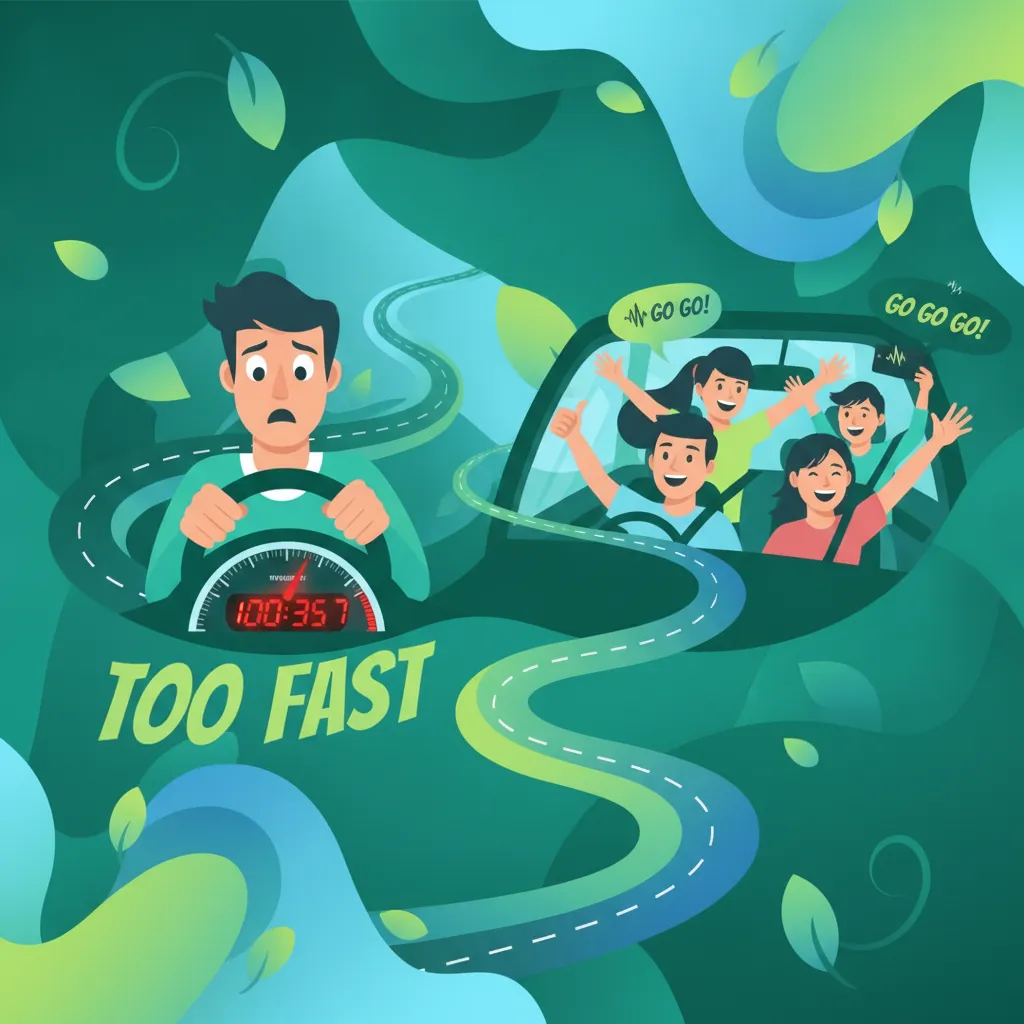
The effect of friends or passengers on a novice driver’s behaviour, often encouraging riskier actions or leading to distractions due to the desire for acceptance or approval.
Young drivers are particularly susceptible to peer pressure and social influence from their passengers or friends. This influence can be subtle or overt, leading to behavioural changes that increase risk. Passive influence might involve loud conversations or music in the car, creating a distracting environment. Active influence could be passengers directly encouraging the driver to speed, overtake dangerously, or engage in other risky behaviours.
The desire to impress peers or avoid social disapproval can override a novice driver's better judgment. This can manifest in speeding to "show off," accepting dares, or neglecting safe driving practices to engage in social interaction. The presence of passengers, especially multiple young passengers, is strongly correlated with an increased accident risk for novice drivers.
The increased likelihood for novice drivers to have their primary focus disrupted by internal (e.g., thoughts, emotions) or external (e.g., mobile phones, passengers, infotainment systems) stimuli.
Novice drivers have a developing attentional capacity and are still mastering the complex task of driving. This makes them significantly more susceptible to distractions compared to experienced drivers. Any secondary task or environmental stimulus that diverts attention from the primary driving task can be particularly dangerous.
Distractions can be internal, such as engaging in intense conversations, or being preoccupied with emotional states. They can also be external, such as using mobile phones (even briefly glancing), interacting with infotainment systems, or being sidetracked by passengers. Even a momentary glance away from the road can have severe consequences, as it reduces situational awareness, delays reaction times, and compromises decision-making, especially at higher speeds or in complex traffic.
Avoid All Forms of Distraction: Before starting your journey, set your GPS, adjust your music, and silence your phone. Resist the urge to engage with any device while the vehicle is in motion. If you need to make a call or send a message, pull over safely.
The lack of practical exposure to a wide variety of road situations, traffic scenarios, and environmental conditions (e.g., diverse weather, different road types).
Driving safely involves more than just knowing how to operate a vehicle; it requires the ability to anticipate and respond to an almost infinite number of evolving situations. Novice drivers, by definition, lack this extensive practical exposure. They have fewer "mental templates" for handling unexpected hazards or complex traffic interactions.
This developmental inexperience can be categorized as environmental, such as a lack of practice driving on challenging Alpine roads, busy motorways, or during heavy rain or snow. It can also be situational, meaning insufficient exposure to complex intersections, multi-lane roundabouts, merging onto high-speed roads, or navigating tight city traffic with trams and cyclists. This lack of experience hampers their ability to anticipate risks, identify potential conflicts early, and apply defensive driving strategies effectively.
To counteract these inherent risks, Austrian traffic law (StVO – Straßenverkehrsordnung) includes specific regulations designed to promote safety for all road users, which are especially crucial for novice drivers. Understanding and strictly adhering to these rules is paramount.
Austrian law mandates that drivers must maintain a sufficient distance from the vehicle ahead to be able to stop safely without colliding, even if the vehicle ahead brakes suddenly. This distance must be adjusted according to speed, road conditions (e.g., wet, icy), and visibility.
While posted speed limits indicate the maximum permissible speed, drivers are legally obligated to adjust their speed according to the prevailing conditions. This includes visibility, the condition of the road surface (e.g., wet leaves, ice, loose gravel), traffic density, and the driver's own capabilities.
Using handheld mobile phones or other electronic devices for communication, information, or entertainment while driving is strictly prohibited in Austria. This rule aims to minimise a significant source of cognitive and manual distraction.
The StVO explicitly states that drivers must ensure that passengers do not jeopardise the safe operation of the vehicle. This places responsibility on the driver to manage the behaviour within their car.
Strict adherence to priority rules at intersections, including those involving roundabouts, is fundamental for preventing accidents. Novice drivers, due to inexperience, can misjudge gaps or hesitate, leading to dangerous situations.
Understanding the theoretical risks is crucial, but recognizing them in practical driving scenarios is even more so. Novice drivers commonly make mistakes that stem from the risk factors discussed:
Safe driving requires constant adaptation to changing conditions. Novice drivers must learn to modify their behaviour significantly based on external factors.
Developing a low-risk driving profile is an active process. Here are core strategies to adopt:
The principles discussed in this lesson are foundational for becoming a safe and responsible driver. They directly inform the purpose and structure of the Mehrphasenausbildung (multi-phase training) in Austria, which is specifically designed to provide structured support and further training for novice drivers during their initial driving period. Understanding these risk factors will help you appreciate why these additional training phases are legally required and how they contribute to your long-term safety.
Furthermore, these behavioural factors are often at the root of traffic violations, leading to penalties and points on your driver's license. By addressing these risks early, you can avoid not only accidents but also legal consequences. This lesson also connects to broader themes of observation and lane use, speed and distance management, and traffic culture, all of which contribute to your overall driving competence.
Driving is a complex skill that develops over time, and it's natural for novice drivers to face unique challenges. By internalising the following principles, you can significantly reduce your accident risk and cultivate a lifelong habit of safe, responsible driving:
By actively applying these insights, you are not only preparing for the Austrian Category B official test but also building the foundation for a safe and confident driving career.
This lesson addresses the psychological and behavioural factors that make novice drivers statistically more accident-prone, including risk perception deficits, overconfidence bias, peer pressure susceptibility, and distraction vulnerability. It connects these human factors to specific Austrian traffic regulations (StVO) governing following distances, speed adaptation, mobile phone use, and passenger management. The content provides practical defensive driving strategies, scenario-based examples of common mistakes, and guidance on adapting driving behaviour to weather, lighting, road type, and vehicle conditions. Understanding these factors is essential for both safe driving practice and answering scenario-based questions in the Austrian Category B theory exam.
A short set of high-value points that capture the most important learning from this lesson.
Novice drivers have a systematic risk perception deficit, meaning they underestimate both the likelihood and severity of hazards due to limited experience in reading traffic situations.
Overconfidence bias develops after initial driving success, leading to skill overestimation and a false illusion of control over complex situations.
Austrian traffic law (StVO) contains specific regulations targeting novice driver vulnerabilities, including mandatory following distances, speed adaptation requirements, and mobile phone prohibitions.
Peer pressure from passengers is a documented risk factor that can override a novice driver's judgment, leading to dangerous behaviours like speeding or aggressive overtaking.
Defensive driving requires anticipating hazards by scanning far ahead and planning escape routes, rather than reacting only to what is currently happening.
Explore all units and lessons included in this driving theory course.
Risk perception deficit causes optimism bias and probability neglect, where drivers believe accidents only happen to others and that personal skill can overcome statistical odds.
StVO § 4.3.2 requires sufficient following distance to stop safely; at 80 km/h on dry roads this means roughly 44 metres (two-second gap), increasing significantly in wet or icy conditions.
StVO § 5 prohibits handheld mobile phone use even when temporarily stopped in traffic, and StVO § 5(3) makes drivers legally responsible for managing distracting passengers.
Developmental inexperience means novice drivers have fewer mental templates for handling unexpected situations, particularly on challenging Alpine roads, motorways, or in adverse weather.
Environmental inexperience includes limited practice with diverse conditions such as snow-covered roads, heavy fog, busy intersections, and multi-lane roundabouts.
Believing that skill and quick reflexes alone compensate for tailgating or speeding, when in reality reaction time and braking distance are physical limits that cannot be overcome by confidence.
Assuming that following a speed limit means driving safely regardless of weather conditions, when StVO § 3 requires adapting speed to actual road, visibility, and traffic conditions.
Underestimating how briefly glancing at a phone diverts attention for several seconds, during which a vehicle travels dozens of metres without driver observation.
Failing to yield correctly at roundabouts by misjudging the speed or proximity of circulating traffic due to overconfidence in personal driving ability.
Assuming passengers will self-regulate their behaviour, when StVO § 5(3) places full responsibility on the driver to manage any distractions within the vehicle.
Lesson content overview
A short set of high-value points that capture the most important learning from this lesson.
Novice drivers have a systematic risk perception deficit, meaning they underestimate both the likelihood and severity of hazards due to limited experience in reading traffic situations.
Overconfidence bias develops after initial driving success, leading to skill overestimation and a false illusion of control over complex situations.
Austrian traffic law (StVO) contains specific regulations targeting novice driver vulnerabilities, including mandatory following distances, speed adaptation requirements, and mobile phone prohibitions.
Peer pressure from passengers is a documented risk factor that can override a novice driver's judgment, leading to dangerous behaviours like speeding or aggressive overtaking.
Defensive driving requires anticipating hazards by scanning far ahead and planning escape routes, rather than reacting only to what is currently happening.
Explore all units and lessons included in this driving theory course.
Risk perception deficit causes optimism bias and probability neglect, where drivers believe accidents only happen to others and that personal skill can overcome statistical odds.
StVO § 4.3.2 requires sufficient following distance to stop safely; at 80 km/h on dry roads this means roughly 44 metres (two-second gap), increasing significantly in wet or icy conditions.
StVO § 5 prohibits handheld mobile phone use even when temporarily stopped in traffic, and StVO § 5(3) makes drivers legally responsible for managing distracting passengers.
Developmental inexperience means novice drivers have fewer mental templates for handling unexpected situations, particularly on challenging Alpine roads, motorways, or in adverse weather.
Environmental inexperience includes limited practice with diverse conditions such as snow-covered roads, heavy fog, busy intersections, and multi-lane roundabouts.
Believing that skill and quick reflexes alone compensate for tailgating or speeding, when in reality reaction time and braking distance are physical limits that cannot be overcome by confidence.
Assuming that following a speed limit means driving safely regardless of weather conditions, when StVO § 3 requires adapting speed to actual road, visibility, and traffic conditions.
Underestimating how briefly glancing at a phone diverts attention for several seconds, during which a vehicle travels dozens of metres without driver observation.
Failing to yield correctly at roundabouts by misjudging the speed or proximity of circulating traffic due to overconfidence in personal driving ability.
Assuming passengers will self-regulate their behaviour, when StVO § 5(3) places full responsibility on the driver to manage any distractions within the vehicle.
Explore search topics learners often look for when studying Novice Driver Risk Profile and Behavioural Factors. These topics reflect common questions about road rules, driving situations, safety guidance, and lesson level theory preparation for learners in Austria.
Browse additional driving theory lessons that cover connected traffic rules, road signs, and common driving situations related to this topic. Improve your understanding of how different rules interact across everyday traffic scenarios.
Learn to identify and manage common risks like overconfidence, distraction, and peer pressure faced by novice drivers. Understand Austrian traffic laws and defensive driving strategies to ensure safer road participation from the start.

This lesson introduces the proactive mindset of defensive driving, which focuses on anticipating potential hazards rather than just reacting to them. It teaches techniques for systematic risk assessment, including scanning the road ahead, checking mirrors frequently, and being aware of the potential actions of other road users. By adopting these safe habits, drivers can create a buffer of safety around their vehicle and significantly reduce the likelihood of being involved in an accident.
This lesson explores the key psychological factors that influence a driver's performance and safety on the road. It covers topics such as risk perception, attention allocation, and the process of making sound decisions, especially when under stress or facing unexpected hazards. By understanding concepts like cognitive load and the importance of maintaining a defensive mindset, drivers can better anticipate dangers and avoid common mental errors that lead to collisions.

This lesson provides advanced strategies for proactively managing interactions with vulnerable road users to prevent conflicts before they arise. It teaches drivers to predict the likely behavior of pedestrians, cyclists, and e-scooter riders, especially at intersections and in congested areas. Key techniques include maintaining larger safety distances, covering the brake, and making eye contact to ensure mutual awareness and avoid accidents.

This lesson identifies and analyzes common risk-taking behaviors prevalent among young and inexperienced riders. It covers the dangers of distractions like mobile phone use, the influence of peer pressure, and the false sense of security from overconfidence. The goal is to foster a mature and responsible approach to riding.

This lesson consolidates knowledge by applying it to common everyday driving situations. It offers practical tips on topics like smooth driving for fuel efficiency, managing distractions in the cabin, and maintaining courtesy in frustrating traffic. The content reinforces defensive driving principles as a constant habit, helping learners transition from theoretical knowledge to confident, safe, and responsible real-world driving.

Driving in tourist hotspots in cities like Salzburg or alpine resorts requires extra patience and vigilance. This lesson explores common unpredictable behaviours, such as pedestrians stepping into the road to take photos or groups of tourists being unaware of traffic. It teaches drivers to slow down, be prepared for anything, and use communication tools like the horn sparingly and appropriately.

This lesson introduces the foundational elements of Austrian traffic culture, placing a strong emphasis on cooperation, courtesy, and effective non-verbal communication between road users. It delves into the societal expectations for driver behavior, highlighting how mutual respect and clear signaling enhance safety for everyone. By understanding and applying these norms, drivers can contribute to a more harmonious and predictable traffic environment, reducing conflicts and potential accidents.

This lesson explains how fatigue, alcohol, and drugs dangerously impair a rider's judgment, coordination, and reaction time. It specifies the legal blood alcohol concentration (BAC) limit for vehicle operators in Austria and describes the severe penalties for driving under the influence (DUI). The importance of being well-rested and completely sober before every ride is strongly emphasized.

This lesson focuses on the critical skill of sharing the road safely with vulnerable users, such as pedestrians, cyclists, and e-scooter riders. It details the legally required distance buffers for overtaking and emphasizes heightened awareness in sensitive areas like school zones and designated pedestrian crossings. The content provides guidelines for interacting with bicycle lanes and shared spaces to foster a protective and respectful driving attitude towards those most at risk.

This lesson explains the critical Mehrphasenausbildung (multi-phase training) process that all new drivers in Austria must complete after obtaining their license. It focuses on the obligations during the probationary period, including the demerit points system and the consequences of traffic violations like a Fahrverbot (driving ban). The content details the mandatory driver improvement courses designed to enhance risk awareness and promote responsible driving habits.
Explore how to adjust speed, observation, and behaviour for diverse Austrian driving conditions including weather (rain, snow, fog), road types (urban, rural, alpine, motorway), and lighting. Essential theory for safe driving.

This lesson addresses the critical skill of adapting driving behavior to conditions of reduced visibility, such as fog, heavy rain, snow, or darkness. It explains the principle of driving only as fast as you can see, ensuring your stopping distance is within your visibility range. The content covers the correct use of headlights and fog lights and emphasizes why speed reduction is essential for maintaining safety when your ability to perceive hazards is compromised.

This lesson equips drivers with the knowledge to handle a range of adverse weather conditions safely. It explains the risks of hydroplaning in heavy rain, reduced visibility in fog, and loss of traction on snow and ice, including the hidden danger of black ice. The content provides practical strategies for speed adaptation, correct use of lighting, and maintaining vehicle control, as well as specific considerations for night driving.

Adverse weather demands a significant adjustment in driving technique. This lesson explains the dangers of aquaplaning in heavy rain, the need for drastically reduced speed in fog, and how to anticipate and correct for the effects of strong crosswinds on a high-sided vehicle. It reinforces the importance of increasing following distances and using appropriate lighting to see and be seen.

This lesson brings together many concepts by focusing on the mindset of an adaptive rider. It teaches how to constantly scan the environment and adjust speed, position, and control inputs in response to changing conditions like road surface, weather, or traffic density. The goal is to develop a proactive, flexible riding style that prioritizes safety and control in any situation.

This lesson examines how adverse weather directly affects motorcycle safety. It explains how water on the road reduces tyre grip, increasing braking distances and the risk of aquaplaning. Strategies for riding in fog, dealing with reduced visibility from road spray, and identifying potential ice patches are covered to help riders manage weather-related risks.

Rural Austrian roads present unique challenges, including lack of markings, tight spaces, and slow-moving agricultural vehicles. This lesson teaches how to read the road ahead, anticipate hazards around blind bends, and use passing places effectively when meeting other large vehicles. It emphasizes adjusting speed to suit the limited visibility and variable road conditions.

This lesson explores the specific characteristics and hazards of rural roads (Landstraßen). It emphasizes the need for careful speed adjustment due to factors like narrow lanes, poor road surfaces, and hidden entrances. Learners will understand how to safely navigate blind curves, use passing places, and anticipate the presence of slow-moving agricultural vehicles or livestock on the road.

This lesson explores the distinct challenges of urban driving, focusing on managing the vehicle in dense, slow-moving, or stop-and-go traffic. It covers strategies for effective lane management, anticipating traffic signal changes, and navigating common city road features like one-way streets and traffic calming measures. Understanding these dynamics helps reduce stress and improve safety in congested environments.
Driving in tourist hotspots in cities like Salzburg or alpine resorts requires extra patience and vigilance. This lesson explores common unpredictable behaviours, such as pedestrians stepping into the road to take photos or groups of tourists being unaware of traffic. It teaches drivers to slow down, be prepared for anything, and use communication tools like the horn sparingly and appropriately.
This lesson explores the key psychological factors that influence a driver's performance and safety on the road. It covers topics such as risk perception, attention allocation, and the process of making sound decisions, especially when under stress or facing unexpected hazards. By understanding concepts like cognitive load and the importance of maintaining a defensive mindset, drivers can better anticipate dangers and avoid common mental errors that lead to collisions.
Find clear answers to common questions learners have about Novice Driver Risk Profile and Behavioural Factors. Learn how the lesson is structured, which driving theory objectives it supports, and how it fits into the overall learning path of units and curriculum progression in Austria. These explanations help you understand key concepts, lesson flow, and exam focused study goals.
New drivers often lack the experience to identify subtle hazard cues. Overconfidence can lead to underestimating the complexity of traffic situations or the time required to react safely to emerging risks.
Peer pressure often leads to riskier decisions, such as driving at higher speeds or ignoring traffic signs to impress others. Being aware of this social influence is the first step in maintaining your commitment to safe driving rules.
Yes, many questions in the hazard perception and defensive driving modules test your ability to understand human limitations and the importance of responsible decision-making behind the wheel.
Focus on keeping the cabin environment quiet and free of unnecessary technology. Establish a habit of scanning the road systematically, rather than focusing solely on the vehicle directly in front of you.
Refine your study plan by searching for specific Austrian driving theory practice sets. Pinpoint questions related to particular road rules, signs, or challenge levels, and begin practicing immediately to reinforce your knowledge and excel in your official exam with confidence. Get started with focused revision today.